


- Tech tantrum. A sharp, tech-led equity selloff rattled global markets as investors questioned stretched AI-driven valuations and higher for longer Fed rates. The Nasdaq is down over 3% on the week.
- Tanker traffic. Strait of Hormuz traffic is recovering as US-Iran peace talks progress, with increasing tanker flows helping to reduce concerns over energy supply disruptions.
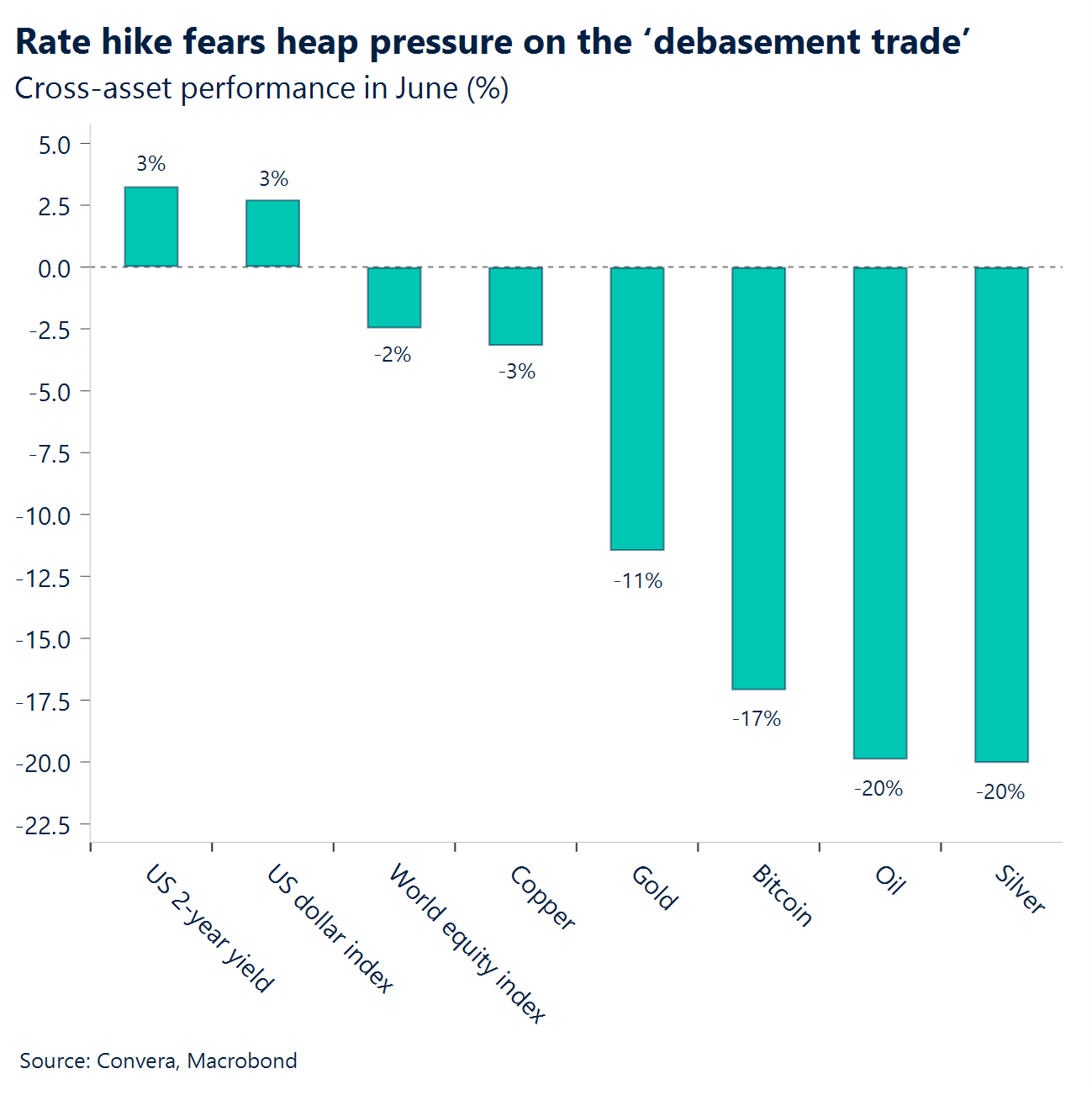
- Oil slick. Suddenly awash in supply, oil prices are now down 20% month-to-date and back to near pre-war levels, easing inflation concerns. The tail risk of oil returning to above $100 has thus significantly diminished.
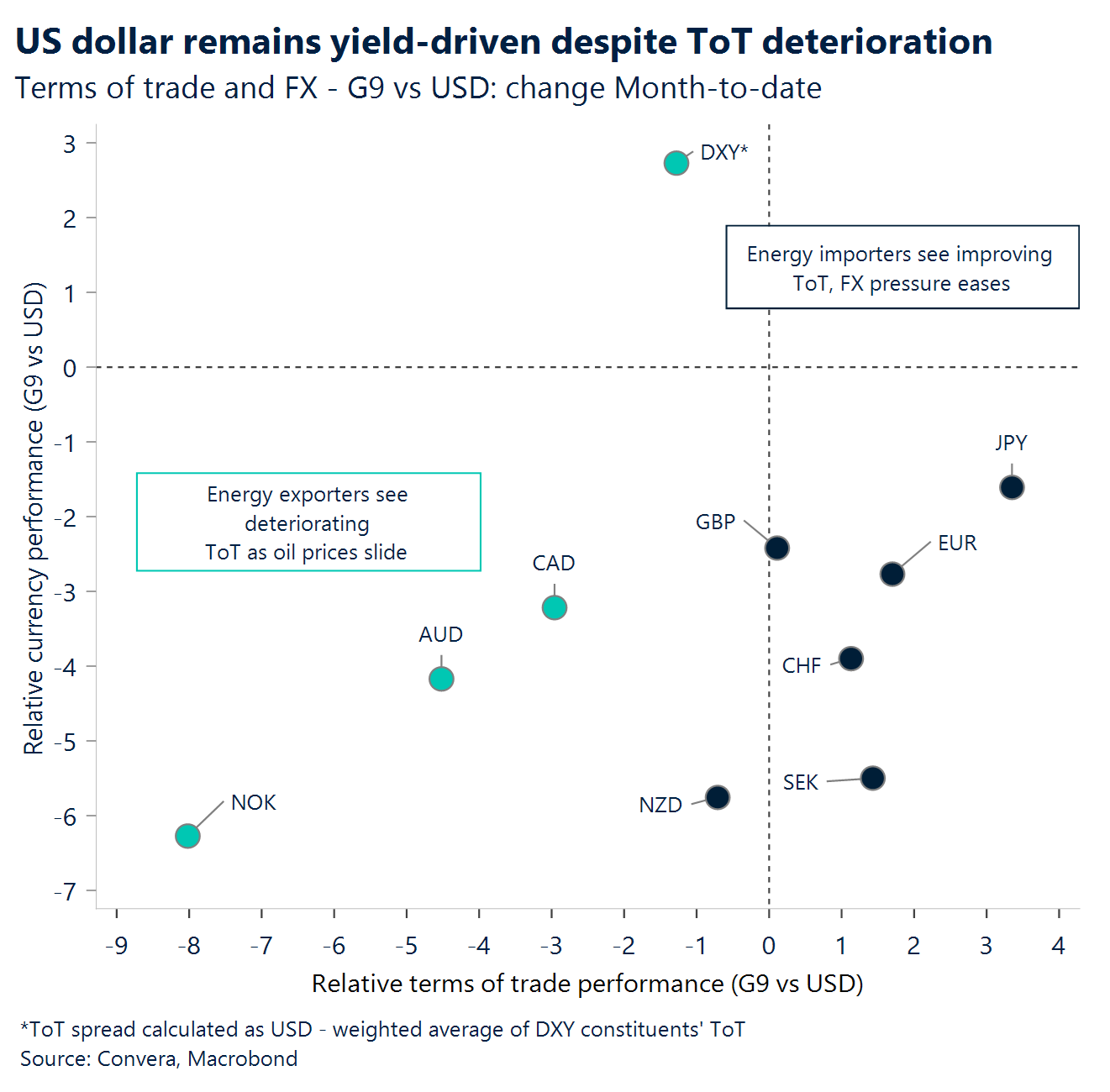
- Energy drained. FX markets remain subdued, with falling energy prices reversing a key tailwind for commodity-linked economies, leaving NOK, CAD and AUD among the weakest-performing G10 currencies.
- Debasement trade on last legs. Gold, silver and bitcoin have been rocked of late. A strengthening USD and fears of interest-rate hikes later this year under the Warsh-led Fed heap pressure on the debasement trade.
- Sayonara Starmer. Following Keir Starmer’s resignation, market focus has shifted to the likely Burnham-led government and the choice of chancellor; while investors appear relaxed, recent history shows even modest fiscal concerns can spark outsized moves in gilts and sterling.
Global Macro
US resilience keeps Fed pressure alive
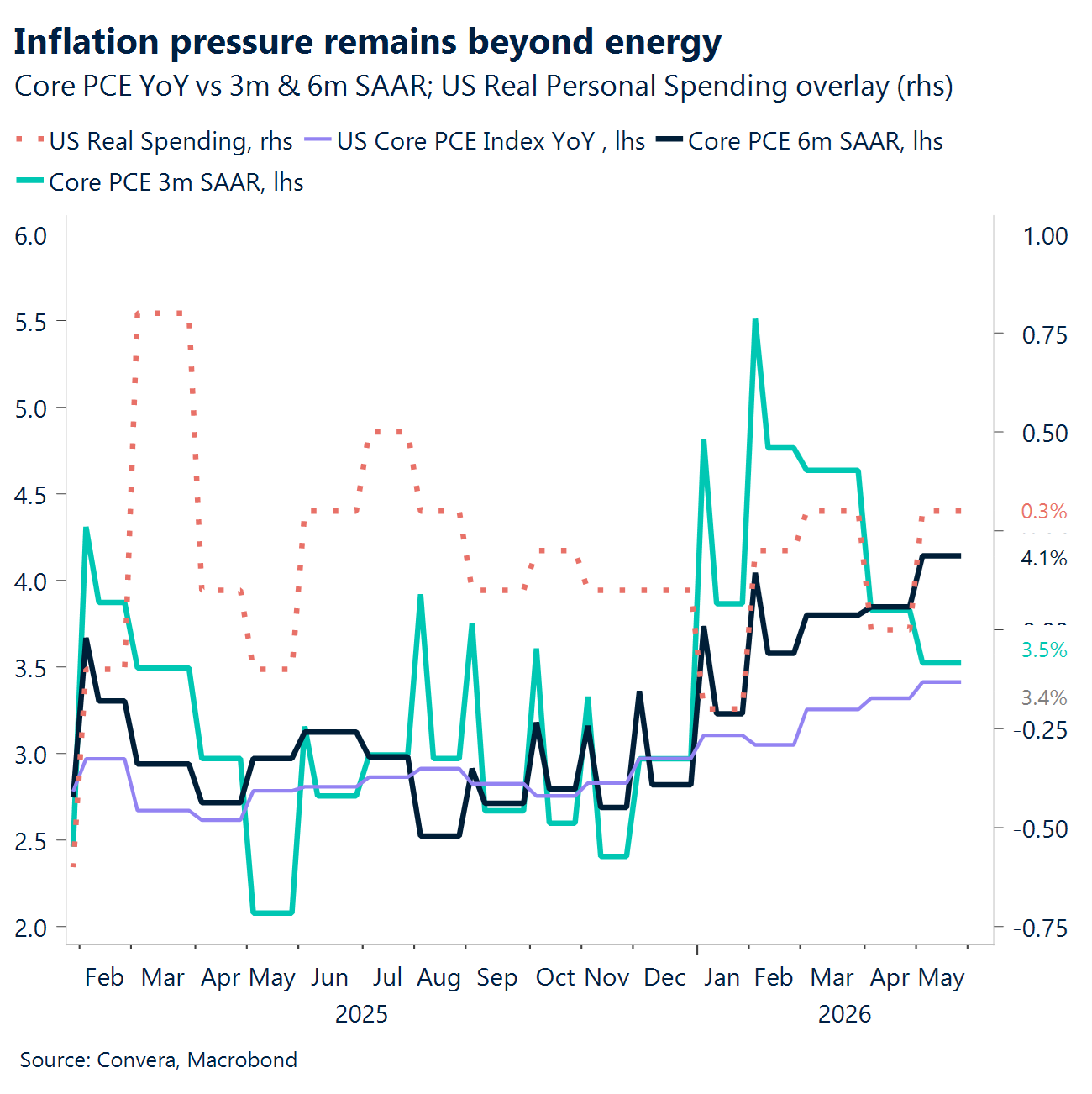
US inflation. While the worst of the energy shock may be behind us, US PCE did not give the Fed much comfort: headline PCE rose 4.1% y/y, in line with expectations, while core PCE rose 3.4% y/y and 0.3% m/m, also in line. The monthly headline print was a touch better at 0.4% m/m vs 0.5% expected, but the annual rate was the highest since April 2023, so the inflation story still supports a cautious Fed.
US resilience. The US consumer is still holding up, with personal income and spending both rising 0.7% m/m, while real PCE increased 0.3%. But the quality of growth is less impressive: Q1 GDP was revised higher mainly due to volatile trade and inventory dynamics, while private domestic demand and real consumer spending were revised lower. The result is not a booming consumer, but a consumer that remains firm enough to keep the Fed focused on inflation rather than growth risks.
Global PMIs. The global PMI mix stayed uneven: the US composite PMI rose to 52.2, Japan improved to 52.5, the Eurozone remained sub-50 at 49.5, and the UK slipped further into contraction at 49.4. The big message is still versus softer Europe/UK, although the US details were less clean because manufacturing strength was partly tied to stockpiling and employment weakness.
Canada inflation. Canada CPI surprised hotter, with headline CPI at 3.2% y/y vs 3.0% expected and +1.0% m/m vs +0.8% expected, driven mainly by gasoline and energy pass-through. Still, core inflation stayed fairly contained, with the BoC’s preferred trim and median measures averaging around 2.1%, which keeps the Bank of Canada more patient than the headline alone would suggest.
Week ahead
Hawkish central banks face a data reckoning
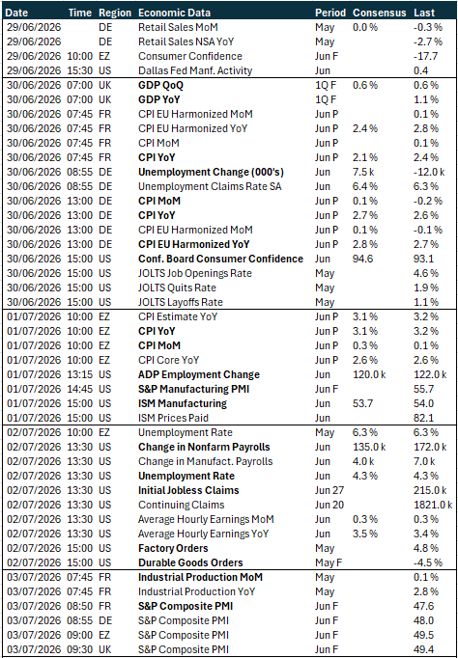
- Markets eye CPI as oil slumps. June’s CPI releases for the eurozone and major member states are due next week. The outcome is highly anticipated given the recent sharp decline in oil prices. Energy moves tend to feed through relatively quickly to the price index, prompting investors to challenge the ECB’s hawkish stance if there is a downside surprise.
- A deluge of labour market data. In the US, key labour market data – from JOLTS to nonfarm payrolls – are expected to continue pointing to a resilient jobs market. The Fed emphasised its focus on inflation at its June policy meeting; therefore, we doubt a softer print would materially challenge the recent hawkish repricing.
- Sintra in the spotlight. Away from the data, markets will be parsing messaging from central bankers meeting in Sintra next week at the ECB’s annual forum. With rapid developments in the Middle East and oil prices hitting lows since the start of the conflict, investors will be on the lookout for any softer tone or more optimistic outlook. ECB President Lagarde, Fed Chair Warsh, and BoE Governor Bailey are all expected to attend.
FX views
Hawkish, for how long?
USD Hawkish Fed fuels dollar surge above 100. The US dollar index heads into the week’s close ~0.5% higher, up 2.5% month to date after a decisive break above the 100-resistance level the week prior. The move was triggered by a hawkish Federal Reserve meeting marking Kevin Warsh’s debut as chair, while also reflecting a broader build-up of supportive factors. Geopolitical tensions have reinforced a hawkish bias across central banks this year, boosting the appeal of fixed income. Notably, strong US macro data is driving real yields higher, attracting inflows and undermining the debasement narrative that dominated 2025 and weighed on the dollar. Warsh’s firm stance has eased concerns around policy easing, signalling greater confidence in inflation control and Fed’s credibility, further supporting the dollar. Overall, the Fed outlook has reasserted itself as the key driver of dollar direction, with geopolitics and oil moves offering limited downside risk. The bias remains constructive, with 100 now acting as support, though near-term consolidation looks likely.
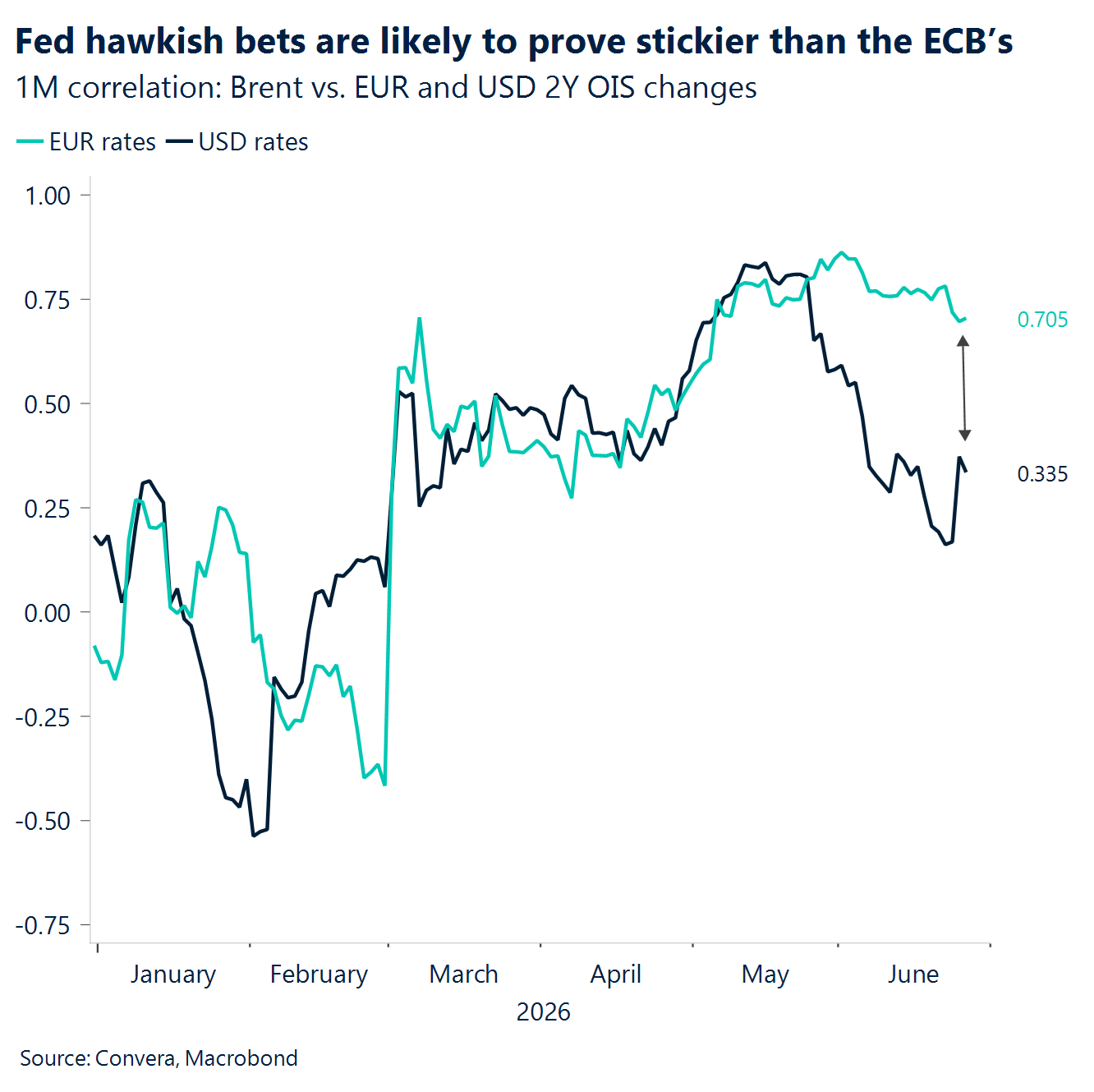
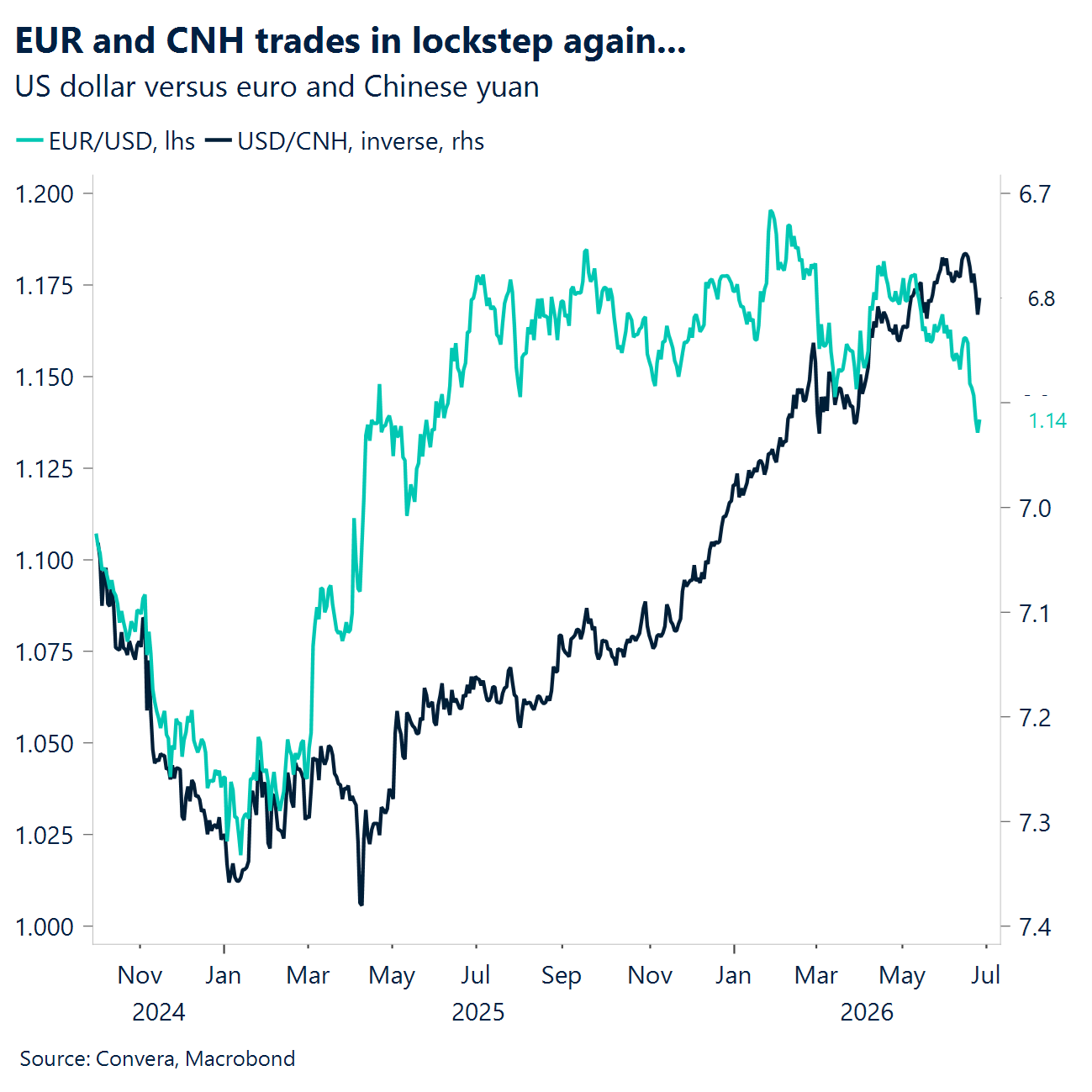
EUR Markets eye energy-led disinflation. The euro struggled this week, breaking below the 1.14 support level, with buying interest emerging around 1.1350. The move lower was predominantly dollar-driven, although dovish-leaning remarks from Lagarde on Monday, suggesting the ECB can avoid aggressive policy reactions to geopolitical spillovers, added further pressure. The bar for additional ECB tightening remains high relative to the Fed, reflecting a softer macro backdrop and a greater sensitivity of the rates outlook to oil price dynamics. That said, the recent decline in oil prices has exerted a broadly synchronized dovish influence across G10 monetary outlooks so far. As a result, the FX focus now shifts to how upcoming inflation prints incorporate these energy effects. This is key to assessing whether central banks can pause further tightening through the remainder of the year, bringing more idiosyncratic drivers to the fore and helping shape the next directional move in EUR/USD.
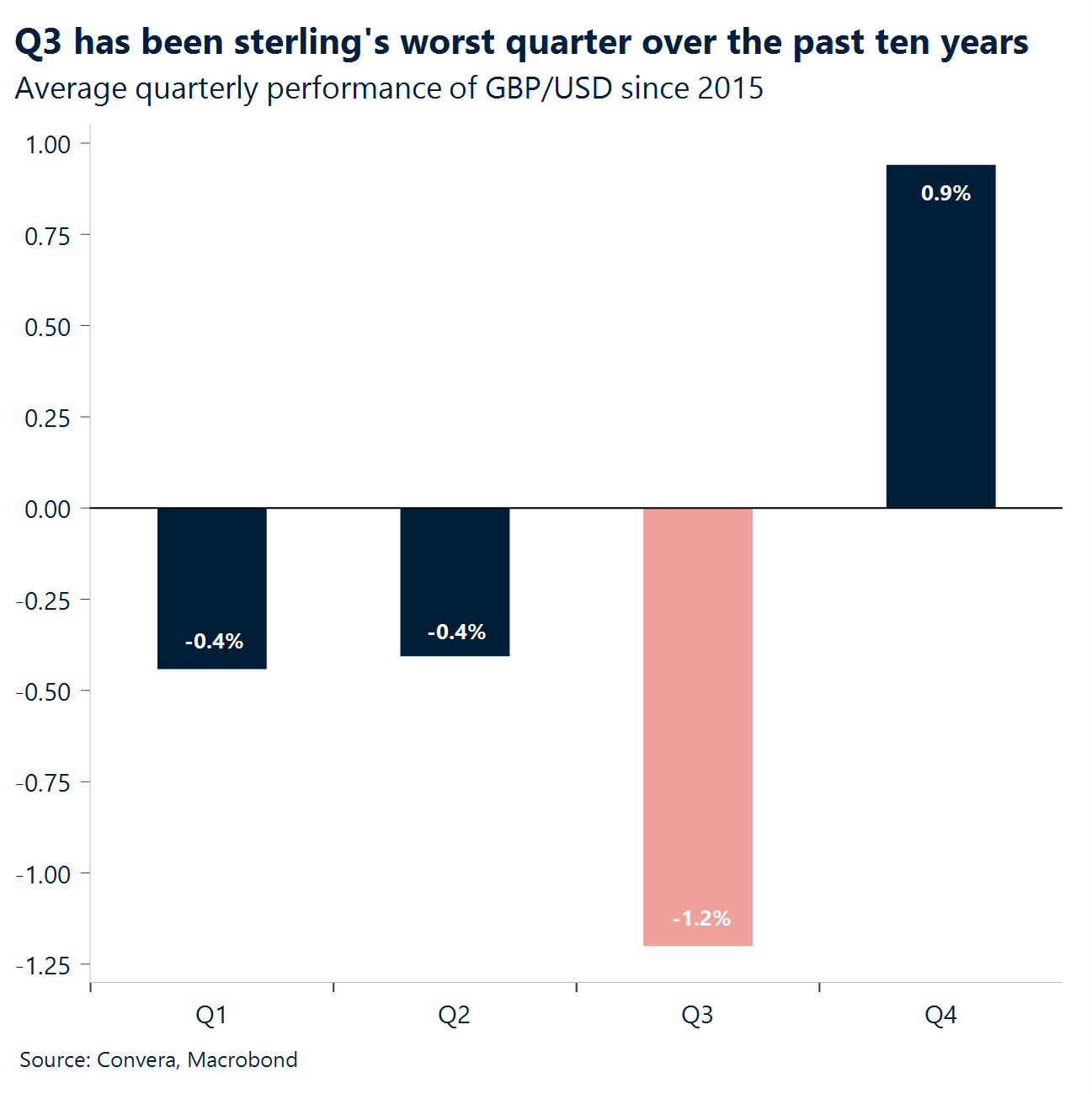
GBP Resilient bar the dollar. GBP/USD is hovering around 1.32, down roughly 2% on the month. However, the picture is not uniformly sterling negative. The pound has held up well against all other G10 peers, a notable outcome given the political fallout surrounding PM Starmer’s resignation. Markets appear comforted by the prospect of an orderly transition and growing expectations that a Burnham-led government would broadly respect existing fiscal rules, although it remains far too early to draw firm conclusions. Meanwhile, the return of the rates channel has been pivotal for FX. Falling oil prices have reduced hawkish BoE bets, eroding one of sterling’s key supports, while stronger US growth and higher yields have re-established the dollar’s advantage. Technically, GBP/USD appears vulnerable too. The pair trades below all major daily moving averages and is testing the 200‑week moving average (1.3191) which has supported for over a year. Momentum indicators are oversold, leaving scope for a corrective bounce, but the broader trend remains lower, especially if we see a decisive close below 1.3191. Looking ahead, next week’s UK GDP data and the July Labour leadership contest are key domestic risks, while unfavourable Q3 seasonality adds another potential headwind.
CHF Not much joy in June. The Swiss franc has softened in June, but the broader domestic backdrop remains supportive for CHF. While the SNB left rates unchanged earlier this month, it simultaneously nudged up its inflation forecasts across the remainder of the year, signalling increased confidence that price pressures will become more persistent. As a result, markets have further scaled back expectations of a return to negative rates. The SNB also reiterated its increased willingness to intervene in FX markets, maintaining the policy asymmetry that has constrained CHF appreciation for much of the year. However, with no clear evidence of sustained intervention activity and Switzerland’s economy continuing to show resilience, the franc remains fundamentally underpinned. This reinforces the prevailing 2026 narrative: CHF is no longer the market’s preferred haven, with rate differentials and USD strength often dominating price action, but solid domestic fundamentals and fading easing expectations should continue to limit downside and keep EUR/CHF anchored near the lower end of its recent range.
CAD Loonie stays exposed. USD/CAD is still trading on a mix of US rate support, softer Canadian fundamentals, lower oil prices, trade uncertainty and bearish positioning. Canada’s May CPI surprised hotter at 3.2% y/y vs 3.0% expected, but the details were mostly energy-led, while core measures stayed close to 2.1%, leaving the Bank of Canada with little reason to chase the Fed’s more hawkish turn. The US side still looks harder to fade: the growth story is not flawless, but it remains firm enough to keep Fed pressure alive and preserve the dollar’s yield advantage. With CUSMA uncertainty still in the background ahead of the July 1 review deadline, and futures positioning already heavily bearish on the Loonie, CAD remains vulnerable. Lower oil adds to that pressure, since it weakens one of the few macro supports the CAD had earlier this year. The technical setup still favors USD/CAD, although the move is getting stretched. Spot is around 1.419, after reaching 1.4248, and remains well above the 20-day moving average at 1.4009, the 50-day at 1.3825, the 100-day at 1.3774, and the 200-day at 1.3832. That alignment confirms the latest bullish trend, with the pair now trading above the old 1.4000 breakout zone and pressing into levels last seen around spring 2025. On the downside, first support sits near 1.4100, followed by the 20-day average around 1.4010. Next week could bring more volatility, with month-end flows along with April advance GDP adding another domestic test on Tuesday and the CUSMA review deadline coinciding with Canada day on Wednesday.
AUD Aussie dollar slides to three month low. We watched the May jobs report closely. Australia added 40.3k jobs, easily beating the 32.5k expected. However, April took a heavy downgrade, now showing a 40.7k drop instead of the earlier -18.6k print. The participation rate held steady at 66.7%, slightly above 66.6%, while the unemployment rate edged down to 4.4% from 4.5%, in line with expectations. Consumers also spent more. Household spending rose 5.5% year-on-year in May, topping the 4.3% forecast and a revised 5.1% in April. AUD/USD remains under pressure, sitting at a three-month low and trading more than 5% below its 6 May high of 0.7278. The pair fell 1.5% last week as sentiment weakened. In the near term, resistance sits near the 21-day EMA at 0.7018, with the 100-day EMA close by at 0.7027. On the downside, we are watching 0.6850 as the next floor.
CNH China, Hong Kong widen access. Wider market access is keeping the yuan well supported, alongside a softer US dollar following weaker price data. China and Hong Kong are moving to open cross-border investment further, including allowing mainland investors to buy Hong Kong-listed shares. The plan will expand eligibility, raise quotas, and broaden product offerings under the Wealth Management Connect scheme. Financial Secretary Paul Chan downplayed concerns about illegal flows, noting that mainland investors will gain access to newer and potentially higher-risk options. USD/CNH continues to hover near a three-year low, sitting about 0.8% above its 17 June low of 6.7539. A clear move above the 100-day EMA at 6.8455 would be needed before AUD/USD can stage a stronger rebound. On the downside, the 21-day EMA at 6.7872 is the next level to watch.
JPY BoJ signals caution. The Bank of Japan’s June summary of opinions keeps the door open for further rate hikes. Some members favour lifting borrowing costs closer to a neutral level, around 2%, as price pressures spread more broadly. Others urge caution, warning that higher rates could weigh on investment, output, and employment, and risk a return to falling prices. The board also approved a plan to stop reducing government bond purchases from April 2027. Overall, the message points to gradual rate increases, balanced by care over timing and how quickly support measures are scaled back. Meanwhile, Tokyo’s June inflation picked up faster than expected, strengthening the case for the Bank of Japan to keep raising rates gradually. Nevertheless, the market is currently only pricing in an 86% likelihood of rate hike in December meeting. USD/JPY remains above 160, trading about 0.1% below its 25 June high of 161.95. Near-term support lies at the 21-day EMA around 160.71, followed by the 50-day EMA at 159.77. On the upside, resistance is at 161.95.
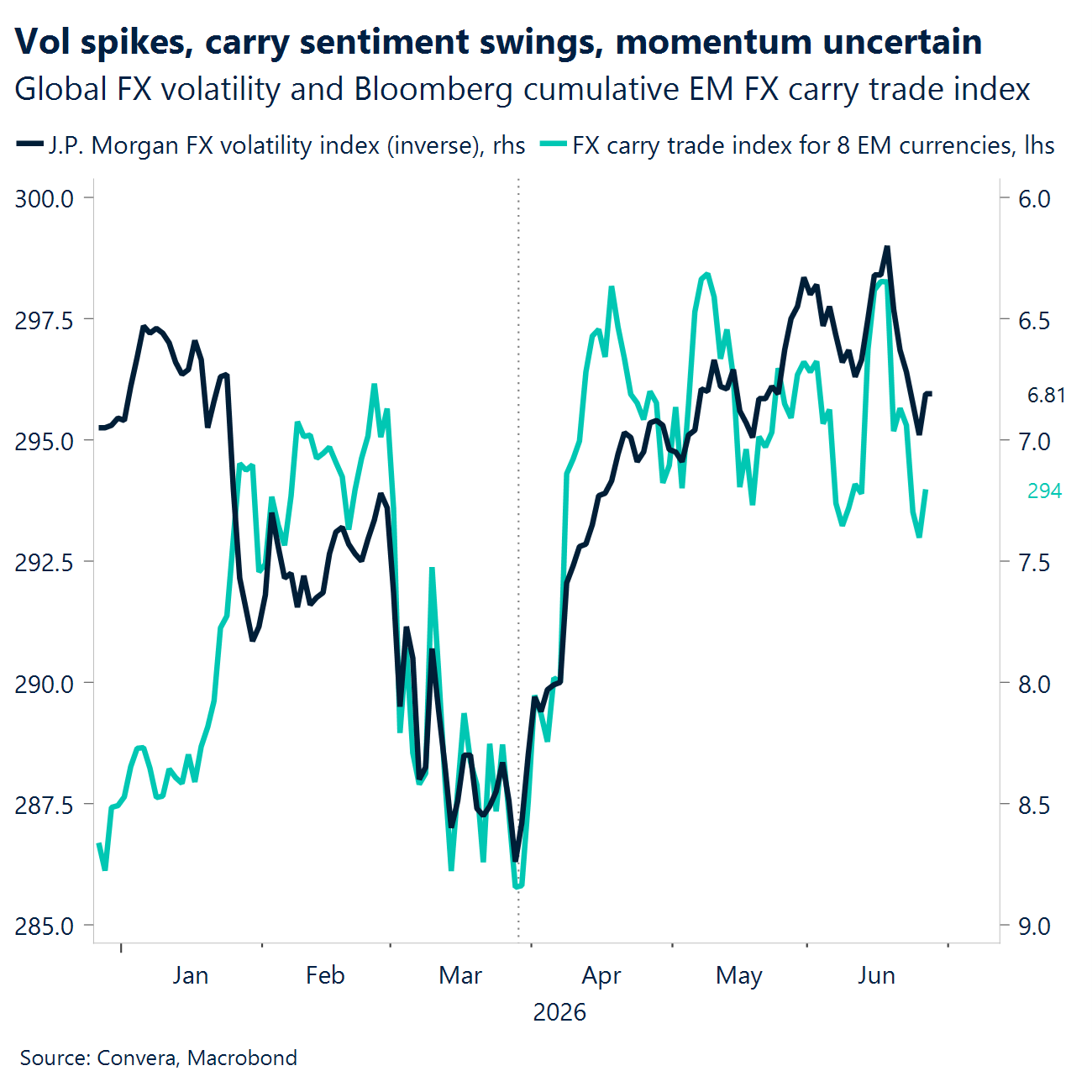
MXN Peso range tested. USD/MXN has moved higher as the dollar’s post-Fed bid tests the peso’s low-volatility carry profile. Banxico’s holding at 6.50% keeps Mexico’s carry advantage intact, and the domestic data mix has not been weak: retail sales rose 4.4% y/y in April vs 3.6% expected, while economic activity also beat expectations. Inflation has also cooled, with early-June CPI slowing to 3.55% y/y vs 3.76% expected, though core inflation remains above target at 4.12%, which keeps Banxico cautious rather than dovish. The problem for MXN is that the US side has turned less forgiving: sticky US inflation, resilient spending, and hawkish Fed pricing are lifting the dollar and making the peso’s carry cushion less comfortable. Technically, USD/MXN has finally tested the top of the range. Spot is around 17.5, after briefly trading as high as 17.66, which means the pair pierced the old 17.56 cap but has not yet delivered a clean hold above it. The move has pushed USD/MXN above the 20-day average at 17.37, the 50-day at 17.35, and the 100-day at 17.44, confirming a firmer short-term structure. The next resistance is 17.65–17.66, followed by the 200-day average near 17.78. On the downside, 17.44 is first support, then 17.37–17.35; a close back below that zone would make this look like another failed range breakout.
BRL Real rally fades. USD/BRL has rebounded as markets digest a confusing policy mix from Brazil’s central bank. Policymakers cut the Selic rate by 25bp to 14.25% for a third straight meeting but paired the move with a hawkish message that pointed to faster growth, higher inflation and the risk that fiscal stimulus could keep price pressures elevated. The central bank also raised its 2026 GDP forecast to 2%, helped by a strong labor market and government spending, while projecting inflation at 5.2% by end-2026, still above target. That leaves investors questioning how much room is left for easing. The technical picture shows USD/BRL trying to build a stronger base after the sharp April-May decline. Spot is around 5.17, after touching 5.2189, and remains above the 20-day moving average at 5.1157, the 50-day at 5.0348, and the 100-day at 5.1160. That keeps the short-term bias tilted higher. A move through 5.20–5.25 would strengthen the dollar rebound, while support sits near 5.12, followed by 5.03.
Have a question? [email protected]
*The FX rates published are provided by Convera’s Market Insights team for research purposes only. The rates have a unique source and may not align to any live exchange rates quoted on other sites. They are not an indication of actual buy/sell rates, or a financial offer.