


- Global markets were under pressure into the end of June. While US equities are down around 3–6% from the highs, the real story is the scale of losses across the mega-cap tech names. From their highs, Alphabet is down 20%, Apple 10%, Amazon 16% and Meta 30%.
- Geopolitics was back on the agenda after US and Iran saw a return of hostilities with a series of tit-for-tat strikes over the weekend of 27-28 June. Both sides agreed to pause fighting on 29 June with a Doha meeting on 30 June described by President Trump as “very good”. WTI crude climbed above USD70 per barrel before later dropping back below this key level.
- The US dollar’s rally paused and the greenback fell to a two-week low after the June non-farm payrolls data disappointed markets. The June payrolls report showed 57,000 new jobs were created, well below the forecast of 113,000.
- The Japanese yen tumbled as USD/JPY moved to the highest level since December 1986. The Japanese yen has weakened as speculation grows that Japanese Prime Minister Sanae Takaichi will push back on further Bank of Japan rate hikes.
- Sterling ended the week as one of the strongest currencies reaching one-year highs against the euro, Swedish krona and Canadian dollar. The pound and gilt markets continue to look through the fragile political backdrop. On the other hand, the euro came under pressure after June inflation printed below expectations.

Global Macro
Central banks turn hopeful on inflation
Payrolls miss, dollar sinks. The US’s June payrolls report showed 57,000 new jobs were created, well below the forecast of 113,000. However, there was some positive news, with the unemployment rate falling to 4.2% from 4.3%. The greenback tumbled on the news, with the USD index down 0.6%, reaching its lowest level since 18 June. The USD fell most sharply against other safe-haven currencies, with USD/JPY down 0.9% and USD/CHF down 0.7%.
Cooling prices dent euro. The euro came under pressure after June inflation printed below expectations. Headline CPI slowed to 2.8% y/y (vs. 3.0% expected), while core inflation eased to 2.4% (vs. 2.5%). EUR/USD fell below 1.1400, while GBP/EUR extended its move convincingly above 1.1600.
China manufacturing rebounds. In Asia, China’s official manufacturing PMI climbed to 50.3 in June from 50.0, beating expectations and returning to expansion territory. The non-manufacturing PMI also inched higher to 50.2, while the composite PMI rose to 50.
Lagarde strikes balanced tone. At the European Central Bank’s annual Sintra conference, the focus was on the softer inflation backdrop reducing the risk of rate hikes. ECB President Christine Lagarde highlighted a more balanced risk outlook than just a few weeks ago, saying downside risks to growth and upside risks to inflation are now less pronounced.
Crowded dollar bets at risk. A similar acknowledgment of easing inflation risks from the Fed’s Kevin Warsh, also in Sintra, weighed on the dollar. Options markets continue to show an aggressive build-up in positions that would benefit from a more hawkish Fed path, leaving the US dollar and rates increasingly vulnerable to even modest dovish signals.
Week ahead
A calmer week for markets
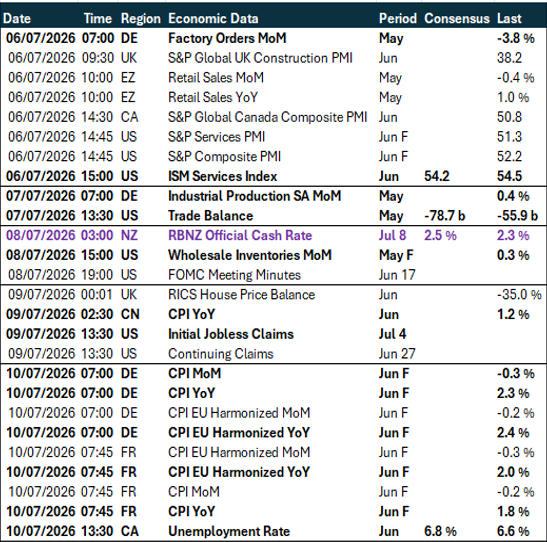
- Funerals pause US-Iran talks. US–Iran peace talks are on hold as Iran begins funeral ceremonies for former Supreme Leader Ali Khamenei, who was killed on the first day of the joint US-Israeli strikes on Iran. The ceremonies begin on 4 July and are expected to conclude with his burial on 9 July. Talks had resumed following last week’s attacks, with both sides reporting that progress was being made.
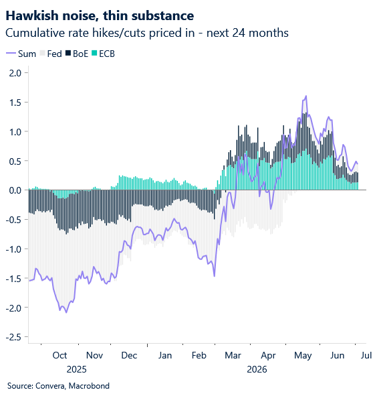
- Markets eye final inflation prints. The final June inflation releases for the major eurozone economies are due. This week’s preliminary readings came in softer than expected, prompting markets to scale back expectations of any ECB rate hikes this year. Any further downside surprises are likely to attract market attention.
- FOMC minutes face a sceptical market. The minutes from the FOMC’s June policy meeting are also due for release. The tone is likely to be hawkish, with around half of policymakers having expressed a preference for at least one further rate hike this year. However, markets may pay less attention than usual. With oil prices falling rapidly and the prospect of a return to full-scale conflict diminishing, inflation risks have eased. Fed Chair Warsh acknowledged as much this week at the ECB Forum in Sintra, Portugal.
FX views
USD rally cools
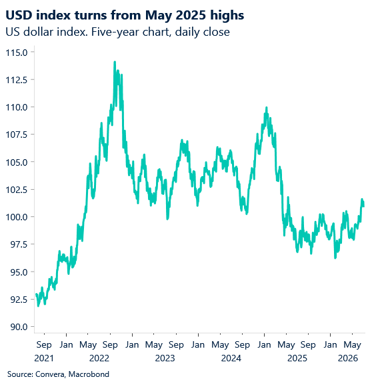
USD Rally cools. The US dollar index has recently reversed from 14-month highs after a monster two-week rally that saw the USD index gain 2.5% since the incoming Federal Reserve chair Kevin Warsh’s first Fed decision on 17 June. While the USD has gained on the back of some tougher talk from the Federal Reserve, the potential for a cooldown in inflation as oil prices drop means markets are not convinced the Fed will necessarily follow through on rate hikes. A weaker June payrolls report added to the pressure on the USD after it showed 57,000 new jobs were created, well below the forecast of 113,000. The greenback’s biggest losses over the week were against the NZ dollar and British pound while losses verses the CAD and euro were more muted. Next week, Fed minutes, due Wednesday, will be closely watched.
EUR EUR/USD trims losses near one-year lows. EUR/USD heads into the week’s close around 0.6% higher, trimming recent losses while still trading near one‑year lows. Comments from Fed Chair Kevin Warsh, acknowledging easing inflation risks, alongside a softer-than-expected US jobs report, led markets to scale back expectations for further tightening this year. This move reflects a similar retreat in ECB hawkish positioning seen earlier in the week following weaker June inflation data. The euro area remains more exposed to imported energy costs and continues to show a softer macro backdrop, which supports a quicker unwind of rate hike expectations as a more dovish narrative takes hold. Risks for the pair remain therefore skewed to the downside, with spot still trading below the 21-day moving average near 1.1480. Next resistance is seen at 1.1520, while the 24 June low at 1.1325 stands out as the key support. The US CPI release in two week’s time could provide the next meaningful catalyst.
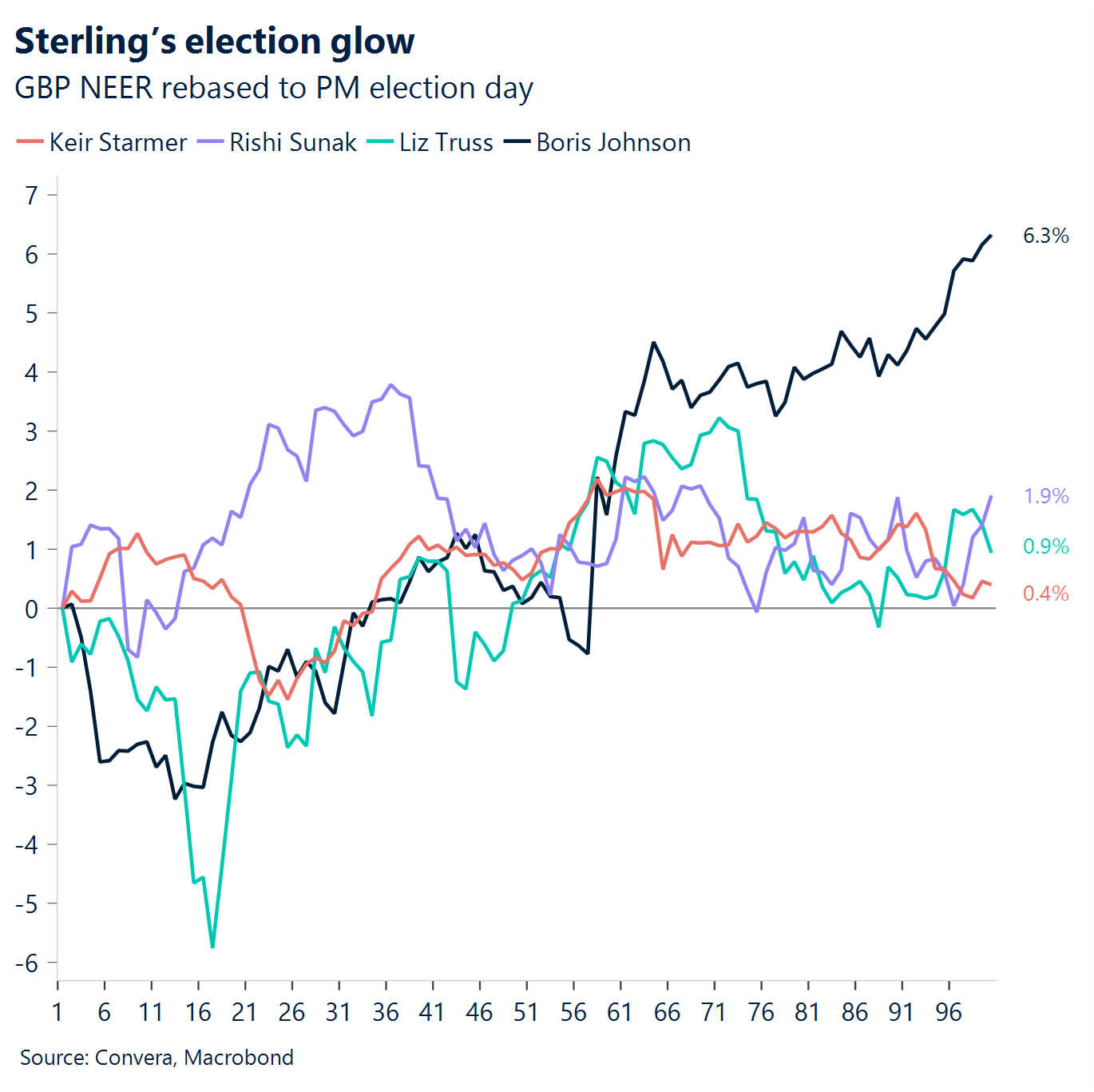
GBP GBP/EUR Break Tests Conviction. GBP strengthened across G10 peers this week. Sterling has benefited from what has, so far, been a relatively cordial political transition, with Andy Burnham increasingly treated as a prime minister‑in‑waiting. GBP/USD has retraced most of the losses seen after the Fed’s hawkish 19 June meeting, moving back above the 21‑day moving average (1.33). The 1.34 level now stands out as key resistance, with a break higher likely to challenge the broader downtrend in place since early May. A softer US CPI print in two weeks’ time would add to this momentum. Until then, consolidation around 1.33 is expected. GBP/EUR has pushed to one‑year highs, briefly testing the 1.17 handle. While the break is notable, conviction behind the move remains less clear, with limited fresh catalysts underpinning a sustained extension higher at this stage. GBP/EUR’s near-term interaction with support at 1.1650, followed by 1.16, should help gauge the strength of the breakout.
CHF Finding strength. The Swiss franc was mainly stronger over the last week helped by USD weakness even after a lower-than-forecast Swiss inflation reading kept the door open for further SNB FX intervention or, less likely, policy loosening. Swiss annual CPI was 0.5% in June. An even weaker EU inflation print also helped the CHF to gain as EUR/CHF fell sharply hitting a one-month lows. USD/CHF fell back to a two-week low and has slipped back into a downtrend with the 8- and 21-day moving averages pointing lower while the long-term 200-day moving average is also shifting lower. The CHF was also stronger versus the CAD and SEK but weakened versus the NZD and NOK. From here, we see support at 0.7960 and then 0.7910 while resistance at 0.8020. Coming up, Swiss unemployment is due Monday while SEO consumer climate due Friday.
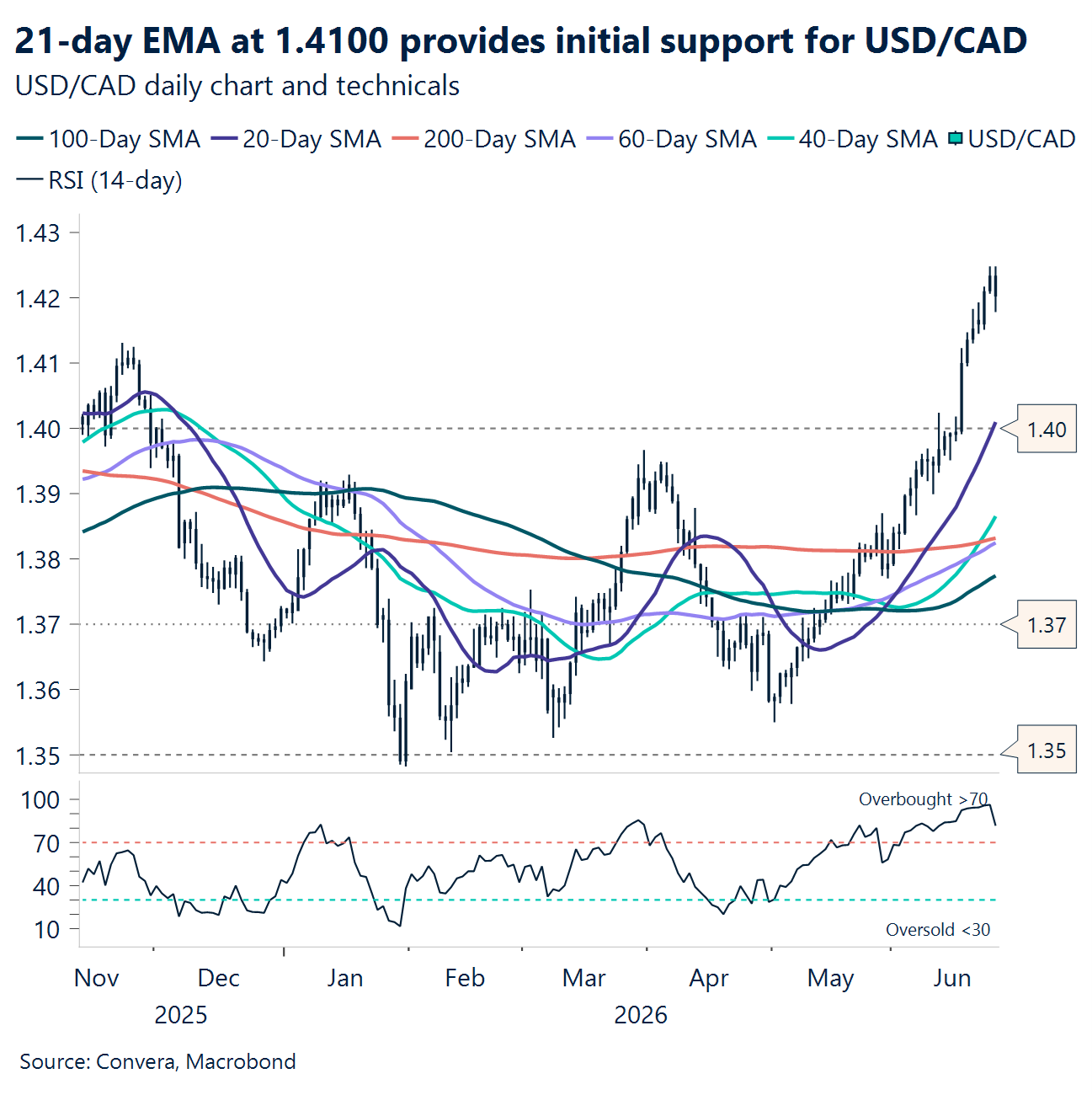
CAD USD/CAD nears pullback risk. The Canadian dollar was dealing with new uncertainty after the US said it will not renew the USMCA trade deal in its current form, although the agreement remains in force and formal negotiations with Canada and Mexico are expected to continue. While the decision raises uncertainty for businesses and consumers, it leaves room for a renegotiated pact before the agreement’s scheduled expiry in 2036. Key areas likely to dominate discussions include automotive content rules, transshipment concerns and broader bilateral trade issues. Meanwhile, the Bank of Canada’s governor said interest rates are near the lower end of their normal range and played down the near-term economic impact of artificial intelligence. The US dollar weakened broadly after soft jobs data and speculation over central bank independence, driving mixed performance across major currencies. For USD/CAD, the next hurdle is the key psychological resistance level at 1.4200. On the downside, the 21-day EMA at 1.4100 provides initial support, followed by the 50-day EMA of 1.3965 and the 100-day EMA of 1.3879. The chart shows USD/CAD is in overbought RSI territory, suggesting upside momentum may be becoming stretched.
AUD AUD/USD attempts to break descending channel resistance. Australia’s manufacturing sector improved for a third consecutive month in June, with stronger hiring and rising inventories lifting the activity index to 51.5. However, factory output and new orders fell again as high prices and economic uncertainty weighed on demand. A sharp miss in US jobs data and concerns over potential political influence on interest rate policy pushed the US dollar lower, although regional currencies continue to move in different directions. AUD/USD is attempting to break above its descending channel resistance while trading 5% below its May peak of 0.7278. To regain momentum, AUD/USD must break above near-term resistance at its 21-day EMA of 0.6979 and 100-day EMA of 0.7016. On the downside, 0.6900 remains the next key support level.
CNH USD/CNH hits one-week low. China’s factory activity expanded modestly to 50.3 in June, while services activity edged up to 50.2. Strong demand for high-tech exports supported production, but domestic demand remains fragile. Falling factory prices and weak retail sales reinforce our view that further government stimulus is likely. While disappointing US employment data weighed on the US dollar, Asian currencies have reacted unevenly. Against this backdrop, USD/CNH has fallen to a one-week low and is trading just 0.5% above its June trough of 6.7539. Over a longer horizon, the pair remains near a three-year low. For a rebound to gain traction, USD/CNH must break above its 50-day EMA of 6.8005, followed by its 100-day EMA of 6.8403. On the downside, the psychological 6.7800 level provides immediate support.
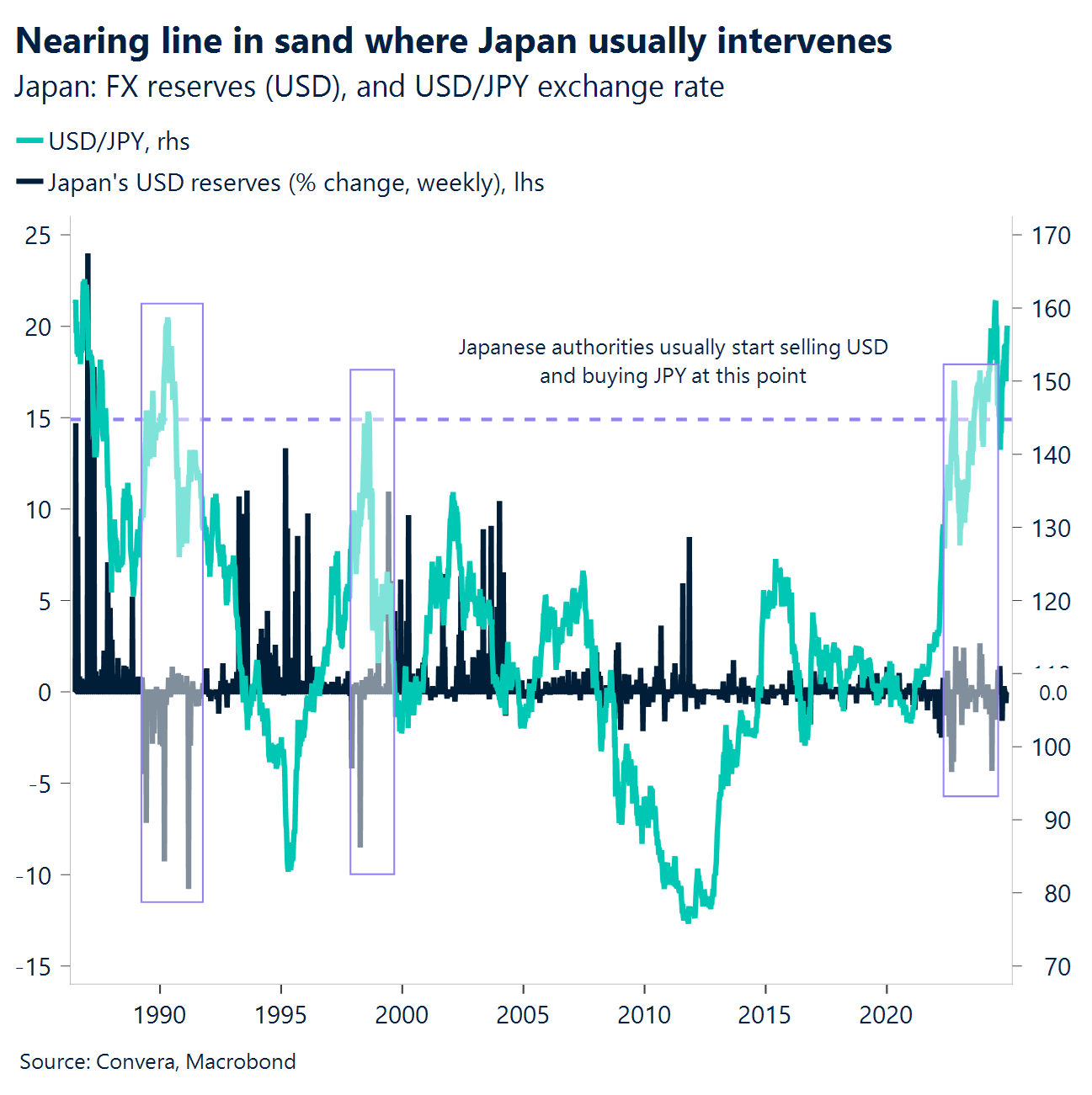
JPY Intervention fears keep yen traders on edge. After USD/JPY hit a 40-year high during the week, trading activity eased following the US jobs report, but the risk of sudden government intervention remains elevated. Japanese and South Korean officials recently signalled the possibility of coordinated action to address currency weakness. With US markets closed for the July 3 holiday, vigilance remains high. The US dollar fell sharply after weak employment data and growing concerns about political influence over the Federal Reserve, leaving the yen particularly sensitive to official action. USD/JPY is trading 1% below its recent peak of 162.84, reached on July 1. Initial support is seen at the 50-day EMA of 160.14, followed by the 100-day EMA of 158.92. On the upside, a move back above 162.84 would signal renewed strength.
Have a question? [email protected]
*The FX rates published are provided by Convera’s Market Insights team for research purposes only. The rates have a unique source and may not align to any live exchange rates quoted on other sites. They are not an indication of actual buy/sell rates, or a financial offer.