
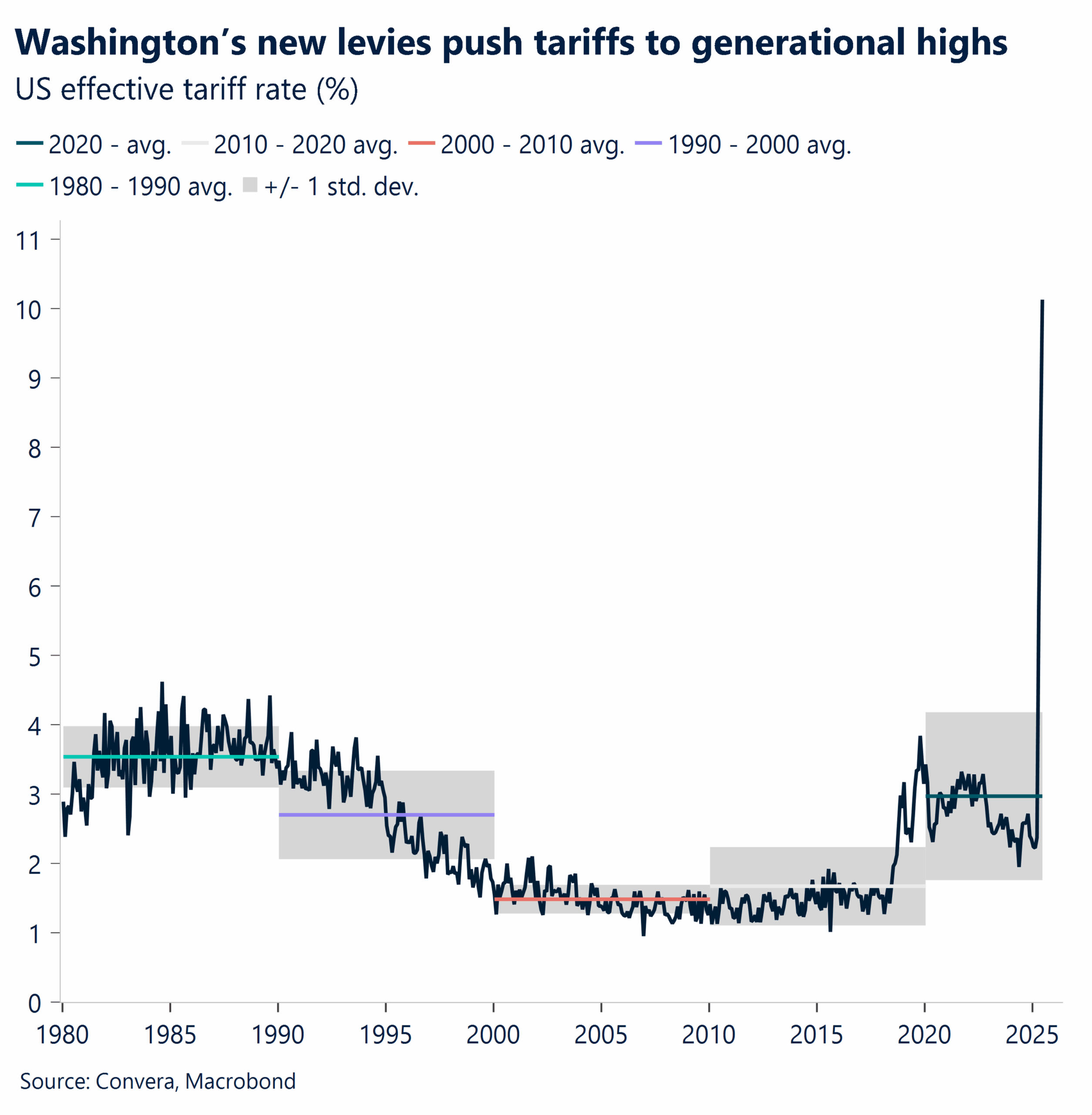
- Global markets initially struggled over the last week after confirmation on the next phase of tariffs with US President Donald Trump signing a new executive order that would see changes in a many countries’ “reciprocal” tariff rates. Notably, Switzerland now faces a 39% tariff rate while Canada was hit with a 35% rate.
- During the week, President Trump also announced a new 100% tariff on computer chip and semiconductor imports. However, he noted an exclusion for companies building new manufacturing plants in the US, such as Apple.
- On the macro front, markets continued to react to the previous week’s shock miss from the July non-farm payrolls report with earlier results also revised lower. The July report came in at 73k new jobs – just below the 106k forecast. However, the June report was revised from 147k to 14k while the May report was lowered from 139k to 19k.
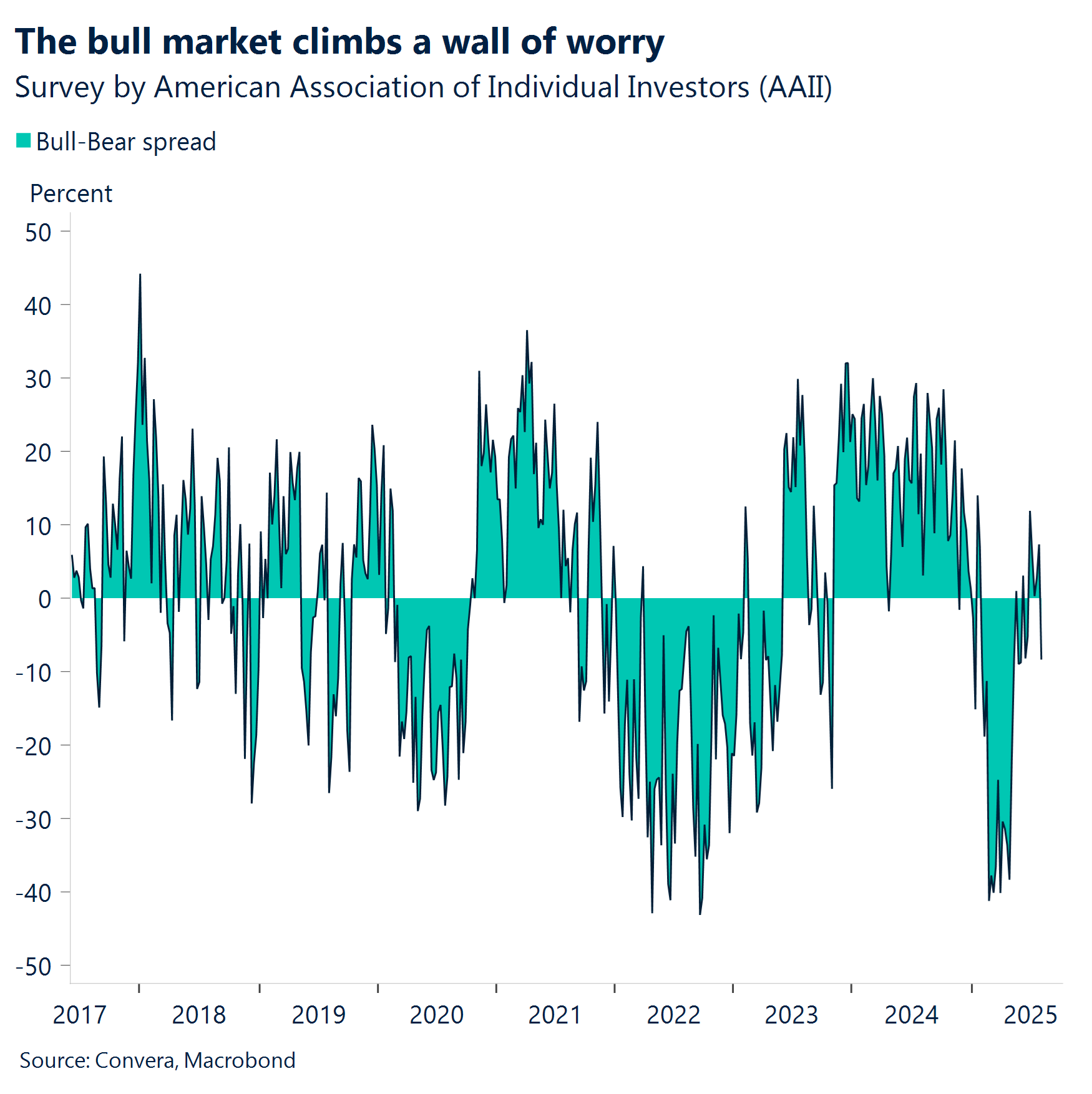
- However, global markets mainly shook off last week’s worries about trade and the weaker US jobs report to rebound strongly with the S&P 500 seeing its best one-day gain since May on Monday.
- What caused the bounce? The initial shock around the US jobs miss evolved into hopes for Federal Reserve rate cuts. Additionally, growing expectations for rate cuts were boosted by the looming announcement of a new Fed chair according to US president Donald Trump.
- Stephen Miran, a close Trump ally, was appointed to the temporarily vacant Federal Reserve board seat left by Adriana Kugler. Financial markets remain on tenterhooks for any further announcements from President Trump.
Global Macro
New tariff regime underway
Protectionism. A new global baseline of reciprocal tariffs has gone into effect, impacting exports from dozens of countries to the U.S. While the inflationary effects have been modest thus far, the full picture is expected to become clearer in the coming months. This week, Switzerland and Taiwan failed to secure exemptions from new duties, while President Trump escalated trade rhetoric further. He threatened a 100% tariff on chip imports, with potential carve-outs for domestic investors, and doubled tariffs on India to 50%, to be phased in over 21 days.
Fed officials. Comments from Fed officials this week highlight a central debate within the central bank: how to respond to a slowing economy amid the potential for tariffs to cause inflation. Christopher Waller, a noted dove and a recent dissenter on the FOMC, maintains that the labor market is at a “stall speed” and that tariffs are a temporary “one-off” price shock the Fed should look past. This contrasts with Raphael Bostic’s more cautious view. Bostic, while open to rate cuts, believes the constant evolution of trade policy and the goal of reshaping supply chains could lead to “persistent” and “structural” changes in the economy, raising a real risk of lasting inflation. Neel Kashkari, in a notable shift, has moved from a “wait-and-see” stance to acknowledging that the economy is clearly slowing. While he now believes two rate cuts are “reasonable,” his view is tempered by the same tariff-related uncertainty that concerns Bostic, he warned the Fed might have to reverse course and raise rates if tariffs ultimately cause persistent inflation.
BoE and Banxico. In a rare display of internal friction, the Bank of England’s Monetary Policy Committee cut its key rate by 25 basis points, but the decision came only after a dramatic three-way vote was forced to a second round. Meanwhile, Mexico’s central bank, Banco de México, also slowed its easing cycle, cutting rates by 25 basis points to 7.75% after a string of four consecutive 50 basis point reductions.
Stagflation. The latest ISM services report captures the Fed’s dilemma: headline activity missed expectations, employment fell to its lowest since March, yet prices paid surged to the highest since October 2022. This stagflationary mix, slowing growth with sticky inflation, is precisely what many economists warned could result from tariff policy.
Week ahead
Currencies on edge as global data storm hits
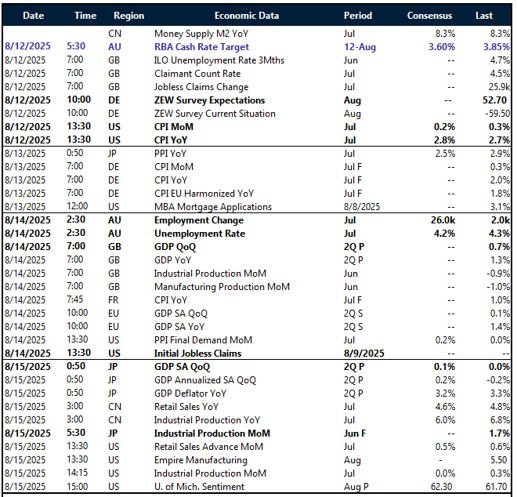
Global data blitz to shake FX markets. The coming week brings a packed economic calendar with critical data across major economies, likely to drive FX volatility. US inflation will be closely watched, with July CPI released Tuesday and PPI on Thursday. Consensus points to still-moderate price pressures (CPI YoY 2.8% vs 2.7% prior), which will be key for recalibrating Fed expectations. Europe’s inflation story continues Wednesday and Thursday with final July CPIs from Germany and France, and GDP prints for both the UK and Eurozone offering timely insight into growth momentum. China’s July activity data (Friday) will be watched for clues on the recovery’s durability, with retail sales and industrial output expected to ease from June’s pace.
Aussie dollar braces for RBA and jobs test. The Reserve Bank of Australia announces its rate decision Tuesday. Consensus expects a 25bp cut to 3.60% (from 3.85%), as inflation moderates and growth slows. With the Australian dollar already under pressure, any deviation from this script could spark volatility. Thursday’s July jobs report (consensus +26k) will further inform RBA trajectory and AUD direction .
GDP prints to reveal growth pulse. Japan’s Q2 GDP (Friday) is forecast to show only marginal growth (+0.1% q/q), as exports and domestic demand remain subdued. UK data releases are clustered Thursday, with GDP, industrial and manufacturing output all due. Eurozone Q2 GDP (Thursday) will be parsed for signs of resilience amid ongoing headwinds.
US consumer data could swing greenback. Beyond inflation, US data will test consumer resilience with July retail sales (Friday, +0.5% m/m expected) and University of Michigan sentiment. Initial jobless claims on Thursday will be monitored for any further softening of the labor market. These data will be key for the dollar, especially if inflation surprises in either direction.
FX Views
Fed cut bets on the rise
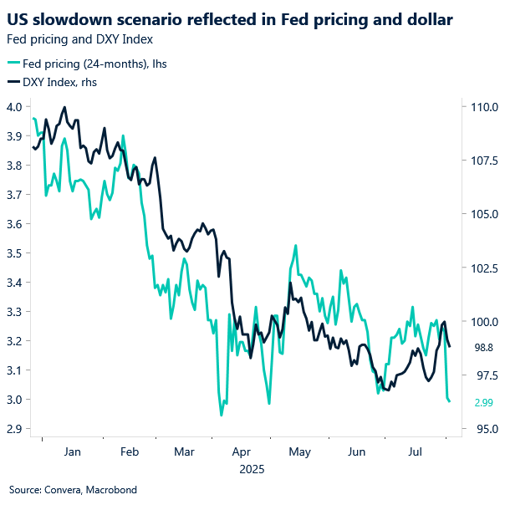
USD Monetary divergence. The U.S. Dollar Index has given up a significant portion of its July gains, falling 0.5% this week alone. This retreat follows last Friday’s disappointing jobs report, which fueled market expectations for Fed rate cuts and drove a 1.2% loss for the dollar. As Federal Reserve officials increasingly acknowledge signs of softness in the labor market, real yields are dropping and the yield curve is steepening. This dynamic is leaving the dollar vulnerable to economic slowdown worries. While the market’s attention has shifted to broad macro shocks and specific trade tensions, the prevailing “soft-landing” narrative for the U.S. economy is a key anchor. Any challenge to this outlook could trigger a rapid shift in investor positioning and further weaken the dollar, leaving it susceptible to renewed losses. For now, the market will likely remain cautious before allowing for renewed dollar strength.
EUR Making a swift comeback. Last week’s warning that the euro’s slide against the dollar might be short-lived has already played out faster than expected as the “sell America” theme ramps up again. EUR/USD has extended its rebound from 6-week lows to trade almost three cents higher in just five trading sessions. The correlation between EUR/USD and short-term yield spreads has surged back to 2025 highs, and with rate differentials once again steering the narrative, EUR/USD looks poised to catch up, especially if the Fed leans as dovish as markets now anticipate. Meanwhile, optimism on a Ukraine-Russia truce has further supported the common currency and should serve as another channel for euro appreciation. The technical backdrop has turned bullish once again with EUR/USD reclaiming ground above its 50- and 21-day moving averages, and we could witness $1.18 print soon if momentum holds firm. FX options traders have also bolstered their expectations on a stronger euro, with risk reversals poised for the most EUR-bullish close since June 26.
GBP Who let the hawks out? The standout event driving sterling this week was the Bank of England’s rate decision. In a rare two-round vote, the MPC was deeply split, with four of nine members opting to hold rates steady. That dissent gave the decision a hawkish tilt, surprising markets and lending support to the pound. GBP/USD has now climbed for five consecutive sessions, its longest winning streak since April, rising over 1% this week to reclaim the $1.34 handle. Meanwhile, GBP/EUR is on track for its strongest week in seven, challenging the 21-day moving average at €1.1525. This hawkish surprise has tempered expectations for further BoE easing, with market odds of another cut this year falling sharply. However, the pound’s rally may face headwinds: UK growth remains sluggish, and services inflation is still sticky. Traders are now recalibrating for a slower, more cautious cutting cycle – one that could keep sterling supported in the near term, but vulnerable if economic data deteriorates.
CHF From shelter to short. The Swiss franc remains under pressure as US tariffs and the prospect of negative interest rates erode its appeal, whilst optimism on a Ukraine-Russia truce reduces safe haven demand. Despite being the second-best performer in the G10 this year – up roughly 11% against the dollar – the tide may be turning. The US has inflicted a steep 39% tariff on Swiss imports, posing a direct threat to growth and key industries like watches and pharmaceuticals. With Switzerland facing a higher tariff rate than many of its peers, the question now is whether the franc reverts to its traditional role as a funding currency in global FX markets. It’s an ideal candidate to be shorted against currencies such as USD, GBP and EUR, particularly if volatility remains subdued. Upward momentum for USD/CHF is likely to accelerate if the pair climbs above the 0.8151 peak seen late last month. A short-term yield pick-up of more than 400 bps versus dollars is increasingly attractive for carry traders looking to capitalize on rate differentials.

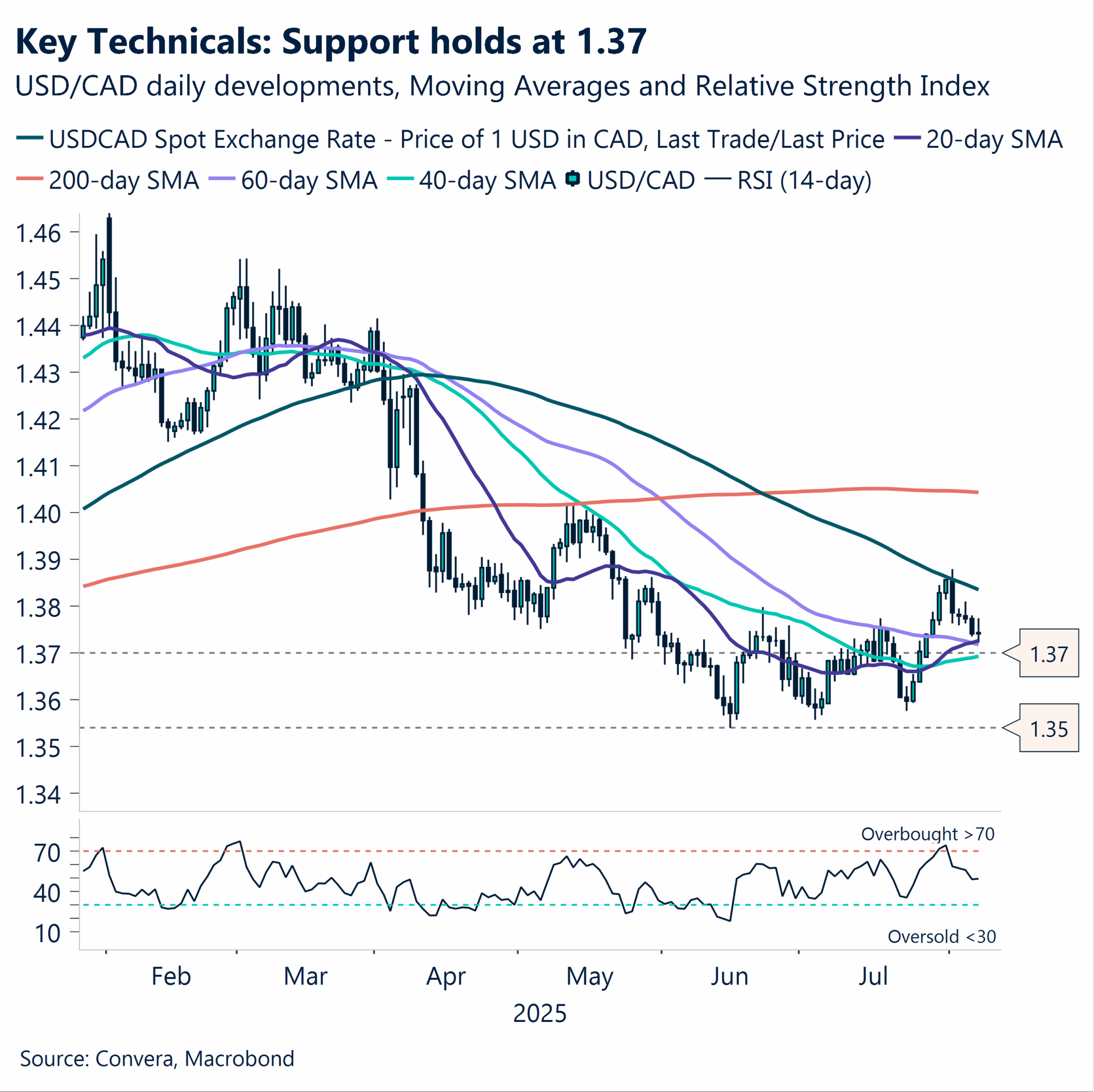
CAD Quiet week. The USD/CAD pair traded mostly below 1.38 this week, with the US Dollar continuing its descent against major currencies as the probability of a September Fed rate cut surged. Domestically, trade data for June showed that a significant portion of US-Canada merchandise trade remains duty-free due to CUSMA exemptions, even as broader macro data points to stagnant growth during the second quarter. With a light domestic data calendar next week, all eyes will be on key US inflation reports, the CPI on Tuesday and PPI on Thursday, to gauge the potential impact of tariffs in goods inflation and how it might affect Fed’s policy trajectory. For the USD/CAD, the 1.37 level remains a critical support zone, marked by the convergence of the 20-, 40-, and 60-day moving averages. On the upside, the 100-day moving average at 1.383 serves as a key resistance level.
AUD Trade surplus surge supports Aussie resilience. Australia’s robust trade performance provides fundamental support for the currency, with the surplus jumping to AUD5.37bn from AUD1.60bn, driven by non-monetary gold exports amid global uncertainty. This external strength offers a buffer against domestic headwinds and potential RBA policy shifts. Technically, AUD/USD maintains its defensive stance above the critical 0.6457 100-day moving average and the 0.634-0.6486 support zone. This technical floor has proven resilient, but a decisive break below would signal a trend reversal toward deeper losses. The 0.6683-0.6722 resistance cluster caps upside momentum, requiring sustained buying pressure to breach. The upcoming NAB business confidence reading will gauge corporate sentiment, while the RBA decision remains pivotal for directional clarity. Employment data could influence RBA hawks or doves, particularly if unemployment shifts significantly from current levels.
CNH Tariff truce talk calms nerves, USD/CNH stays in range. Commerce Secretary Lutnick’s comments suggesting a likely 90-day extension of the China trade truce provide near-term relief for risk sentiment, though uncertainty persists around broader tariff policy. The August 12 deadline remains crucial, while Treasury Secretary Bessent’s remarks on potential China tariffs maintain underlying tension. USD/CNH is now above its 21-day EMA of 7.1828. The next key resistance levels lie at 50-day EMA of 7.1882 and 100-day EMA of 7.2044. USD/CNH likely will likely stay in the range of 7.1712 – 7.1959. Market participants will keep an eye on upcoming CPI, PPI, fixed asset investment, industrial production and unemployment rate.
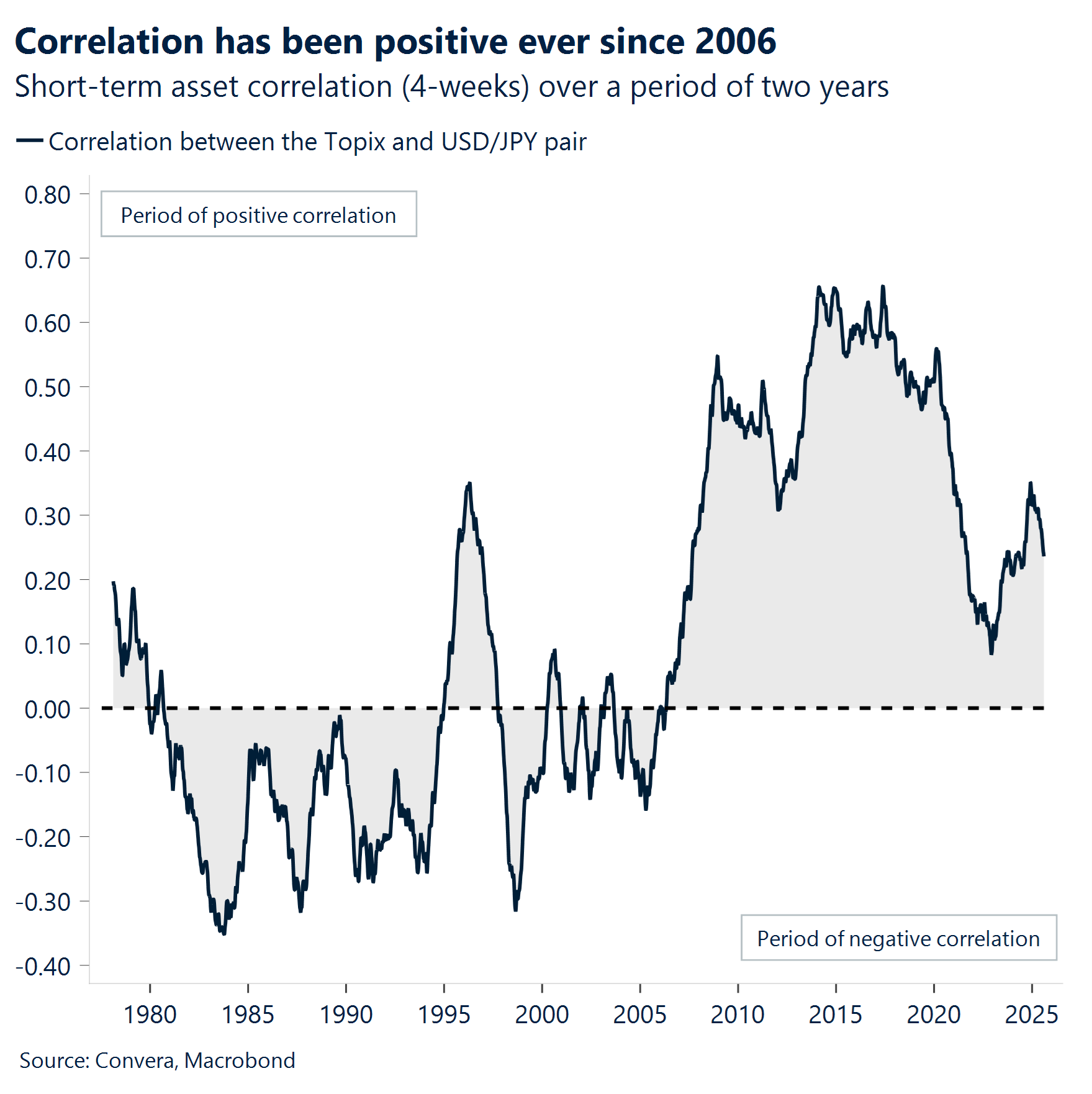
JPY BoJ optimism signals hawkish shift. Japan’s central bank is striking a cautiously upbeat tone—and markets are listening. With TOPIX breaking the 3000 mark for the first time, investors seem to welcome the Bank of Japan’s latest Summary of Opinions from its July meeting. The BoJ’s July meeting summary reveals growing confidence in Japan’s economic recovery, with policymakers viewing trade tensions as easing following US developments. This optimistic assessment, combined with expectations for CPI movement toward target levels, signals potential policy normalization ahead. The central bank’s readiness to raise rates if economic forecasts materialize marks a notable hawkish tilt. In currency markets, dollar-yen is defying the crowd. While most major currencies gained vs USD, USD/JPY edged up 0.2% for the week, standing out among its G10 peers. The pair is holding firm above key support levels—specifically the 50-day EMA of 146.67 and 100-day EMA of 146.78. Traders are now eyeing the next resistance at the 21-day EMA of 147.46. Upcoming GDP data will test the BoJ’s optimistic economic assessment, while industrial production figures could validate or challenge their recovery narrative.
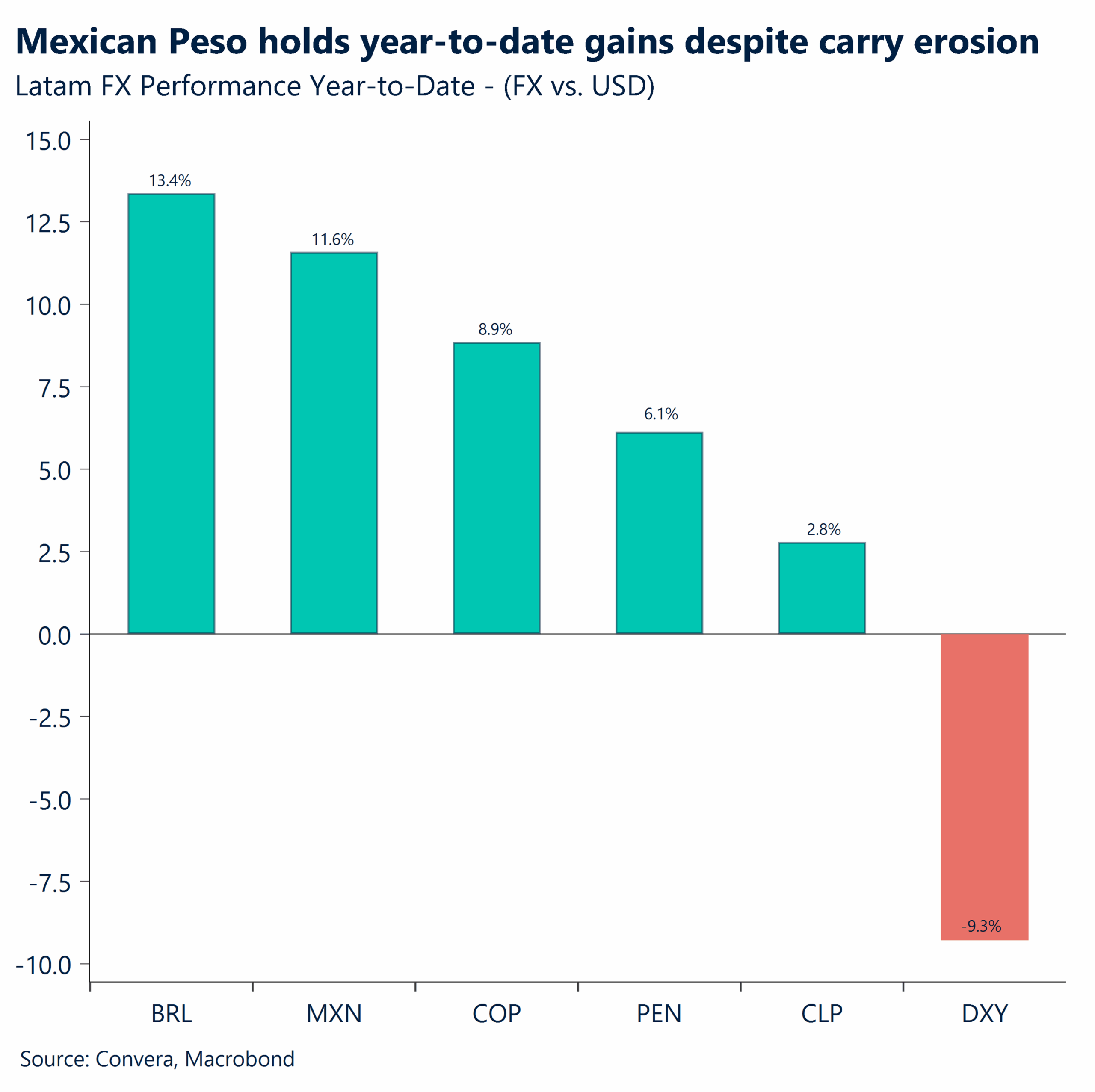
MXN Banxico cuts as expected. Breaking a streak of four consecutive 50 basis point cuts, Banco de México today lowered its key interest rate by 25 basis points to 7.75%, marking the ninth consecutive rate cut.
The smaller cut signals a more cautious approach to monetary easing, due to a shift in the board’s overall economic outlook. The decision was also more divided, with one member (Jonathan Heath) voting to hold the rate, a more hawkish dissent.
The central bank’s shift comes as general inflation has improved, but core inflation has shown signs of persistence, with short-term forecasts for that component being adjusted upward. The press release also noted that economic activity in the second quarter was slightly stronger than in the previous quarter, a factor that may have reduced the urgency for a larger rate cut.
According to the National Institute of Statistics and Geography (INEGI), Mexico’s GDP expanded by a seasonally adjusted 0.7% in the second quarter, handily beating market expectations of a 0.4% increase. This marks the sharpest pace of growth since late 2024. Growth was broadly based, with the services sector expanding by 0.7% and manufacturing growing by 0.8%, which offset a 1.3% plunge in primary industries. The economy’s year-over-year growth, however, was a more modest 0.1%.
The board reiterated its commitment to bringing inflation to its 3% target by the third quarter of 2026, while acknowledging the risks posed by global trade policies and new US administration policies.
No major changes for the USD/MXN after the decision, trading at 18.65, which is still closer to its 2025 low (18.52), and its 2-year average (18.55).
Have a question? [email protected]
*The FX rates published are provided by Convera’s Market Insights team for research purposes only. The rates have a unique source and may not align to any live exchange rates quoted on other sites. They are not an indication of actual buy/sell rates, or a financial offer.