


- Maximum pressure. Operation Economic Fury is the new play by the US, hoping that sanctions, shipping restrictions and financial measures will disrupt Iran’s oil revenues and weaken its economic power.
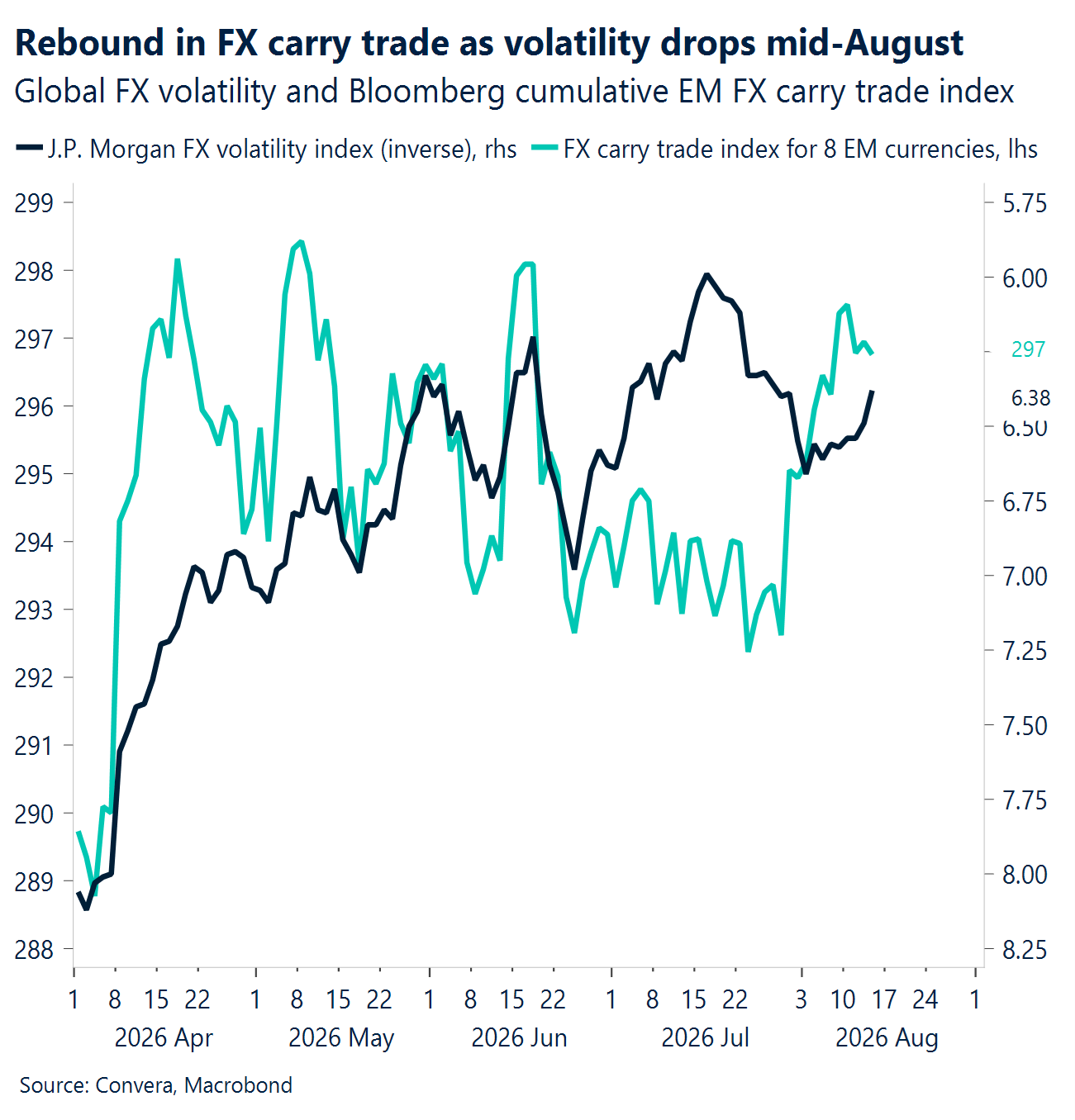
- Ebb and flow. Energy prices continue to fluctuate, with daily 5% swings higher and lower in oil a regular weekly occurrence. Yet risk sentiment remains resilient, with global equities notching fresh record highs and FX carry trades in full force.
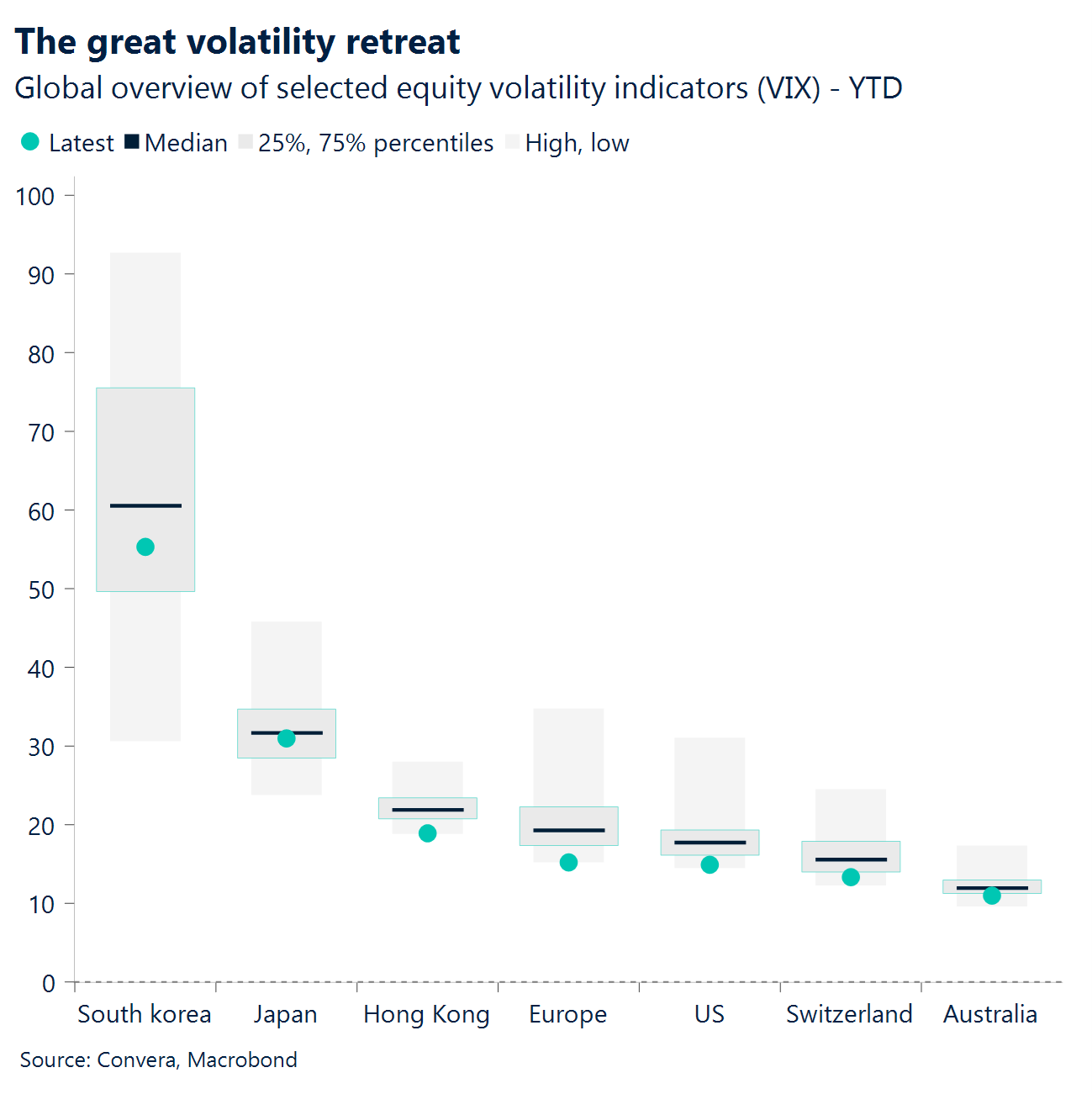
- Wakey wakey. Cross-asset volatility continues to compress as investors appear comfortable embracing risk. The VIX has fallen to its lowest level of 2026, the MOVE index has pulled back and FX volatility gauges hover near multi-year lows.
- The price is right. Benign US inflation prints, arriving on the heels of softer labour market data, have strengthened the disinflation narrative and helped underpin risk sentiment across markets.
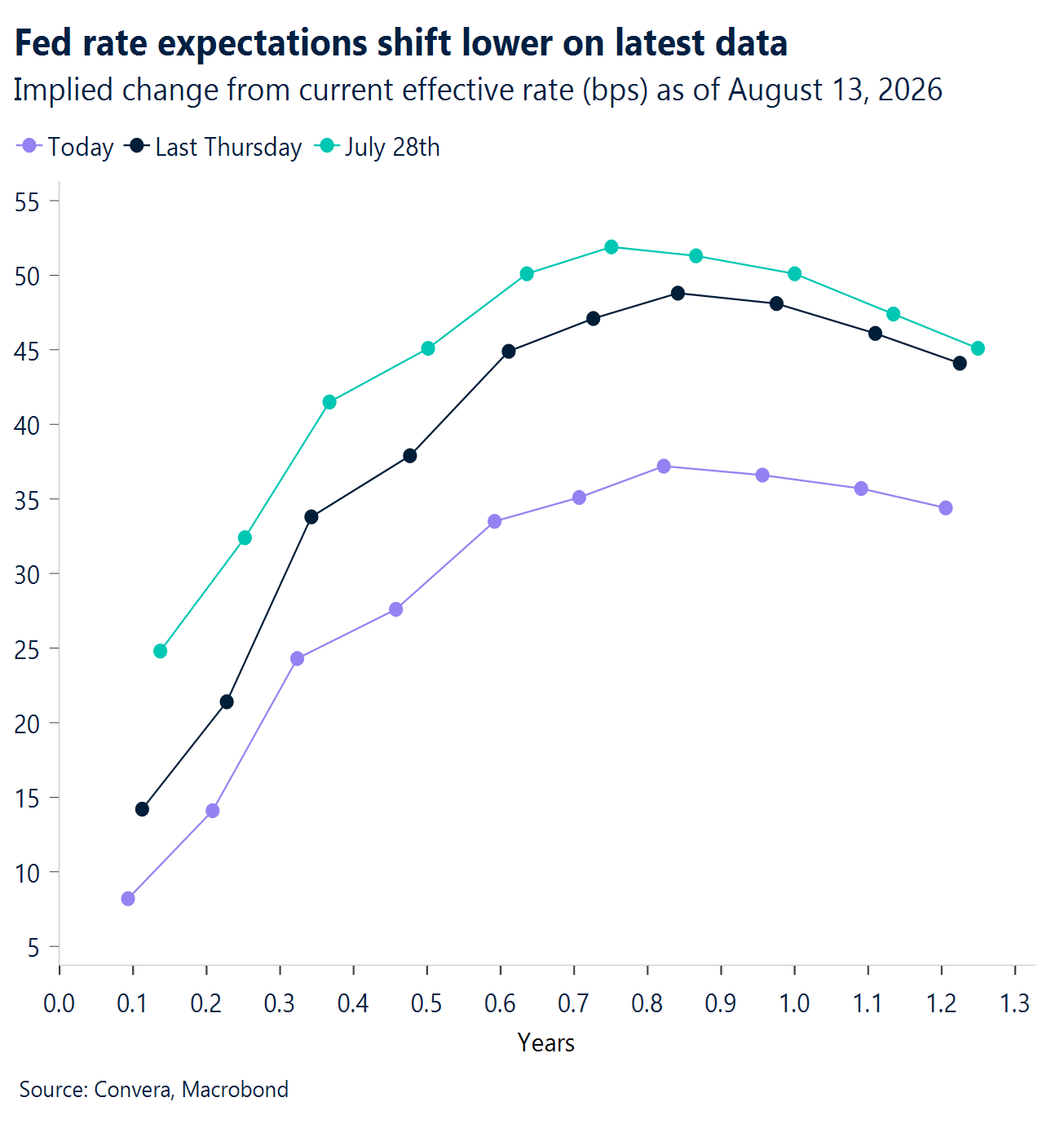
- Long memories. Short-dated Treasury yields have fallen as markets push back Fed tightening bets, but longer-dated yields remain elevated, reflecting receding growth fears and lingering inflation risks tied to Middle East tensions.
- Kicking the can. There is still reluctance to price out further Fed tightening, which is keeping dollar downside in check. The US dollar index is eyeing its first weekly gain in three, though much of the advance reflects JPY weakness.
- No yen for the yen. Despite growing expectations of BoJ tightening and narrowing US-Japan rate differentials, low volatility and robust carry demand continue to weigh on the low-yielding yen.
Global Macro
Inflation cools, central banks stay cautious
US CPI relief. US CPI came in at +0.1% m/m vs +0.2% expected, while headline inflation slowed to 3.4% y/y vs 3.5% expected. Core CPI printed +0.2% m/m and 2.5% y/y, both in line with expectations, giving markets a mild disinflation signal without fully reopening the easing story. Energy fell 1.5% m/m but shelter still accounted for roughly two-thirds of the monthly gain.
PPI cools. US PPI was softer than feared, with final demand flat m/m vs +0.2% expected and +4.7% y/y vs +4.9% expected. Core PPI ex food and energy rose +0.2% m/m vs +0.3% expected, while goods prices fell 0.7% on lower energy and food. The services side still rose 0.2%, so pipeline pressure eased, but did not disappear.
Central banks hold. The RBA held at 4.35%, as expected, while stressing that inflation remains too high and the Board is focused on preventing it from becoming embedded. Norges Bank also held at 4.25%, in line with expectations, but kept a hawkish bias by saying another hike may still be needed if inflation does not keep slowing. The policy message was clear: lower inflation prints are helping, but central banks are not ready to claim victory.
UK growth stabilizes. UK Q2 GDP rose 1.2% y/y vs 1.1% expected, while quarterly growth was 0.4%, in line with consensus. June GDP also beat, rising 0.3% m/m, helped by services and investment, even as industrial production remained weak.
Eurozone Q2 GDP rebounds. The Eurozone economy grew 1.0% y/y in Q2, accelerating from an upwardly revised 0.5% in the previous quarter, according to second estimates. Strong AI-related investment, resilient government spending, and one-off factors helped offset the impact of the conflict in Iran and higher energy prices.
Week ahead
Sentiment check, UK in focus
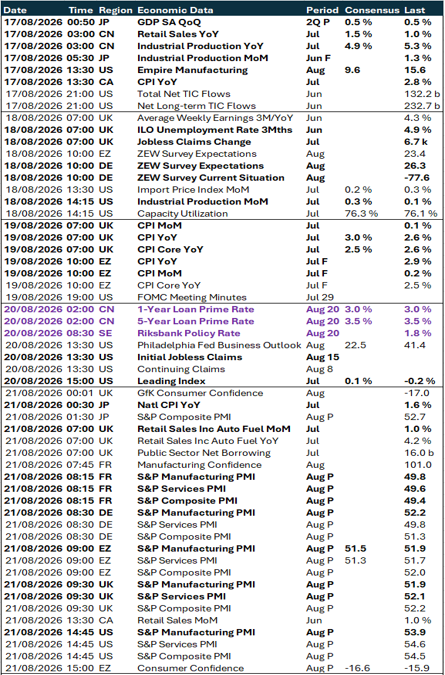
Inflation test ahead. Markets will pay close attention to the July’s UK CPI report. Headline inflation is expected to jump to 2.9% from 2.6%, while the core measure, which strips out volatile food and energy prices, is forecast to edge lower to 2.5% from 2.6%. The estimates clearly point to an energy-led inflationary backdrop, while underlying price pressures appear more subdued. After all, the softening UK labour market comes as little surprise and is partly responsible for a relatively muted demand-driven inflation impulse.
Labour market watch. The UK labour market will also be a key focus for markets. While recent reports have shown some signs of stabilisation, the broader trend remains soft. The unemployment rate continues to hover near five-year highs. Elevated energy prices stemming from Middle East tensions, alongside lingering political uncertainty, remain key deterrents to a more robust rebound in hiring.
Testing the recovery narrative. A slew of preliminary August PMI releases across major economies is also due. Recent readings have struck a more upbeat tone, but markets will be watching closely to see whether that optimism can be sustained amid persistent geopolitical tensions and elevated energy prices.
FX views
Back to a rates-driven regime
USD No haven no hawk. The Dollar Index, or DXY, traded just south of the 100 level throughout the week, with bullish momentum continuing to fade. The main culprit has been a less hawkish Fed, reinforced by this week’s benign CPI and PPI readings. Meanwhile, the conflict in the Middle East has morphed into an economic pressure campaign, with the US preparing to further tighten the screws on Iran’s economy. We do not see the dollar drawing meaningful safe-haven support from this latest phase of the conflict, nor from the USD-denominated energy transactions channel. That leaves the Fed firmly in the driver’s seat. Fed Chair Warsh is doing little to revive the Fed’s hawkish bias, leaving incoming data to do the heavy lifting. August CPI and the Jackson Hole symposium will be the next key tests. Unless either reinvigorates the hawkish stance, the dollar may struggle to regain momentum.
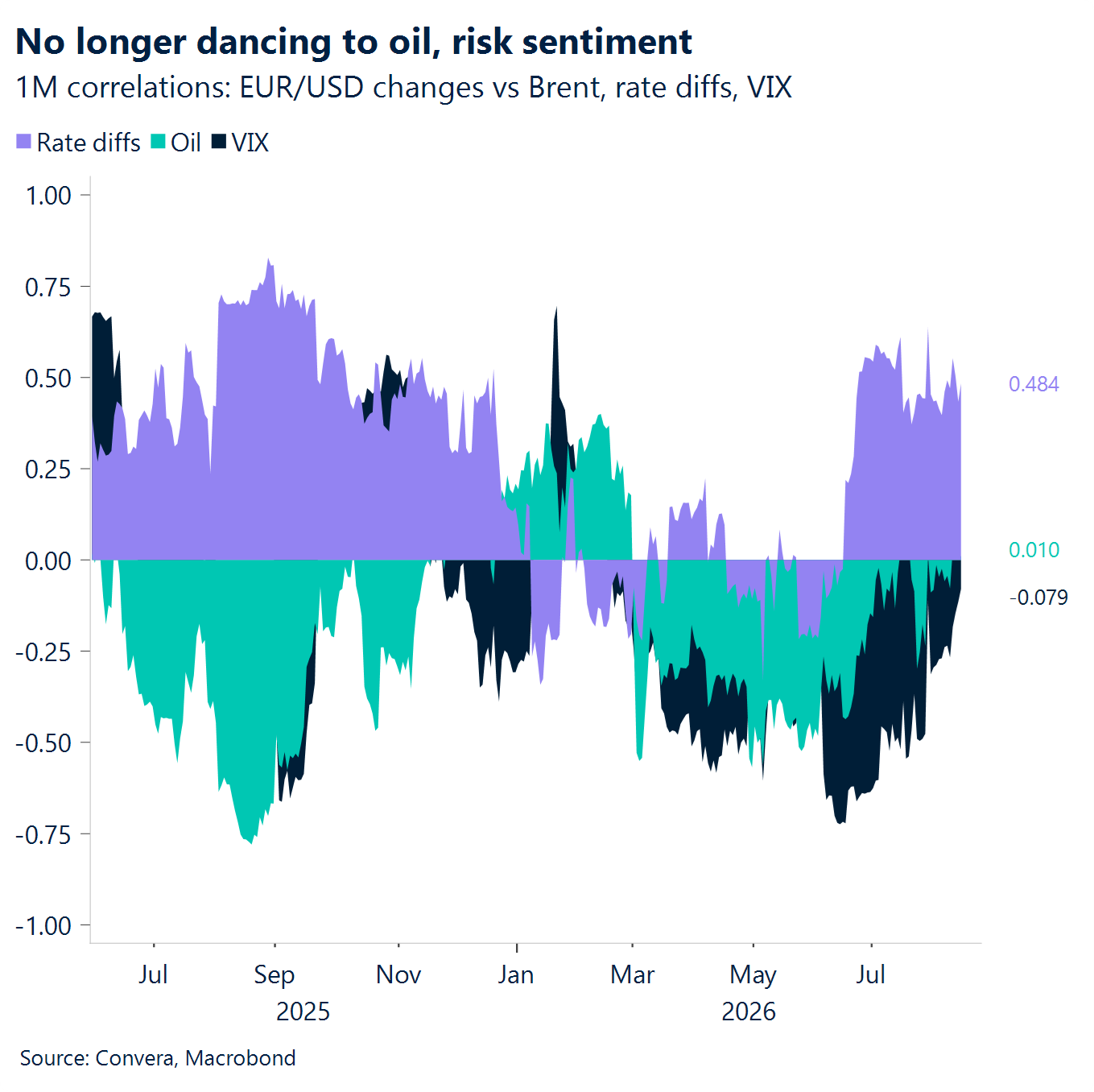
EUR No rush higher. EUR/USD traded largely sideways this week, hovering around the 1.1550 mark. The pair remains a dollar-driven story. With markets pricing in close to a full ECB hike by September, further gains depend on the USD leg and a renewed narrowing of the EUR:USD 2-year swap spread in the euro’s favour. That said, we do not expect much movement in the relative rate outlook ahead of the Jackson Hole symposium later this month. Meanwhile, oil and broader risk sentiment have lost much of their influence over the euro’s price action. For now, EUR/USD looks set to consolidate around current levels. The pair has reasserted itself above the key 1.14 and 1.15 support zones that have underpinned price action since the summer of 2025. Meaningful upside looks unlikely in the near term unless Fedspeak takes a decisively dovish turn.
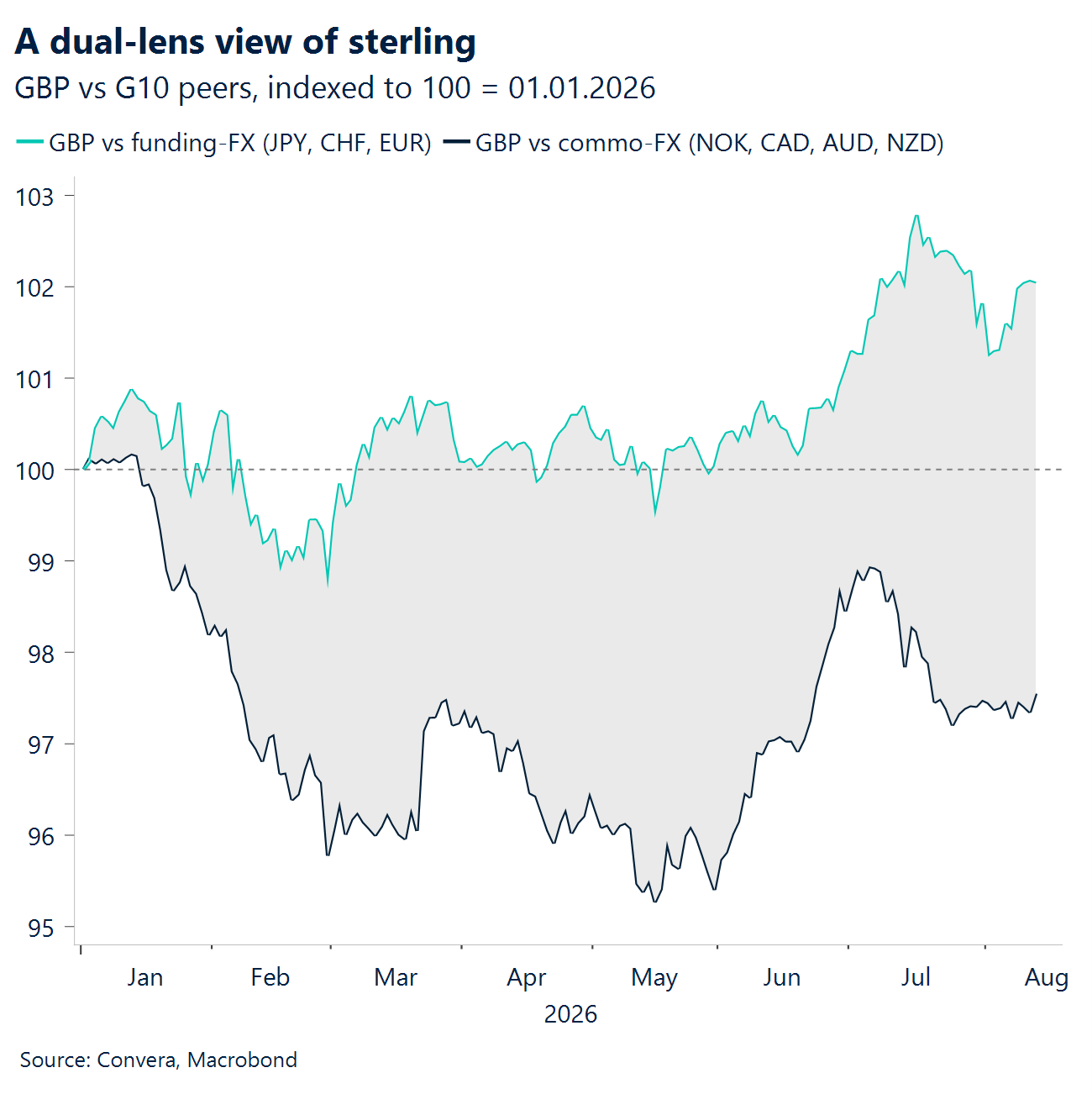
GBP Floating on global currents. Sterling remained resilient this week, with its performance continuing to reflect a combination of favourable carry dynamics, subdued volatility and supportive global risk sentiment. That said, stronger-than-expected UK GDP data confirmed a resilient economy in the face of geopolitical uncertainty. GBP/USD remains comfortably above its key daily and weekly moving averages, preserving a constructive technical outlook and helping the pair hold above the 1.35 handle. Meanwhile, GBP/EUR reclaimed the 1.17 handle despite still appearing somewhat rich relative to underlying rate differentials. The cross has instead been supported by investors’ willingness to seek carry in a low-volatility environment. With equities near record highs and FX volatility well below historical norms, sterling’s high-beta characteristics continue to attract support. However, the pound’s resilience remains vulnerable to any sharp deterioration in risk appetite or resurgence in market volatility. A critical week for UK data now lies ahead, with the results set to influence rate expectations and reveal whether sterling’s resilience extends beyond the current risk-on backdrop.
CHF Swiss and sour. The Swiss franc remained on the defensive this week as soft inflation data reinforced expectations that the SNB will remain one of the most dovish G10 central banks. Headline CPI slowed to 0.4% y/y in July from 0.5%, while producer and import prices fell 2.1% y/y, extending a deflationary streak stretching back more than three years. The data highlight the limited inflation pass-through from higher energy prices and leave little justification for tighter policy. Against this backdrop, CHF continues to benefit from its growing status as a preferred funding currency. EUR/CHF has risen more than 4% from its 2026 low and is approaching December 2025 highs near 0.94, while USD/CHF has reclaimed 0.81, with its 50-day moving average continuing to provide firm support since late May.
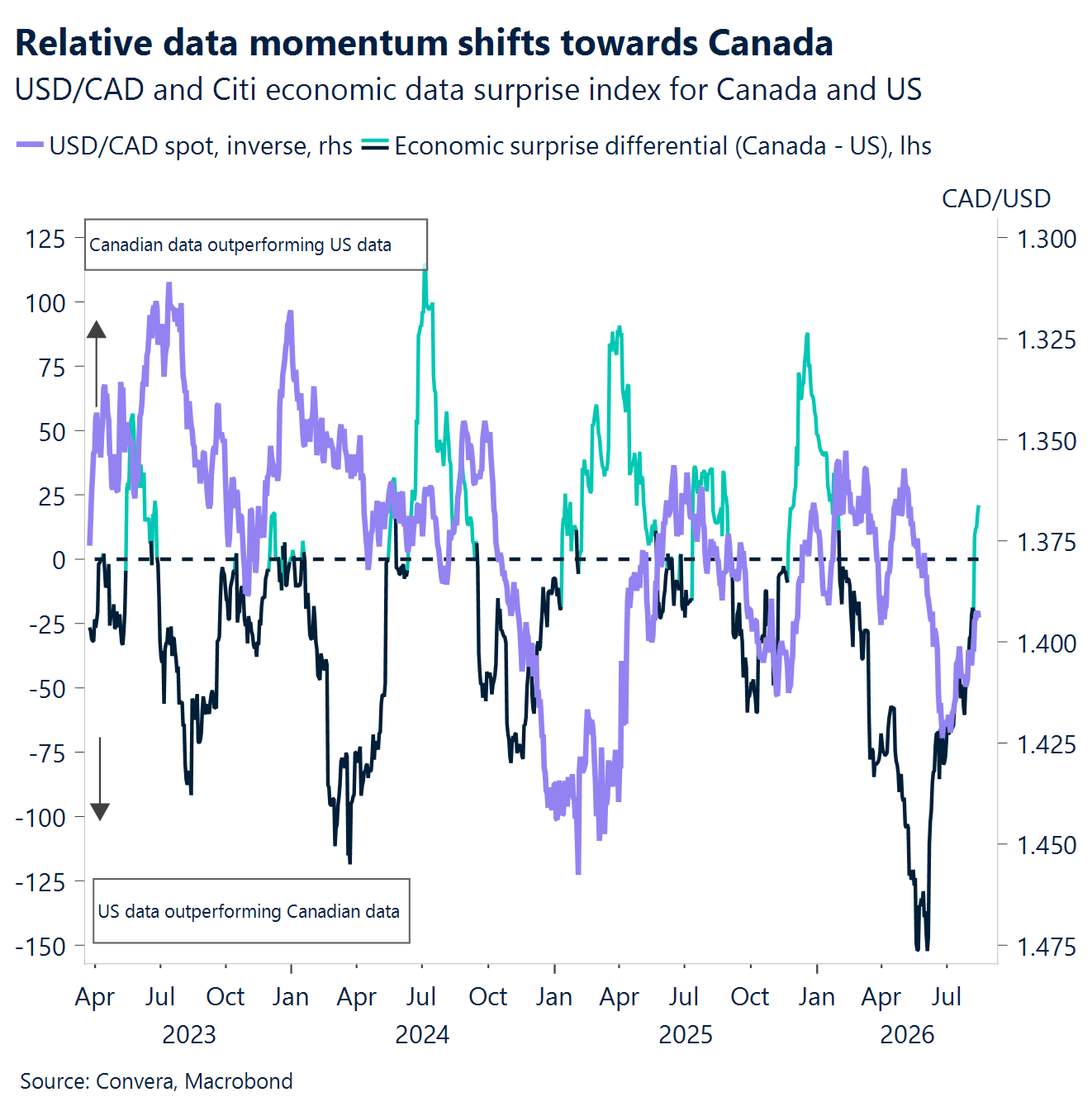
CAD Breakout. USD/CAD is trading near 1.3945, its lowest level since early June, after finally breaking below the 1.40 floor that held from June 16 to August 6. During that stretch, the pair repeatedly found support above 1.40, but also failed to sustain gains above 1.42, leaving the latest move lower technically meaningful. The shift is being driven by a sharp narrowing in rate spreads, with the US-Canada two-year yield gap down to roughly 121bp from about 145bp in late July as softer US data pulled Treasury yields lower while Canadian yields held up better. Canada’s July jobs report added fuel, with employment rising 75k and unemployment falling to 6.4%, while stronger exports and a wider C$3.86bn trade surplus have made the CAD rally look broader than oil alone. The main near-term risk is the August 19 tariff deadline, with Canada and the US trying to reach an interim deal before a new 50% tariff on roughly US$20bn of Canadian exports takes effect. Next week, besides any meaningful trade headlines, the focus turns to July CPI on Monday, where markets expect inflation to rise slightly to 3.0% from 2.8%, followed by June retail sales on Friday; a deal and firmer data could extend the move toward 1.37–1.38, while tariff escalation would leave CAD exposed and move back closer to 1.40.
AUD RBA keeps options open. Australia’s central bank chief said RBA’s decision came down to a straight choice: lift rates or sit tight. The next meeting lands at the end of September, and before then we get fresh reads on jobs, the economy, prices, and business feedback. She was blunt that September hinges on whether those numbers track the way officials expect. If they don’t, and price pressures build, the board will weigh moving again — and soon. AUD/USD sits roughly 3% under its 6 May peak of 0.7278. We see first support at the 21-day EMA of 0.7027, then the 50-day EMA of 0.7020, with 0.7100 capping the topside.
CNH Holding firm. China welcomed roughly 35 million overseas visitors last year, topping pre-pandemic numbers for the first time. We see that rebound cementing the mainland as one of the region’s top draws, with arrivals now ahead of Thailand and closing on Japan and Malaysia. Easier entry did the heavy lifting: visa-free trips made up more than 70% of arrivals in 2025, up from 50% a year earlier. The catch is spending hasn’t kept pace — visitors still part with less per head than neighbours, so the revenue upside is yet to show. USD/CNH is hovering near a three-year low. We think a push above the 21-day EMA at 6.7565 opens the way toward the 50-day EMA at 6.7728 while 6.7400 offers a psychological floor beneath.
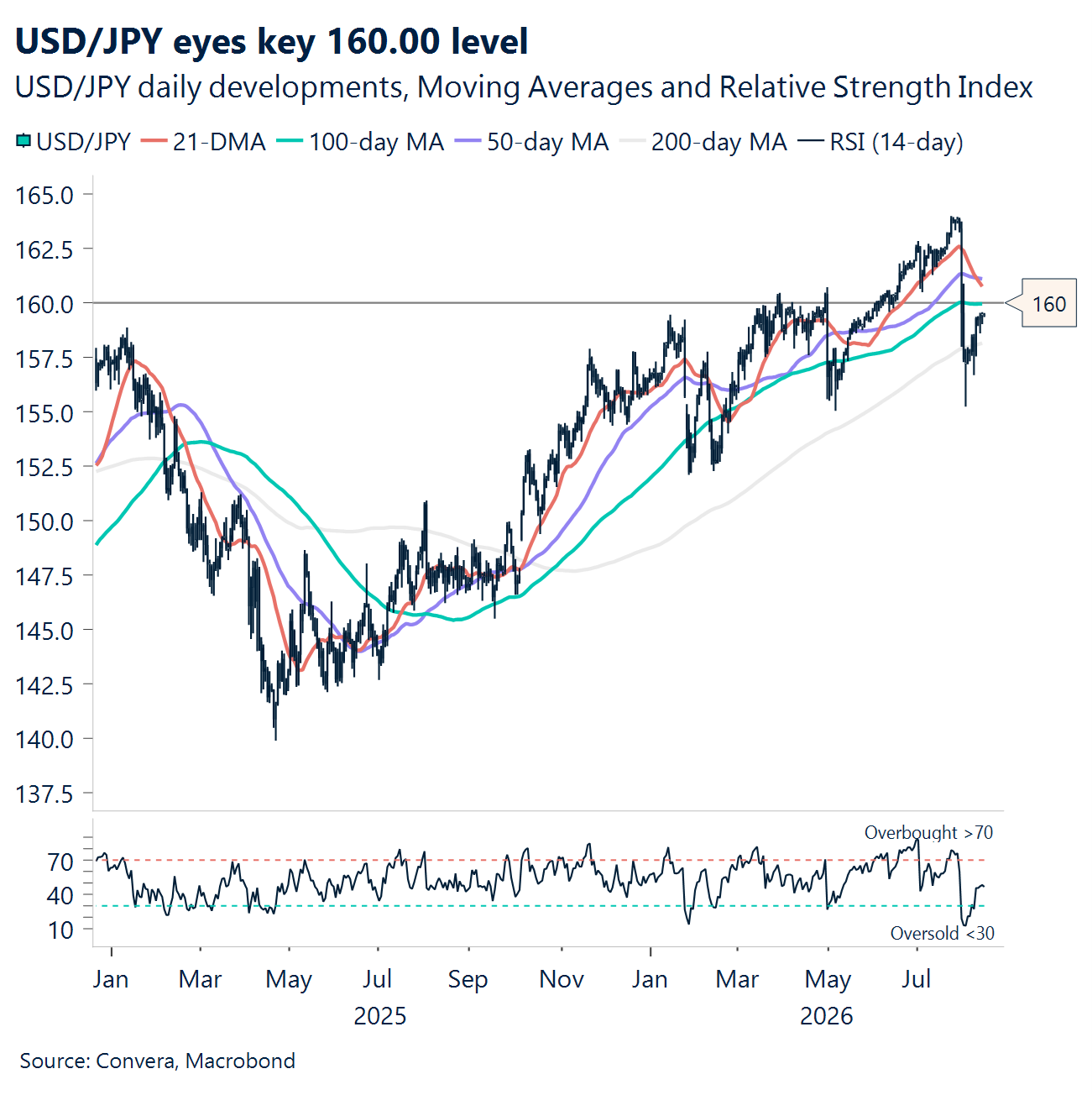
JPY BoJ hike hopes. We see cooler US prices and softer oil trimming rate-hike bets and pulling US yields lower — a shift that takes pressure off the yen. Reports point to the government backing a near-term rate rise, likely in September or October. Worries that a soft yen is pushing prices higher, paired with a wish to lock in the recent joint currency move, appear to be pulling officials and the central bank onto the same page. The premier’s office wouldn’t be drawn on detail but stressed it wants the bank working hand-in-glove with the government to reach the 2% price goal in a steady way. Still, for now, narrowing US-Japan rate spreads have yet to support JPY, with low volatility and strong carry appetite continuing to outweigh the BoJ tightening narrative. USD/JPY has fallen about 3% from its 23 July peak of 163.99, but is up almost 1% in a modest rebound this week. Initial resistance is seen at the 100-day EMA (159.79), followed by the 21-day EMA (160.01). Elsewhere, SGD/JPY and EUR/JPY have climbed to their highest levels in two weeks.
MXN Peso carry holds. USD/MXN is trading near 17.06, its strongest level in roughly two years and beyond the pre-Sheinbaum election area from May 2024, as softer dollar conditions, contained US inflation and steady risk appetite keep the peso bid. Banxico’s hold at 6.50% reinforced that support, with policymakers signaling little urgency to restart easing and pushing expected inflation convergence to Q4 2027 from Q2 2027. Headline inflation is close to target, but core near 3.95% and sticky services inflation keep the central bank cautious, preserving Mexico’s carry advantage even as the rate spread has narrowed. Mexico’s Q2 GDP rebound of 1.5% q/q, strong exports and reserves near USD257bn add a stronger domestic base than carry alone. Technically, USD/MXN has broken through 17.40, 17.20 and 17.10, leaving 17.00 as the next major level. Positioning is the main risk, with crowded peso longs raising the chance of a quick unwind if US inflation surprises higher or risk appetite turns.
BRL Real underperforms. USD/BRL is trading near 5.19, with the real underperforming most EM peers despite a softer dollar and a benign US PPI print. Brazil still offers one of the strongest carry profiles in EM, with the Selic at 14.00% after Copom delivered a fourth straight 25bp cut, but the central bank removed forward guidance and kept policy fully data-dependent, reinforcing that the easing cycle is close to its floor rather than accelerating. That should support BRL in theory, especially with markets pricing only one more 25bp cut by year-end, but politics and fiscal risk are dominating the currency story. Election uncertainty, equity outflows, fuel-tax politics and fresh US-Brazil diplomatic noise are keeping investors cautious, even as high rates remain attractive. Technically, USD/BRL has climbed from around 5.08 to 5.19 in recent sessions and is approaching the 5.21 area; a break above that zone would open 5.25–5.30, while support sits near 5.10–5.12. For now, BRL carry is still rich, but the market is demanding a bigger political and fiscal risk premium before adding exposure.
Have a question? [email protected]
*The FX rates published are provided by Convera’s Market Insights team for research purposes only. The rates have a unique source and may not align to any live exchange rates quoted on other sites. They are not an indication of actual buy/sell rates, or a financial offer.