
- Shutdown showdown ends. America’s longest government shutdown has finally ended. The Congressional Budget Office estimates the shutdown shaved 1.5 percentage points off GDP growth this quarter.
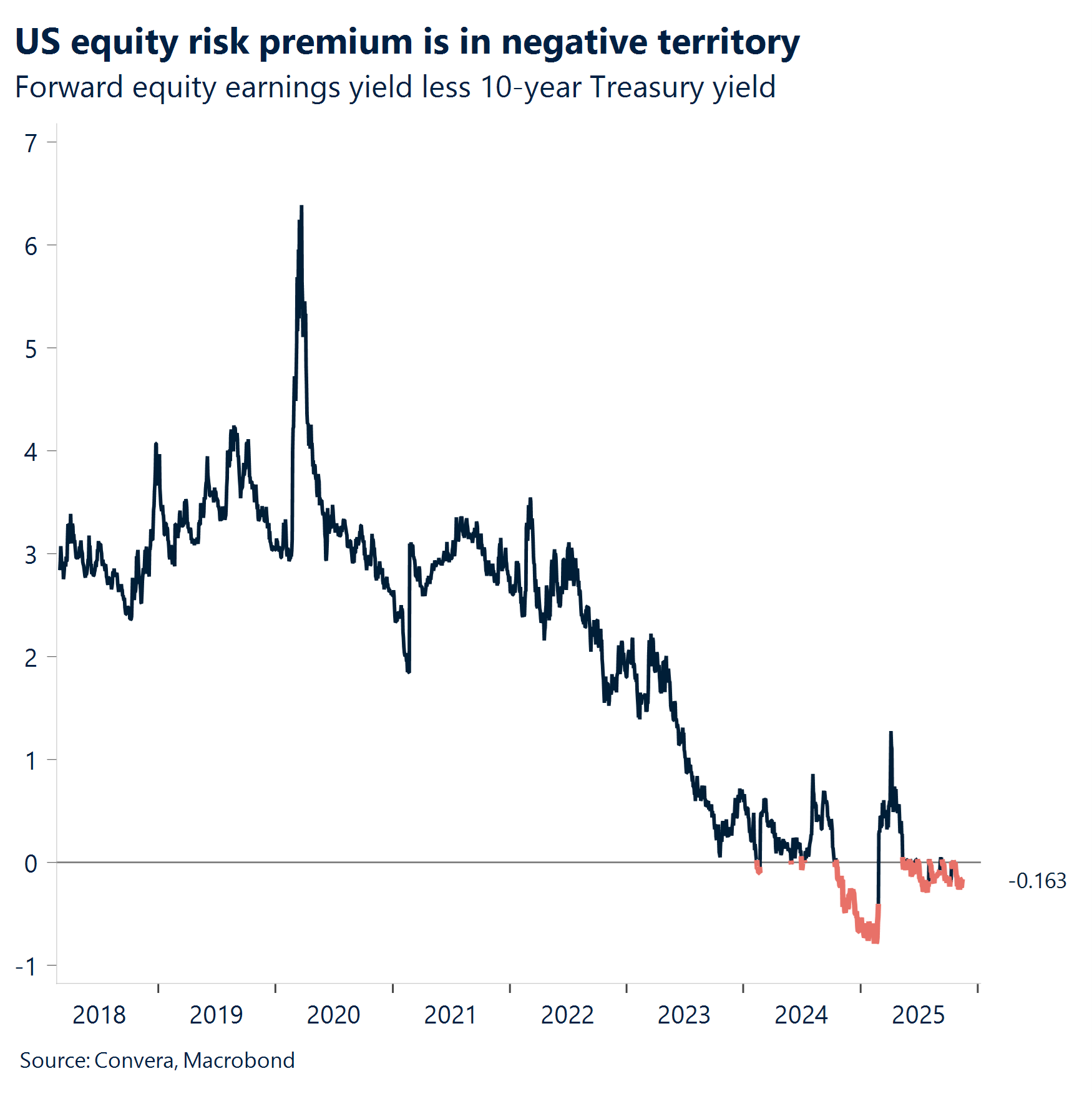
- Index stress test. US equity benchmarks suffered their steepest declines since October earlier this week. With the equity risk premium still negative — underscoring stretched valuations — stocks remain vulnerable to shifts in sentiment.
- Bit by bit. Bitcoin tumbled below $100,000, down more than 20% from its October peak, as risk aversion and tech‑sector weakness dragged the cryptocurrency to its lowest level since May.
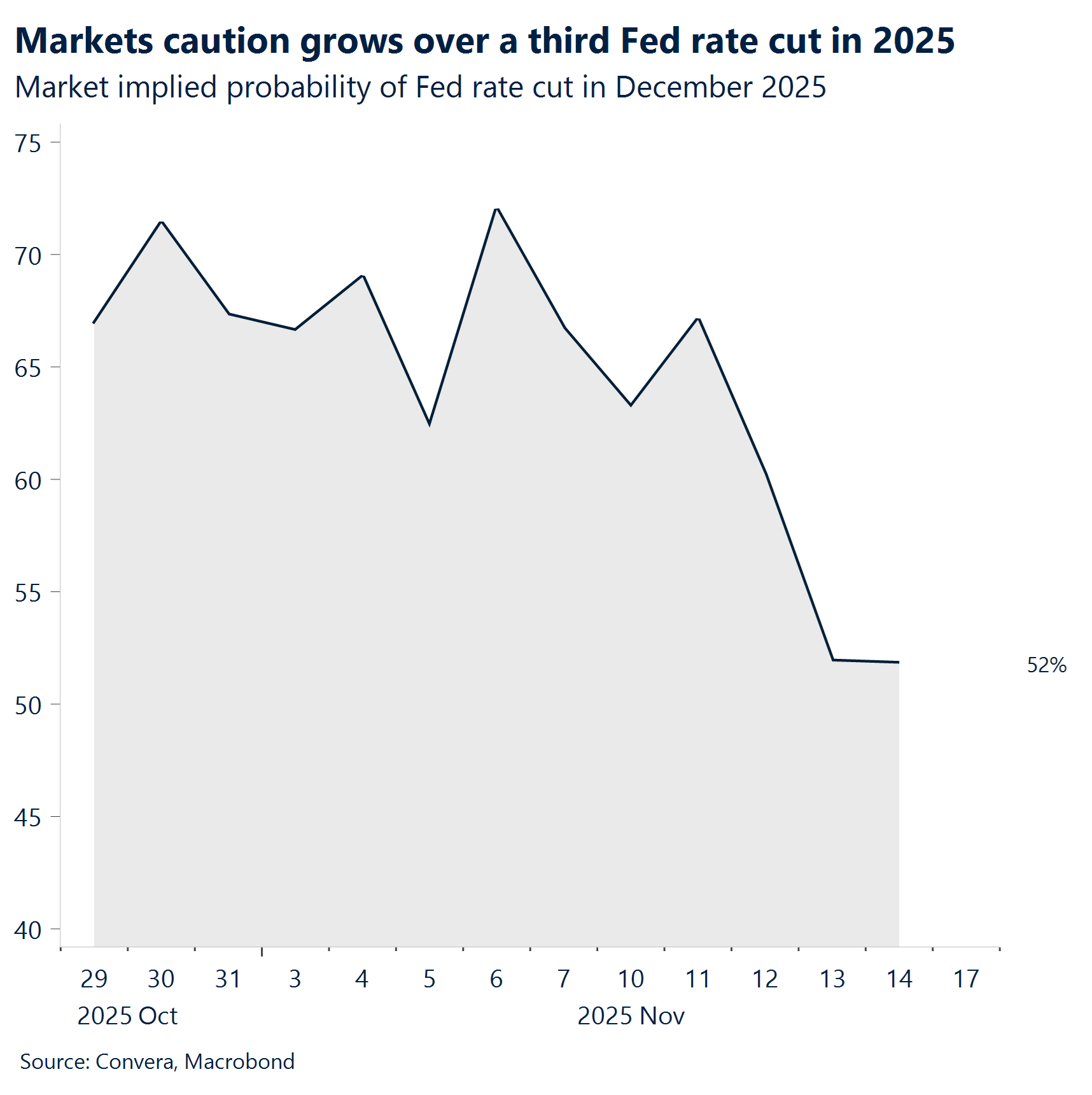
- Cut it out. Shifting expectations around Fed policy drove selling, with market odds of a December rate cut falling from 70% to 50%, dampening risk appetite across assets.
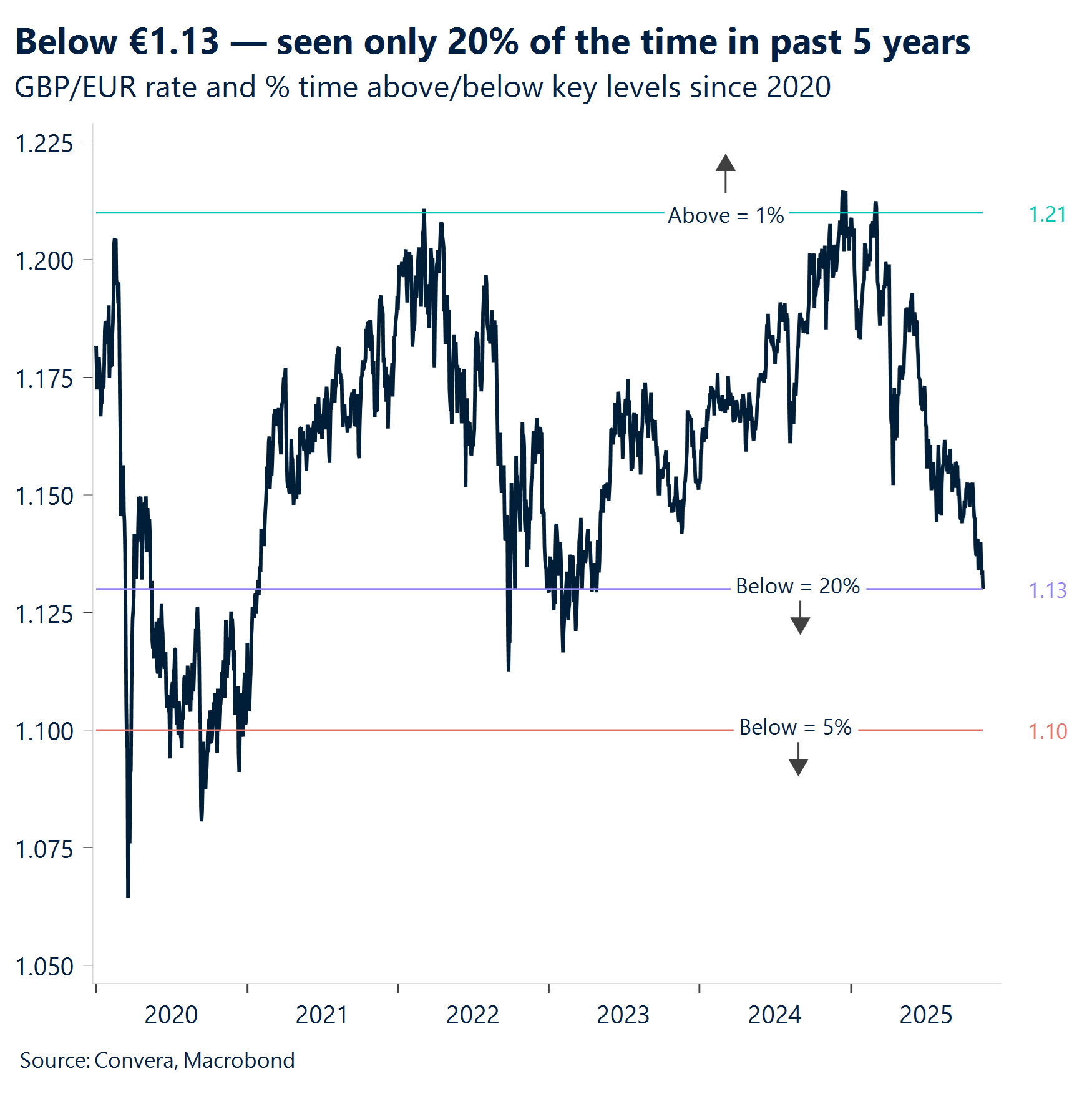
- Quid pro woe. Political infighting in the UK rattled confidence, adding to sterling’s risk premium and pushing GBP/EUR to its weakest levels in more than two years.
- Fiscal fumble. Furthermore, reports that the UK Chancellor may abandon planned tax hikes later this month reignited concerns over how the UK will plug its revenue shortfall.
- Vols on the rise. Across the G10 – the one‑month implied/realized volatility spread is the widest since April – signaling markets are bracing for turbulence as fresh US data returns to focus.
Global Macro
Government reopens, Fed slams the door
Shutdown over. President Trump signed legislation ending the longest government shutdown in U.S. history, lasting 43 days. The interim spending package funds most of the government only through January 30, leaving the prospect of another shutdown looming. Markets cheered, but doubts remain about the durability of the fragile truce.
Hawks return. Optimism after the end of shutdown was short-lived. Boston Fed President Susan Collins signaled a cautious stance on rate cuts, warning that job market risks have grown since summer. She sees a high bar for easing anytime soon, arguing that more cuts could stall progress on inflation. For now, she supports holding rates steady “for some time.” FOMC December rate cut odds dipped to 50/50 as policymakers played down imminent easing and uncertainty over US data releases persisted
Markets. Global stock markets tumbled on Thursday, led by tech and AI shares. Strikingly, equities, bonds, and the U.S. dollar all fell together, echoing risk-off episodes seen after Liberation Day. Even safe-haven gold offered no protection against the risk-off wave. Bitcoin dropped below 100K.
China. China’s October data underscored broad weakness, with retail sales up just 2.8% YoY and industrial output slipping to 5.5% on fewer working days and softer exports. Credit growth missed expectations, while fixed asset investment fell -1.7% YTD—the lowest since June 2020—highlighting that policy easing has yet to gain traction. With no further rate or RRR cuts expected this year, activity indicators continue to disappoint as policymakers hold back on additional support.
Week ahead
When will the numbers return?
Shutdown ends, data still in limbo. We remain unclear on how the US government will release the backlog of data following the end of the shutdown, or when upcoming series will resume. Nonetheless, some releases are expected to start trickling in.
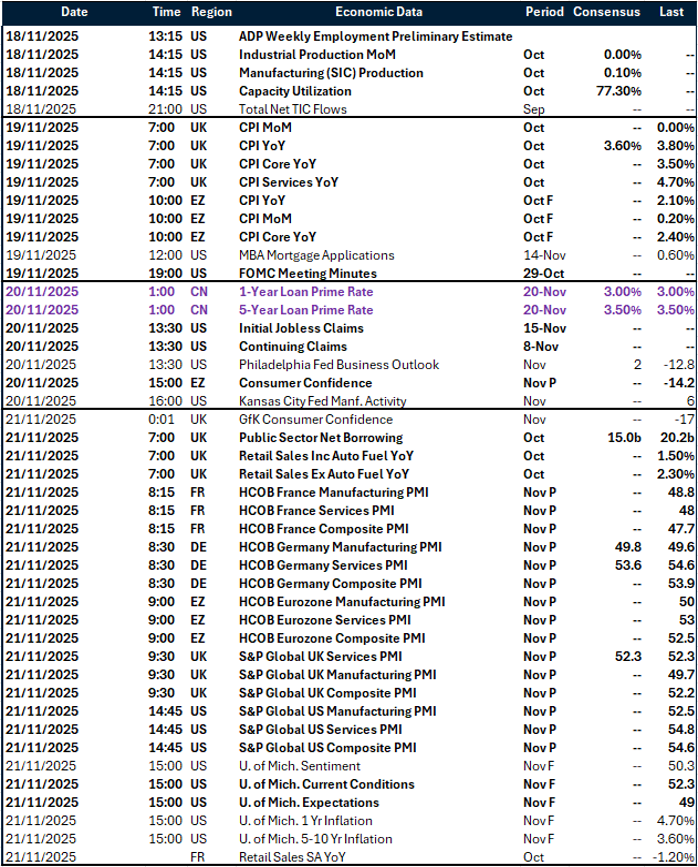
Spotlight on US jobs. On Tuesday, US industrial production is due, with the weekly jobs report scheduled for 20 November. Later in the week, PMIs will be released. It’s not a major week for the US, as PMIs were never interrupted, but we’ll be watching closely for catch‑up data to fill the gaps.
UK CPI takes centre stage. UK CPI is out and will be crucial. Recent weak labour market numbers, combined with unimpressive Q3 GDP growth undershooting expectations, weighed on sentiment. Yet doves refrained from fully pricing in a BoE cut, with still 15% underpriced. As inflation remains top of mind for MPC members, a confirmation of the disinflation trend seen in September’s print could trigger full dovish pricing.
PMIs return, investors stay wary. A raft of PMIs across the UK, France, Germany, the eurozone, and the US will provide a pulse on regional sentiment. Still, with US hard data returning and eurozone PMIs recently proving misleading against the broader macro backdrop, investors are likely to read these releases with caution.
FX Views
Markets wait: shutdown over, data absent
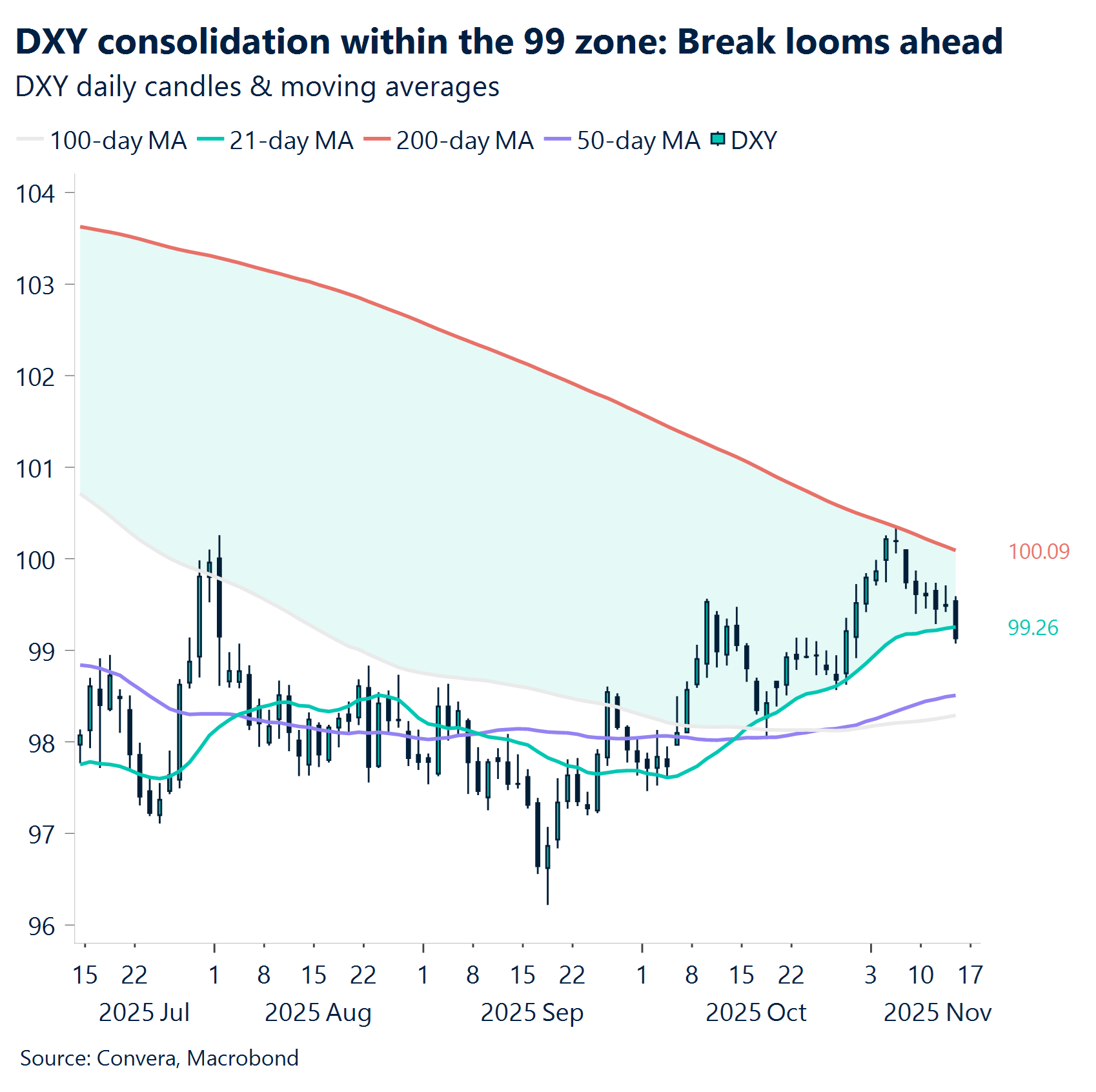
USD Fragile range, fragile confidence. The big event of the week was the shutdown coming to an end, with President Donald Trump signing legislation to conclude the longest government shutdown in US history (43 days). The setup still looks vulnerable, however, with funding agreed only until the end of January, hinting at further discord as 2026 begins. It may also take a few days for official government data – what the dollar has been craving – to start coming back. Amid the continued data void, the dollar consolidated, floating in what now appears to be a confined 99 range, capped by the 200‑day moving average at 100.100 and supported by the 21‑day moving average at 99.200. The range looks increasingly fragile, as incoming data – and how investors interpret it – will determine whether the dollar breaks north, gaining bullish momentum, or retreats south.
EUR US data holds the key for euro upside. Euro bulls pressed harder into the week‑end, breaking north of the EUR/USD 21‑day moving average, which had capped price action since early October. With the shutdown now over, expectations have grown for a return of softer US macro data – still the euro’s clearest bullish catalyst, as EUR/USD trades more closely to fundamentals. While calling for sustained upside may be premature, momentum could accelerate quickly if weak US data is confirmed. After more than a month of speculation and tentative signals, such confirmation would likely embolden euro buyers, blending sentiment with fundamentally‑driven conviction.
GBP Headwinds and headlines. Sterling remains under strain following a run of disappointing UK data and mounting political uncertainty. Third‑quarter GDP undershot forecasts, while labour‑market figures showed unemployment rising to levels last seen during the pandemic. Markets reacted quickly, with traders now pricing in more than an 80% chance of a BoE rate cut in December. Political risk has added to the mix. Internal fighting over Keir Starmer’s leadership unsettled sentiment, while reports that Chancellor Reeves may drop plans to raise income tax in this month’s Budget reignited concerns over the UK’s fiscal position. Against this backdrop, sterling is on track for its third weekly decline in four versus the dollar. Yet investor behaviour suggests GBP/EUR is emerging as the cleaner channel for bearish views: the cross has fallen to its lowest since April 2023, briefly breaking below the €1.13 threshold, while GBP/USD remains supported above the psychologically important $1.30 level. A sharp paring of GBP losses on Friday was a result of improved UK growth forecasts from the OBR, which prompted the policy U-turn by Reeves. Still, FX options markets reflect growing caution, with traders adding fresh downside protection ahead of key UK releases — inflation (Nov 19), retail sales (Nov 21), and the Budget (Nov 26).
CHF Tariff truce, franc boost. The Swiss franc has found fresh support amid signs that Switzerland and the US are nearing a trade agreement. A revised tariff deal – reducing levies on Swiss exports to 15% from the 39% announced in August – could be finalized within two weeks. The news helped the franc pare earlier losses against the dollar this week and adds to its already strong performance this year. However, the scope for further appreciation may be limited by the Swiss National Bank’s cautious stance. While the SNB has resisted rate cuts below zero, recent comments suggest a greater willingness to intervene if financial conditions tighten excessively. This evolving policy backdrop makes the franc’s near-term trajectory particularly sensitive. Traders will be watching closely to gauge how much strength the SNB is willing to tolerate, especially if the trade deal removes a key obstacle to further gains.
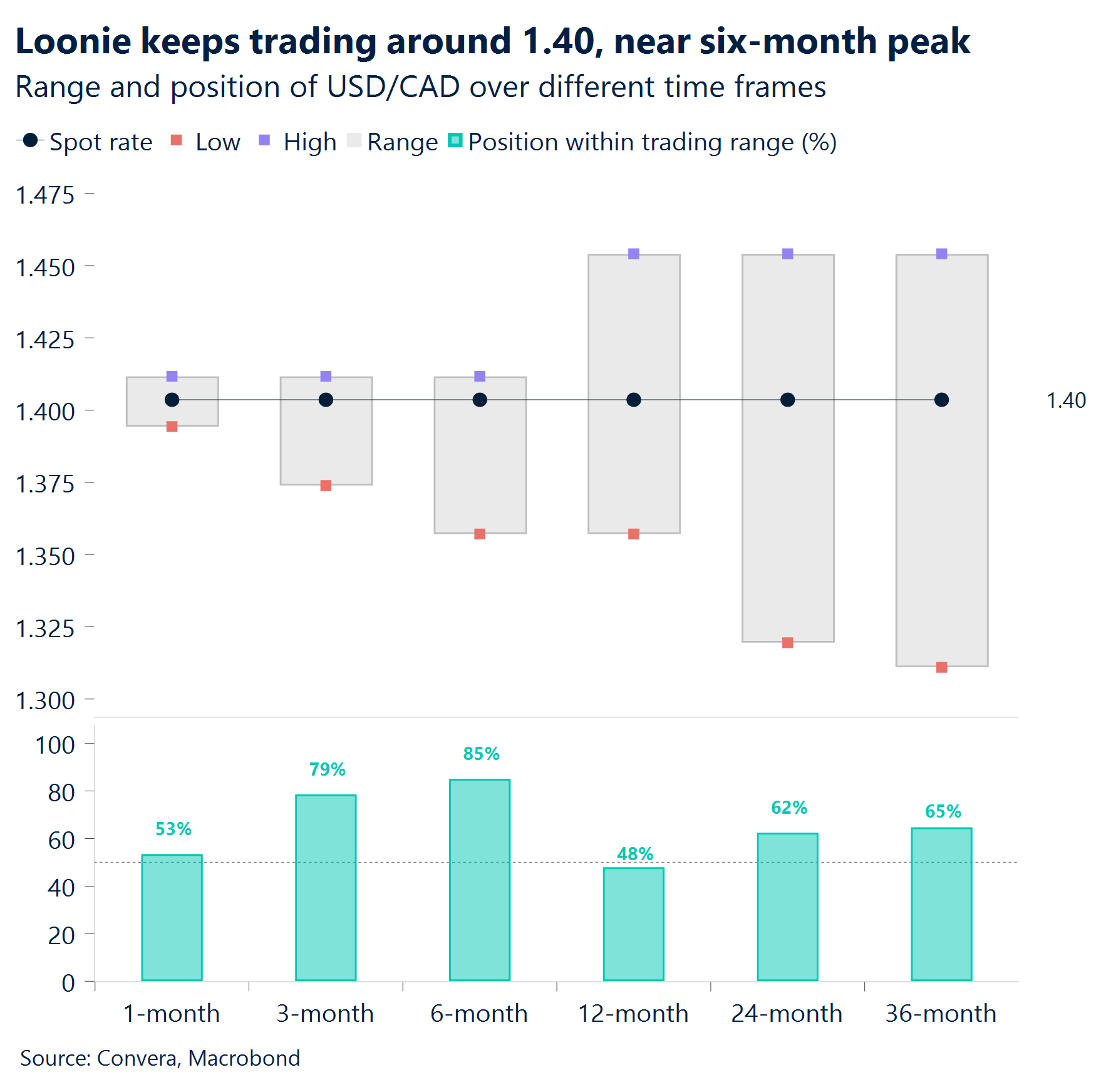
CAD Sustained weakness. Earlier in the week, the CAD gained support from a weaker US dollar and a stronger-than-expected October jobs report. Although the employment increase was concentrated in part-time positions, the headline provided enough momentum for the Loonie to climb as high as 1.414 before easing back to hover near 1.40. Despite Thursday’s decline in the US dollar, the Canadian dollar remained muted, as fiscal concerns kept FX markets cautious ahead of upcoming voting in Ottawa. On the trade front, progress remains limited. Looking ahead, next week’s federal budget decision, and CPI release will be pivotal in shaping expectations for the Bank of Canada’s final meeting of the year.
AUD Aussie job boom stuns forecasts. Australia’s labor market roared back in October, smashing expectations and reversing the recent uptick in unemployment. Employment surged by 42.2k—more than double the 20k forecast—driven by a 55.3k jump in full-time roles, while part-time jobs dropped 13.1k. The unemployment rate fell to 4.3%, beating both the 4.4% forecast and last month’s 4.5%. This strong print reinforces the RBA’s wait-and-see stance, likely keeping rates steady through Q1 2026 unless growth sharply deteriorates. Technically, AUD/USD next key support will be at the 100-day moving average of 0.6520, with 0.6500 as the next line in the sand. Conversely, the next strong key resistance lies at 0.6600. Traders now eye the upcoming RBA minutes and wage data for further cues
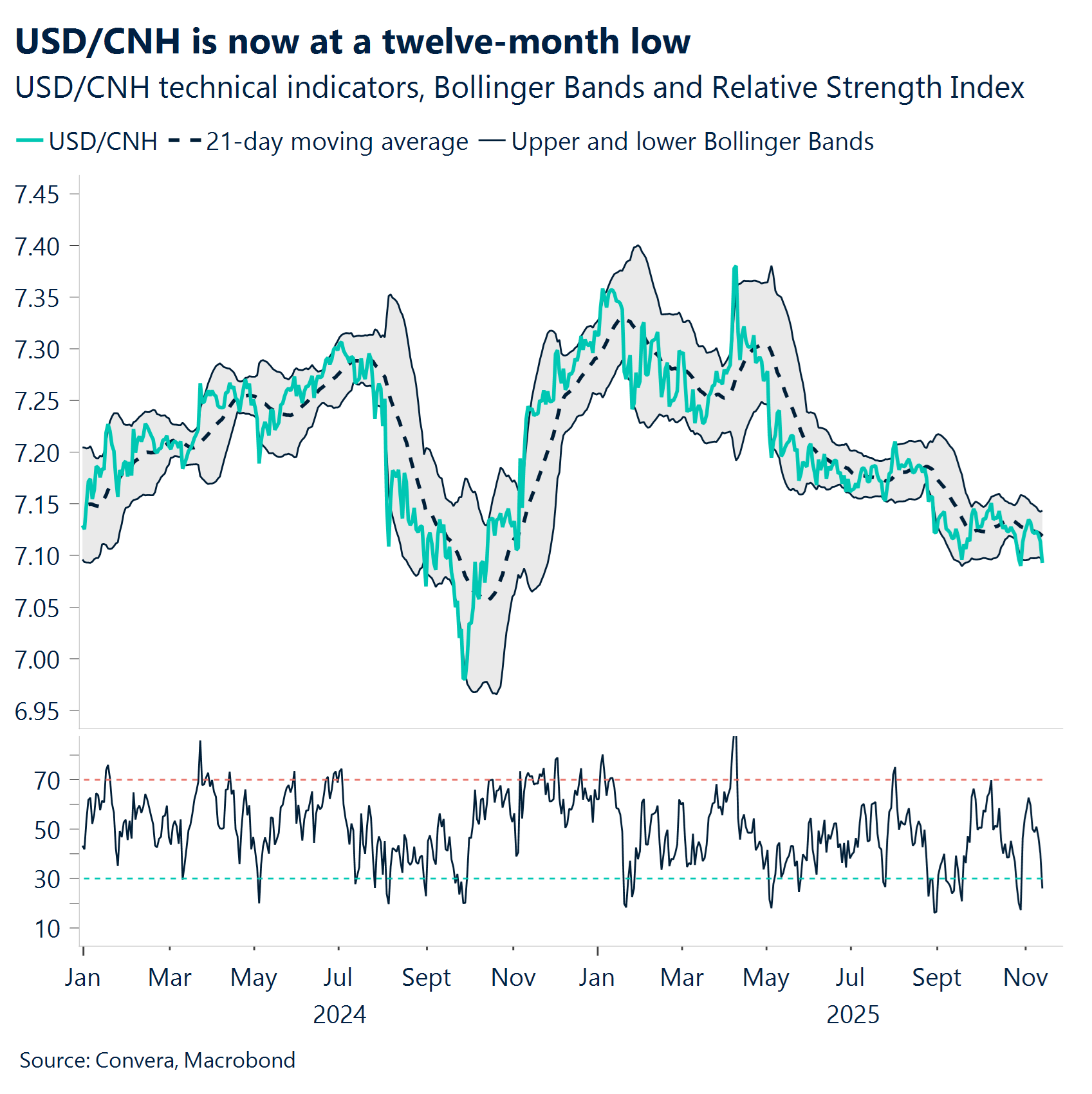
CNH Yuan edges higher as China bets on industry revamp. China’s push to modernize its industrial base under the 15th Five-Year Plan is fueling optimism across pro-cyclical sectors like advanced manufacturing and materials. Investors are betting that strong domestic and North American demand for energy storage will drive up prices across the battery supply chain—from electrolytes to lithium. USD/CNH is now at a twelve-month low, briefly dipping below 7.100 and hovering just 0.2% above the September low of 7.0851. On the charts, resistance looms at the 21-day moving average of 7.1185, followed by the 50-day EMA at 7.1286. Markets now await China’s loan prime rate decision for further direction.
JPY Worst performer across G10. USD/JPY climbed to a fresh nine‑month high despite broad dollar softness, underscoring the yen’s vulnerability. The currency’s weakness reflects a confluence of domestic political instability and global rate dynamics: investors are questioning Japan’s policy direction under a fragile government, while elevated U.S. yields continue to erode the yen’s appeal. Technically, support lies at the 21-day EMA of 153.24, followed by the 50-day EMA at 151.44. The yen’s resilience may persist as traders await key economic releases including GDP, industrial production, CPI, and the au Jibun Bank Services PMI for fresh momentum.
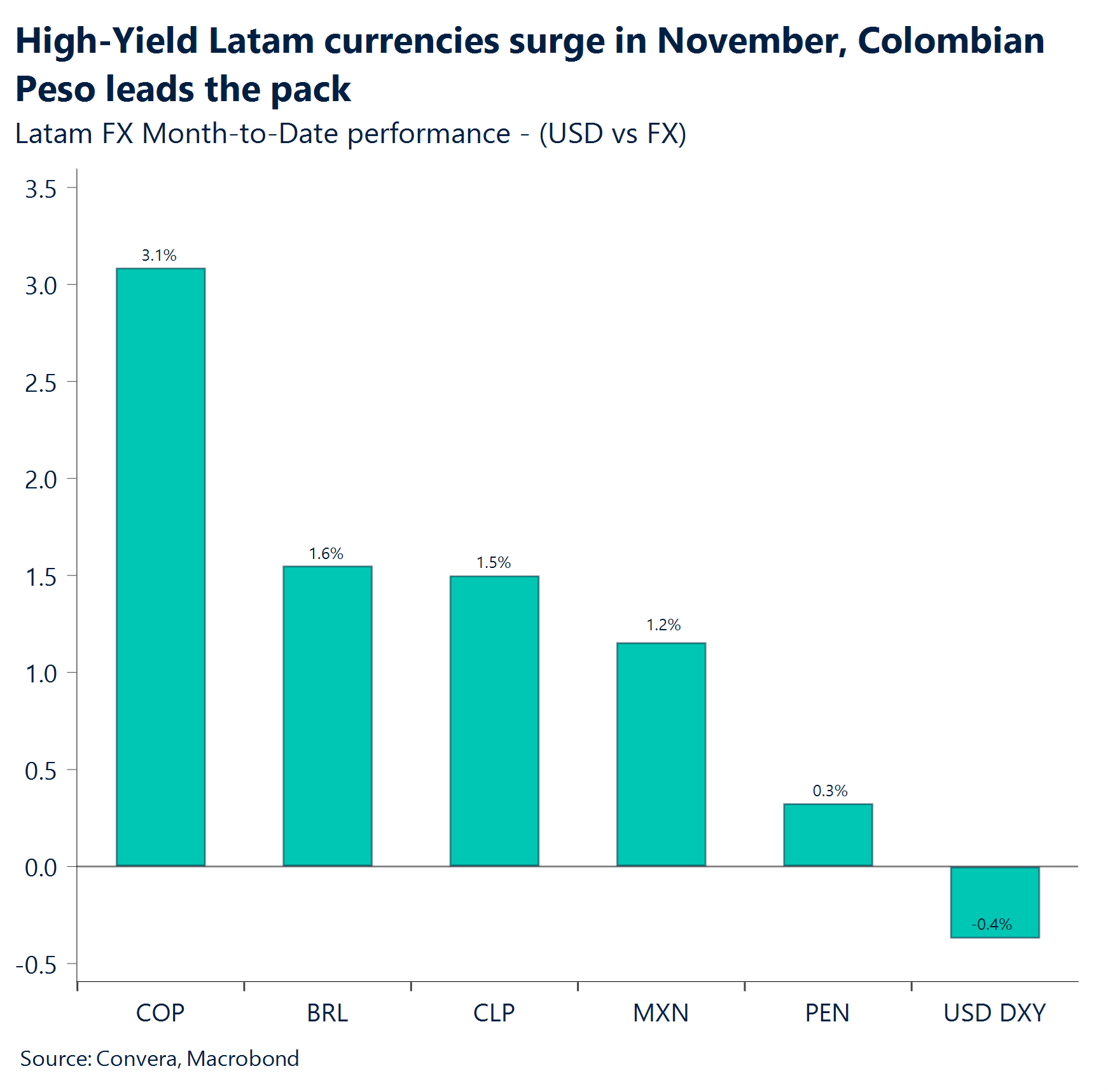
MXN Strong recovery. A strong recovery for the USD/MXN, which failed another breakout attempt above 18.6, a level coinciding with its 50-day SMA. After hitting 18.7 last week, it rallied driven by concerns around the US job market, which weighed on the dollar. However, the Peso’s gains are also largely due to the return of a risk-on environment. This improved investor appetite, which boosted emerging-market stocks, was sparked by US lawmakers’ progress toward ending the nation’s longest government shutdown. While domestic macro data, such as September’s industrial production, came in line with expectations, it is this positive global sentiment that has bolstered the Peso. By the end of week, despite markets entering risk-off territory, the Peso cemented weekly gains thanks to a weaker US Dollar. This has pushed the USD/MXN pair back down, trading close to its 2025 low of 18.2.
Have a question? [email protected]
*The FX rates published are provided by Convera’s Market Insights team for research purposes only. The rates have a unique source and may not align to any live exchange rates quoted on other sites. They are not an indication of actual buy/sell rates, or a financial offer.