


USD: Dollar back in command
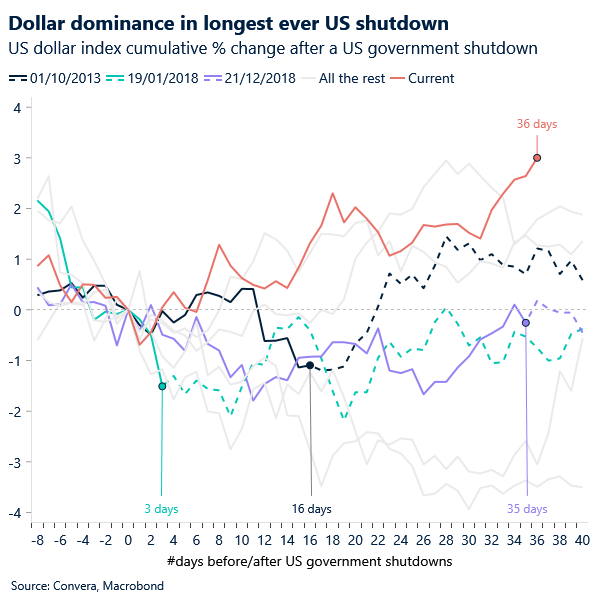
Markets have opened the week under a cloud of uncertainty as the US government shutdown stretches into its 36th day — now the longest in history, surpassing the 35-day standoff of 2018–19 in President’s Trump’s first term. Risk assets are under the pump, whilst the US dollar has reasserted itself as the dominant safe haven in the FX space.
As the government shutdown extends, the absence of fresh US economic data has left the Fed’s rate path murky, amplifying volatility across asset classes. Risk sentiment is softening: Bitcoin has entered a bear market, down over 20% from recent highs, while global equities show signs of fatigue after a record-breaking rally from April lows pushed valuations to exuberant extremes. Investors remain wary as policy paralysis and stretched pricing collide with fragile macro signals.
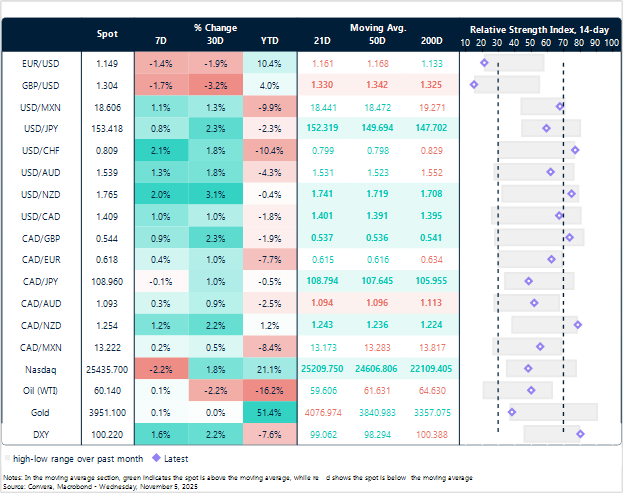
The US dollar is trading at its highest level since May, marking a sharp turnaround from April’s selloff. Up over 1% against every G10 peer this quarter, the greenback’s rebound reflects a normalization — not speculation. Rate differentials are back in focus, with 1y1y swaps tracking USD strength. Fed officials’ data-dependent tone adds nuance, but risk-off flows and repriced expectations have reestablished the dollar as the anchor of global macro. With the euro lagging growth, sterling pressured ahead of the UK budget, and Japan facing tightening tensions, the dollar basket looks increasingly constructive.
This rebound isn’t just tactical — it’s a return to form for the world’s reserve currency.
CAD: Loonie continues sliding
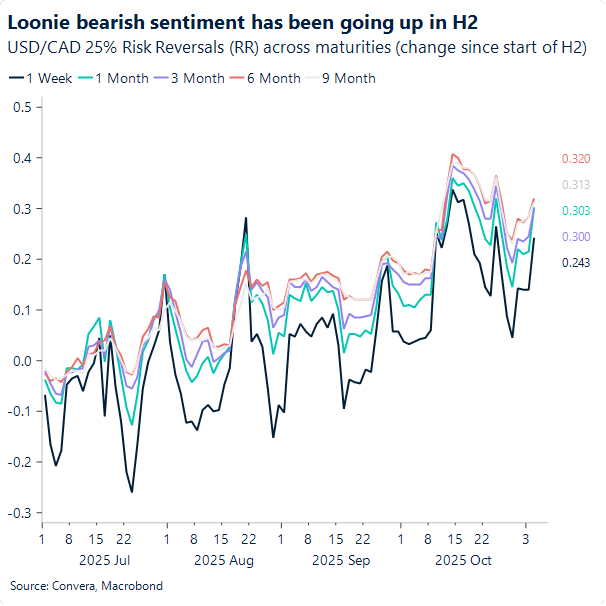
USD/CAD’s dip below 1.39 following the Bank of Canada’s rate cut was quickly reversed. The pair shot back above 1.40 after Fed Chair Powell signaled a December cut isn’t guaranteed, forcing markets to reprice the “two and through” scenario. The Loonie’s end-of-month weakness was reinforced by Friday’s soft August GDP print, which underscored fragile economic momentum heading into Q4. This was compounded by a stronger U.S. Dollar and evident monetary policy divergence between the Fed and the BoC.
Adding to the pressure, Canada’s fiscal outlook is poised to deteriorate. After the federal budget was tabled in Ottawa, fiscal uncertainty is becoming a key headwind. Markets are increasingly sensitive to signs of fiscal slippage.
In short, the Loonie is being squeezed by a trifecta of negatives: widening policy divergence, persistent U.S. Dollar strength, and mounting domestic fiscal concerns. As mentioned previously, if demand for the U.S. Dollar holds and US labor data doesn’t point to weakness, the Loonie will remain under pressure.
GBP: Pressure is mounting on sterling
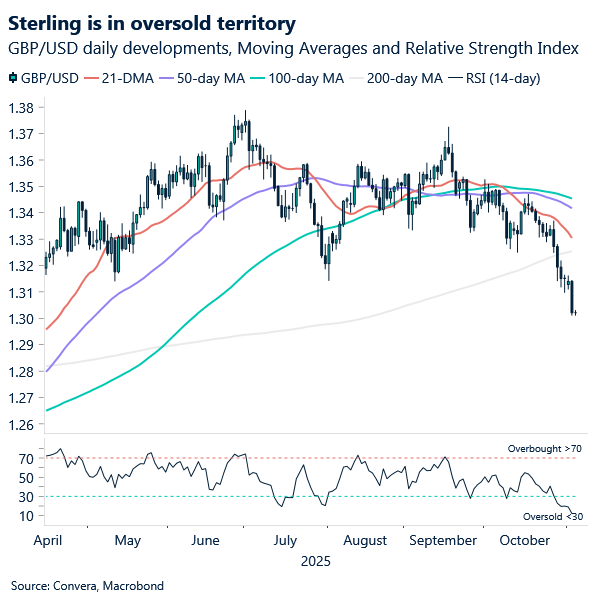
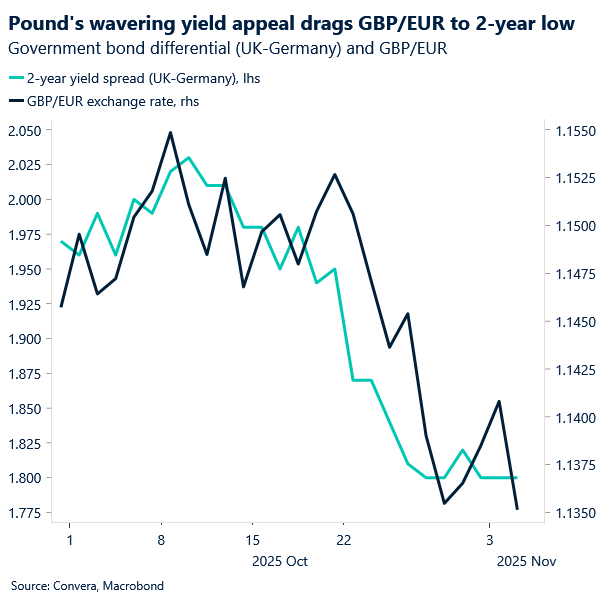
Selling pressure on sterling is intensifying, with GBP/USD sliding to its lowest since April and a test of the psychologically important $1.30 handle now in sight. But we note the pair is now in heavily oversold territory according to the daily relative strength index. GBP/EUR has also hit a fresh two-year low, as the pound’s yield advantage erodes amid rising bets on Bank of England (BoE) rate cuts.
Fueling those expectations is the prospect of tighter fiscal policy at this month’s Budget. Chancellor Reeves’s remarks yesterday suggest a more aggressive stance than markets had anticipated. We note three key takeaways:
- Productivity downgrade: Reeves all but confirmed the OBR will revise down trend productivity growth, widening the fiscal gap and reinforcing the need for corrective measures.
- Greater fiscal headroom: She called for a larger buffer than the £9.9bn left in spring, implying a more cautious and front-loaded tightening path.
- Tax pledges shelved: Reeves declined to repeat Labour’s manifesto promises not to raise income tax, national insurance, or VAT — opening the door to broader revenue-raising options.
Bond traders have welcomed the shift, with UK gilt yields falling across the curve. But for currency traders, the concern is whether fiscal tightening will deepen the consumption slowdown already underway, hence the pound’s depreciation.
Sterling is likely to remain on the back foot ahead of the Budget, with further downside risk this week if the BoE delivers a rate cut — still only partially priced by money markets. If tax hikes dampen growth and fail to deliver expected revenues, the Chancellor could face a vicious cycle of tightening measures and economic underperformance — a fiscal treadmill with rising headwinds.
That’s why any revenue-raising steps must be carefully balanced with bold, growth-oriented reforms to avoid compounding the slowdown already underway.
CAD: An eye on the budget
Prime Minister Mark Carney’s federal budget is framed as a “once-in-a-generation” plan, built around a central fiscal tension, pairing massive new capital spending with deep federal cuts. The plan projects a $78.3 billion deficit for the current year, nearly double previous projections, driven by $141.4 billion in new spending over five years. These commitments are only partially offset by $58.2 billion in planned cuts, including a 10% reduction in the federal public service, totaling 40,000 jobs by 2029.
Advertised as “transformational,” the budget seems like a pivot that falls short of expectations. It marks a departure from the previous government’s approach, shifting Canada’s economic focus from demand-side support to supply-side investment. The spending is heavily weighted toward capital: $115 billion for infrastructure, $110 billion for productivity and competitiveness, and $30 billion for defence. Many expected the budget to address both Canada’s productivity slump and the worsening affordability crisis, particularly the housing supply issue.
However, when examining the specifics of the housing plan, the budget’s primary limitation is its failure to address the most significant cost drivers and regulatory bottlenecks that inflate building prices. While a $25 billion investment is proposed, it is too small for the massive supply deficit. More structurally concerning is the lack of federal leverage over critical provincial and municipal obstacles, such as restrictive local zoning and high development charges.
This became evident in the budget’s soft stance on municipal fees. The government backed away from a firm commitment to reduce these charges, instead offering a vague framework for negotiation, a delay that the housing industry warns lacks urgency. Furthermore, a key direct market measure, GST relief, is limited only to first-time buyers on new homes. This addresses a small fraction of the market and does little to lower costs for the vast majority of renters or existing homeowners. Critically, by omitting the Multi-Unit Residential Building (MURB) tax incentive, the government missed an opportunity to spur private capital for much-needed purpose-built rentals.
The budget’s most significant policy shift is on climate. In a major break from the Trudeau era, the government is effectively shelving the controversial oil and gas emissions cap. While the draft regulation remains technically in place, the new “climate competitiveness strategy” signals its obsolescence. The government now claims the cap will “no longer be required,” instead prioritizing a strengthened industrial carbon pricing system and expanded tax credits for carbon capture (CCUS) to meet 2050 net-zero goals.
The plan’s credibility, however, hinges on a volatile fiscal framework. The $58.2 billion in cuts, though substantial, are overshadowed by the scale of new spending. Most concerning is the projected 37% surge in public debt charges, from $55.6 billion in 2025–26 to $76.1 billion by 2029–30. This sharp rise in interest payments underscores the central execution risk: the budget’s success depends on politically difficult cuts being implemented and supply-side investments delivering enough growth to offset the cost.
This fiscal proposal is obscured by a critical blind spot in the budget’s optimistic messaging. The government touts Canada’s “lowest net debt-to-GDP ratio in the G7” at 13.3%, citing the IMF. However, this figure includes the substantial assets of the uniquely structured CPP and QPP. A more accurate comparison, general government gross debt including provincial liabilities, places Canada’s debt burden at an estimated 113% of GDP, among the highest in the G7 and approaching levels that recently triggered a downgrade for France.
Market and business reaction has been tepid. With most measures pre-announced, the budget offered few surprises. Business leaders called it “incremental” rather than the promised “game-changer.” While tax incentives like the “Productivity Super-Deduction” are welcomed, critics argue they fail to address deeper constraints on investment, particularly the lack of competitive financing. Ultimately, with most measures pre-announced, the budget offered few surprises. The 2025 Budget aims to appear like a strategic pivot toward a new economic model, but one that has yet to convince the business community it will deliver.

Pound is heavily oversold versus US dollar
Table: Currency trends, trading ranges and technical indicators
Key global risk events
Calendar: November 3-7
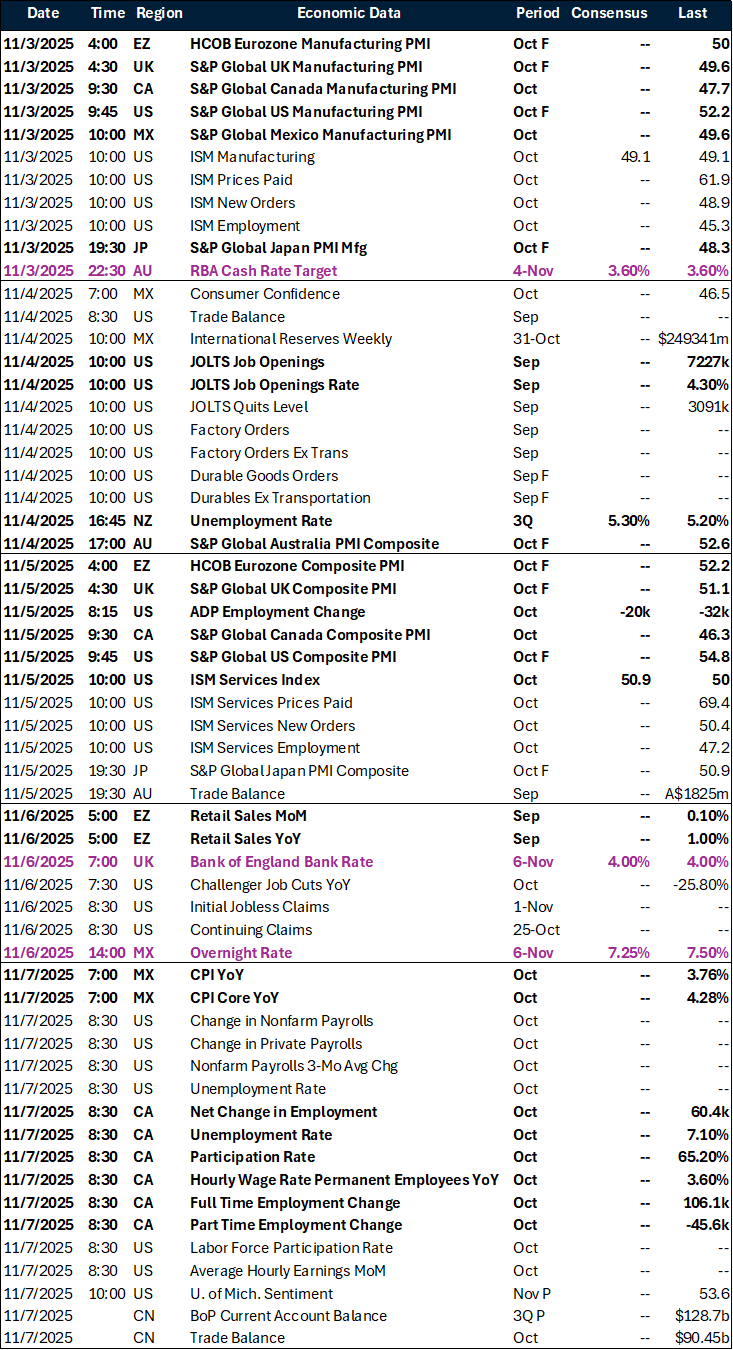
All times are in EST
Have a question? [email protected]
*The FX rates published are provided by Convera’s Market Insights team for research purposes only. The rates have a unique source and may not align to any live exchange rates quoted on other sites. They are not an indication of actual buy/sell rates, or a financial offer.