


- A blue wave. Democrats secured the House and Senate by comfortable margins highlighting the political sensitivity of cost-of-living pressures and the Iran war.
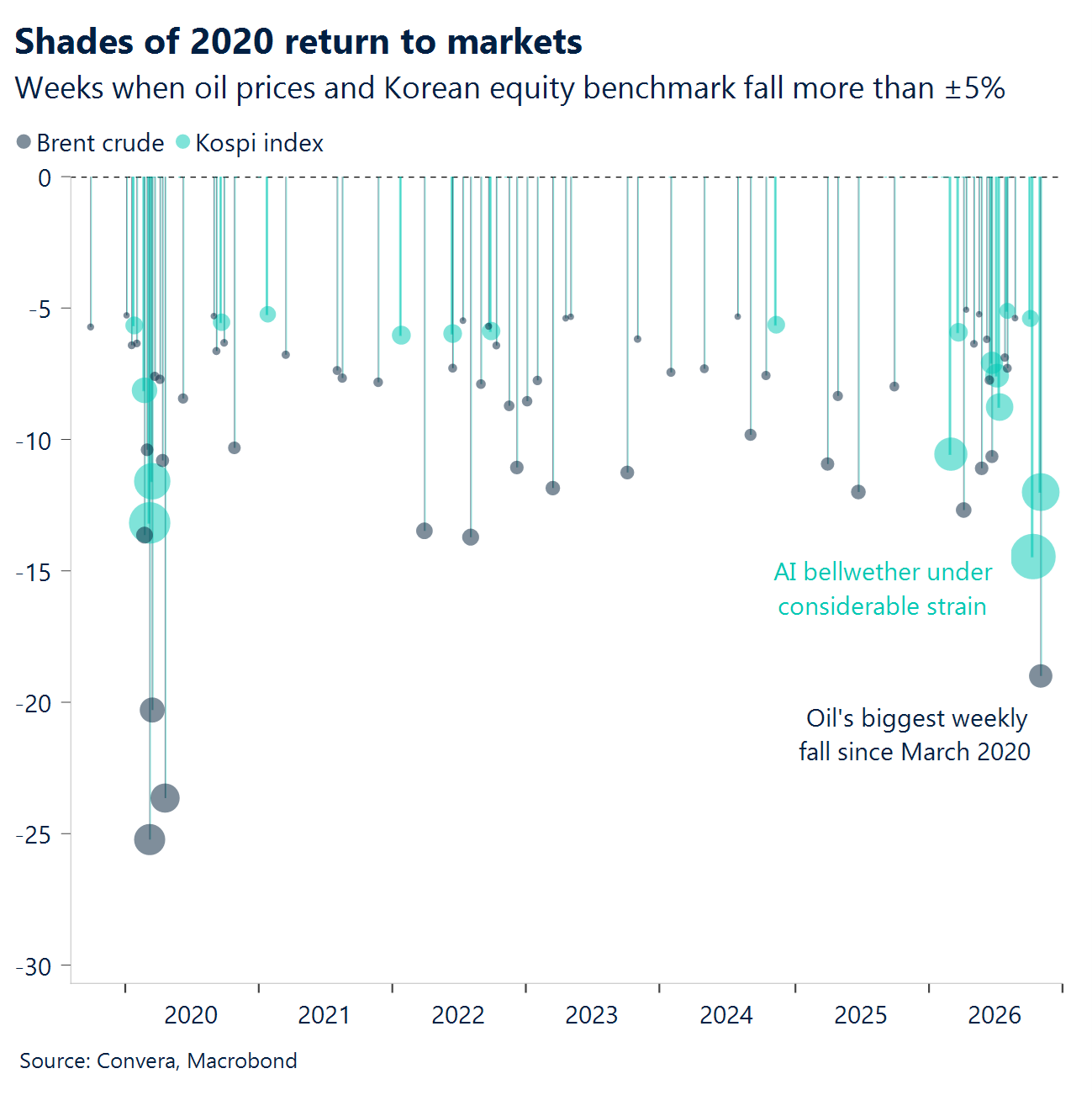
- AI trade rout. Markets increasingly fear tighter AI regulation and greater scrutiny of data-centre expansion. Neocloud stocks fell more than 20% on the week, the Kospi more than 10% and the Nasdaq 100 suffered its largest one-day decline since March 2020 – wiping out $2.3 trillion in market value, the most on record.
- Cooling war talk. Brent crude plunged as much as 20% this week as investors bet a Democrat-controlled Congress could constrain further escalation with Iran.
- Fiscal policy conundrum. Democratic control reduces the likelihood of additional fiscal stimulus, but a deficit above $2tn and continued heavy Treasury issuance should keep pressure on the long end.
- Dollar dilemma. Falling oil prices, lower Treasury yields, and less Fed hikes priced in, dragged the US dollar index to five-week lows before safe haven demand allowed it to recover much of its post-election losses.
- Split the difference. The Bank of England delivered its first rate hike in three years, but the hawkish 8-1 vote split surprised markets and supported the pound.
- Inflation pressures. Eurozone inflation rose to its highest since 2023, but the euro and ECB hiking bets were little changed.
- Blockbuster jobs. A stronger-than-forecast nonfarm payrolls print, upward revisions to previous numbers, a drop in the unemployment rate and higher than expected wages, all helped lift yields and dollar higher by end of week.
Global macro
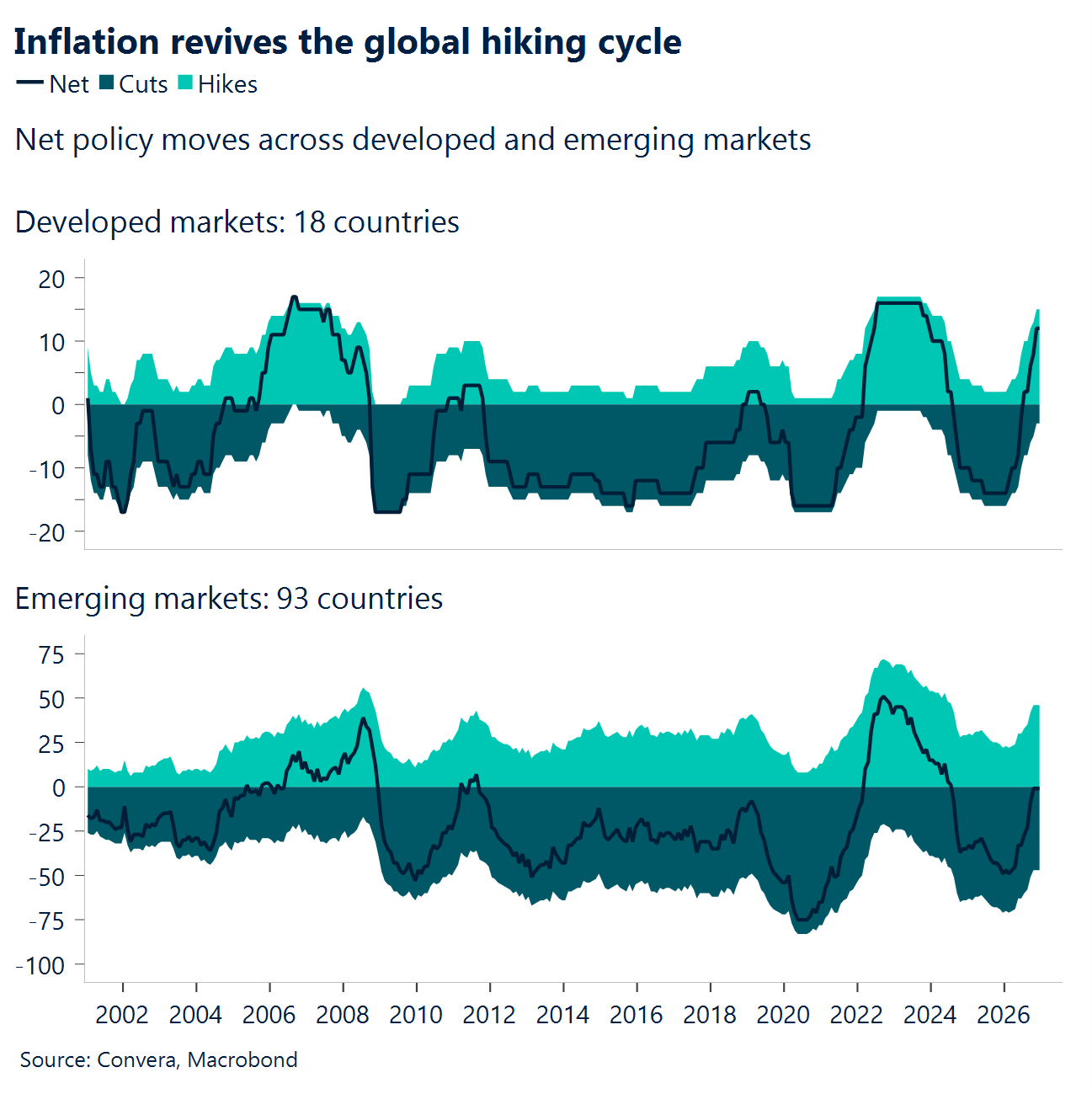
Energy shock broadens global hiking cycle
Central banks hike. The RBA raised rates 25bp to 4.85%, its fifth hike this year, while the Riksbank lifted its policy rate to 2.00% and the Bank of England increased Bank Rate to 4.00% in an 8–1 vote. Norges Bank held at 4.50%, but retained a hawkish bias and left the door open to another hike as domestic costs, energy prices and above-target inflation continue to pressure the outlook.
US activity diverges. ISM Manufacturing rose to 55.5 from 54.5, supported by stronger production, while Services eased to 54.5 from 54.9 as new orders and business activity slowed. Employment remained in expansion across both sectors, but Prices Paid stayed elevated at 75.2 in manufacturing and 73.0 in services, keeping pipeline inflation pressure firmly in view.
Euro inflation reaches 4%. Euro-area inflation accelerated to 4.0% from 3.8%, matching expectations and reaching its highest since September 2023. Energy inflation climbed to 20.8%, while core inflation held at 2.5%, showing that the latest acceleration remains concentrated in energy rather than a broad underlying surge.
US payrolls beat. US non-farm payrolls rose by 165,000, more than double the 70,000 consensus. Unemployment edged down to 4.1%, while wage growth accelerated to 3.1% year over year, adding to a run of firm labor data from job openings to claims. The surprise forced yields and December hike expectations higher, helping to further reverse the dollar’s post-midterm decline.
Canada jobs disappoint. Employment fell 4.7k vs a 15k gain expected, while unemployment rose to 6.7% and private-sector payrolls dropped 52.5k. Slower wage growth at 2.0% added to the weak details, reinforcing Canada’s growth divergence with the US and limiting the Bank of Canada’s room to tighten further.
Week ahead
Few catalysts on deck, but US inflation matters
US inflation the key test for December hike. The key data release next week is October’s US inflation report. Oil prices are trading at their lowest levels in more than a month, although we doubt October’s release will fully capture the recent decline. A hot outcome is likely to reinforce bets that the Fed will hike rates in December.
Growth resilience faces BoE and winter chills. The UK’s preliminary Q3 GDP figures are also due next week. The narrative so far this year has been one of resilient growth despite higher energy prices linked to the conflict in the Middle East. A key driver behind this resilience has been AI-related investment. That said, important hurdles lie ahead, including BoE tightening, and the energy price cap reset due in January. Household energy bills are expected to rise by around 25% as a result.
Secondary data in focus. Secondary releases next week include US PPI and UK industrial production. These will complement the US CPI and UK GDP releases, respectively. Given the supply-driven nature of the inflation shock, upstream price pressures remain important. Meanwhile, stronger output has been a key contributor to recent GDP growth, putting the spotlight on industrial production.
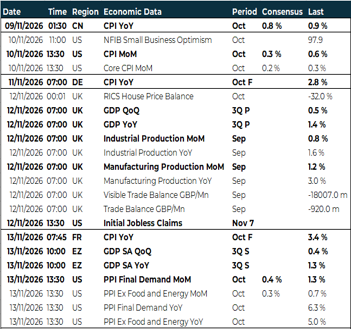
All times in GMT
FX views
Markets caught between narratives
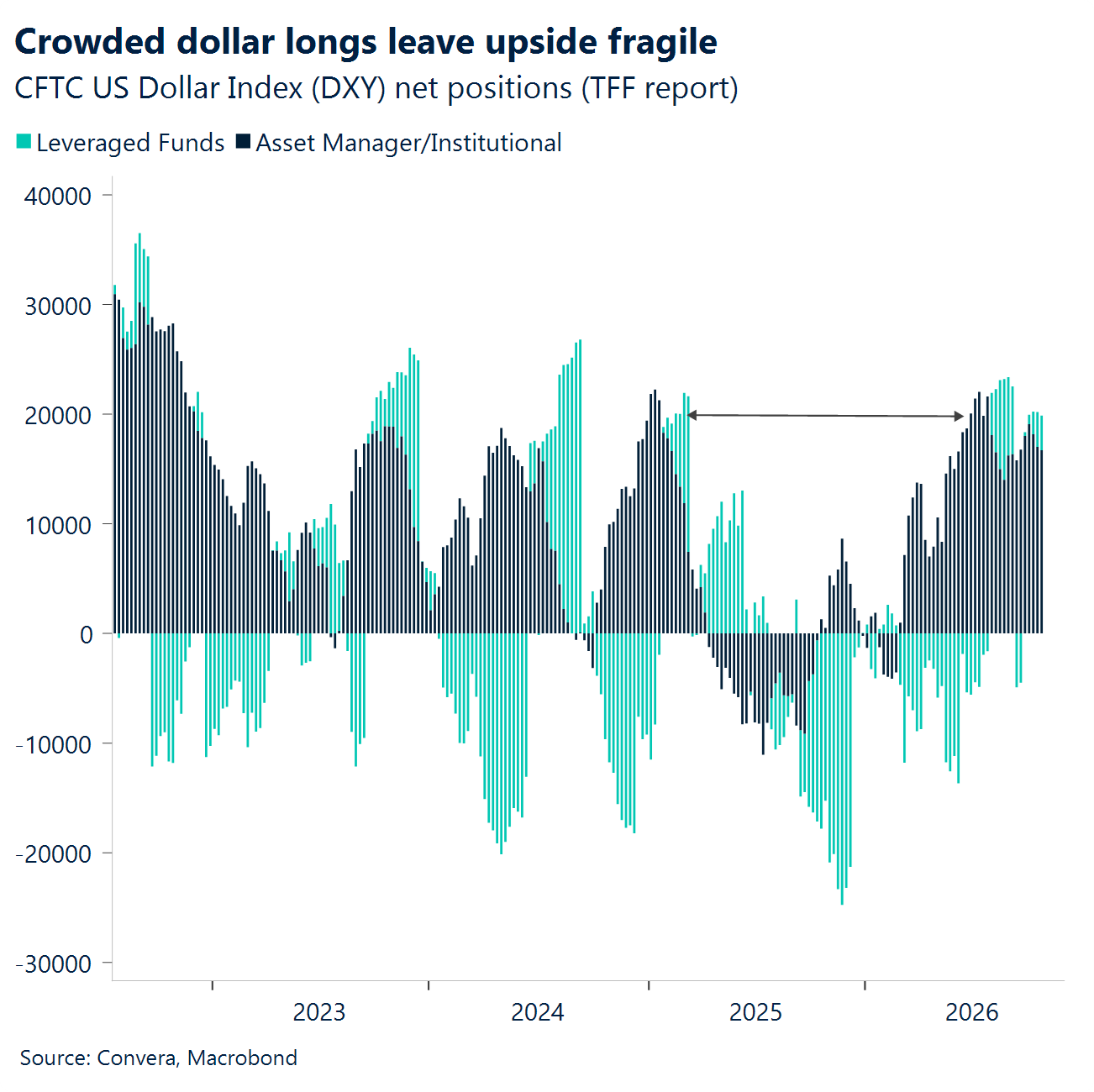
USD Dollar awaits its next catalyst. The US dollar continues to be tossed around by competing narratives, consolidating between 102.500 and 101.500 for more than a month. On one side is the blue sweep delivered by the midterms, which markets are currently interpreting as implying greater AI regulation, higher growth risks and a less hawkish Fed. On the other is a backdrop of elevated geopolitical risk, a resilient US economy and a hawkish Fed. While markets are struggling to settle on a single narrative, we suspect the latter is likely to dominate for now. The strong US nonfarm payrolls report, released today, points in that direction. Bullish momentum could gather pace next week with the release of October US inflation data. That said, downside risks remain noteworthy. In a risk-averse environment, and with bullish dollar positioning already crowded, the case for further dollar gains depends much more heavily on US macro data continuing to impress. Should that fail to materialise, a break below 101.500 becomes a distinct possibility.
EUR Little to offer. France or not France, EUR/CHF continues to grind lower, having fallen to a five-month low. The franc’s safe-haven bid has strengthened further amid the tech rout, fuelled by concerns over AI spending. A close below 0.915 would open the door to 0.910. We are less convinced the pair would move much beyond those levels should AI sentiment stabilise. That said, France’s fiscal risk, which continues to linger through social unrest and a constrained hawkish ECB, remains the clearest downside risk for the pair. Another weak spot for the euro this week was against CEE currencies, which strengthened amid a sharp drop in oil prices. Elsewhere, the euro staged a modest recovery, particularly against commodity currencies that have been pressured by lower energy. The euro’s broader backdrop remains weak, however, leaving little for the ECB to offer in terms of support. The early departure of President Lagarde also adds uncertainty, further dampening confidence in a more resolute hawkish path ahead.
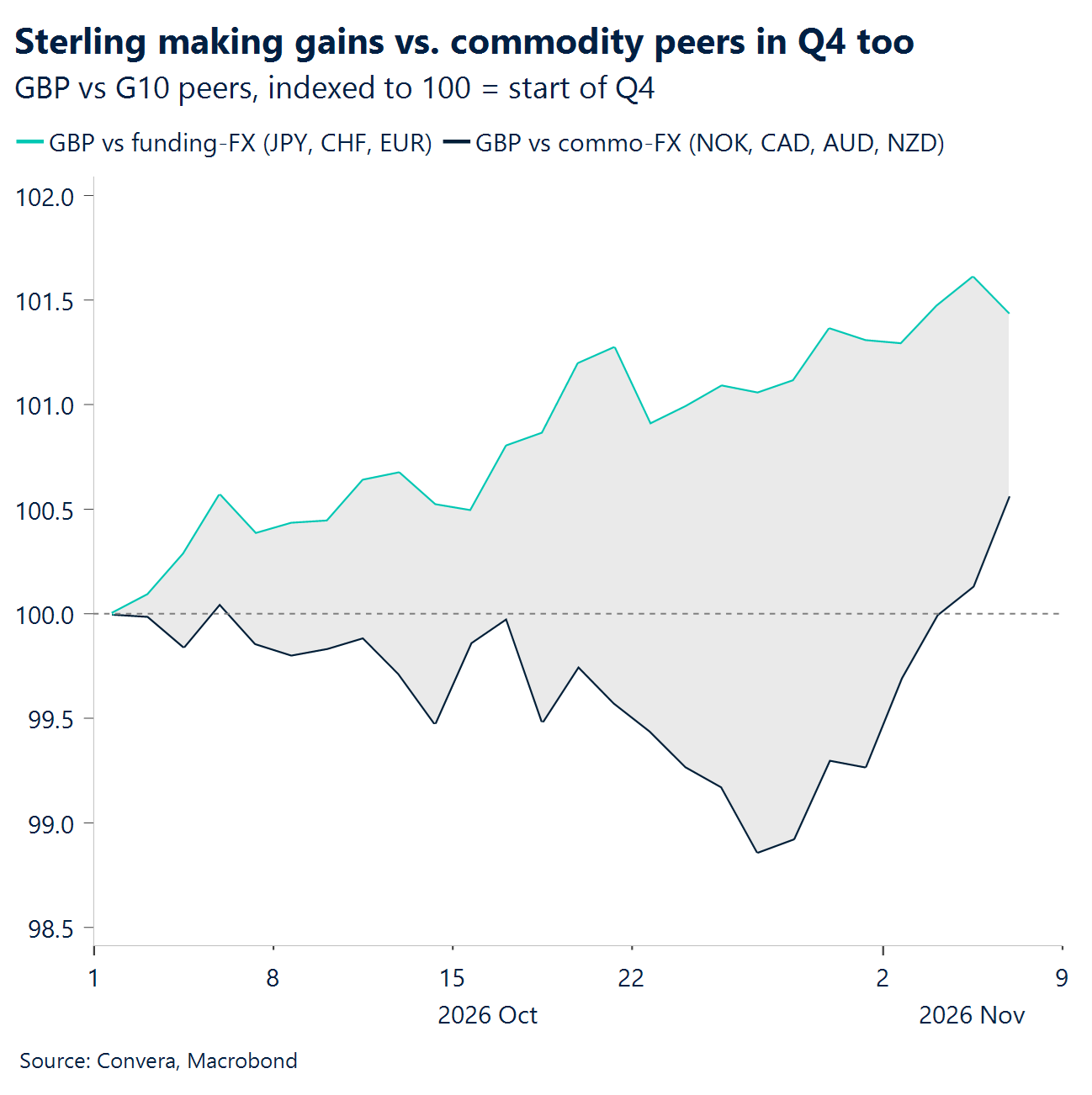
GBP Lacking gains despite hawkish BoE. Sterling had a mixed week across the G10, highlighting the competing forces currently pulling on the currency. The pound underperformed the USD and CHF as a combination of post-midterm risk aversion, a sell-off in technology stocks and safe-haven demand supported defensive currencies. By contrast, sterling outperformed the AUD and NOK, helped by a sharp fall in oil prices and a broader retreat in commodity-linked FX. Domestically, the backdrop remained supportive. The BoE delivered its first rate hike in three years. More importantly, the vote split and forecasts were hawkish, yet sterling’s reaction was relatively muted, as the bar for a hawkish repricing was high. From a technical perspective, GBP/USD briefly broke above its 200-day moving average and tested 1.35. However, risk aversion followed by a strong US payrolls report saw cable retreat back below 1.34, where it found support at its 50-day moving average. Meanwhile, GBP/EUR spent much of the week pressing against the 1.20 level, though is still yet to convincingly break above. Overall, sterling remains supported by resilient UK growth, attractive carry and a hawkish BoE, though gains are becoming increasingly selective as global risk sentiment ebbs and flows.
CHF In demand. The Swiss franc was one of this week’s standout performers, initially boosted by a surprisingly firm October inflation print before attracting additional support from haven flows as technology stocks slumped following the Democratic sweep in the US midterms. The jump in inflation to 1.5% y/y has prompted fresh questions over whether the SNB can realistically keep rates unchanged throughout 2027, a shift that has improved the franc’s appeal. A late-week flight to safety added further fuel to the rally. Price action reflects the improving backdrop. EUR/CHF has now fallen for eight consecutive weeks, reaching levels last seen in early June and breaking below key moving averages, signalling growing downside momentum. Meanwhile, USD/CHF is down almost 1% this week but continues to find support around its 100-day moving average.
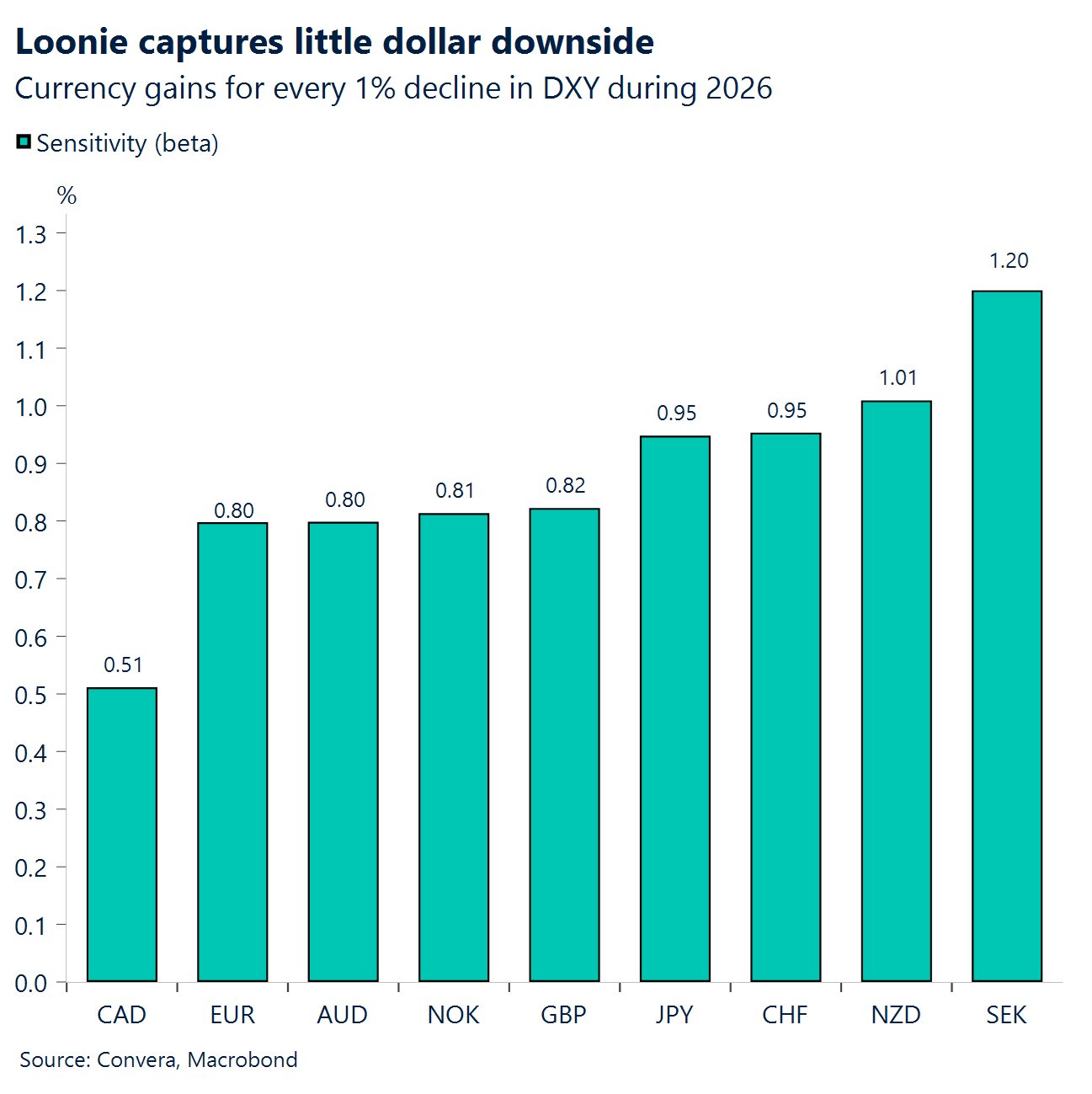
CAD Loonie loses support. USD/CAD has moved back above 1.40, trading near 1.409 after a sharp divergence between the Canadian and US labor reports. Canada lost 4,700 jobs against expectations for a 15,000 gain, while unemployment rose to 6.7% and private-sector employment fell by 52,500. Wage growth also slowed to 2.0%, contrasting with the 165,000 increase in US payrolls and reinforcing the relative growth and rates advantage behind the greenback. The Bank of Canada’s renewed five-year framework retains the 2% inflation target but removes the explicit commitment to maximum sustainable employment, giving policymakers a clearer inflation mandate even as private demand weakens. That tension is visible in rates, with the Canada-US two-year yield gap near 138bp, while USD/CAD has reclaimed its 20-day average around 1.407 and 50-day average near 1.404. A sustained move above 1.41 would bring 1.425 back in focus, while 1.40 remains the key support. Next week, the Bank of Canada’s Summary of Deliberations will show how officials balance weaker employment against inflation and fiscal support, while Canadian manufacturing sales and US CPI will provide the next direction for USD/CAD.
AUD RBA board divided over communication. Falling tech shares and a firmer US dollar weighed on risk-sensitive currencies, with the Aussie bearing the brunt. Some Reserve Bank of Australia (RBA) board members privately criticised Deputy Governor Andrew Hauser for signalling a possible rate hike before this week’s meeting, arguing that his remarks moved markets and pre-empted the board’s decision. The rift emerged after a 6-3 vote to raise the cash rate to 4.85%. Assistant Governor Sarah Hunter also caught some members off guard by saying the RBA had “not quite yet” done enough to tame inflation. We expect the split to keep the focus on future RBA guidance. Key resistance for AUD/USD is at the 21-day EMA of 0.6992, followed by the 50-day EMA at 0.7019. On the downside, key support stands at 0.6850.
CNH Yuan slips as China’s services lose steam. China’s services sector growth slowed to a three-month low in October. A business survey fell to 50.8 from 51.6, although it remained above the 50 threshold that separates expansion from contraction. New orders held steady, exports rose for a sixth consecutive month, and firms continued hiring. However, rising material, fuel and labour costs pushed input prices to a five-month high. At the same time, intense competition forced businesses to cut prices for a second straight month, while confidence slipped to a three-month low. USD/CNH is trading 0.4% above its 2 November low of 6.6426. We see resistance at the 50-day EMA of 6.6939, followed by the 100-day EMA at 6.7267. Meanwhile, AUD/CNH has fallen to a 12-month low.
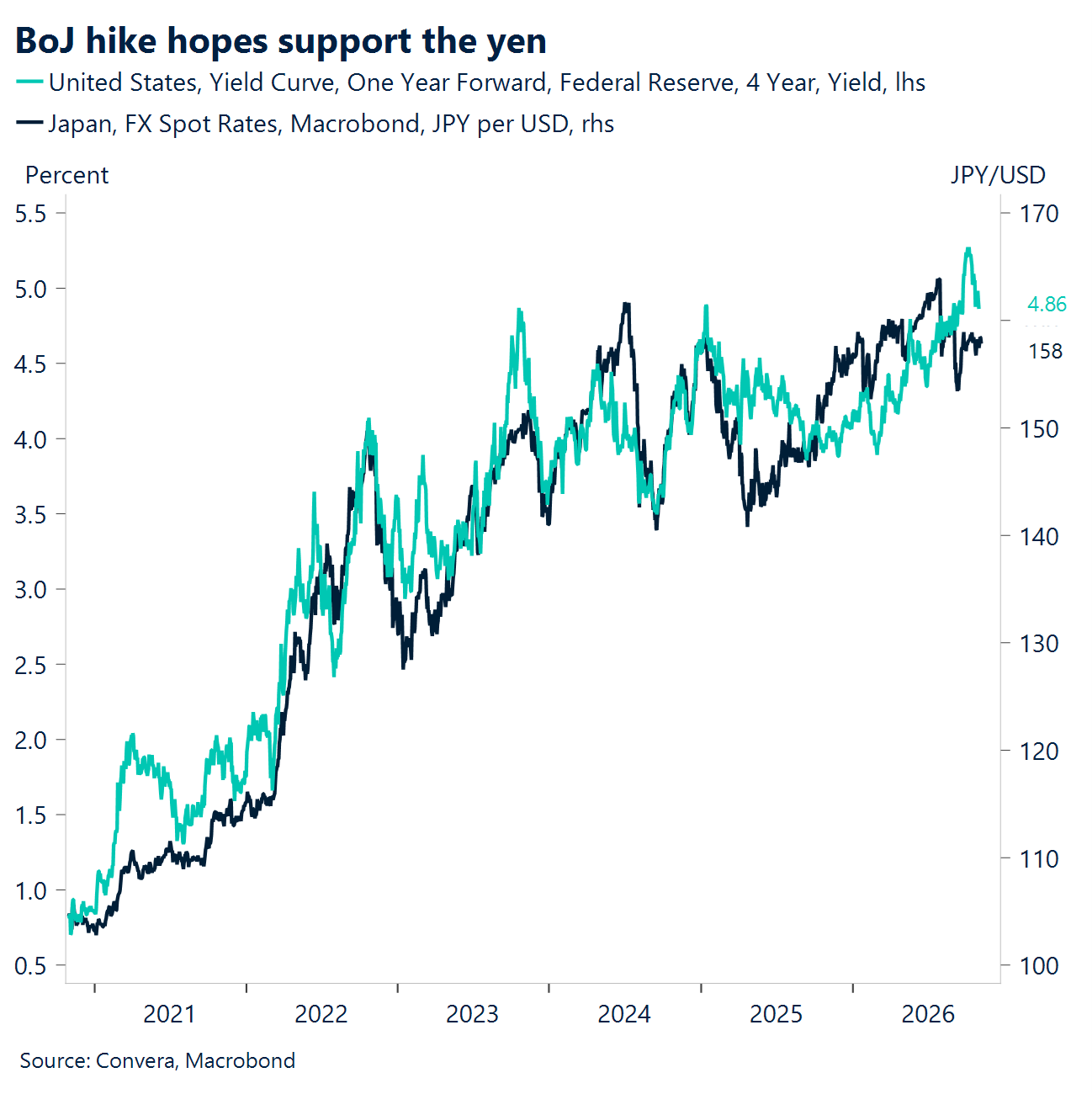
JPY Record pay gains keep a BoJ hike in play. Japan’s average cash earnings rose 4.6% year-on-year in September, beating forecasts of 3.8% and marking the strongest increase since January 1997. Real wages climbed 2.2%, extending their streak of gains to nine consecutive months. Minutes from the BoJ’s September meeting showed policymakers remained supportive of further rate hikes, with one member calling for faster action if inflation overshoots expectations. Officials also noted that higher food prices and Middle East-related energy risks could push inflation higher from autumn. We believe strong wage growth supports the case for a December rate hike. USD/JPY has fallen to a one-week low. The pair is trading near 157.90, around 3.7% below its 23 July peak of 163.99. We see resistance at the 100-day EMA of 158.30 and support at 157.00. Meanwhile, AUD/JPY has fallen to a three-week low, while SGD/JPY is at a one-week low, underscoring the JPY’s relative strength.
MXN Carry cushion narrows. USD/MXN is trading near 18.73 after Banxico unexpectedly cut rates 25bp to 6.25%, with only six of 26 surveyed economists anticipating the move. The narrow 3–2 vote and higher year-end inflation forecast created an uneasy policy mix, as persistent economic slack prompted easing even as inflation is expected to reach 3.7% in Q4. Mexico’s two-year yield premium over the US has narrowed to roughly 287bp, leaving the peso more sensitive to risk sentiment and further Banxico easing. Record short positioning and reduced US tariff risk could trigger sharp countertrend rallies, but the broader technical picture remains weak, with USD/MXN above its 20-day average at 18.58 and 50-day average at 17.89. A break above 18.90–19.00 would extend the dollar rally, while 18.58 provides initial support. Next week, Mexico’s October inflation, industrial production and reserve data will test Banxico’s case for easing and the credibility of its signal that rates will remain at 6.25% for an extended period.
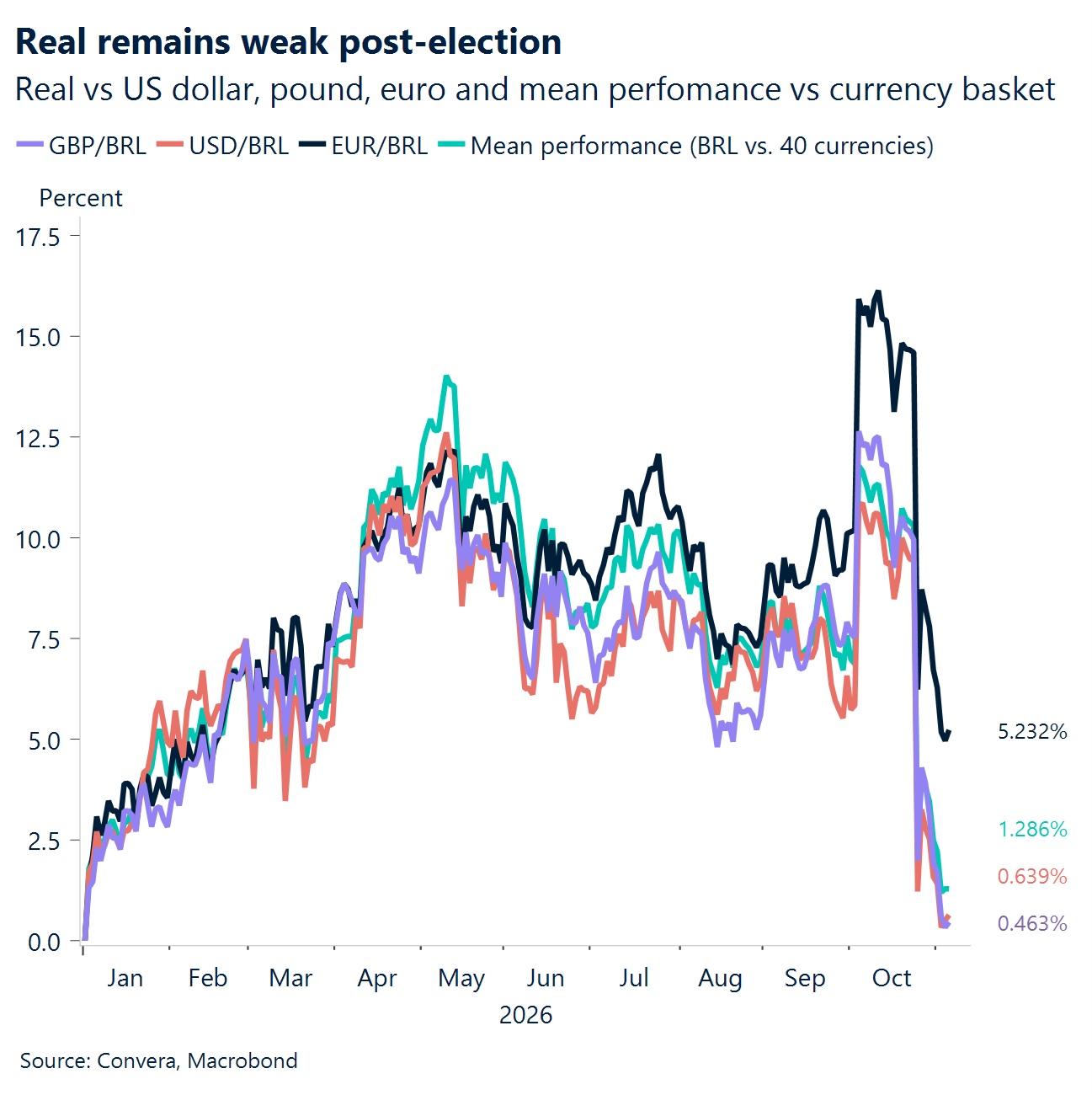
BRL Fiscal anchor missing. USD/BRL is trading near 5.49, up roughly 2% this week, as uncertainty over Brazil’s post-election fiscal direction extends the real’s sharp selloff. The BCB held the Selic rate at 13.75%, pausing after five consecutive cuts, but offered little guidance on whether inflation risks could force a hike in December or January. Brazil’s carry remains substantial, with two-year and 10-year yield premiums over the US near 821bp and 1,031bp, while October FX inflows of $18.15bn provide some underlying support. Even so, the yield curve’s steepness and long-end rates above 15% show that investors are demanding more compensation for fiscal and political risk. USD/BRL is stretched above its 20-day average at 5.19 and 50-day average at 5.16, with 5.50 the immediate resistance and 5.34–5.40 the first support area. Next week, the BCB minutes, October IPCA, and September retail sales will test whether tighter policy expectations can stabilize the real while markets wait for cabinet appointments and a credible spending framework.
Have a question? [email protected]
*The FX rates published are provided by Convera’s Market Insights team for research purposes only. The rates have a unique source and may not align to any live exchange rates quoted on other sites. They are not an indication of actual buy/sell rates, or a financial offer.