


- Market muddles. Markets continue to struggle for direction post-midterms, with equities and oil swinging as investors reassess what the result means for AI and the Iran war. Brent is down another 3% this week, the MSCI global equity index is up 3%, yet high-beta FX remain contained due to recent hawkish Fed repricing.
- Naughty Nvidia. Nvidia is down roughly 30% from its October peak amid controversy surrounding Jensen Huang, though broader technology stocks have still managed to rebound, whilst the USD remains firm.
- CoreWeave comeback. A 25% surge on an upbeat outlook helped reassure investors that cracks in individual names needn’t derail the broader AI theme.
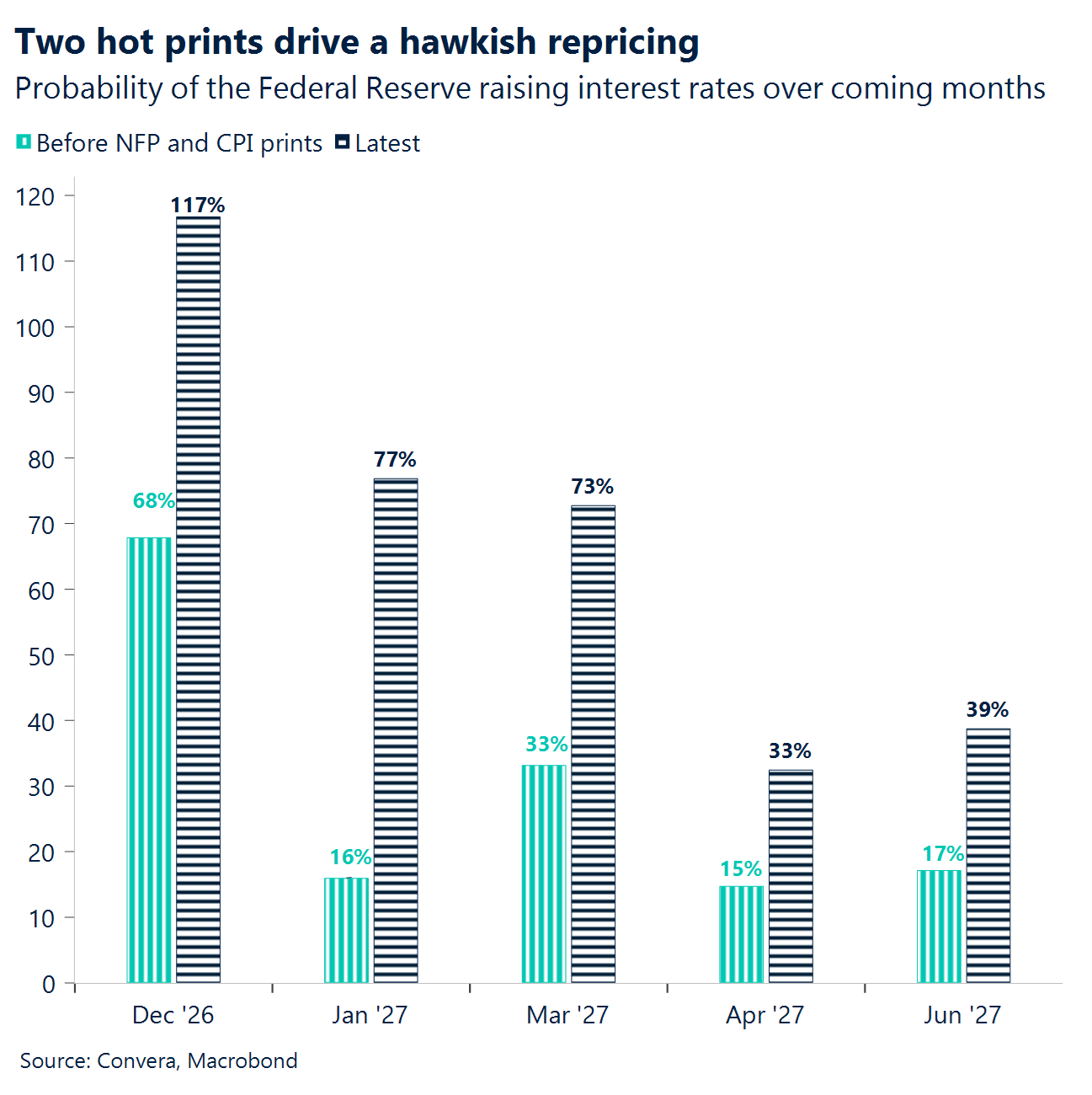
- Waller’s warning. Fed governor Waller floated a potential 50bp December hike if inflation remained hot. October CPI subsequently delivered, sending US yields, mostly at the short-end, higher, along with the US dollar.
- Price pressures. Headline US CPI rose 0.4% m/m versus 0.3% expected, while core also beat at 0.3%, with price pressures broadening across major categories for a third month, and cementing expectations for another Fed hike following the blowout US jobs report last Friday.
- Dominant dollar. The US dollar hit fresh one-year highs as front-end real-rate differentials widened. Sticky inflation, resilient growth and renewed Fed tightening risks leave the greenback firmly in the driving seat across the board.

Global macro
Inflation stays hot as growth divides
US inflation stays firm. October CPI rose 0.4% m/m vs 0.3% expected, slowing from September’s 0.6% but remaining too strong for comfort. Core CPI increased 0.3% for a third straight month, while food rose 0.5% and shelter accounted for more than 30% of the headline gain. A December Fed hike looks locked in; the question is 25 bps or 50?
UK growth accelerates. The UK economy expanded 0.7% q/q in Q3, in line with expectations and up from 0.5% in Q2, while annual growth reached 1.9%. Services grew 0.9%, supported by programming, cloud computing and AI-related activity, while construction contracted 0.7%. September GDP rose 0.2% m/m, beating expectations for no growth.
China’s imbalance deepens. October CPI slowed to 0.7% y/y vs 0.8% expected, but producer inflation accelerated to 5.7% from 5.0% as energy and industrial input costs increased. Exports surged 35.2% y/y and imports 41.6%, pushing China’s cumulative 2026 trade surplus above $1tn while domestic consumer demand remained subdued.
Japan’s pipeline pressure builds. Japanese producer prices rose 0.7% m/m and 7.1% y/y, accelerating from 6.8% and exceeding expectations. Import prices jumped 24.8% y/y, with petroleum, chemicals, electricity and steel driving the monthly increase, strengthening the case for further Bank of Japan normalization.
US layoffs remain low. Initial jobless claims rose to 200k from 191k, slightly above expectations, but remained near historically low levels. Continuing claims fell by 20k to 1.697mn, suggesting that the labor market remains firm despite the modest weekly increase in filings.
Week ahead
Testing the BoE’s hawkish resolve
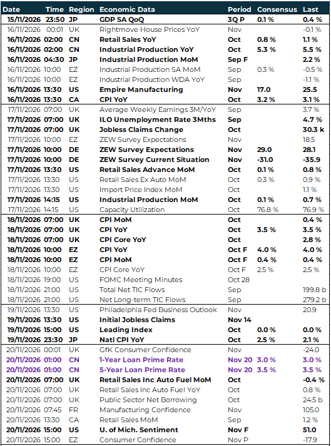
Stabilization in sight? Next week brings the UK jobs report. Amid renewed economic momentum, the UK jobs market this year has shown signs of stabilisation, compared with the softening trend seen throughout 2025. That said, economic resilience has been most evident in activity data, with AI-driven investment powering production. Positive spillovers into the labour market are, therefore, not a guarantee.
Oil adds upside risks. October’s UK inflation numbers are also due next week. With oil prices having moved higher throughout the month, the release is likely to come in hot while strengthening the case for further BoE tightening.
Resilient optimism. The ZEW sentiment survey is due. The series captures the expectations of financial experts and institutional investors regarding the economic outlook for Germany and the eurozone. Despite the conflict in the Middle East, sentiment has remained particularly resilient so far this year. Strong investment in infrastructure and defence has had a major role.
Stronger ties, stronger pound? The UK-EU summit kicks off on Friday. A potential return of the UK to the EU still sounds too farfetched. Yet the momentum is helping sweeten sentiment toward the pound in the meantime. Also, regardless of the final outcome, closer ties are likely to translate into stronger economic activity, yet another theme that has helped keep the pound’s outlook constructive this year.
FX views
US dollar at 18-month highs
USD Hawkish Fed backs dollar bulls. The US dollar index reached the highest levels since April 2025 this week amid a re-awakened hawkish Fed story and fizzling de-escalation momentum. These two forces have been defining the dollar’s bullish profile this year, but took more of a secondary role throughout October, as tech stock wobbles shifted investors’ focus to AI bubble risks and the growth outlook. For much of October, the DXY had traded range-bound between 101.500 and 102.500. This week, alongside stabilised stock market sentiment, the catalyst was a hotter-than-expected US CPI print for October. The release strengthened the case for a Fed hike next month, which is now priced with certainty. A chorus of Fed speakers has added to the hawkish message. Most notably, Christopher Waller – a known dove – even signalled that the case for a 50 bps hike in December looks strong. Against this backdrop, we remain bullish on the dollar in the near term.
EUR Heading for 1.10. The euro continues to offer little of its own to drive price action forward. The common currency has performed particularly well against commodity currencies so far this month. EUR/AUD and EUR/NOK stand out, both close to 3% higher on a month-to-date basis. A sharp fall in oil prices following the US midterms, amid renewed hopes of de-escalation in the Middle East, has weighed on commodity currencies. However, we continue to see these rebounds as better entry levels for sellers rather than the beginning of any meaningful reversal. Realistically, little progress has been made toward re-opening the strait of Hormuz, which leaves energy prices on an upward trajectory. Meanwhile, EUR/USD broke south of its 1.1150/1.1250 range this week, reaching levels not seen since February 2025. A refreshed hawkish Fed momentum is the main culprit, with 1.10 the next key support in sight ahead of next month’s Federal Reserve policy meeting.

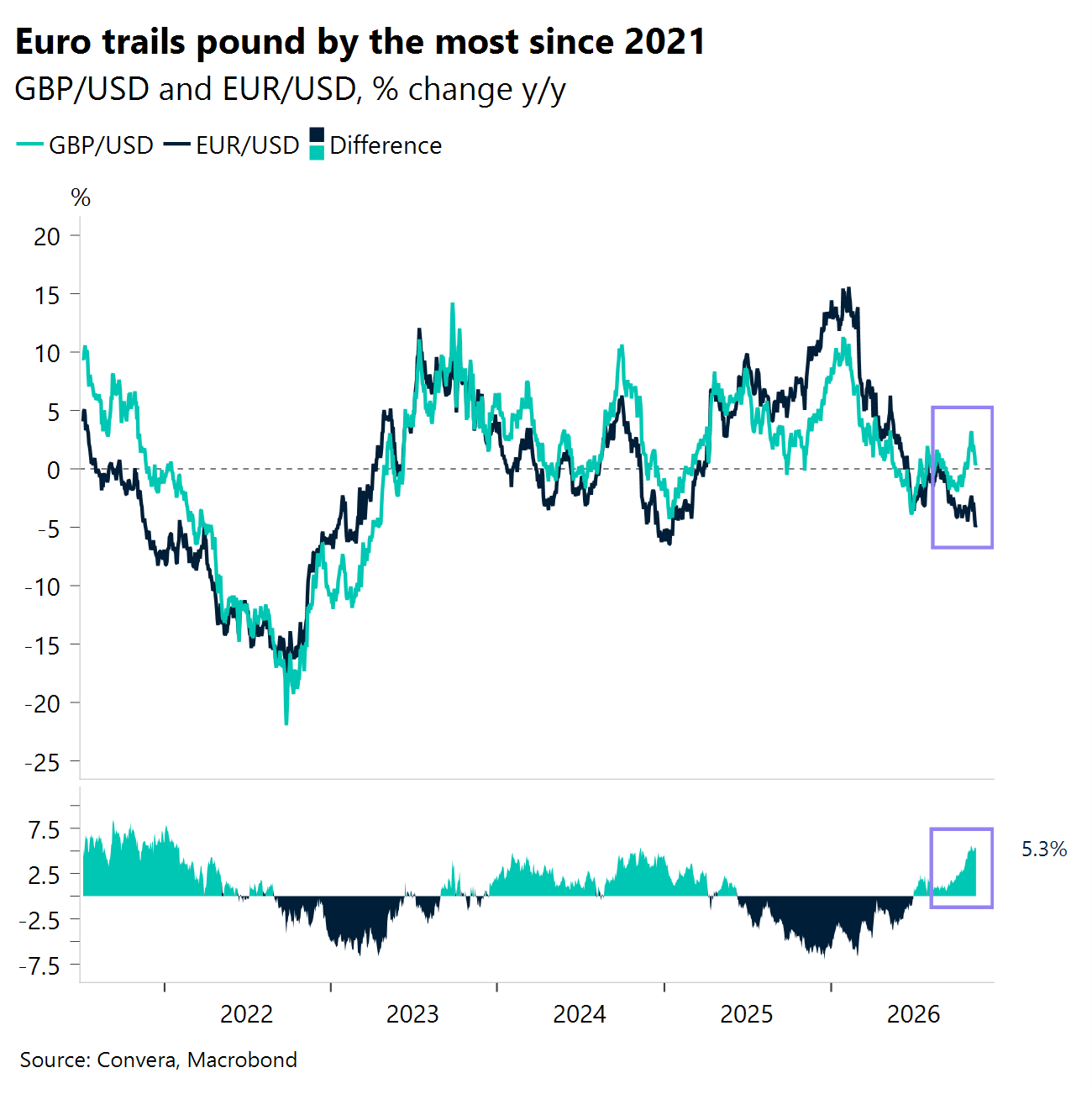
GBP Global forces overwhelm. A mixed performance across the G10 reflects the competing forces driving the pound. The rebound in risk sentiment and extended fall in oil prices of late have helped both GBP/CHF and GBP/NOK jump 1%. Such conditions would usually support GBP/USD too, especially since UK GDP data surprised to the upside, reinforcing the Bank of England’s hawkish rate hike. Instead, bullish dollar dynamics, namely robust US data and hawkish Fed repricing, have overwhelmed sterling’s relatively supportive backdrop. Cable is at a 1-month low and trades below its major daily moving averages – a clear deterioration in short-term momentum. GBP/EUR has also corrected further from 1.20. The 21-day moving average near 1.1950 is the immediate technical test; a clean break below could expose the 1.18 area. Despite the recent pullback in GBP/EUR, the underlying divergence between sterling and the euro remains striking. The euro’s year-on-year performance trails sterling by the widest gap since 2021. French political uncertainty is driving a more idiosyncratic euro risk premium, suggesting the recent GBP/EUR correction may mask a still-supportive relative backdrop for sterling. Upcoming UK labour market figures, inflation and retail sales will be the next big domestic tests.
CHF From squeeze to unwind. The Swiss franc has surrendered some of last week’s sharp gains as risk sentiment improves and safe-haven demand fades. EUR/CHF has rebounded around 1% this week, reclaiming the 0.92 handle, while USD/CHF has jumped more than 1.5%, putting it on course for its strongest weekly rise since May and keeping the pair firmly above its 100-week moving average support. The dollar leg has also been amplified by a renewed hawkish Fed repricing following hotter US inflation, with markets now expecting another rate hike in December. The reversal comes after the franc benefited disproportionately from last week’s risk-off move. CHF-funded carry trades have become increasingly popular this year given Switzerland’s near-zero interest rates, meaning the deterioration in global risk appetite forced investors to unwind short-franc positions and added fuel to its traditional safe-haven rally. The subsequent unwind boosted CHF, but this week’s improvement in risk appetite has put that process into reverse.
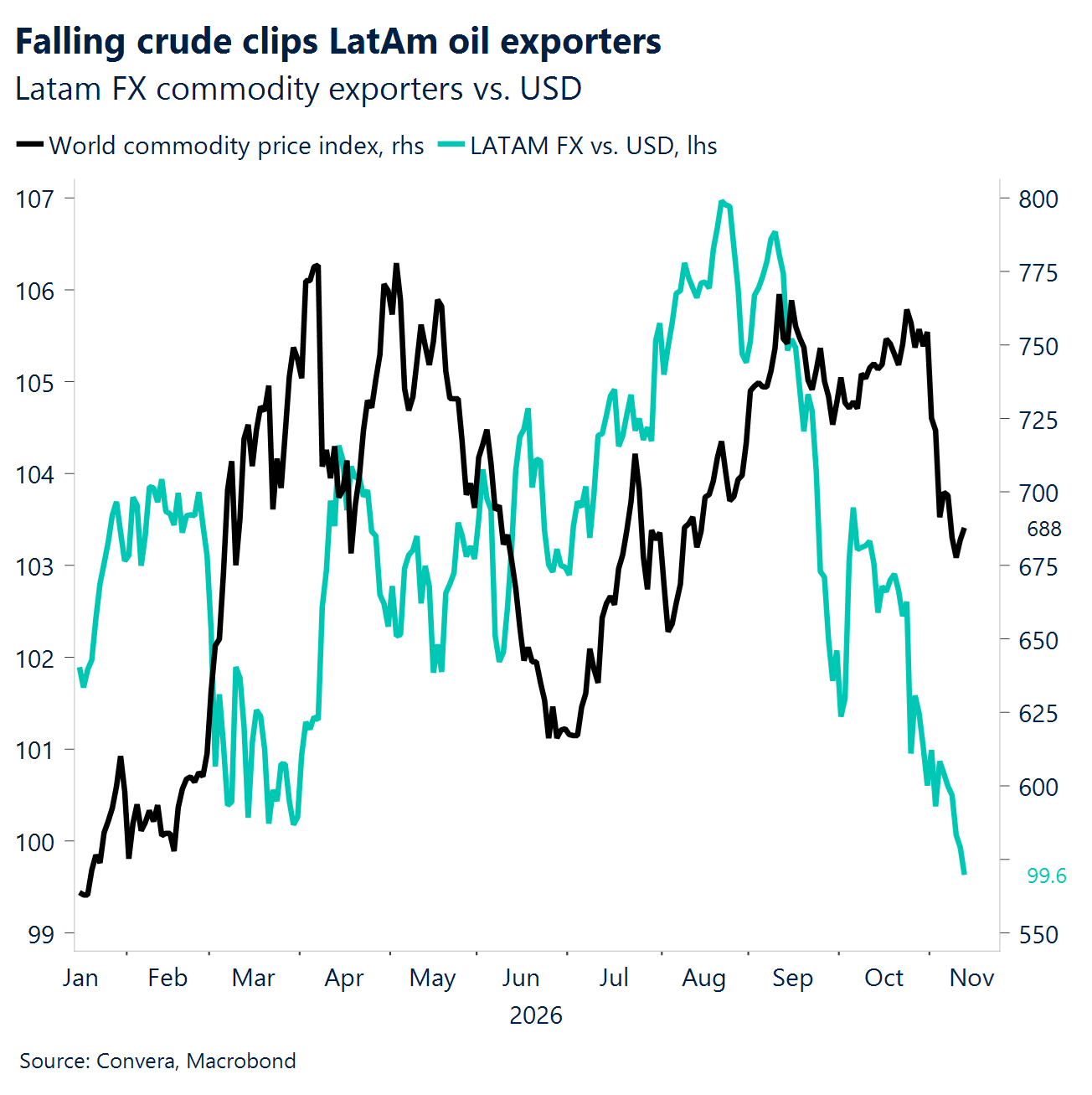
CAD Squeezed by spreads. The loonie closes the week under acute pressure, hovering at 1.425 and sitting just a few pips shy of its 2026 high near 1.429. Despite hopes for post-midterm trade detente with Washington and constructive long-term growth forecasts, spot CAD is being battered by an 18% oil price collapse and widening yield differentials that see the 2-year lag the US by 142 basis points. With domestic data like building permits confirming a cooling economy, the Bank of Canada’s October hawkish pivot looks increasingly out of step with reality. Looking at the charts, the pair retains a positive bias above its 100-day moving average, with weekly option expiries anchoring spot near 1.425 and initial support resting down in the 1.415–1.42 zone. Looking ahead, Monday’s Canadian October CPI print is the marquee domestic catalyst alongside retail sales and housing data later in the week. An inflation miss would reinforce expectations that the BoC is done hiking and open the door for a clean break toward 1.435.
AUD Hitting January lows. The Australian dollar was the second-worst performer in the G10 space this week, ahead of only the Swedish krona, as the recent AI- and rates-driven sell-off in global markets weighed on sentiment. AUD/USD fell around 2.0% over the week, hitting its lowest level since 23 January, as a fresh bout of risk aversion lifted the US dollar. The pair is now near key support at 0.6800. A clear break opens the way to a longer-term decline, first towards 0.6710 and then 0.6400. Looking ahead, RBA Governor Michelle Bullock speaks on Tuesday and the October unemployment report is due on Thursday.

CNH Holding firm. The Chinese yuan extended its 18-month trend of staying largely unmoved by broader FX swings, holding steady even as most other currencies fell sharply against the US dollar. The yuan has been strong all year and is up 4.2% against the US dollar year to date. This week’s resilience was helped by a 35% jump in October exports, which pushed the year-to-date trade surplus past USD1trn at the fastest pace on record. USD/CNH remains in a downtrend, with all key moving averages pointing lower. Looking forward, US President Donald Trump and Chinese President Xi Jinping will meet at the APEC summit in China next week.
JPY Two-month highs. USD/JPY rose to its highest level since early September as the US dollar surged on heightened Federal Reserve rate expectations. US October CPI showed headline prices up 0.4% m/m against 0.3% expected, while core inflation rose 0.3% against a 0.2% forecast. In Japan, the data was mostly disappointing: household spending, bank lending and M2 money stock all came in below expectations. USD/JPY remains in an uptrend, with the 8- and 21-day moving averages both pointing higher. Coming up are Japan’s GDP on Monday and its trade balance on Wednesday.

MXN Carry under double pressure. The Mexican peso is holding up with relative composure near 18.62 despite fresh tariff threats from President Trump over migration, largely because markets discount social media ultimatums until formalized into policy. Still, the currency faces a clear structural drag after Banxico delivered a surprise 25-basis-point cut to 6.25% in a split decision last week right alongside an upside October inflation print of 3.75%. That awkward pairing has sparked a credibility debate while compressing Mexico’s carry advantage from both sides as hot US inflation lifts Treasury yields, narrowing the two-year spread to 280 basis points. Technically, USD/MXN remains pinned in the upper half of its 18.50–18.80 consolidation band, with initial support down at 18.30–18.40 and key resistance looming at the October high near 18.9. Looking ahead, Thursday’s Banxico policy minutes and retail sales data will test whether the board’s “extended hold” pledge holds water, while any formal tariff escalation risks a breakout toward 19.00.
BRL Fiscal doubts crush carry. The Brazilian real is sliding sharply, pushing USD/BRL to a three-month high of 5.599 as massive nominal yield advantages fail to stem $2.06 billion in early-November net FX outflows. Hot US inflation has narrowed Brazil’s rate buffer from the American side, while domestic fiscal credibility remains fractured after reports of President Lula consulting left-leaning economists undermined a newly proposed R$50–60 billion spending-cap bill—leaving investors demanding a steeper risk premium without a confirmed Finance Minister. Meanwhile, the central bank is trapped in a stagflationary corner, holding rates at 13.75% with dovish minutes despite above-target 4.63% inflation as Services PMI plunges to 44.5. Technically, USD/BRL is pressing directly against psychological resistance at 5.60, where a clean break opens a path toward 5.65, while initial support sits down in the 5.40 post-election zone. Looking ahead, markets will scrutinize Congress’s reception of the fiscal package alongside Monday’s economic activity and inflation prints ahead of the December 9 policy meeting.
Have a question? [email protected]
*The FX rates published are provided by Convera’s Market Insights team for research purposes only. The rates have a unique source and may not align to any live exchange rates quoted on other sites. They are not an indication of actual buy/sell rates, or a financial offer.