
USD: Weak jobs report caps Dollar advance
Treasury yields reversed earlier losses and ticked lower across the curve immediately following the data release, with the 10-year yield dropping from 4.16% to 4.12%. Equity futures took a hit as the S&P 500 fell 0.75% and the Nasdaq 100 dropped nearly 1%. The US Dollar Index (DXY) is retreating toward daily lows as it feels the brunt of a dismal jobs report, even as the broader market remains fixated on the conflict in Iran and volatile oil prices. With the US macro outlook clouded by the latest jobs data, any further upside for the Greenback likely depends on a worsening conflict in Iran and subsequent safe-haven demand.
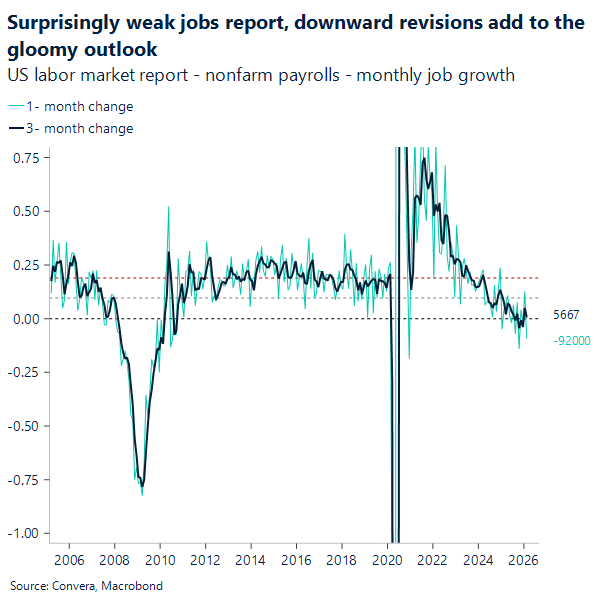
The underlying employment numbers paint a weak picture of the labor market and make the positive January data look like a total outlier. Total nonfarm payrolls contracted by 92,000 in February, and the gloomy outlook was compounded by downward revisions that subtracted another 69,000 jobs from the prior two months. Job losses were broad and included a 12,000 decline in manufacturing that dashed hopes of a sector turnaround, alongside continued severe staffing cuts in the federal government. Health care employment also fell uncharacteristically, though this was primarily driven by strike activity at physician offices.
This combination of a contracting labor market and stubborn inflation pressures from higher energy prices leaves the Federal Reserve in a very tough spot. The current data is not at all consistent with the economic stabilization narrative touted by many officials, which will likely mount pressure on the central bank to consider resuming rate cuts. While average hourly earnings did provide a tiny bright spot by coming in slightly stronger than expected at 0.4%, that silver lining offers little consolation against the broader backdrop of outright job losses.
CAD: Comparatively resilient
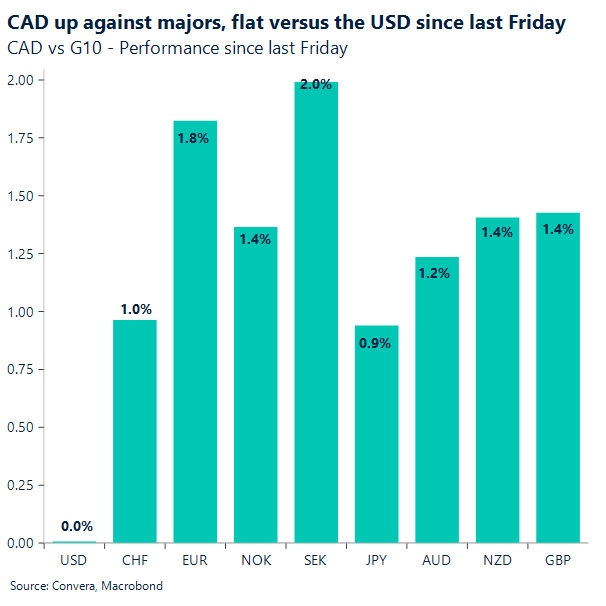
Markets remain hypersensitive to Middle East headlines, and the hope for a quick de-escalation increasingly looks like wishful thinking. Crude is grinding higher as doubts persist that naval escorts can fully safeguard flows through the Strait of Hormuz, leaving a durable risk premium embedded in price. That backdrop keeps the USD bid, up against all G10 peers, including the Loonie, as the dollar’s safe haven bid combines with its tendency to amplify energy shocks. Historically, the USD has appreciated ~0.5–1.0% for every +10% move in oil; this week’s tape fits the pattern, with DXY up ~1.8% since last Friday against WTI up ~24%, a ~0.9% per +10% oil beta, squarely in the usual range.
Within FX, a clear energy led split has opened: the USD is outperforming even traditional havens, oil/energy sensitive importer countries have struggled, while commodity FX is well supported. Notably, the CAD has been comparatively resilient, suggesting terms of trade support is offsetting, not erasing, the broader USD surge. A sticky oil risk premium plus safe haven demand is to keep the USD bid, while the CAD’s relative outperformance hints at a more nuanced energy impulse beneath the headline move. Today’s US NFP report caps USD advancement, leaving the CAD positioned to trade lower to end the week, any further upside for the Greenback likely depends on a worsening conflict in Iran and subsequent safe-haven demand.
EUR: Why is the euro under pressure?
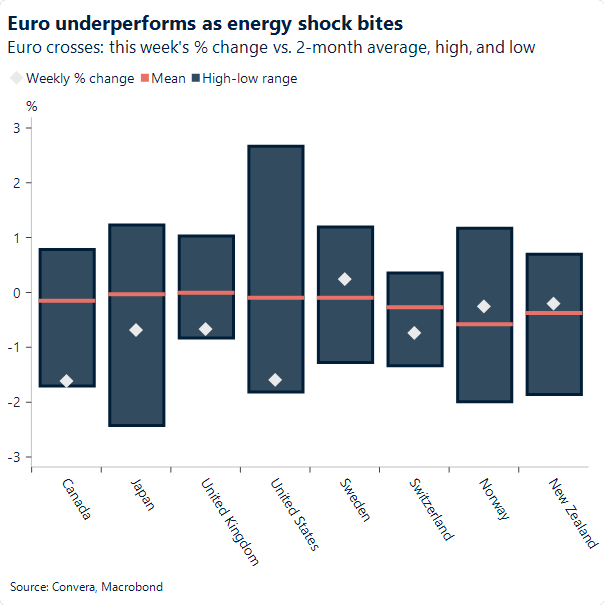
The euro has come under heavy pressure this week as the Middle East conflict drives a sharp repricing in energy markets and, by extension, Europe’s macro outlook. EUR/USD is down around 2% as oil has surged more than 15% and European natural gas briefly doubled — a combination that hits Europe far harder than the US given the bloc’s reliance on imported energy.
This is the same vulnerability that dragged the euro below parity during the 2022 energy crisis, and the mechanism hasn’t changed: higher energy costs squeeze real incomes, weaken growth prospects and complicate the disinflation path. The duration of the shock will determine whether EUR/USD gravitates towards $1.12 or finds support closer to $1.15, but for now the bias remains lower. Until Dutch TTF prices meaningfully retrace, EUR rallies are likely to be short‑lived and offer opportunities to fade.
Markets are already adjusting ECB expectations. A renewed inflation pulse from energy leaves the ECB in a difficult position and the market now assigns roughly a one‑in‑three chance of another hike by year‑end — a reminder that Europe’s inflation problem is more sensitive to commodity shocks than the US.
Beyond Europe, Asian currencies face an additional layer of risk given their dependence on fuel shipments through the Strait of Hormuz, where flows have slowed sharply. That dynamic reinforces broad USD strength and adds another headwind for EUR via the global risk channel.
Overall, unless energy prices retreat, the euro will struggle to regain traction as markets weigh the twin risks of weaker growth and stickier inflation — a combination that tends to widen Europe’s risk premium and keep EUR/USD on the defensive.
Market snapshot
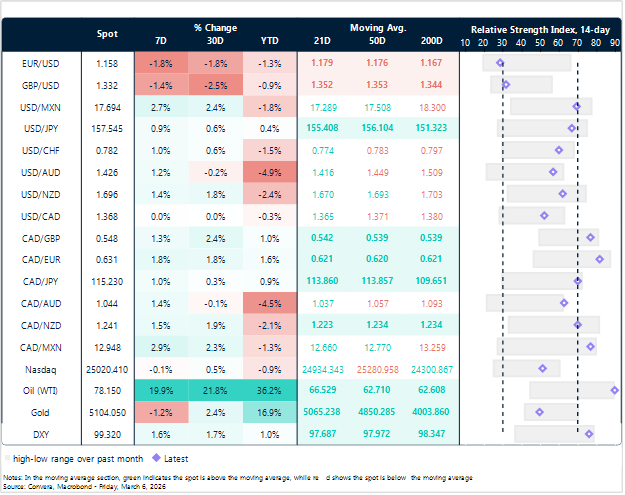
Table: Currency trends, trading ranges & technical indicators
Key global risk events
Calendar: March 2 – 6
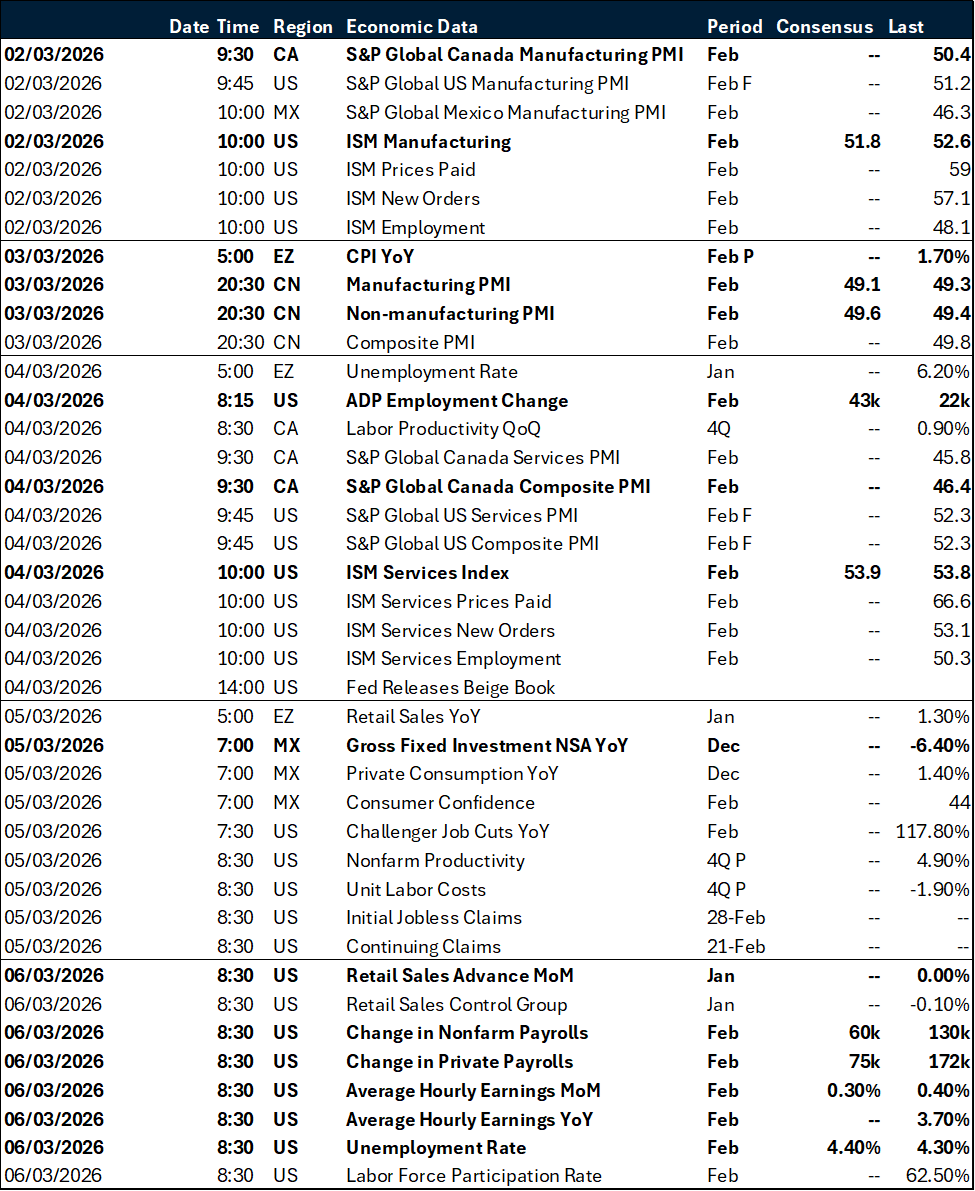
All times are in EST
Have a question? [email protected]
*The FX rates published are provided by Convera’s Market Insights team for research purposes only. The rates have a unique source and may not align to any live exchange rates quoted on other sites. They are not an indication of actual buy/sell rates, or a financial offer.