

Key Takeaways
- The six-year review deadline for USMCA (CUSMA) is on Wednesday; Canada and Mexico want a 16-year extension, but the US is expected to decline.
- If the US withdraws, it could create uncertainty in regional trade relations; a joint extension would bring clarity.
- Canada’s economy is facing pressures from softer GDP growth, lower oil prices, and trade uncertainty, affecting the CAD.
- The US dollar’s recent rally may face a pause, impacted by upcoming labor market data and geopolitical risks.
- Key focus this week includes the CUSMA review, US job market data, and global economic indicators from China and Europe.
The mandatory six-year review deadline for USMCA (CUSMA) falls on Wednesday, the same day Canadian markets close for Canada Day. Canada and Mexico have already signaled that they want to extend the agreement for another 16 years. The US, however, is widely expected to decline the automatic extension, a move that would trigger annual joint reviews and “institutionalize” uncertainty in regional trade relations.
The worst-case scenario would be a US withdrawal from the trade deal, though that remains unlikely. The best case for North America would be for the US to join Canada and Mexico in extending the agreement, bringing clarity and lifting the cloud of uncertainty that has hung over the region over the past year. Based on recent headlines and comments from President Trump, that also looks unlikely.
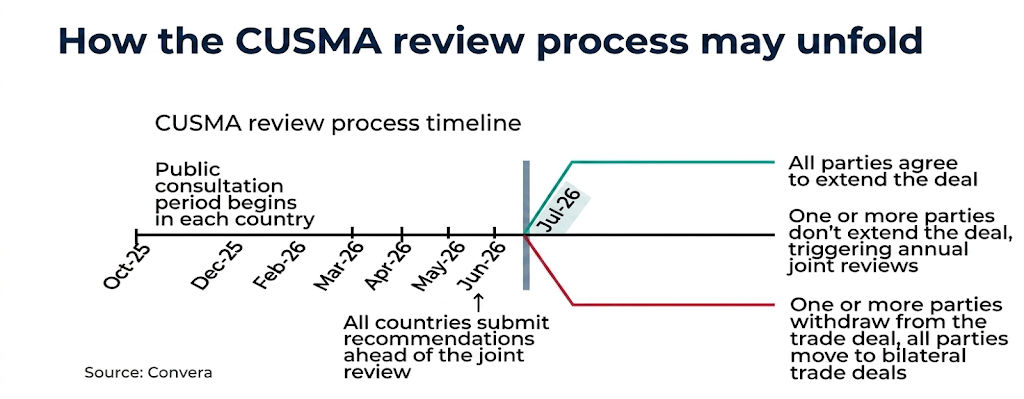
For more detail on the CUSMA deal review and its implications for businesses, markets and FX, see our latest report here.
GDP and CUSMA to test CAD’s fragility
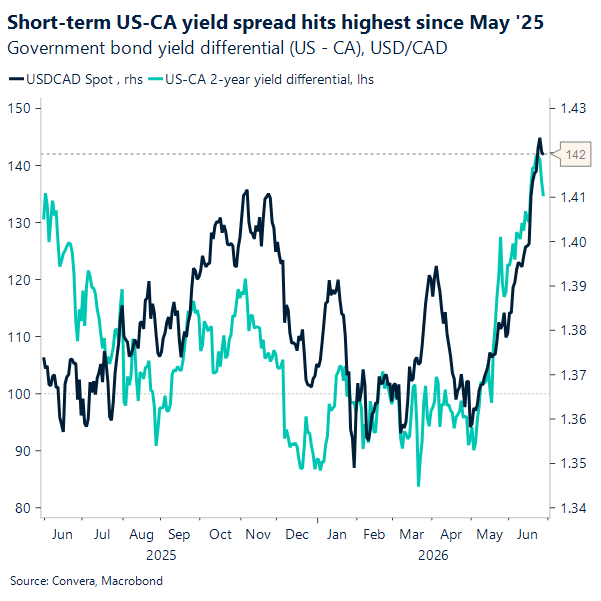
USD/CAD faces another test this week, with Canada’s April GDP due Tuesday and the July 1 CUSMA review deadline landing Wednesday. Markets already appear to be pricing in the view that the US will not agree to an automatic extension of the deal. Any negative headlines beyond that would likely reinforce the pressures that have been building against CAD over the past few weeks: firmer US rates, softer Canadian momentum, lower oil prices and lingering trade uncertainty.
The pair still looks supported by a more credible higher-for-longer Fed backdrop and a cleaner US relative-rate advantage. June’s Fed repricing has kept front-end US yields elevated, while the Bank of Canada remains more constrained by softer domestic conditions. Canada’s May CPI surprised hotter at 3.2% y/y versus 3.0% expected, but the details were largely energy-led, with core measures still closer to 2.1%. That leaves the BoC with little reason to chase the Fed’s more hawkish tone.
Oil is another headwind. As the Iran peace process holds and shipping flows normalize, the direct risk premium in crude should keep fading. That weakens Canada’s terms of trade and remove an important support that had helped cushion CAD earlier in the year.
Trade uncertainty adds to the pressure. The CUSMA deadline matters less as an immediate breakdown risk than as a confidence test around rules, market access and business planning. With futures positioning already heavily bearish on the Loonie, CAD may be vulnerable to further bad news.
The technical and macro setup still favors USD/CAD holding above 1.40. Downside in the pair should be harder to sustain unless US yields fall and the Canadian trade-risk premium starts to fade at the same time. Neither looks likely this week, though markets are not positioned for positive surprises. Those could come from a better-than-expected April GDP print, constructive trade headlines, or, on a relative basis, a US labor market that falls short of expectations.
US dollar rally runs into job week
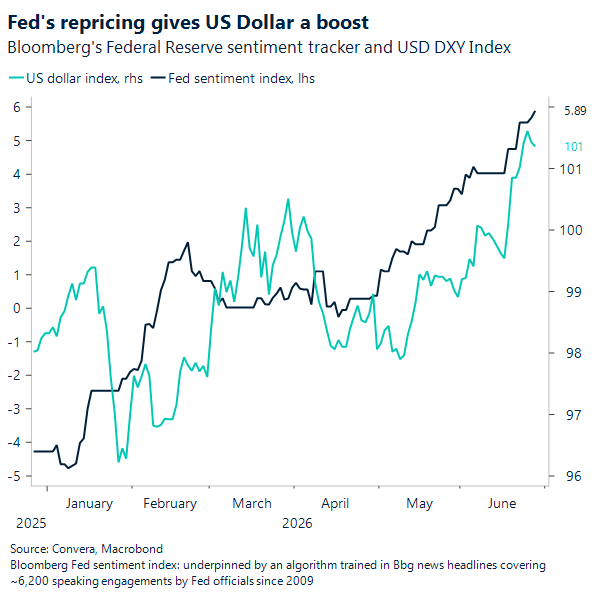
After climbing for several sessions after the Fed meeting, the DXY took a breather into the end of last week. The index is still up roughly 2% over that stretch as investors moved back into the greenback. Markets now assign a high probability of a Fed hike by September, supported by sticky inflation, resilient income growth and no clear break in the consumer. This week, even with the shortened holiday schedule, markets will have plenty to digest on the labor front, with JOLTS, ADP, jobless claims, Challenger job cuts and payrolls all due before Friday’s market closure.
The higher-for-longer story should remain intact unless the data weaken more clearly. Kevin Warsh’s arrival has added another layer, with markets still leaning on the SEP and dot plot even as the new chair signals a more conditional and less predictable Fed communication framework. Thinner guidance usually carries a higher uncertainty premium, especially at the front end, where two-year yields have absorbed much of the recent repricing. The reaffirmation of Fed independence has also narrowed part of the US policy-risk premium that weighed on the dollar earlier this year.
Still, the dollar may consolidate after its recent run, especially as Treasuries have rallied across the curve and front-end yields have eased. Much of that move followed Friday’s PCE report and came through lower inflation compensation, with one- and two-year breakevens falling as crude gave back its geopolitical premium. Another sustained leg higher likely requires a fresh widening in US rate differentials. If lower oil gives real yields room to follow breakevens lower, one of the dollar’s strongest supports should soften.
The move also looks tactically crowded. Oil’s support for the dollar has faded as the US-Iran ceasefire holds and the terms-of-trade boost from higher crude unwinds. Bullish dollar sentiment also looks stretched, and there is a case that the best of the US data surprise is behind us. Europe still offers little real competition, with softer price signals in recent French and German PMIs and a more dovish tone from Lagarde widening the rate gap in the dollar’s favor. But if June proves to be the peak of the energy shock and Fed hawkishness, softer CPI and PCE prints in the coming months could start to challenge the dollar’s momentum.
For now, the breakout is real. But with DXY still elevated and RSI nearing overbought territory, the next leg higher may need more than momentum alone. This week’s labor data will be the main test.
What’s happening in markets this week?
Even after investors have moved past the worst fears of a broader US-Iran conflict, headlines from the Middle East are still adding a layer of unease. The US retaliatory strike on Iran on Friday and Saturday’s attack on a commercial ship in the Strait of Hormuz have kept geopolitical risk in view, with potential spillovers for energy prices, shipping costs and inflation expectations. For now, though, markets appear willing to look through those risks, treating them more as a background concern than a central macro driver. The focus this week will be on the US labor market, while traders also watch China’s latest PMIs and India’s fiscal updates for a broader read on global growth. In Europe, the ECB’s annual forum in Sintra will offer another policy signal, with remarks from Christine Lagarde, Kevin Warsh and other central-bank officials likely to shape the conversation.
By midweek, the focus shifts to North American trade. The mandatory six-year review deadline for CUSMA falls on Wednesday, the same day Canadian markets close for Canada Day. The US is widely expected to decline an automatic 16-year extension of the agreement, a move that would trigger annual joint reviews and add uncertainty to regional trade relations. While Canada is on holiday, US markets will have plenty to digest, including JOLTS, ADP employment and ISM manufacturing data. Together, the releases should offer a cleaner read on labor demand and factory activity heading into the back half of the week.
The main macro event arrives Thursday with the US monthly jobs report. Consensus looks for payroll gains of 115,000, wage growth of 0.3% on the month and an unchanged unemployment rate of 4.3%. Weekly jobless claims and Challenger job-cut figures will add more detail on the state of the labor market. On Friday, US markets will be closed for the Independence Day holiday. The week should leave investors with plenty to weigh: lingering geopolitical risk, trade-policy uncertainty and, most important for the Fed outlook, another test of US labor-market resilience.
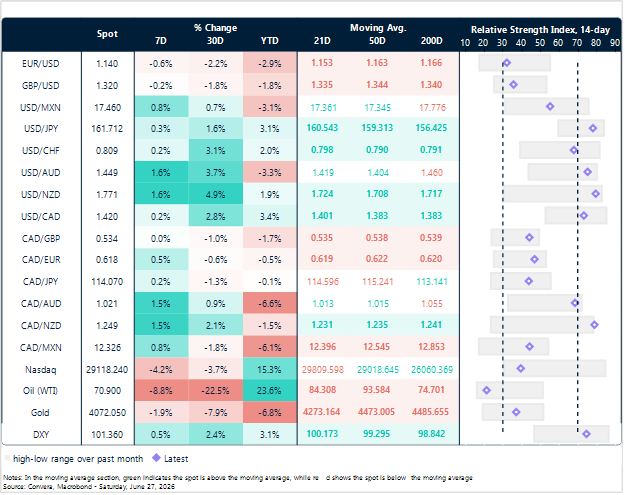
Market snapshot
Table: Currency trends, trading ranges & technical indicators
Key global risk events
Calendar: June 29- July 03
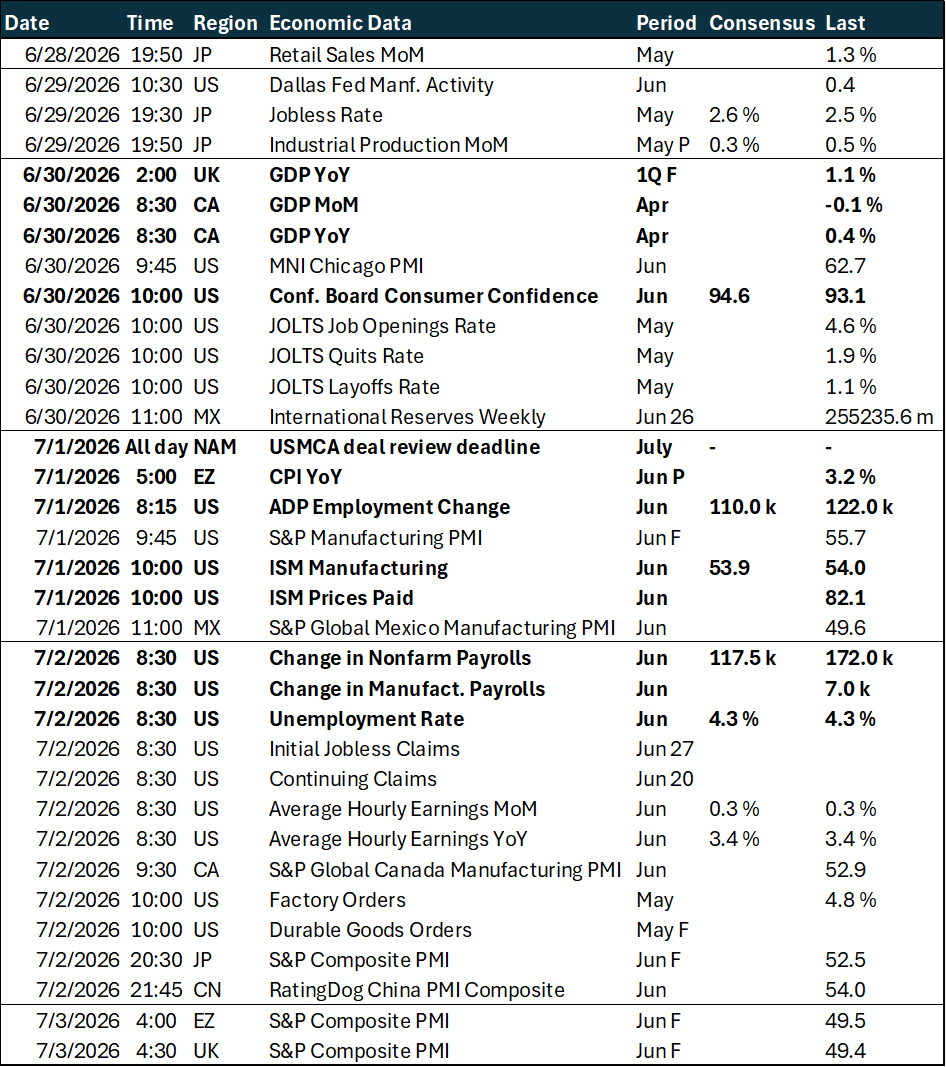
All times are in EST
Have a question? [email protected]
*The FX rates published are provided by Convera’s Market Insights team for research purposes only. The rates have a unique source and may not align to any live exchange rates quoted on other sites. They are not an indication of actual buy/sell rates, or a financial offer.