


Aussie, kiwi remain pressured
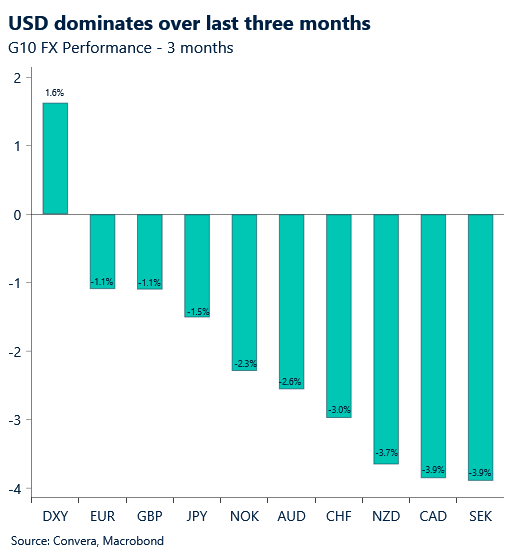
The US dollar eased from one-year highs on Friday with global markets still under pressure into the end of June.
While US equities are down around 3–6%, the real story is the scale of losses across the mega-cap tech names. Alphabet is down 20%, Apple 10%, Amazon 16% and Meta 30%.
Markets are entering the northern hemisphere’s low-liquidity window in July and August, which raises the risk of a deeper sell-off. Seasonality is back in focus, reinforcing the “sell in May and go away” narrative.
While the US dollar was lower, the Aussie and kiwi remain pressured.
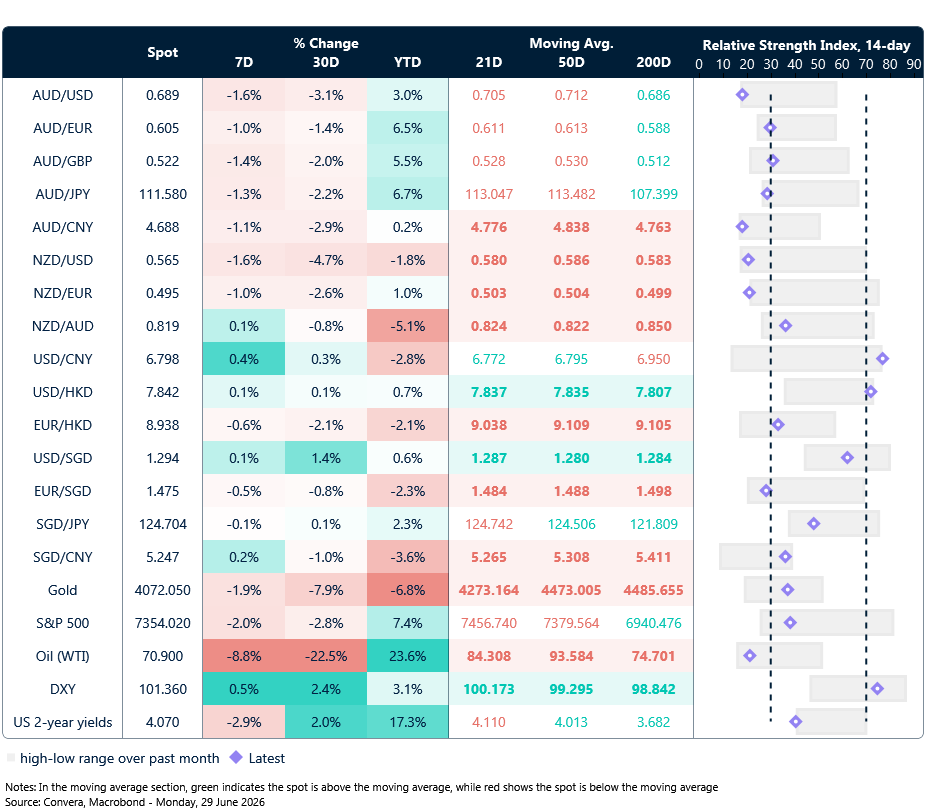
AUD/USD remains in a clear downtrend. It is technically very oversold, but there are still no convincing signs of a reversal. Major support sits at 0.6800. Near-term levels to watch are 0.6930 and 0.6980 on the topside, with 0.6850 below.
NZD/USD is tracking a similar path, with major support at 0.5600. Key levels are 0.5650 and 0.5720 above, and 0.5610 on the downside.
Euro consolidates as disinflation narrative builds
EUR/USD has found support at 1.1350 and is consolidating just above 1.1400, though it remains more than 2% lower month-to-date.
In Asia, the euro is mixed. It is firmer against AUD and NZD, but softer versus SGD and HKD.
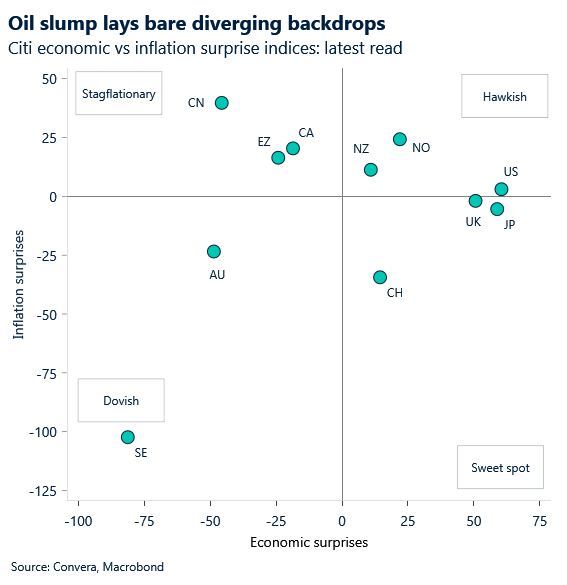
There has been a notable unwind in hawkish rate pricing across G10, driven largely by the sharp decline in oil prices. ECB expectations have shifted from around 40bps of tightening last week to roughly 24bps now, less than one full hike. Similar repricing has occurred for the Fed and BoE.
The key question is how lower oil prices feed through to inflation, and whether growth and labour market dynamics take a more prominent role in central bank reactions.
For the euro, and perhaps FX more broadly, this week’s main risk event is Wednesday’s eurozone CPI release. A downside surprise could cap any move towards 1.1500, especially if US labour data remains firm. Lagarde’s comments at the Sintra Forum will also be in focus after last week’s more dovish tone.
Barring major surprises, EUR/USD may grind higher while holding above 1.1400. The 1.1500–1.1520 zone remains a strong resistance area with no clear catalyst for a sustained break.
Tokyo CPI surprises but yen stays weak
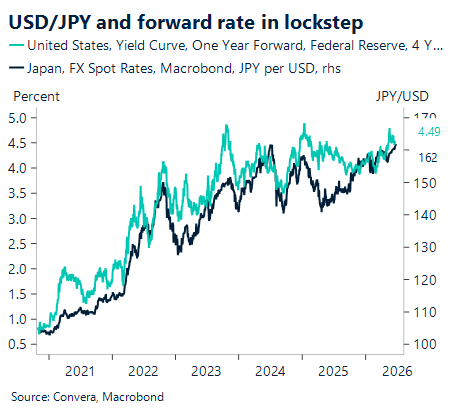
JPY remains one of the weaker currencies in G10. It is down 6% against AUD and 1% against NZD year-to-date, despite expectations for further Bank of Japan tightening.
Tokyo June inflation surprised to the upside. Headline CPI rose 1.7% y/y, above the 1.6% forecast and up from 1.4%. Core CPI came in at 1.6% y/y, matching expectations but accelerating from 1.3%. Core-core CPI rose 1.9% y/y, beating forecasts and up from 1.6%.
The steady rise in inflation points to a potential upside surprise in national data and supports the case for gradual further tightening from the BoJ.
USD/JPY remains elevated, trading just below multi-year highs near 162.00. Initial support sits at the 21-day EMA at 160.71, followed by the 50-day EMA at 159.77 and the 100-day EMA at 158.61.
Greenback eases
Table: seven-day rolling currency trends and trading ranges
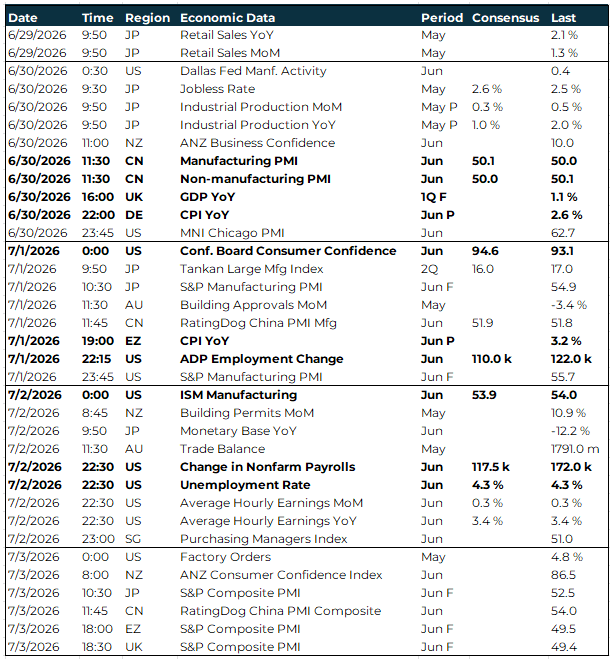
Key global risk events
Calendar: 29 June – 3 July
Have a question? [email protected]
*The FX rates published are provided by Convera’s Market Insights team for research purposes only. The rates have a unique source and may not align to any live exchange rates quoted on other sites. They are not an indication of actual buy/sell rates, or a financial offer.