


USD: Rates regime strengthens as debasement trade fades
Risk sentiment has wavered this week, with another bout of equity selling emerging as investors reassess some of the market’s most crowded trades. Weakness in Apple and reports that OpenAI may delay its IPO have weighed on the AI theme that has underpinned much of this year’s rally. The fallout has been most visible in Asia, where the MSCI Asia Pacific Index has fallen around 3% and Korea’s Kospi briefly triggered a trading halt after dropping roughly 7%. European equities and US futures are also lower.
Elsewhere, markets remain relatively orderly. The US dollar is broadly unchanged, government bonds are modestly firmer, and oil prices are down over 1% despite renewed tensions in the Strait of Hormuz. The bigger story is a broader shift in market leadership.
Markets are increasingly moving away from the debasement narrative that dominated much of the past two years and back towards one centred on growth, inflation and interest rates. Resilient US activity and sticky inflation have revived the higher-for-longer rates theme, pushing real yields higher and reinforcing dollar strength. In turn, traditional debasement hedges such as gold and Bitcoin are finding it harder to compete as the opportunity cost of holding non-yielding assets rises.
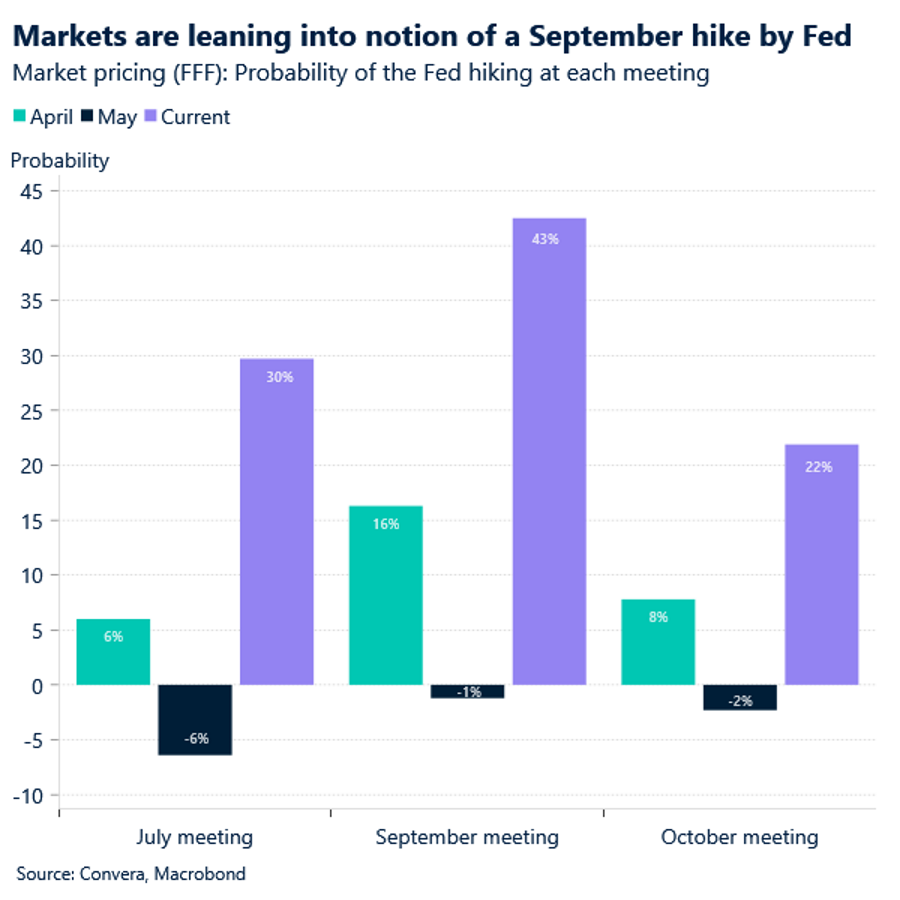
The rates story continues to support the greenback. Markets now assign a high probability of a Fed hike by September as inflation remains stubbornly elevated. Recent data largely justify that view. First-quarter GDP was revised higher to an annualised 2.1%, personal income and spending both surprised to the upside, and core PCE inflation remains elevated at 3.4% year-on-year.
The details are less impressive than the headlines. Consumer spending momentum remains only modest, while part of the GDP upgrade reflected inventories and trade. Nevertheless, growth is proving resilient enough to prevent a meaningful dovish repricing of the Fed. Underlying business investment also remains firm, reinforcing the view that the US economy continues to outperform many of its peers.
For the dollar, that remains a supportive combination. Growth is not booming, but neither is it weakening enough to offset persistent inflation pressures and a hawkish Fed backdrop.
EUR: EUR/USD’s decline stalls at 1.1350
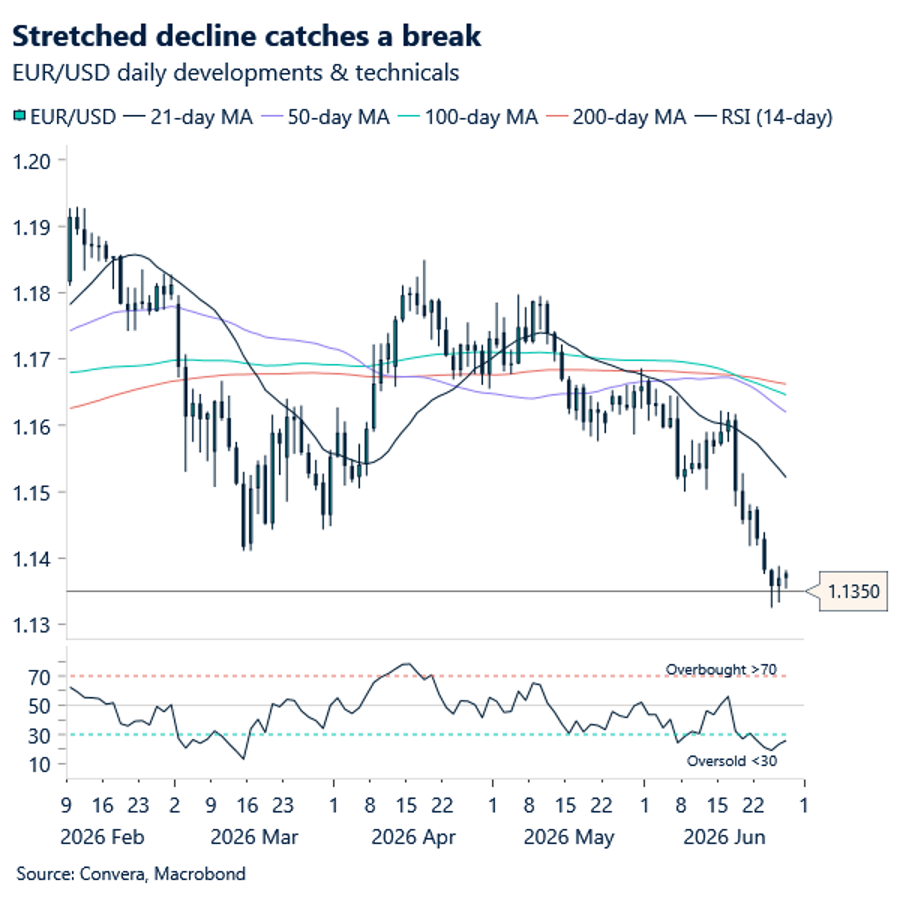
EUR/USD stabilised near 13‑month lows, with 1.1350 attracting euro buying interest. The drop in the pair appeared stretched, with EUR/USD cascading from 1.16 last Wednesday after Kevin Warsh struck a hawkish tone at his first Fed’s policy meeting. A softer-than-expected US PCE report yesterday, with the m/m print missing estimates to the downside, prevented a fourth consecutive daily decline in EUR/USD.
EUR upside is likely to remain contained, however, as yesterday’s close higher looks more like a profit-taking setup than any meaningful macro story re-writing. The US dollar continues to benefit from a more resilient macro backdrop than the eurozone can offer. In this environment, we are unlikely to see a meaningful unwind in Fed hawkish expectations just yet (US treasury real yields still sticky).
The next key test for the euro comes next week, with June’s CPI due. Central bankers will also be meeting in Sintra for the ECB’s annual Forum on central banking. Investors will be parsing for any shifts in tone following recent hawkish-leaning policy meetings, particularly in light of the recent decline in oil prices alongside Lagarde’s surprising dovish remarks on Monday.
GBP: Sterling’s problem is the dollar
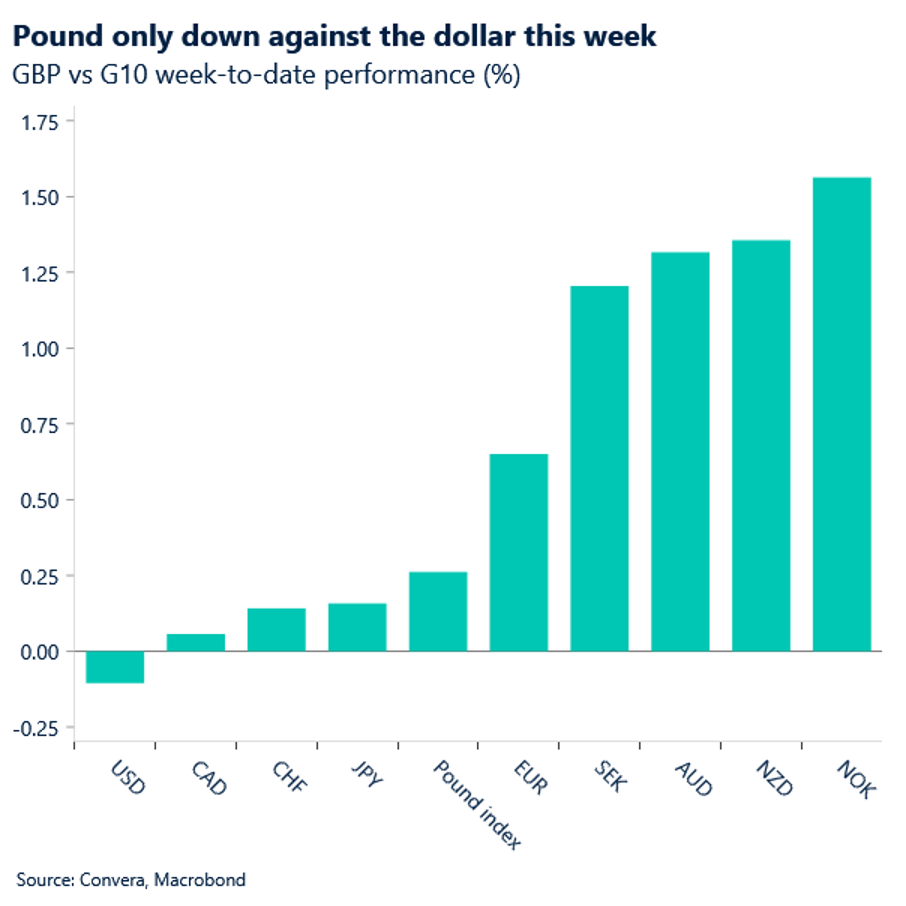
Sterling remains under pressure against the broadly stronger dollar, with GBP/USD flirting with 1.32, down around 0.25% on the week and 2% on the month. However, the pound has fared better against several other G10 peers, highlighting that USD strength rather than outright GBP weakness remains the dominant driver of recent price action.
The shift back towards the rates channel has been an important theme. Earlier in the year, falling oil prices and resilient risk sentiment provided a tailwind for sterling. More recently, lower energy prices have encouraged a less hawkish Bank of England outlook, narrowing the UK’s relative yield advantage just as markets have become more constructive on the US growth and rates story.
Domestic politics remains the key UK-specific focus. With the prospect of an Andy Burnham premiership becoming increasingly likely, attention is gradually shifting away from the leadership transition itself and towards the composition of the next government. In particular, markets are becoming increasingly focused on who will inherit the Chancellor role, with fiscally credible candidates viewed far more favourably than those associated with a looser spending agenda.
From a technical perspective, the outlook remains challenging. GBP/USD has fallen to a fresh seven-month low this week and continues to trade below all major daily moving averages, signalling negative momentum across multiple timeframes. While momentum indicators have slipped into oversold territory, suggesting scope for consolidation or a short-covering bounce, the broader trend remains bearish.
A key level to watch is the 200-week moving average near 1.32. The pair is hovering around this long-term trend indicator and failure to reclaim it could see the level increasingly act as resistance rather than support. For now, any stabilisation looks more likely to reflect stretched positioning than a meaningful shift in the underlying trend.
Market snapshot
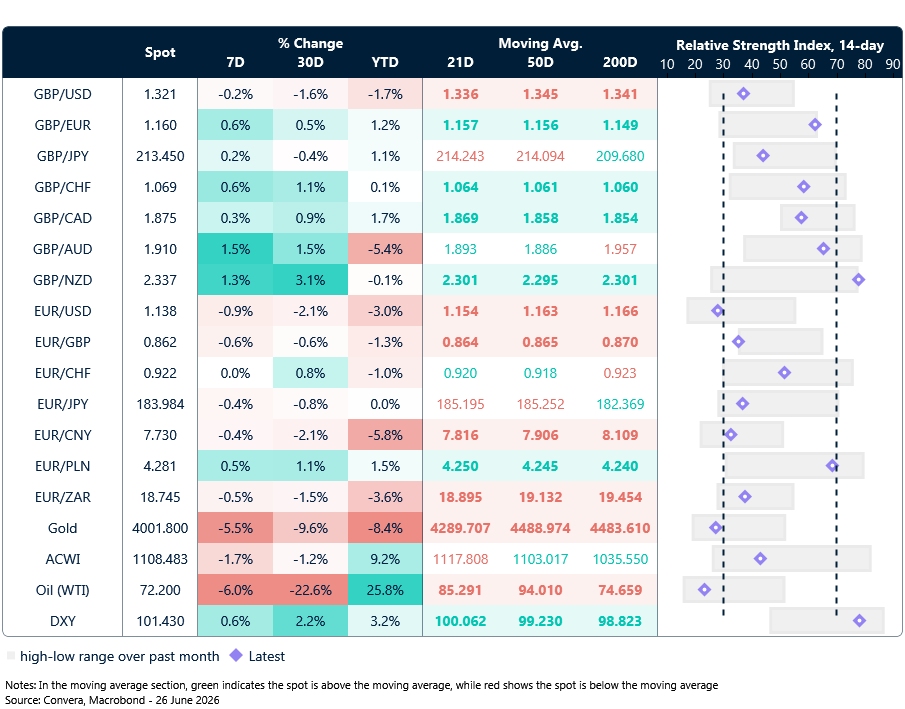
Table: Currency trends, trading ranges & technical indicators
Key global risk events
Calendar: June 22-26
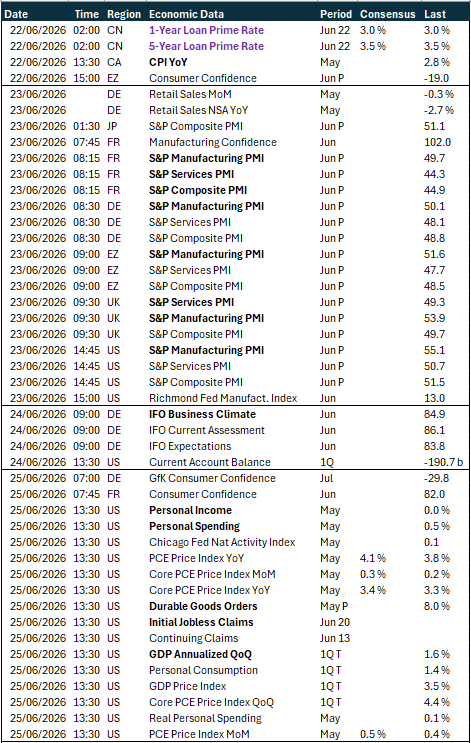
All times are in BST
Have a question? [email protected]
*The FX rates published are provided by Convera’s Market Insights team for research purposes only. The rates have a unique source and may not align to any live exchange rates quoted on other sites. They are not an indication of actual buy/sell rates, or a financial offer.