


USD: Shrugging off dovish data
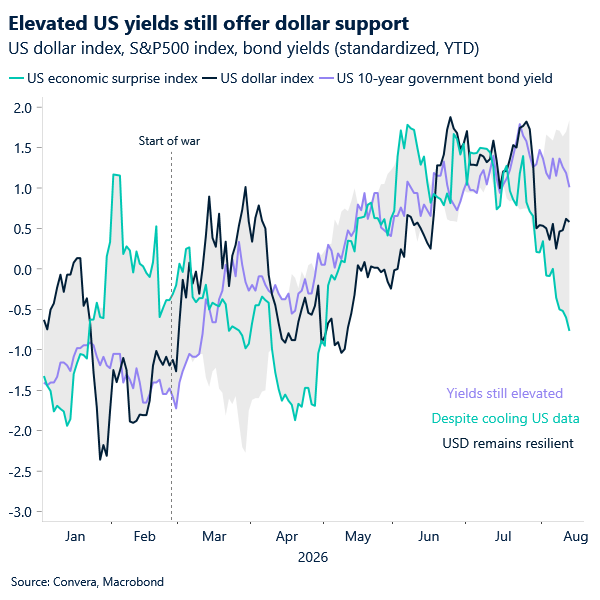
The US dollar is on track for its first weekly gain in three, despite softer US jobs and inflation data reducing expectations of a near-term Fed hike. The key reason is that while short-dated Treasury yields have fallen on the view that policymakers can afford to wait, longer-dated yields remain elevated. That suggests investors are becoming less concerned about immediate Fed tightening, but are not pricing a meaningful deterioration in the US growth outlook.
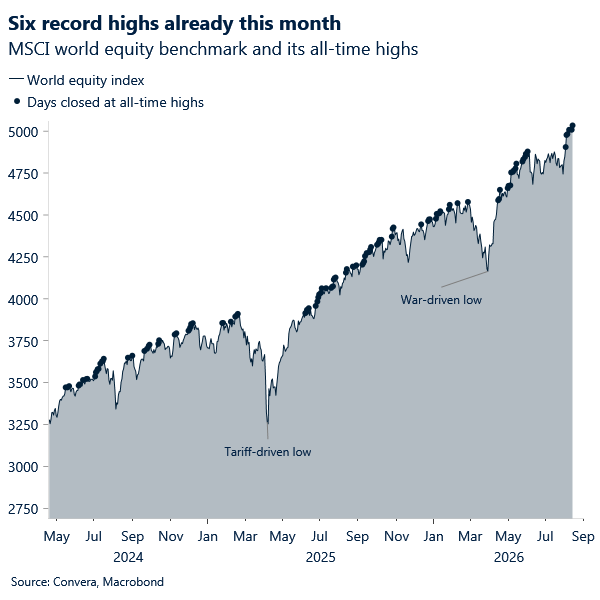
The broader market backdrop supports that interpretation. Global equities are heading for a third consecutive weekly gain, notching yet another record high, driven by a revival of the AI trade after several weeks of volatility. Korea’s Kospi has surged around 10% this week, while the Nasdaq 100 has pushed back towards its late-June highs as strong earnings helped restore confidence in technology sector spending.
At the same time, rates markets are sending a more nuanced signal. Two consecutive benign US inflation prints and last week’s softer payrolls report have reduced the probability of a September Fed hike to around 35%. Yet the 10-year Treasury yield is still higher on the week, reflecting expectations that growth will remain resilient and that inflation risks have not fully disappeared, particularly with Middle East tensions unresolved.
Indeed, oil prices are up 5% this week amid the US administration’s new “Operation Economic Fury” strategy aimed at restricting Iran’s oil revenues through sanctions, shipping restrictions and financial measures. Fresh Houthi attacks on Saudi energy infrastructure have added to concerns about supply disruptions.
Bottom line for the dollar: lower short-end yields have removed some policy support, but resilient growth, elevated long-end yields and renewed energy risks continue to provide a constructive backdrop. That helps explain why the USD is strengthening even as expectations for near-term Fed tightening have softened. US retail sales is the main data point in focus this afternoon, but would likely need to deliver a significant surprise to trigger a meaningful dollar reaction.
EUR: Rangebound, lacking conviction
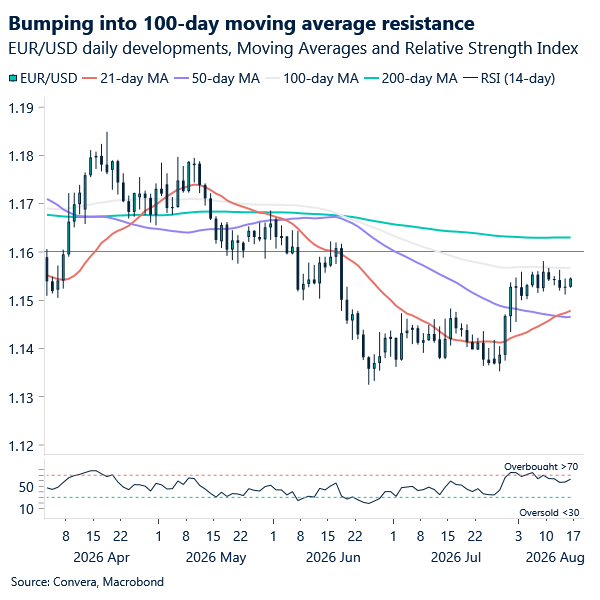
EUR/USD remains stuck in a narrow range despite another soft US inflation report, highlighting a recurring theme this summer: the absence of conviction rather than the presence of a strong directional story.
A low-volatility environment continues to dominate FX markets. While that would normally be supportive of risk-taking, it arguably works against the euro. With yield volatility subdued and carry trades back in favour, investors have increasingly gravitated toward higher-yielding currencies, limiting the euro’s relative appeal despite an improving Eurozone backdrop.
Recent data have been supportive. Eurozone growth has held up better than expected, while inflation remains firm enough to keep alive expectations of further ECB tightening later this year. Yet the euro has struggled to capitalise. Markets are already close to pricing a full 25bp ECB hike next month, leaving limited scope for additional euro-positive repricing from the rates channel.
Instead, EUR/USD continues to take its cue from the dollar side of the equation, which has shrugged off the benign inflation prints this week.
Technically, the euro remains trapped beneath key resistance around 1.16, while support around 1.15 continues to hold. Today’s revised Q2 Eurozone GDP is unlikely to alter that picture, with no significant revision expected from the previously reported 0.4% quarter-on-quarter expansion.
GBP: Low vol, firm sterling
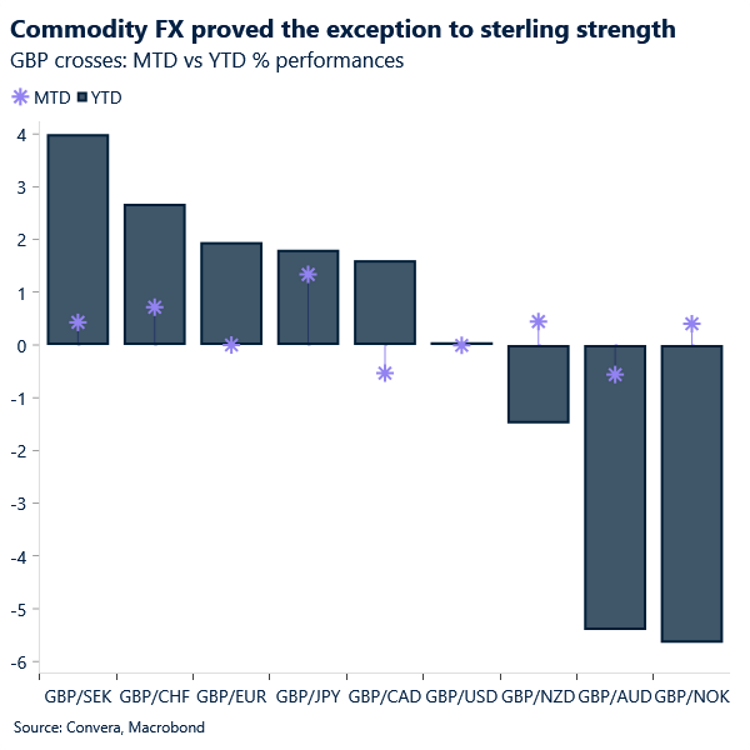
With little in the way of political headlines to stoke fiscal concerns for now, and amid a low-volatility environment, sterling remains relatively well supported given its high-yield appeal. Meanwhile, it is understandable to see the pound struggling against the commodity complex, given the elevated energy price backdrop resulting from renewed tensions in the Middle East.
Markets also remain relatively complacent about the newly minted Prime Minister, Andy Burnham. GBP/EUR, perhaps the clearest expression of the UK’s political risk premium, sits just over 1% higher since the 7 May local elections, which could be viewed as the starting point of the political turmoil that ultimately led to Burnham replacing Starmer. Elsewhere, Nigel Farage’s victory over Count Binface in the Clacton by-election yesterday generated headlines but little market reaction. That said, the investigation into Farage’s finances will recommence now and could yet trigger another by-election should the situation escalate.
In our view on GBP/EUR, a move back below 1.16, a level that acted as key resistance from mid-2025 through to July 2026, appears unlikely in the near term. We favour a period of consolidation within the 1.16-1.17 range, with more meaningful downside risks likely to emerge ahead of the late-October Autumn Budget, when Burnham’s fiscal credentials are set to come under greater scrutiny.
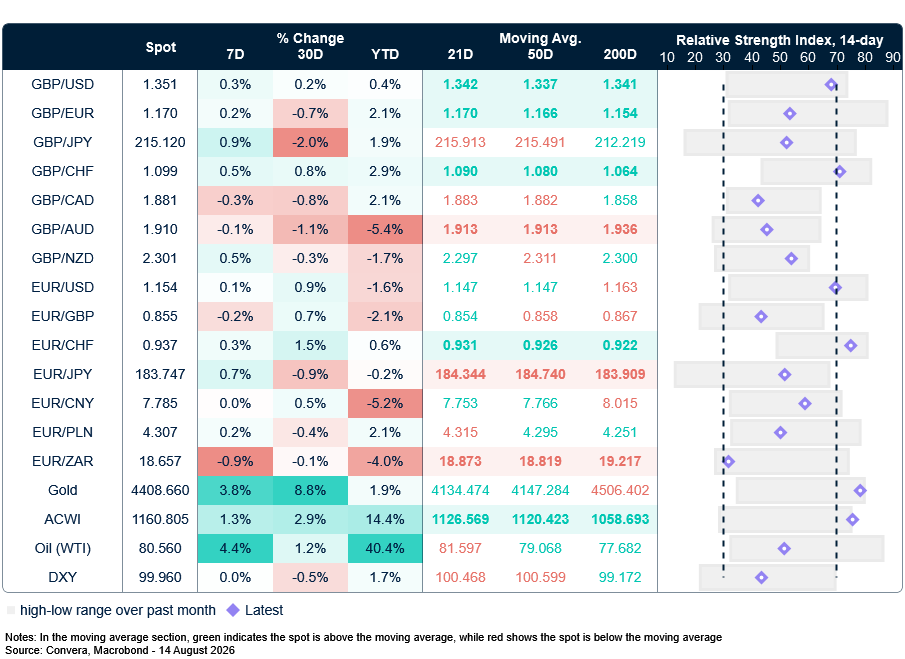
Market snapshot
Table: Currency trends, trading ranges & technical indicators
Key global risk events
Calendar: August 10-14
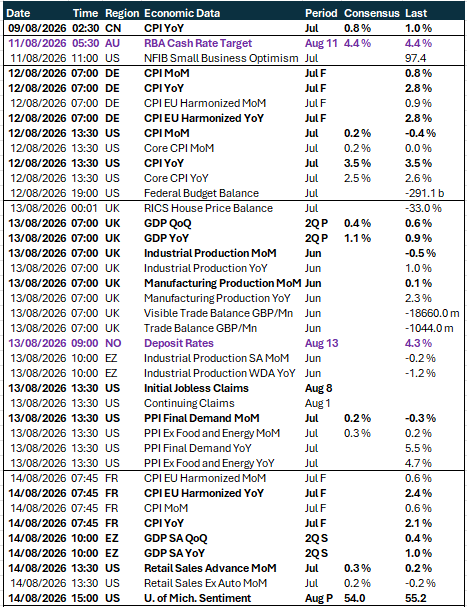
All times are in BST
Have a question? [email protected]