


CAD: Holding the line
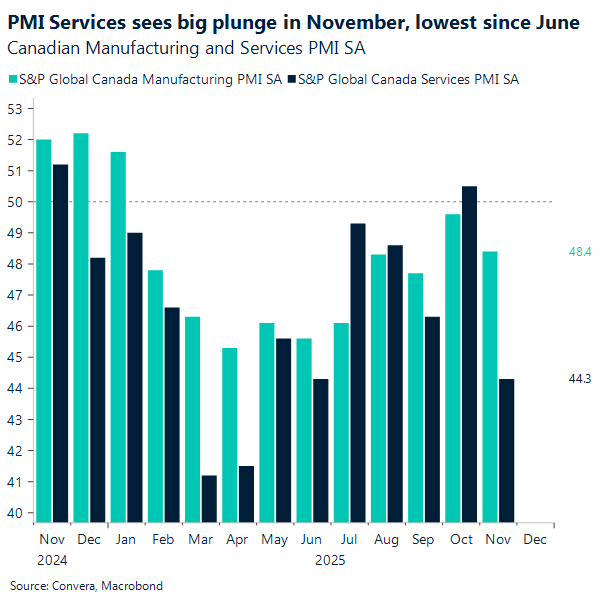
The latest S&P Global Canada PMI data for November 2025 painted a sobering picture, highlighting a steep contraction across the private sector, driven primarily by the services industry. The headline Services PMI Business Activity Index dropped significantly to 44.3 in November, a sharp decline from 50.5 in October and its lowest level since June. This severe downturn was the result of ongoing economic uncertainty, which made clients unwilling to commit to new contracts, leading them to adopt a “wait-and-see” approach. Consequently, new business volumes fell for the twelfth consecutive month, with the rate of contraction the steepest since April, and new export orders falling to the greatest degree in seven months. This widespread weakness resulted in a notable cut in employment levels, the greatest degree of reduction in nearly five-and-a-half years, as firms contended with dwindling workloads, spare capacity, and a subdued outlook.
Compounding the problem, the overall private sector, as measured by the Composite PMI Output Index, also fell back into steep contraction at 44.9, following a brief marginal growth in October. While the downturn was services-led, manufacturing output also experienced a modest fall. Despite elevated input cost inflation driven by tariffs and higher wages, competitive pressures and weak demand restricted the pricing power of services firms, leading to only marginal increases in selling prices, the lowest inflation in seven months. This inability to pass on costs, combined with falling workloads, resulted in squeezed margins and a diminished confidence in the future outlook, which fell to a five-month low across the sector.
The Canadian dollar has recently firmed to 1.395/397, supported by a weaker U.S. dollar following a weaker-than-expected US ADP report. Historically, December is noted as being a notoriously quiet month for the CAD based on the long-term average performance since 1970, yet the broader U.S. Dollar index has suffered declines in eight of the past ten years, suggesting a potential for CAD strength.
While this quiet historical trend exists, several upcoming events may inject volatility, including Friday’s November employment report in Canada, the Federal Reserve (Fed) meeting next Wednesday, along with the Bank of Canada (BoC) meeting, the US employment report a week after, and Canadian CPI data on December 15. Ultimately, the Loonie’s ability to sustain trade below the critical 1.40 level is seen as heavily reliant on continued U.S. Dollar weakness, aligning with the observed recent historical pattern of the USD struggling in the final month of the year.

GBP: Pound pops to 1-month highs
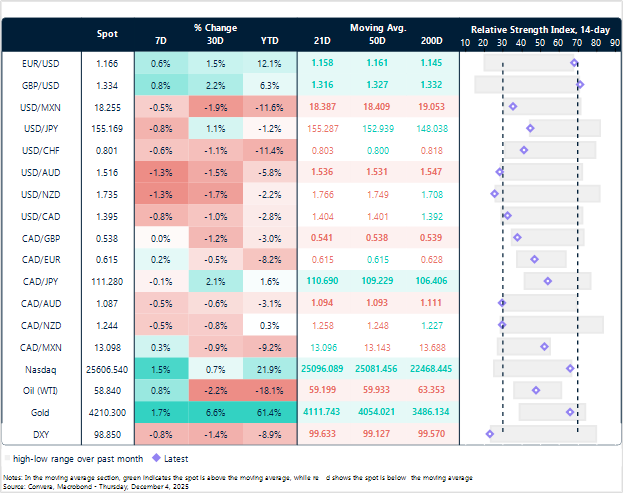
Sterling surged over 1% versus the US dollar yesterday – its biggest one day rise since April. GBP/USD bulldozed through key moving averages on a path towards $1.34 though momentum stalled just shy of the 100‑day average around $1.3370. The surge beyond its upper Bollinger Band and nearing overbought RSI levels, reflects strong bullish momentum but it also raises the risk of consolidation. Meanwhile, GBP/EUR also climbed to a one‑month high, hinting at a tentative short‑term breakout.

Helping the pound extend its post-Budget rally, a closely watched survey showed that UK business activity expanded at a stronger pace than expected, painting a rosier picture of the country’s economy. The services PMI was revised up to 51.3 from 50.5, comfortably above the 50 threshold separating expansion from contraction, while the composite PMI rose to 51.2 from 50.5 reflecting the seventh consecutive month of expansion in the UK’s private sector activity.
Positioning dynamics suggest further unwinding of GBP shorts have added fuel to the pound’s recovery, while a reduced — though not eliminated — fiscal risk premium has provided some breathing space too. Options markets reflected heightened pre‑Budget anxiety, with traders building significant downside hedges in sterling. With the Budget broadly validating expectations, some of those left‑tail risks have now been priced out, easing immediate pressure on GBP volatility.
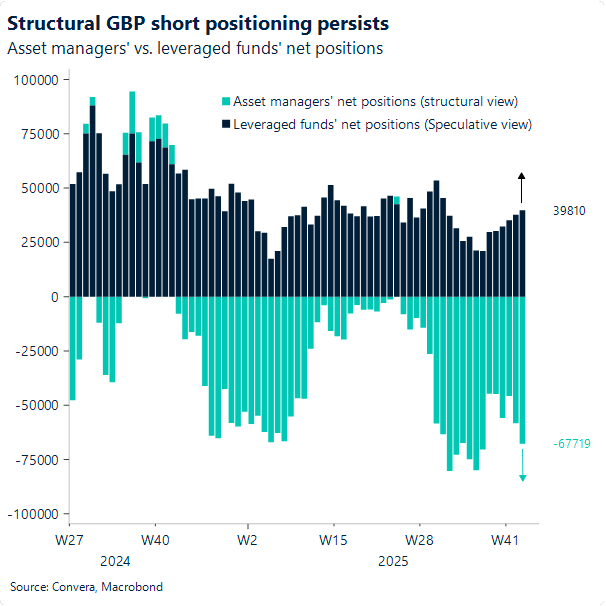
Meanwhile, CFTC data also highlight a divergence in sterling positioning: leveraged funds, whose bullish bets halved during the summer selloff, have since steadily rebuilt longs. In contrast, asset managers — typically a proxy for longer‑term sentiment — remain net short, underscoring persistent structural caution toward GBP.
Taken together, sterling’s rebound looks more like a counter‑trend stabilisation than a fundamental shift in sentiment in our view. Near‑term resilience offers tactical opportunities, but persistent headwinds mean 2026 is likely to be a challenging year for the currency.
MXN: Ignoring the data
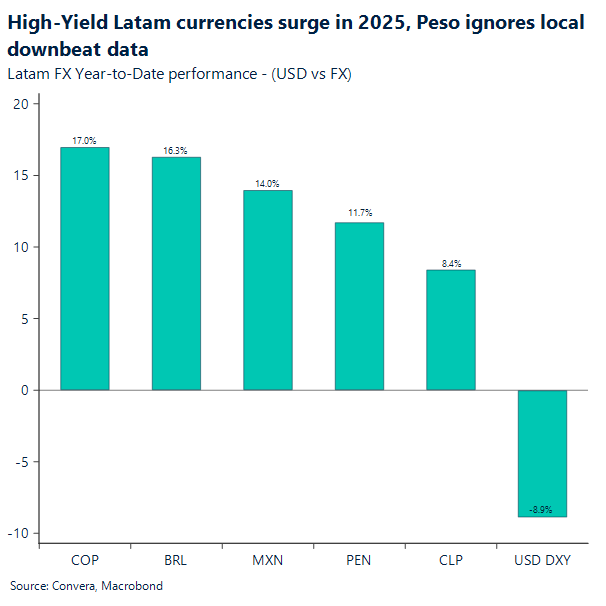
Despite a series of negative domestic data, including the S&P Global Mexico Manufacturing PMI report, the peso’s strong performance this year has continued, benefiting this week from a weaker US Dollar and the return of risk-on sentiment to the market, which has been the consistent story of 2025 that has helped keep bid emerging market and Latam high-yield currencies.
The November 2025 S&P Global Mexico Manufacturing PMI of 47.3 signaled the third consecutive month of deterioration in operating conditions and the fastest contraction since June. This drop was driven by a solid fall in new orders, the fastest reduction since the middle of the year, and a decline in output for the seventeenth consecutive month, marking the greatest extent since May. Firms broadly attributed these declines, along with cuts to production and employment, to US tariff policy.
The prevalent weakness in the manufacturing sector, lines up with the recent report from the National Institute of Statistics, Geography, and Informatics (Inegi) that Mexico’s capital investment dropped 6.7% year-over-year (y/y), which was slightly better than the consensus estimate of -7.7% and represented a modest rebound from the revised -10.9% drop recorded in August. On a monthly basis, the data was also a relative positive, as capital investment saw only a 0.3% fall month-over-month (m/m), which was a much milder contraction compared to the revised -3.0% decline in August. These mixed macro data points, still align with the general expectation of a cooling economy and an increased probability that the economy may enter a technical recession to end 2025.
EUR and Pound in overbought territory
Table: Currency trends, trading ranges and technical indicators
Key global risk events
Calendar: December 01 – 05
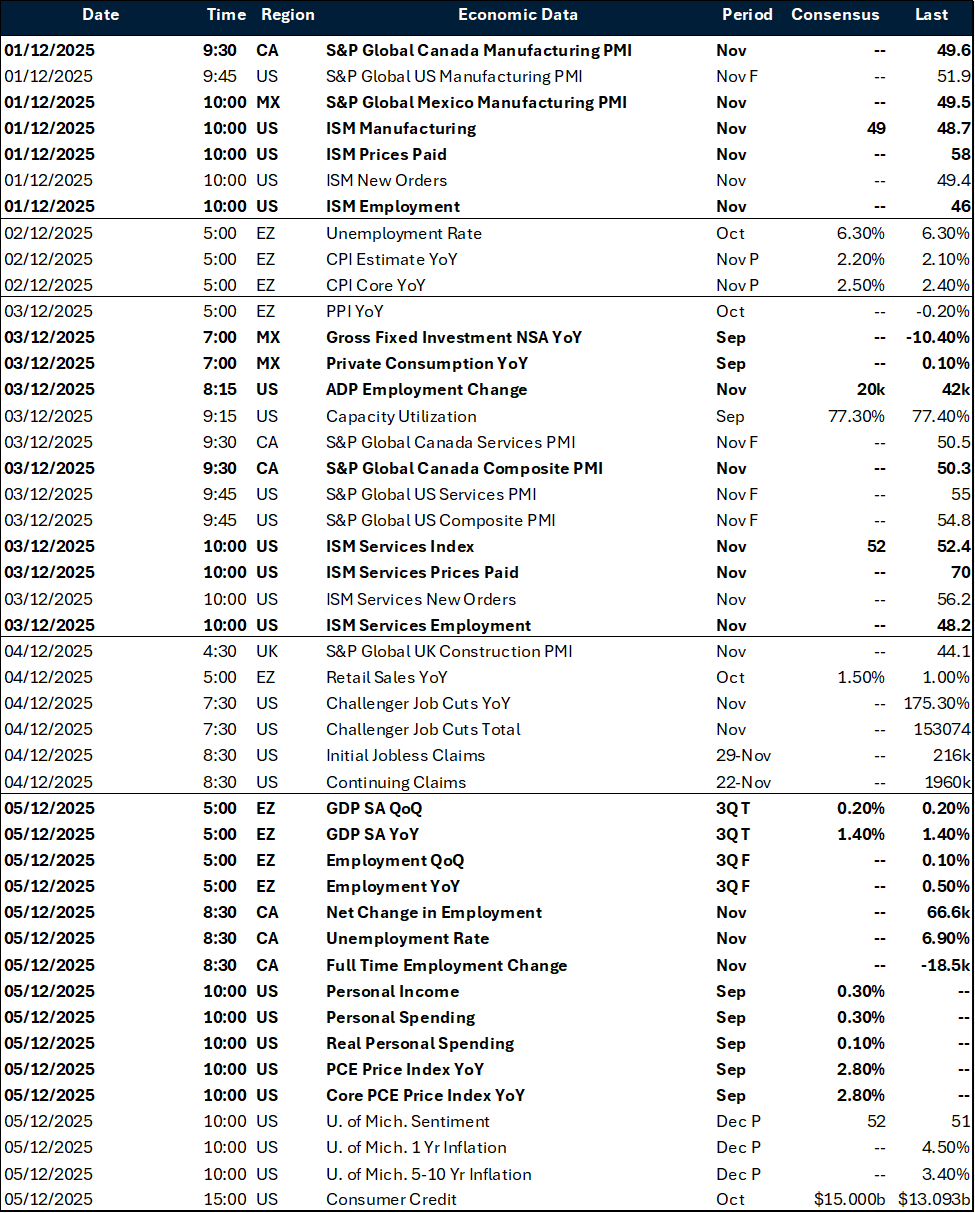
All times are in EST
Have a question? [email protected]
*The FX rates published are provided by Convera’s Market Insights team for research purposes only. The rates have a unique source and may not align to any live exchange rates quoted on other sites. They are not an indication of actual buy/sell rates, or a financial offer.