


Tariffs hit home
No other than Stephen Miran, the intellectual architect of the Trump administration’s protectionist agenda, is set to temporarily fill the vacant seat on the Federal Reserve’s Board of Governors until January. After writing a paper on restructuring the global trading system that markets later dubbed the “Mar-a-Lago Accord,” he was named the chair of the Council of Economic Advisers. (we wrote a short piece on the accord earlier in the year). It’ll take a few weeks before his nomination to be confirmed by the Senate.
His appointment adds another dovish voice to the Fed’s upcoming meetings, a development that coincides with a broader debate among officials over the economic impact of tariffs. Atlanta Fed President Raphael Bostic highlighted a central dilemma for the FOMC this week, calling the question of whether tariffs are a one-time price shock or a source of persistent, structural changes “perhaps the most important question that we have today.” While the continued evolution of tariffs extends the timeframe for higher prices, risking a lift in inflation expectations, markets are currently focused on signs of a slowing economy. This has led to aggressive pricing for a potential rate cut as early as September.

Against this backdrop, speculation about the next Fed Chair is intensifying. A recent Bloomberg report named current governor and outspoken dove, Chris Waller, as a possible successor. Meanwhile, the US Dollar has remained soft this week amidst the latest round of tariff announcements.
The president has taken to social media to announce a new series of trade measures, including:
- Unsuccessful attempts by Switzerland and Taiwan to secure exemptions from new duties.
- A threat to impose a 100% tariff on chip imports, with a possibility of exemptions for companies investing domestically.
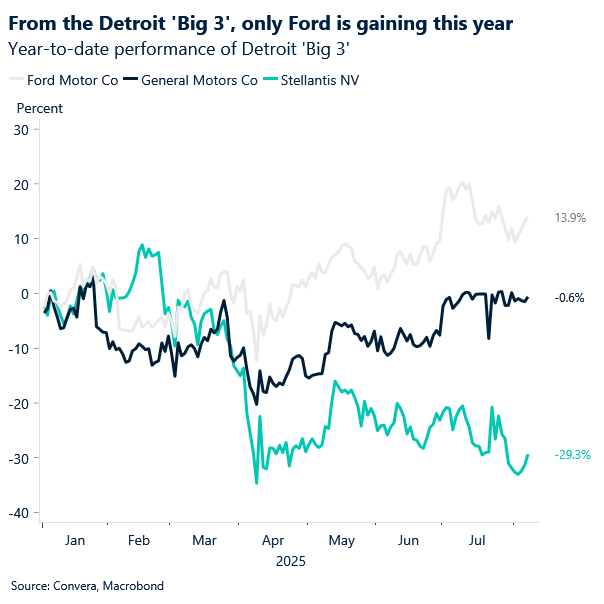
- A doubling of tariffs on India to 50%, effective after a 21-day grace period.The earnings season has clearly shown how the auto sector has felt the full brunt of tariffs.
These developments, combined with a broader tariff regime now in effect, have created a climate of uncertainty around the economic consequences of unprecedented protectionism from the U.S.
Quarterly earnings reports are revealing a stark contrast in performance across different sectors. While the overall S&P 500’s earnings per share are tracking 9% above the initial 4% consensus, this growth is far from uniform. The “Magnificent Seven” tech giants, for instance, have posted an average year-over-year earnings growth of 26%, solidifying a tech-centric growth story.
However, a different reality is unfolding in manufacturing, particularly for the automotive sector, which is bearing the brunt of new tariffs. The “Detroit Big three”, General Motors, Ford, and Stellantis, have reported significant financial hits. GM cited a $1.1 billion impact, Ford took an $800 million blow, and Stellantis warned of potential costs up to €1.5 billion this year. The pain is not limited to the US, with Japan’s Toyota also reporting a quarterly tariff impact of $3 billion. These figures highlight how trade policies are creating substantial headwinds for certain industries, even as the broader market is propped up by a handful of tech companies.
Next week’s U.S. Consumer Price Index (CPI) report for June is shaping up to be the most critical economic data point of the month, particularly following a weaker-than-expected jobs report. The market anticipates a year-over-year increase of 2.8%, with observers looking for further evidence of how tariffs are impacting goods inflation. A monthly increase exceeding the expected 0.2%, however, could inject significant volatility into the markets by reigniting fears of stagflation, a risk that Federal Reserve officials are increasingly concerned about. The report’s significance is amplified by the fact that the Bureau of Labor Statistics, which produces this key inflation data, recently saw its commissioner, Erika McEntarfer, fired by President Donald Trump.
Hawkish cut helps pound
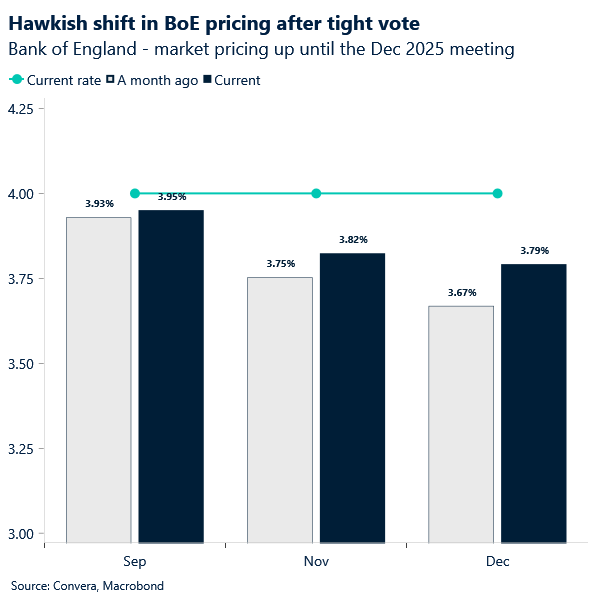
The Bank of England’s 25-basis point rate cut to 4% yesterday has sparked debate over whether the easing cycle is nearing its end. Despite the cut, the tone was unexpectedly hawkish, with policymakers warning that monetary policy is becoming less restrictive. Markets now expect only two more cuts by mid-2026, and none for the rest of 2025. The decision was deeply divided, requiring a historic two-round vote.
Initially, the vote split was a deadlock: 4 members voted to cut, 4 to hold, and 1 for a more aggressive 50bp cut. That forced a recast, with dovish outlier Alan Taylor switching his vote from 50bp to 25bp, tipping the final tally to 5-4 in favour of a cut. The split highlights tension between rising inflation, now expected to peak at 4% in September, and signs of labour market strain after higher payroll taxes and minimum wage hikes.
But it’s the four votes to hold rates steady that caught markets off guard. The pound jumped higher on the news, in line with surging gilt yields, as traders recalibrated expectations for further easing. The odds of another cut in Q4 have now dropped to less than 65%, down from over 90% before the decision.
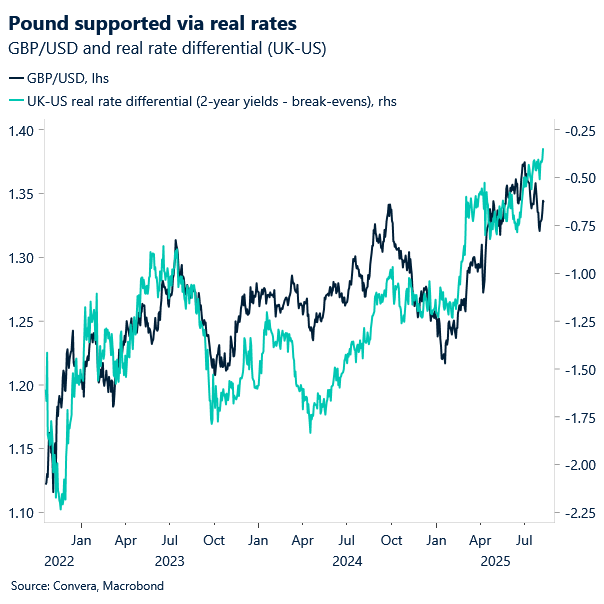
Two-year gilt yields recorded their biggest daily gain in a month and could prove to be a key support for sterling. However, the UK is grappling with a stagflationary mix: stubborn inflation and weakening growth. Services inflation remains elevated, while real GDP contracted in April and May. So, this toxic backdrop might cap how much support sterling can draw from higher yields over the long term, especially as its real yield advantage might diminish.
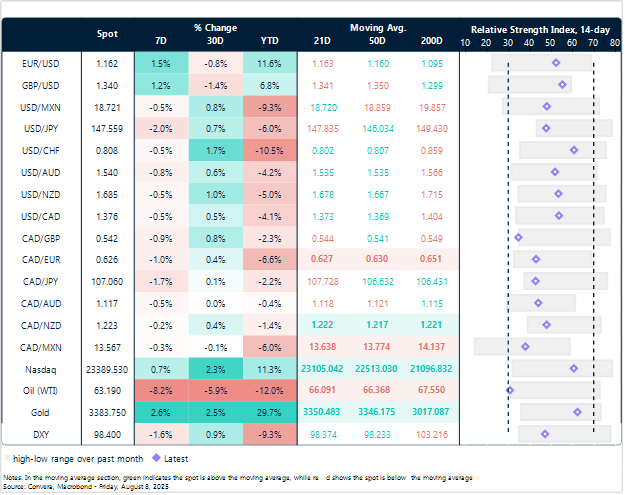
Still, GBP/USD has now risen for five days straight, its best streak since mid-April, and trading over 1% higher so far this week to reclaim the $1.34 handle. Meanwhile, GBP/EUR is primed for its best week in seven, attempting to overthrow the 21-day moving average at €1.1525.
Euro eyes fresh highs amid monetary divergence
After enduring its steepest weekly drop of 2025, EUR/USD has staged a notable recovery this week, retracing nearly half of those losses and climbing back above the 21-day moving average. That average is now curving upward, signaling a potential build-up in short-term bullish momentum. The turnaround in sentiment has been swift, driven by growing expectations of Federal Reserve rate cuts and renewed optimism surrounding a possible Russia-Ukraine ceasefire.
On the macroeconomic side, European indicators have underwhelmed. Eurozone retail sales for June came in below forecasts, July’s private sector activity was revised downward, and German industrial production fell far short of expectations. Despite this, the euro may still find support from central bank dynamics. With the European Central Bank nearing the end of its tightening cycle – markets now pricing in a 60% chance of just one more rate cut this year – compared to the Fed, which is expected to accelerate its easing pace, the euro stands to gain from this policy divergence.
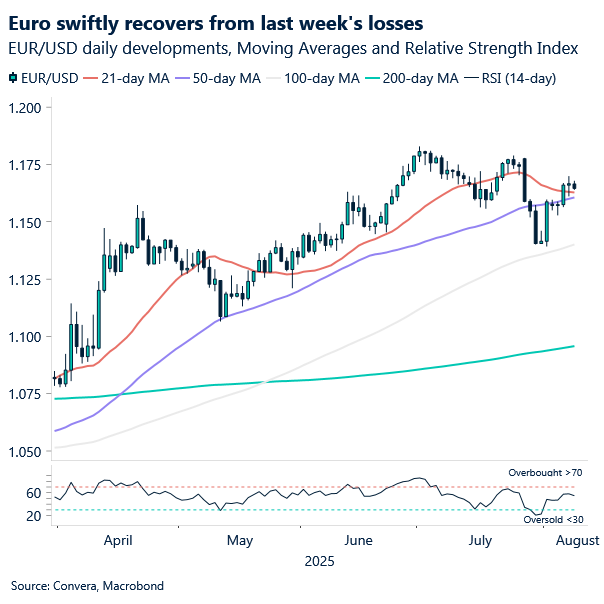
We see $1.18 as a short-term target, with $1.20 possible before year-end. If this plays out, it should keep GBP/EUR gains capped, despite the hawkish BoE decision yesterday casting doubt on the path for UK rates.
Elsewhere, the Swiss franc remains under pressure as US tariffs and the prospect of negative interest rates erode its appeal, whilst optimism on a Ukraine-Russia truce reduces safe haven demand. Unless geopolitical and trade tensions escalate, prompting a spike in volatility, we think franc selling pressure will persist even though it looks oversold in the short term.
Oil plunges 8% over the last 7 days
Table: Currency trends, trading ranges and technical indicators
Key global risk events
Calendar: August 4-8

All times are in ET
Have a question? [email protected]
*The FX rates published are provided by Convera’s Market Insights team for research purposes only. The rates have a unique source and may not align to any live exchange rates quoted on other sites. They are not an indication of actual buy/sell rates, or a financial offer.ve a unique source and may not align to any live exchange rates quoted on other sites. They are not an indication of actual buy/sell rates, or a financial offer.