

USD: Japanese intervention drives broad dollar pullback
The US dollar came under broad pressure on Thursday following a sharp surge in the Japanese yen. USD/JPY dropped roughly 3% — the yen’s largest one‑day move in nearly two years amid strong indications of official intervention. This mechanically dragged the broader dollar lower given the yen’s heavy weight in the US dollar index .
The move followed a prolonged stretch of yen weakness, with the currency trading beyond 160 per dollar and hovering near multi‑decade lows. At those levels, policymakers had growing reason to intervene, as yen depreciation was amplifying imported inflation pressures at a time when energy costs are already elevated. The backdrop was further complicated by this week’s decisions from both the Bank of Japan and the Federal Reserve to leave policy rates unchanged, reinforcing a wide interest‑rate differential that has favoured the dollar for months.
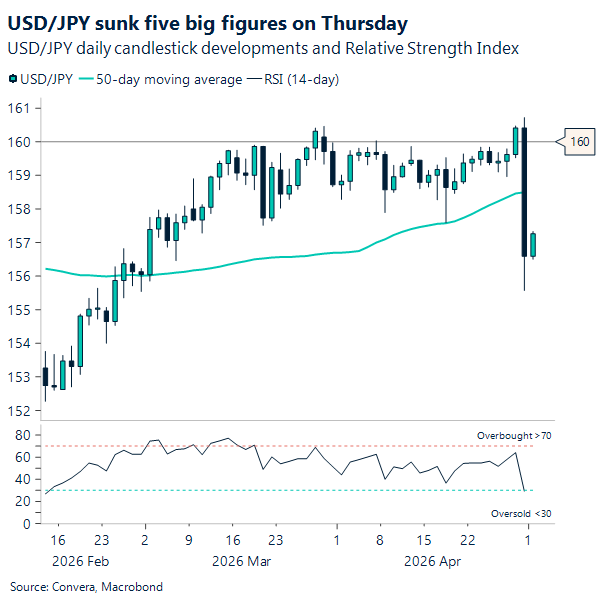
Attention now turns to whether this marks the start of a sustained intervention campaign or a tactical warning shot. Previous episodes in 2022 and 2024 show that a single round of yen buying is rarely sufficient to reverse entrenched trends. The key variable remains coordination: any indication of US support would significantly raise the deterrent effect on speculative positioning.
Macro monitor
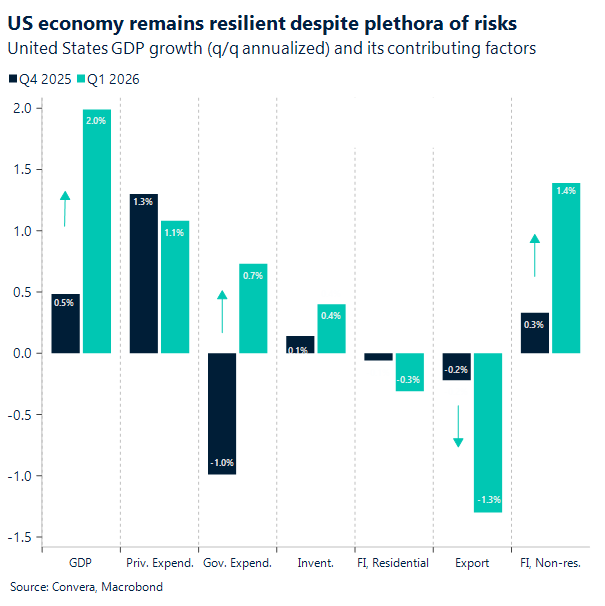
Beyond FX, US macro data continue to underscore relative economic resilience. Growth in the first quarter held close to a 2% annualised pace, underpinned by firm consumer spending and robust business investment, particularly in AI‑related equipment and infrastructure. Price pressures remain sticky, with core PCE inflation accelerating to its fastest pace since 2022, while jobless claims fell to multi‑decade lows, signalling that softer hiring intentions have yet to translate into meaningful labour market stress.
Taken together, strong earnings momentum and sustained AI investment are cushioning the US economy against geopolitical headwinds — a backdrop that limits dollar downside even as FX dynamics temporarily favour its peers.
EUR: ECB prepared to hike in June
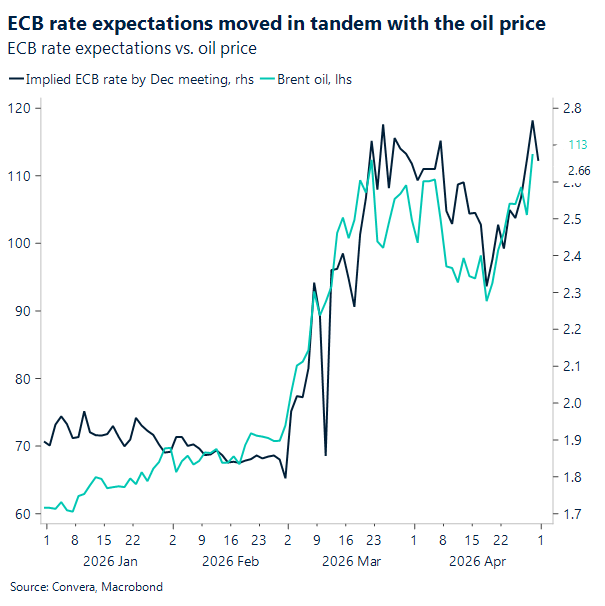
EUR/USD moved higher as the yen’s sharp appreciation triggered a broader bout of dollar selling across G10, but the European Central Bank’s (ECB) hawkish policy meeting also played a role to help the currency pair back above the 1.17 handle. While the Governing Council left rates unchanged at 2% as expected, President Lagarde’s press‑conference remarks introduced a clearer hiking bias than markets had anticipated. Markets interpreted the outcome as a further step toward a June rate hike – now priced at almost 90%.
Most notably, Lagarde confirmed that a rate hike was actively debated, even though the final decision to hold was unanimous. That acknowledgement alone marks a shift. The ECB also emphasised that the Eurozone economy has moved away from the March baseline scenario, citing heightened risks to both growth and inflation. With headline inflation pressures intensifying amid the Middle East conflict — and the risk of broader supply‑chain spillovers — the ECB is signalling growing discomfort with maintaining a purely wait‑and‑see stance.
That said, the policy trade‑off remains acute. Recent data point to rising stagflationary pressures: softer Q1 growth, tightening credit conditions, weaker loan demand, and falling core inflation in parts of the bloc. This raises uncomfortable parallels with 2011, when the ECB tightened into an exogenous shock, only to reverse course as growth deteriorated. While a June hike has become more likely, its economic justification remains fragile, and markets will question whether such a move would be symbolic rather than stabilising.
The euro’s reaction was constructive and it cemented a strong April performance of over 1.5% against the dollar. However, EUR/USD continues to trade alongside oil prices but mainly broader risk sentiment, reflecting ongoing uncertainty around US–Iran developments. Yesterday’s rebound reinforces the prevailing regime: the euro is supported by a hawkish tilt at the ECB and fading USD war premium, but conviction remains conditional. Absent either a decisive geopolitical resolution like the Strait of Homurz reopening, or a clear policy follow‑through, EUR/USD is likely to remain supported on dips rather than break out decisively higher.
GBP: BoE on “active hold”
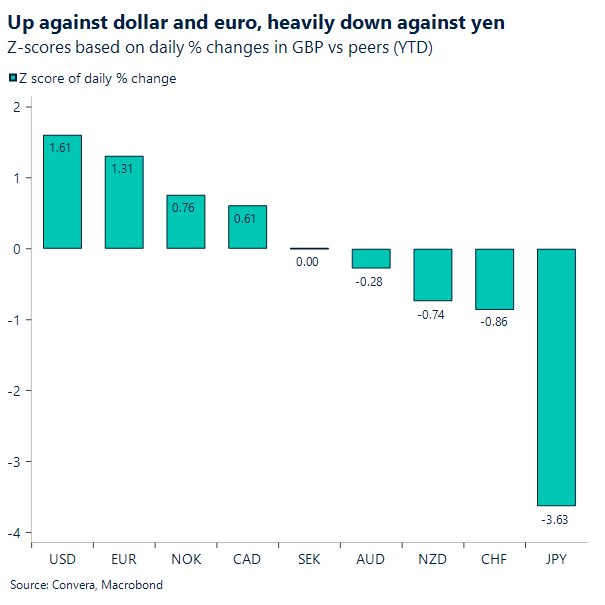
Sterling price action was driven far more by global FX dynamics than domestic policy signals, as the sharp surge in the Japanese yen destabilised USD crosses and spilled into GBP pairs. GBP/JPY fell aggressively as the yen strengthened, while GBP/USD climbed back toward the 1.36 handle as broad dollar weakness dominated. While the Bank of England’s (BoE) policy decision leaned modestly dovish, it was the yen‑led USD move that ultimately set the tone for the pound.
The BoE kept Bank Rate unchanged at 3.75% in a decisive 8–1 vote, reinforcing a preference for patience amid rising external uncertainty. Policymakers acknowledged that renewed energy disruptions linked to the Iran conflict are likely to keep inflation above target for longer, but showed little appetite to respond mechanically to what they view as a supply‑driven shock.
Governor Bailey struck a measured tone, stressing that higher energy costs are landing on an economy already characterised by cooling labour markets, subdued money growth and tight financial conditions. In contrast to 2022, policymakers appear more concerned about exacerbating the slowdown than chasing inflation higher through additional tightening. The emphasis was firmly on restraint rather than complacency. Notably, Bailey’s comment that monetary policy can do little to offset oil‑driven cost pressures reinforced the sense that the Bank is prioritising flexibility over pre‑commitment.
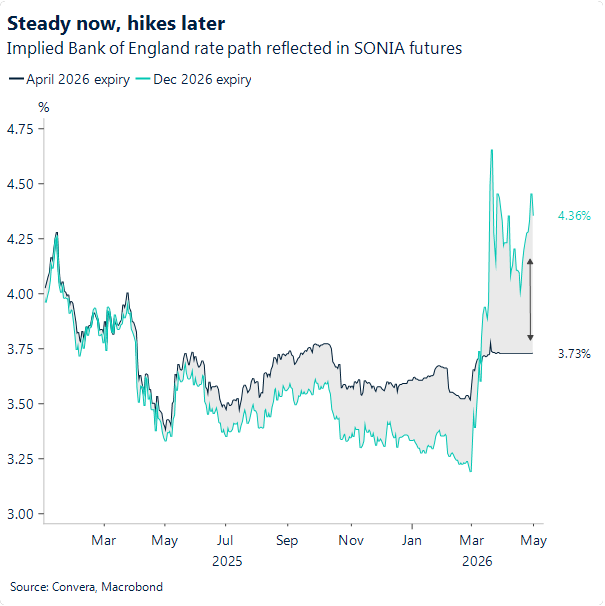
Markets read the communication as marginally dovish. Gilt yields edged lower across the curve, led by a sharp decline in the front end, as investors pared expectations for further hikes. Sterling softened initially following the decision, but price action quickly became dominated by yen‑driven USD weakness rather than UK‑specific factors.
From a technical perspective, GBP/USD has surged further north of key daily moving averages after testing the 100‑day moving average support this week. This suggests momentum has picked up after a period of consolidation as we hinted at yesterday. A clean break of 1.36 could set the stage for a run at 1.38 which last traded back in late January.
Market snapshot
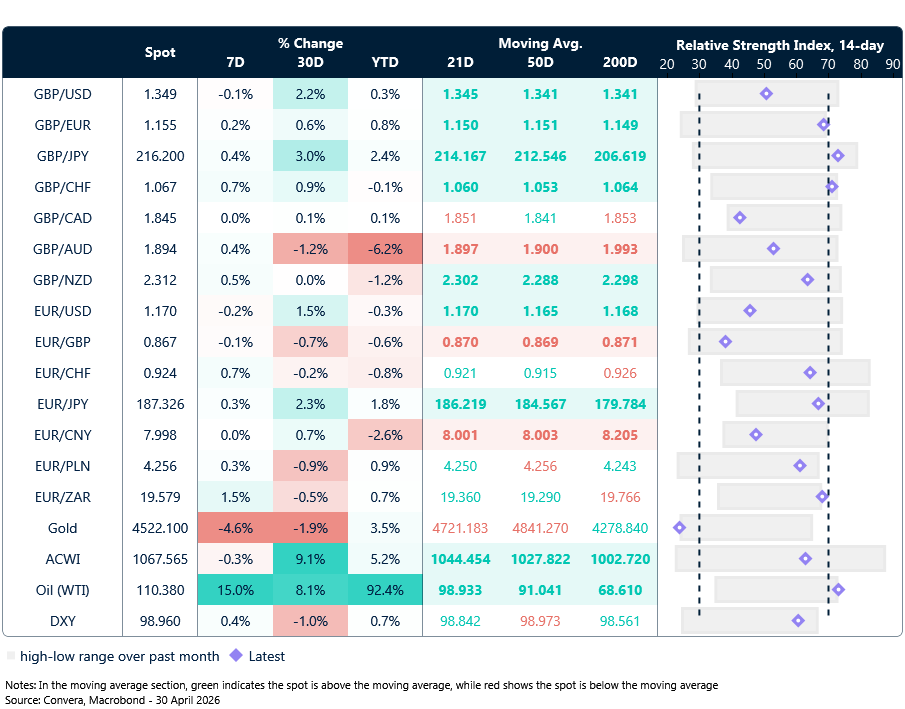
Table: Currency trends, trading ranges & technical indicators
Key global risk events
Calendar: April 27-May 01
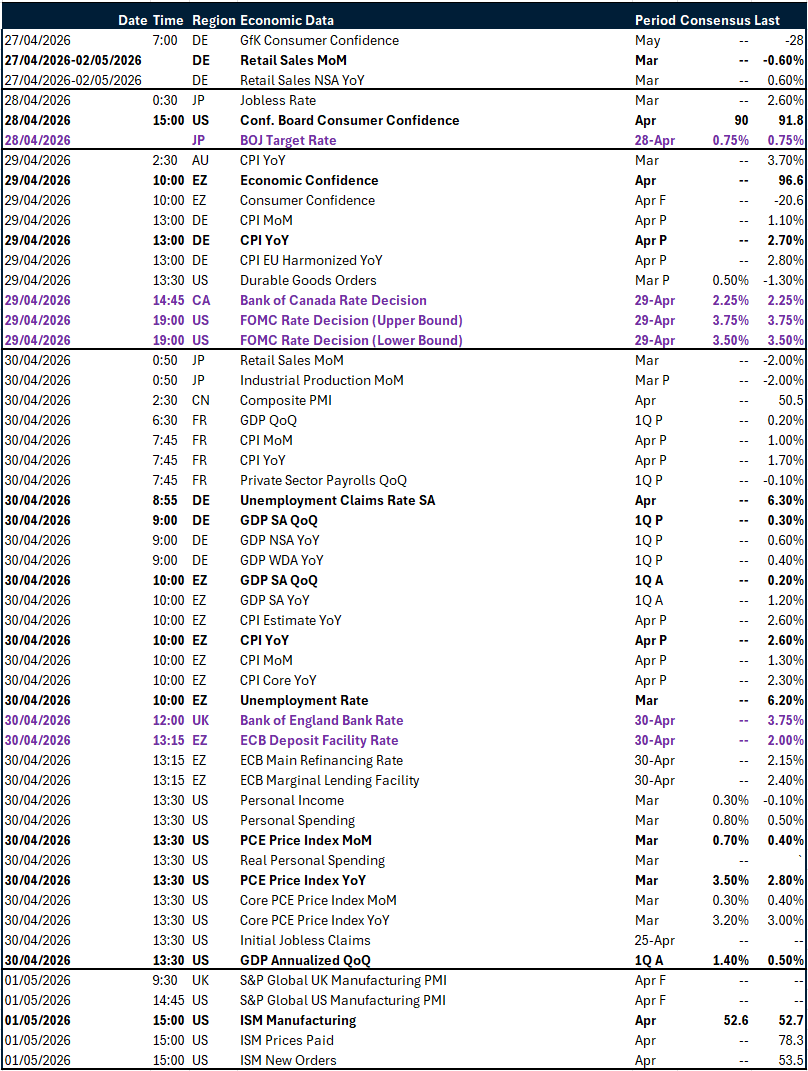
All times are in BST
Have a question? [email protected]
*The FX rates published are provided by Convera’s Market Insights team for research purposes only. The rates have a unique source and may not align to any live exchange rates quoted on other sites. They are not an indication of actual buy/sell rates, or a financial offer.