


Rare earths, tariffs and a TACO walk-back
Analysts and economists spent their weekend doing the now-familiar scramble, trying to decipher the fallout from the latest US-China trade spat, this time sparked by China slapping tariffs on rare earth exports. Naturally, President Trump responded in true Trump 47 fashion via a Truth Social post that sent markets spinning. Cue the usual chaos, followed by a classic, and rather humiliating, TACO climbdown that left everyone wondering what the point was in the first place.
The US Dollar (USD) retreated into the end of the week, giving up some of its earlier gains as this fresh round of US-China tensions blindsided investors, proving that the tit-for-tat skirmishes are far from over. Beijing fired the opening shot this time, unveiling a comprehensive and seemingly out-of-nowhere set of export controls on rare earth elements and certain lithium-ion batteries, critical inputs for US tech, defense, and auto giants. The move, which could put a chokehold on key supply chains, prompted a dramatic response from President Trump, who threatened to double existing tariffs on Chinese imports by an additional 100% come November 1st. On the surface, China’s actions signaled a clear willingness to weaponize its economic leverage, putting the Trump administration in a tight spot.
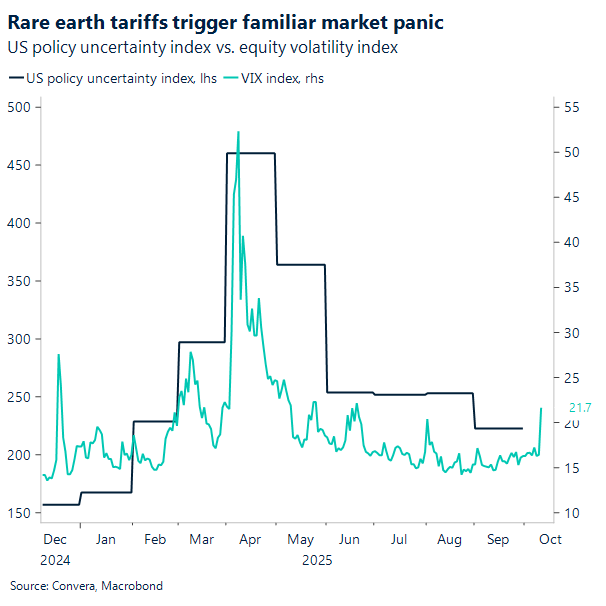
By Friday, markets had already gone into panic mode. The mere threat of sweeping new tariffs, combined with the real supply-chain risks from China’s rare earth restrictions, sent investors scrambling. The tech-heavy Nasdaq Composite took a heavy hit, plunging 3.6% (820 points), while the broader S&P 500 logged its worst day since April, sliding 2.7%. Investors rushed into safe-haven assets, pushing 10-year Treasury yields lower and weakening the broad dollar index. The message was clear: China has the strategic capability to hit the very tech firms that have powered the US market’s recent highs.
By Sunday, however, the tone shifted. Trump took to social media again, telling everyone to “not worry about China,” in what looked like a de-escalation attempt. Meanwhile, China’s Commerce Ministry issued a statement saying, “we do not want a tariff war, but we are not afraid of one,” urging the US to resolve differences through dialogue and calling repeated tariff threats “not the correct way to get along with China.”
The administration’s trade strategy, which had gone back on the offensive earlier this year to force China’s hand, now appears to be backpedaling. The latest skirmish ended in a temporary truce after fears of a “sudden stop” to the global economy briefly seized markets on Friday.
Markets are poised to bounce on Monday, but caution will linger. With China not only limiting access to crucial industrial materials but also maintaining its freeze on US soybean purchases, the headwinds for President Trump, and American farmers, are unlikely to ease. Trump may try to show a willingness to negotiate by keeping his planned meeting with President Xi and dialing back tariff threats. But if he chooses the hardline route, it could prove a costly gamble, one that leaves US industries, not Beijing, footing the immediate bill.
To make matters more complicated, the Treasury’s decision to extend a swap line to Argentina, aimed at stabilizing its collapsing peso, has drawn sharp criticism from domestic stakeholders, particularly US farmers. With agricultural exports already under pressure from China’s retaliatory freeze and broader global demand weakness, many in the Midwest see the Argentina lifeline as a misallocation of resources that could have been better directed toward struggling domestic sectors.
In the bigger picture, this latest escalation sharpens the focus on who can unwind their dependencies faster. China is aggressively building domestic capacity to reduce its reliance on US tech, especially in semiconductors. Meanwhile, the US faces a long and difficult road to break free from China’s near-total control over rare earth processing. With no major macro data on deck this week, markets will turn their attention to Q3 earnings. Thirty-six S&P 500 firms are set to report, with financials in the spotlight. BlackRock, Wells Fargo, JPMorgan Chase, Goldman Sachs, and Citigroup kick things off Tuesday, followed by BofA and Morgan Stanley on Wednesday. One key will be whether the broader S&P 500 universe will suffer any margin erosion from elevated heights. A possible reason could be supply chain cost pressures, including but not limited to tariffs, as a first-round response, versus whether productivity and cost controls, including reduced hiring, may be offsetting.
EUR: Euro politics – rinse and repeat
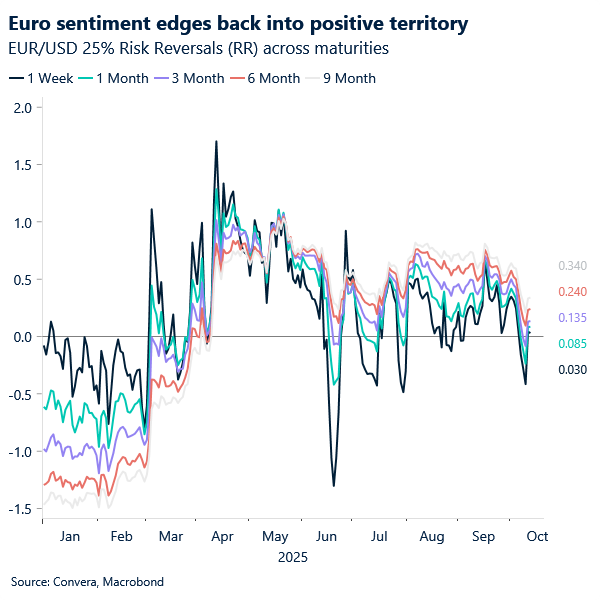
The euro’s recent drop was largely sentiment-driven, following the second collapse of the French government in under a month. While Friday’s reappointment of Sébastien Lecornu likely marks the end of the most acute phase of euro-negative headlines, the political backdrop remains fragile.
The move risks deepening France’s political impasse – after facing heavy criticism over his proposed cabinet, Lecornu’s renewed push to pass the 2026 budget looks ambitious at best. Investor perceptions aren’t likely to improve either, reinforcing the sense of limited alternatives amid a deeply fractured parliament. This political fix is poised to have limited upside for the euro, with the currency more likely to tilt south on politics alone.
We see 1.16 as favourable short-term support for the euro, which will tune in closely to fresh central bank signals this week – including Lagarde and Cipollone on the ECB side, and Powell, Bowman, and Waller on the Fed side. But with well-telegraphed rhetoric expected from both sides of the Atlantic, the next meaningful directional impetus is likely to come from the September BLS US inflation report, due despite the ongoing shutdown, now expected at an as-yet-unconfirmed date this month (it was initially scheduled for this Wednesday).
Meanwhile, keep an eye on the final inflation prints across eurozone members – given how central inflation is to the ECB’s policy outlook, any non-negligible undershoot will carry more weight than usual in swaying the bank toward another cut.
GBP: UK jobs report in focus
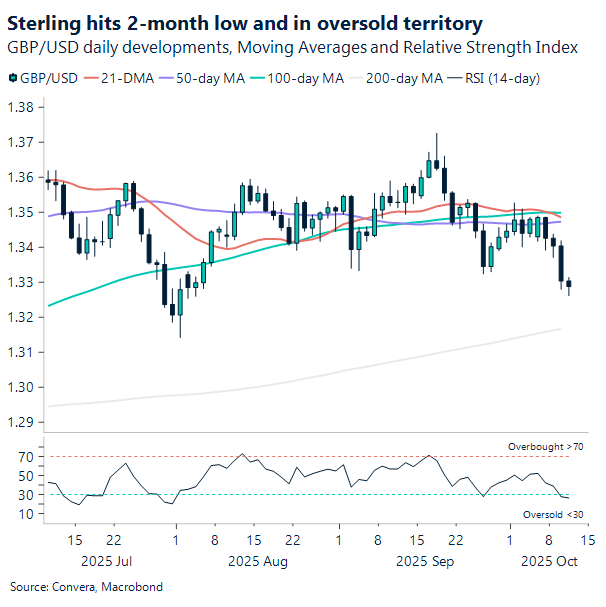
Sterling dropped to a fresh two-month against the US dollar last week, pressured by firm dollar demand amid rising global political risks. Despite oversold conditions, momentum remains strongly bearish, suggesting further downside risk for GBP/USD in the near term, with $1.3173 a potential target.
With no major data releases last week and UK-US yield spreads holding steady, sentiment took the reins in driving sterling’s performance. GBP risk reversals — particularly the 2-month tenor — continued to decline, reflecting growing demand for downside protection and a rising premium against potential pound weakness heading into the UK Budget risk event. Moreover, the pair’s vulnerability is compounded by safe-haven flows into the dollar following developments in Japan and France.
Attention turns to Tuesday’s UK employment report covering the three months to August. This jobs print could be pivotal in shaping near-term expectations for Bank of England policy and sterling’s trajectory. While technical indicators show stretched positioning, the prevailing trend points to continued weakness in sterling.
Sterling shows mixed positioning across the board
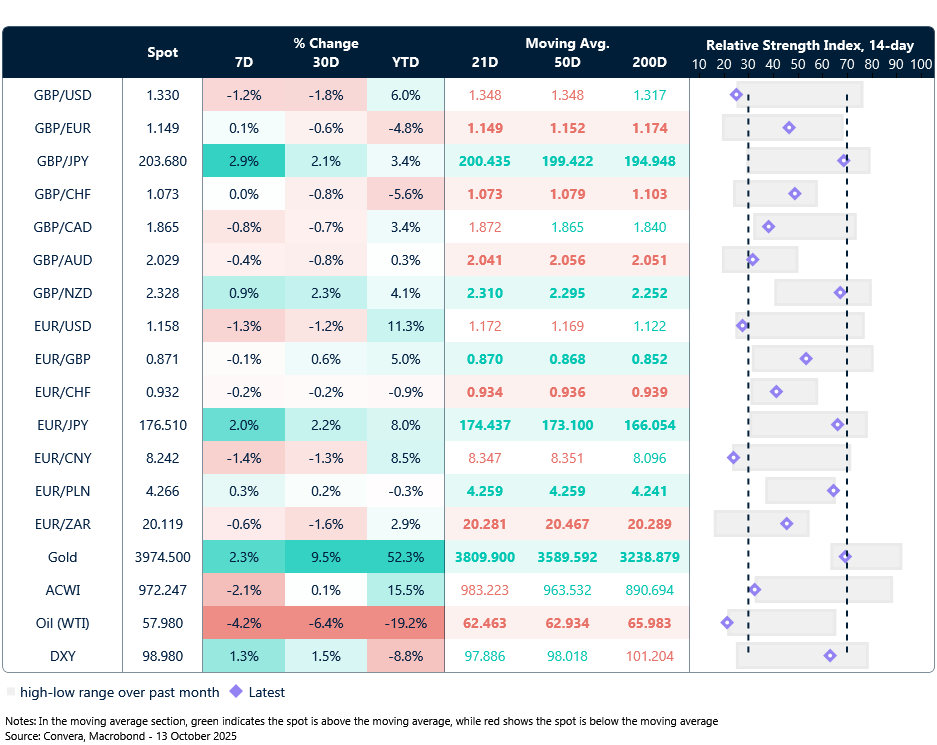
Table: Currency trends, trading ranges and technical indicators
Key global risk events
Calendar: October 13-17
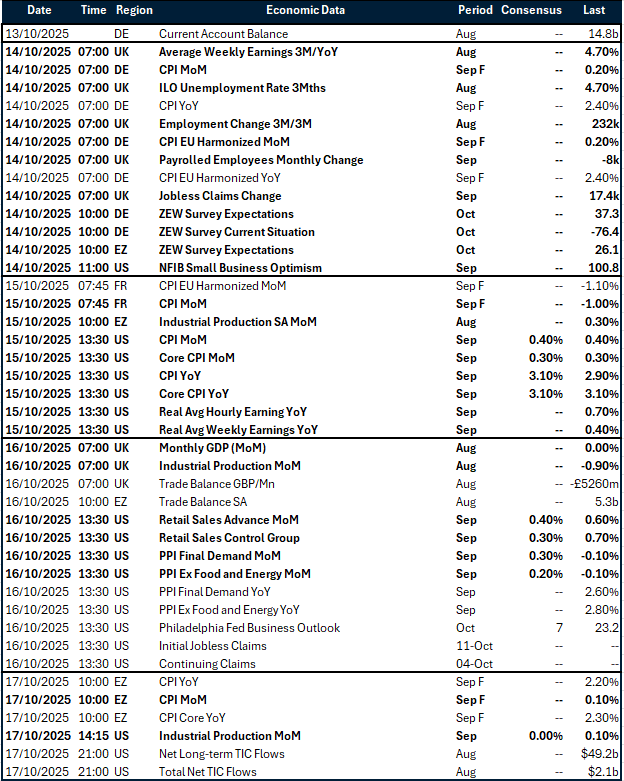
All times are in BST
Have a question? [email protected]
*The FX rates published are provided by Convera’s Market Insights team for research purposes only. The rates have a unique source and may not align to any live exchange rates quoted on other sites. They are not an indication of actual buy/sell rates, or a financial offer.