

CAD: Strong rally
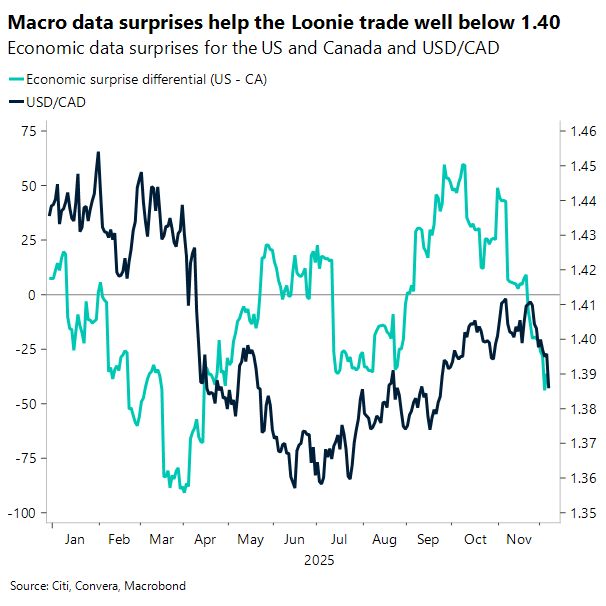
The Canadian Dollar had its best two-week rally since early April, appreciating by 1.9% from a recent 6-month high of 1.414 to 1.383 against the US Dollar. This significant recovery was primarily fueled by a series of surprisingly upbeat macro data that defied market expectations of a slowing economy. Specifically, the Q3 annualized GDP growth dramatically outperformed, hitting 2.6% versus the anticipated 0.5%, the unemployment rate unexpectedly declined from 7.0% to 6.5%, and labour productivity saw a solid 0.9% increase in Q3.
As pointed out a few weeks ago, there were tentative signs of stabilization in the Canadian economy. Although deeper analysis reveals underlying weaknesses in the labor market and domestic demand, these stronger-than-expected headlines have been sufficient to support the CAD recovery given the dispersion in economic surprise, leading markets to now price the next Bank of Canada (BoC) move as a hike, though not significantly until the second half of 2026. However, as trade policy appears back in the spotlight, persistent long-term trade uncertainty may continue to slow further gains.
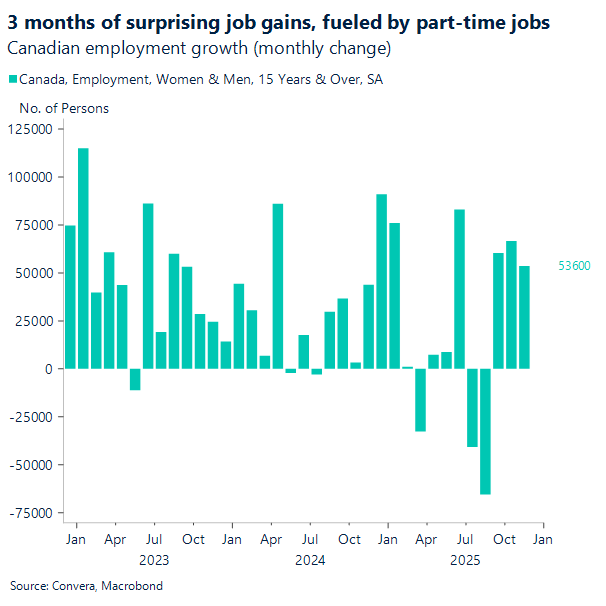
Speaking of the recent labour market report in specific, it showed signs of renewed momentum in November, marked by the third consecutive monthly increase in employment, adding 54,000 jobs (a 0.3% rise). This positive trend led to a noticeable improvement in key labour indicators: the unemployment rate fell significantly by 0.4 percentage points to 6.5%, and the employment rate climbed to 60.9%. However, the nature of job growth was concentrated in specific areas, primarily driven by a surge in part-time employment and centered on youth aged 15 to 24, who saw a substantial gain of 50,000 jobs. Industrially, the largest gains were recorded in Health Care and Social Assistance (+46,000) and Accommodation and Food Services (+14,000), while Wholesale and Retail Trade experienced the biggest monthly decline (-34,000). Regionally, Alberta led the country with a major employment increase (+29,000), pushing its unemployment rate down to 6.5%.
Despite the encouraging headline numbers, the survey highlighted growing concerns over job stability among employees. Nearly one quarter of employees (26.4%) expressed feeling insecure in their jobs, a noticeable drop in perceived security compared to two years prior. Furthermore, employee confidence in their future employability also declined, with the share of workers who felt it would be easy to find another job with a similar salary falling by 6.2 percentage points since November 2023. This insecurity was particularly acute in certain sectors, such as Public Administration, which recorded the sharpest decline in perceived job security. Overall, while the official labour statistics point to a strengthening market with falling unemployment and rising average hourly wages (up 3.6%), these underlying employee sentiment indicators suggest a labour environment marked by greater economic uncertainty and caution.
USD: It’s Fed week
The Federal Reserve is entering a critical juncture, and its independence is under intense scrutiny. Speculation is mounting that Kevin Hassett, a vocal advocate for aggressive rate cuts, could be nominated to replace Chair Powell in May 2026. That possibility alone raises alarms about political influence, especially given the administration’s push for lower rates. The concern is that decisions may appear driven by politics rather than the Fed’s data-dependent mandate.
This tension comes to a head at the upcoming Fed meeting, where markets are pricing in a near-90% chance of a rate cut. Yet, the vote is unlikely to be unanimous. A fractured outcome, perhaps 7-5, would underscore the dilemma: how to support a cooling labor market without reigniting inflation, which remains stubbornly near 3%. A cut perceived as politically motivated rather than grounded in economic conviction risks being ineffective, or worse, counterproductive.
The economic backdrop complicates matters further. Growth is slowing, not accelerating. While PCE inflation met expectations, real consumer spending has eased to 2.1% year-over-year, challenging the narrative of robust demand and strengthening the case for easing. But fiscal headwinds loom large. A ballooning deficit could worsen if the Supreme Court curtails executive tariff authority, forcing heavier Treasury issuance. That supply surge would pressure yields higher, even as the Fed lowers short-term rates, creating an undesirable steepening of the curve. The result: mortgage and auto loan costs stay elevated, undermining the very goal of rate cuts.
For the U.S. Dollar, this mix of monetary vulnerability and fiscal uncertainty is toxic. A steeper curve and doubts about central bank independence weigh heavily on the currency. Add in tariff-related risks, either higher inflation or deeper deficits, and structural pressure intensifies. The Dollar’s path of least resistance looks lower.
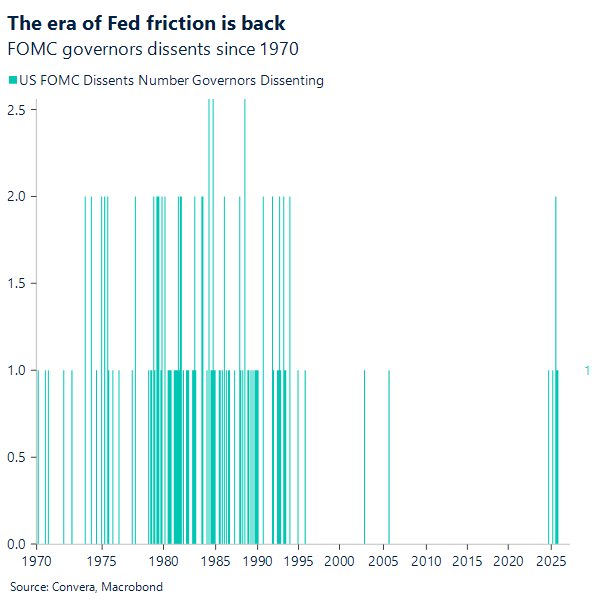
Markets will be laser-focused on the Fed’s new dot plot and projections this week, especially as confidence erodes that the Chair reflects consensus.
While AI-driven market fears have largely subsided, the onset of the Fed friction era may define 2026 as a year where central bank independence becomes a dominant theme, shaping sentiment, volatility, and capital flows across global markets.
MXN: A new 2025 low
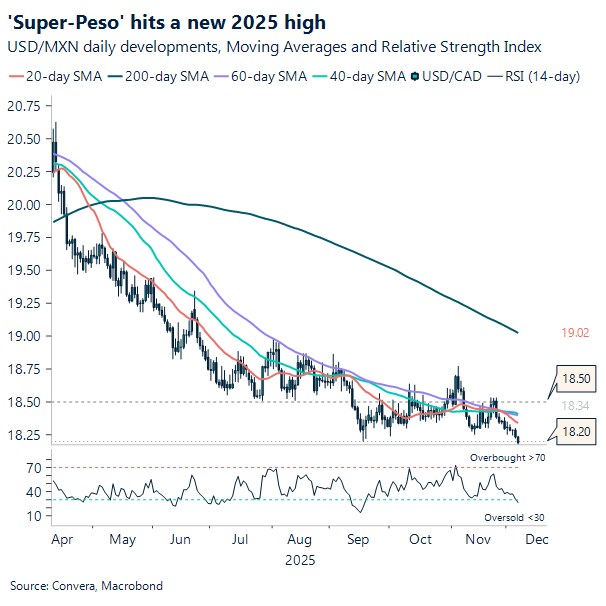
Despite a string of disappointing domestic data in recent weeks, the Mexican peso has extended its strong performance this year, buoyed by a weaker U.S. Dollar and a renewed risk-on tone across global markets. This dynamic has been the defining theme of 2025, keeping emerging market and Latin American high-yield currencies well supported. As a result, USD/MXN has broken out of its 18.20–18.76 consolidation range, at least momentarily, and posted a new year-to-date low at 18.18.
Banco de México’s (Banxico) Quarterly Report for July–September 2025 underscores the growing disconnect between currency strength and recent domestic fundamentals. The report revealed a sharp slowdown in Mexico’s economy, with third-quarter activity contracting primarily due to weakness in the industrial sector. Banxico cut its 2025 GDP growth forecast to just 0.3%, signaling deeper-than-expected economic softness and continued labor market cooling. External uncertainty, particularly trade tensions and evolving U.S. commercial policy, remains a key downside risk to growth. On inflation, progress is evident: headline CPI eased to 3.61%, back within the central bank’s variability range, driven largely by declines in non-core components such as energy and fresh food. However, core inflation edged higher to 4.25%, reflecting persistent stickiness in merchandise prices. Banxico still expects headline inflation to converge to its 3% target by Q3 2026. Financial conditions have improved, with the peso appreciating and government bond yields falling as global markets anticipate further rate cuts abroad.
The peso’s decisive break below 18.20 confirms strong technical momentum, supported by high-yield carry trade demand that markets expect to persist into Q1 2026. Still, the tension between a firm currency and a cooling domestic economy, highlighted in Banxico’s report, introduces risks that could cap further gains, particularly with the upcoming CUSMA review adding another layer of uncertainty.
Market snapshot
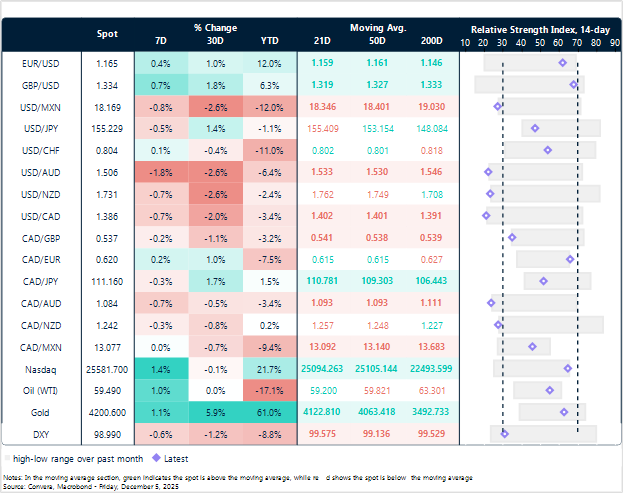
Table: Currency trends, trading ranges and technical indicators
Key global risk events
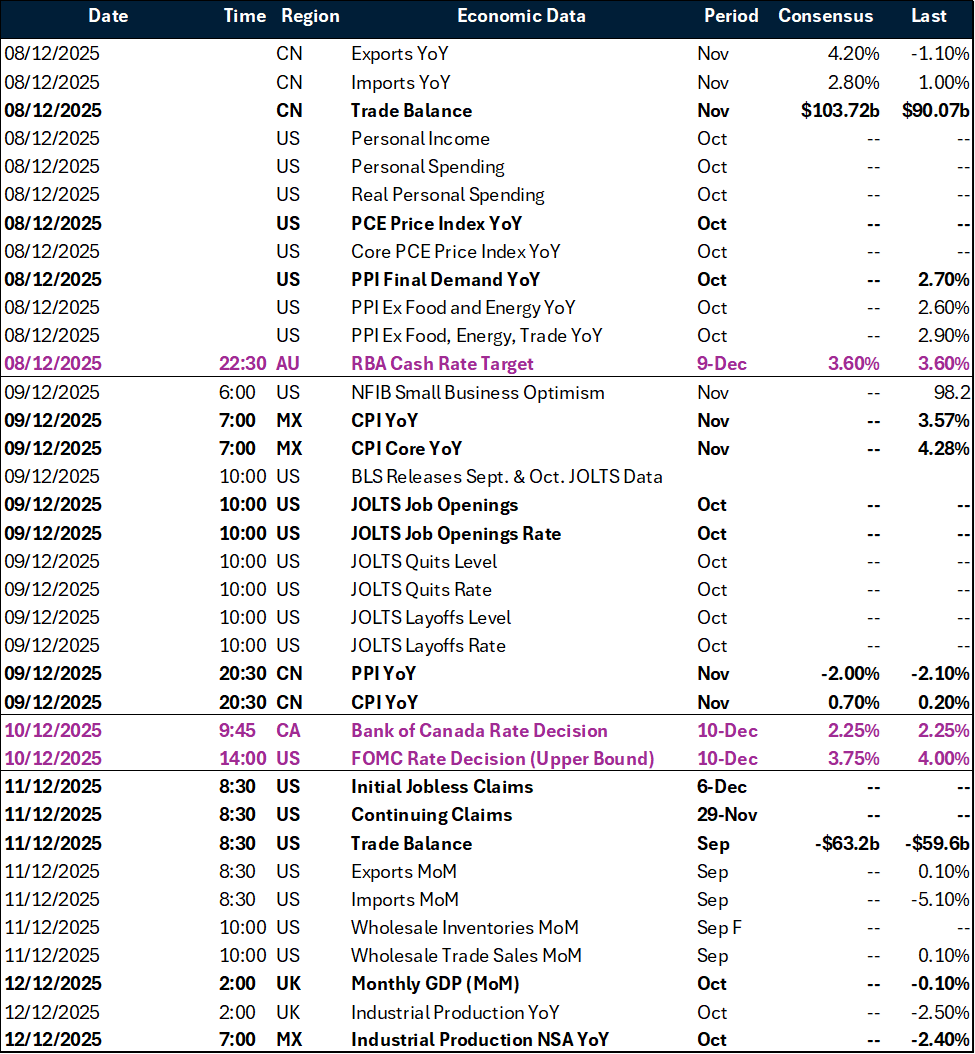
Calendar: December 08 – 12
Have a question? [email protected]
*The FX rates published are provided by Convera’s Market Insights team for research purposes only. The rates have a unique source and may not align to any live exchange rates quoted on other sites. They are not an indication of actual buy/sell rates, or a financial offer.