


CAD: Canada dodges election after tight budget vote
The budget squeaked through by just two votes, 170 to 168, giving Prime Minister Mark Carney a lifeline in Parliament and keeping his government intact. The win came thanks to a crucial nod from the Green Party leader and the fact that a few opposition MPs didn’t show up for the vote.
Carney’s plan lays out tens of billions in new spending on trade infrastructure, defense, and housing, while also pledging to slim down the public sector. It’s a mix of big-ticket investments and promises of restraint, and for now, it was just enough to keep an election off the table.
On the macro front, recent Canadian data point to tentative stabilization in an otherwise fragile economy, with both manufacturing and wholesale sales beating expectations in September and lifting growth momentum into the third quarter. Manufacturing sales jumped 3.3% month‑over‑month to their highest level since February 2025, driven by large gains in Transportation Equipment (+9.2%) and Petroleum and Coal (+5.3%), and producing the biggest quarterly rise in manufacturing sales since 2022. Capacity utilization in manufacturing climbed from 78.2% to 80.7%, signalling a meaningful pickup in production, especially in Ontario and Quebec’s auto and aerospace hubs, while inventories held steady and unfilled orders fell for a third straight month.
Wholesale trade also hit record highs in Q3, with September sales up 0.6%, led by Food, Beverage and Tobacco and Building Materials and Supplies; the sector’s inventory‑to‑sales ratio eased from 1.59 to 1.57, suggesting healthier turnover even amid lingering trade uncertainty. Provincial detail was encouraging: Ontario and Quebec powered the manufacturing rebound, and Alberta, Quebec, and British Columbia were the main drivers of wholesale growth.
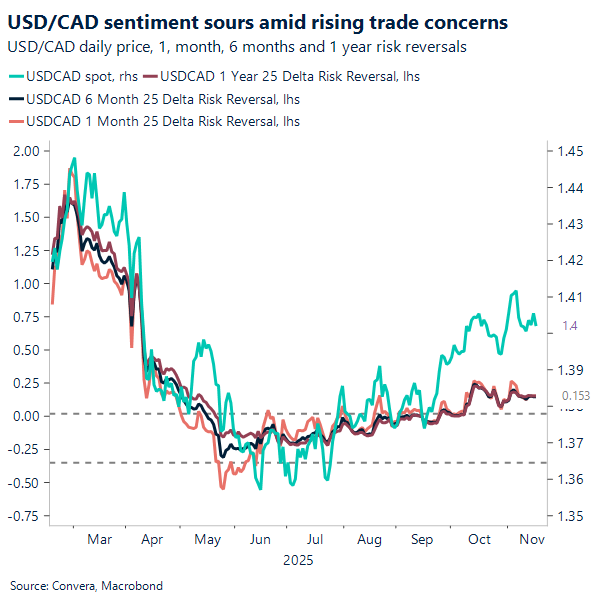
The recent domestic strength, along with the passing of the federal budget, has so far produced only a muted FX reaction, USD/CAD remains just above 1.40, and looks undervalued. Looking ahead, this week’s retail sales print will be the next test for the recovery story and will shape expectations for the Bank of Canada’s final policy meeting of the year.
EUR: Euro treads water
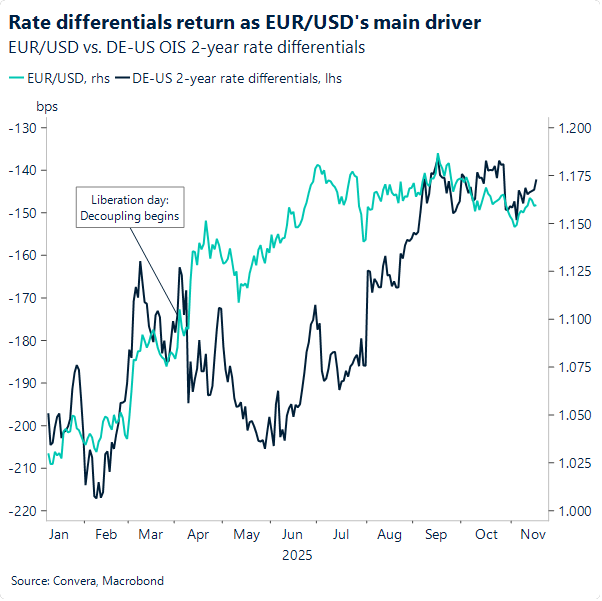
The euro treaded water around the 1.16 level against the dollar yesterday, with further important upside unlikely unless softer US macro data comes through. Meanwhile, the European Commission released its autumn outlook, projecting the euro area economy will maintain moderate expansion after weathering Trump’s tariff turmoil better than expected. The Commission upgraded its 2025 forecast relative to May (1.3% vs. 0.9%), while 2026 saw a minor downgrade (1.2% vs. 1.4%).
While little reaction was expected from the euro, the data nonetheless reinforces the familiar “we’re in a good place” mantra. Here, the contrast between a steadier ECB and an uncertain Fed makes the dollar the dominant driver.
Meanwhile, EUR/GBP, after hitting fresh year‑to‑date highs at 0.8865 on Friday, fell 0.2%, bouncing off support at 0.88 yesterday. We view this as profit‑taking, giving sellers an opportunity to step in at better levels, with further sterling downside likely. Sterling also found a mild lift from hawkish‑leaning remarks by BoE policymaker Catherine Mann, who warned that the UK is operating in “a more shock‑ridden environment,” with recent shocks continuing to give “an upward bias to inflation.”
GBP: Facing a tough backdrop
Sterling continues to face a difficult backdrop, shaped by soft UK data, dovish repricing of Bank of England expectations, and persistent political noise. The near‑term bias remains tilted toward weakness, with GBP/EUR offering the cleaner expression of downside risk, despite recently hitting over 2-year lows. For GBP/USD, a decisive break below $1.30 would likely require renewed dollar strength.
Technically, cable has struggled to reclaim its 21‑day moving average since closing beneath it in mid‑September, keeping the downtrend intact. Still, if US data surprises on the soft side and triggers a dovish shift in US rate expectations, scope exists for a retest of $1.33.
Nevertheless, the pound’s trajectory is closely tied to the Autumn Budget on 26 November. While the threshold for credibility should be relatively low given stronger underlying fiscal dynamics compared with other G10 peers, doubts linger. Months of speculation around the fiscal gap, the measures to address it, and the durability of government stability leave investors cautious. A credible Budget could help reduce sterling’s fiscal premium, but political risks are unlikely to fade quickly.
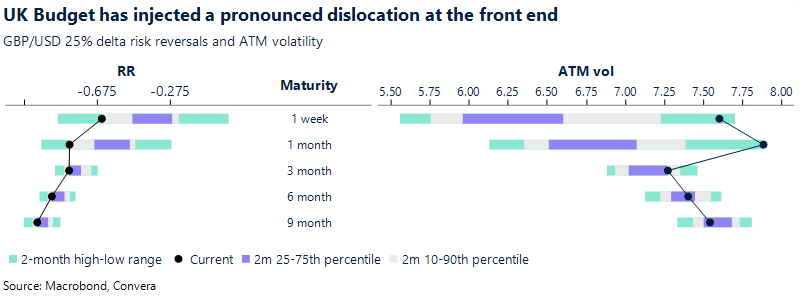
Options markets reflect this unease. GBP/USD’s volatility skew has widened to its largest since March, with downside protection becoming progressively more expensive at longer tenors. The Budget itself has injected a pronounced dislocation at the front end, underscoring the scale of event risk facing sterling.
MXN: Escalating rhetoric
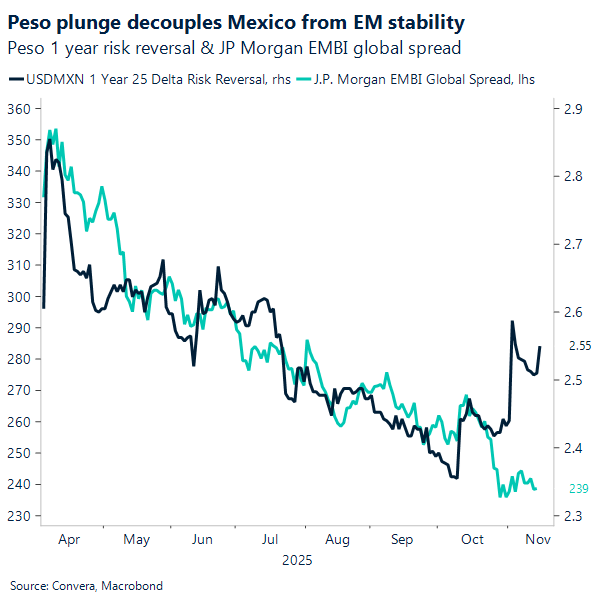
The Mexican peso took an immediate hit yesterday, dropping to a fresh session low against the US dollar following some rather inflammatory comments from President Donald Trump. During a White House press event on Monday, the President didn’t mince words, stating he would be “okay” with conducting strikes against Mexico if necessary to curb the flow of drugs, adding, “I am not happy with Mexico.” This sharp escalation in regional rhetoric clearly spooked the market. Furthermore, he indicated a similar willingness to act against drug targets in Colombia, saying he “would be proud to knock out Colombia drug factories.” This is exactly the kind of headline risk that currency traders and investors dread, highlighting how quickly geopolitical concerns can translate into market volatility.
It’s important to remember that the Emerging Markets (EM) trade has been one of the standout performers of 2025, yielding some of the year’s best returns so far. However, this sudden weakness in the peso and the accompanying shift in sentiment serve as a stark reminder of just how fragile these gains can be. Political or military rhetoric, even if not acted upon, injects a high degree of uncertainty, and the move in the Mexican peso is a classic example of capital fleeing risk at the first sign of trouble.
Japanese yen is worst performer across G10
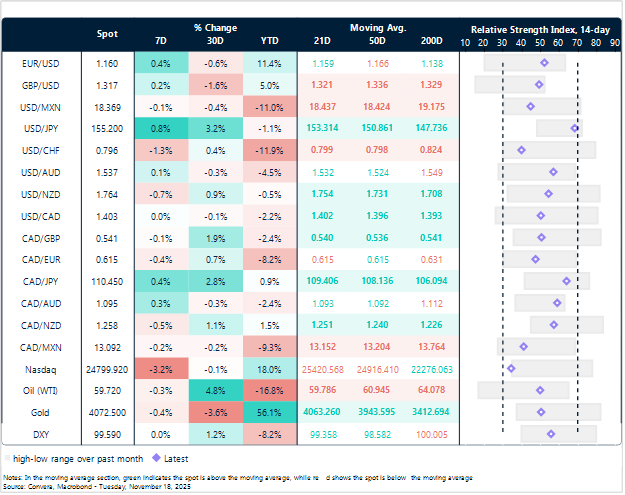
Table: Currency trends, trading ranges and technical indicators
Key global risk events
Calendar: November 17-21

All times are in EST
Have a question? [email protected]
*The FX rates published are provided by Convera’s Market Insights team for research purposes only. The rates have a unique source and may not align to any live exchange rates quoted on other sites. They are not an indication of actual buy/sell rates, or a financial offer.