


USD: Dollar range-bound
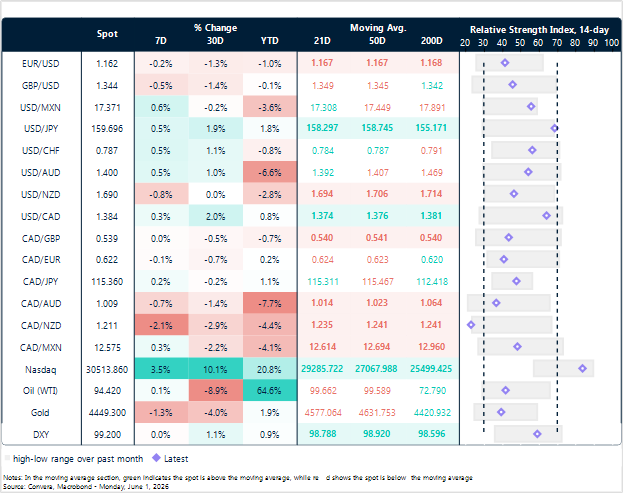
The US dollar had a relatively flat trading session yesterday, extending the range-bound behaviour it has exhibited for most of May into June. The 99 mark – reinforced by the 50-day moving average hovering nearby – acts as solid support, while 99.25 serves as the first resistance level, followed by 99.50 as the second.
Conflicting signals out of Hormuz, while investors continue to cling to a de-escalation narrative, appear to have frozen the dollar’s safe-haven appeal – and with it, its price action. A parallel risk-on tone in equities, led by AI-driven euphoria in US stocks, has further paralysed that appeal. At the same time, selling USD more aggressively remains unwarranted. Firstly, from a technical perspective, the DXY remains within the below-100 corridor it consolidated into following heavy sell-offs tied to tariff jitters in early 2025. Secondly, a resilient macro backdrop, coupled with accelerating price pressures, is keeping hawkish expectations elevated. Against this backdrop, accompanied by declining FX volatility, the US dollar maintains its carry appeal, which offsets a more subdued safe-haven tone.
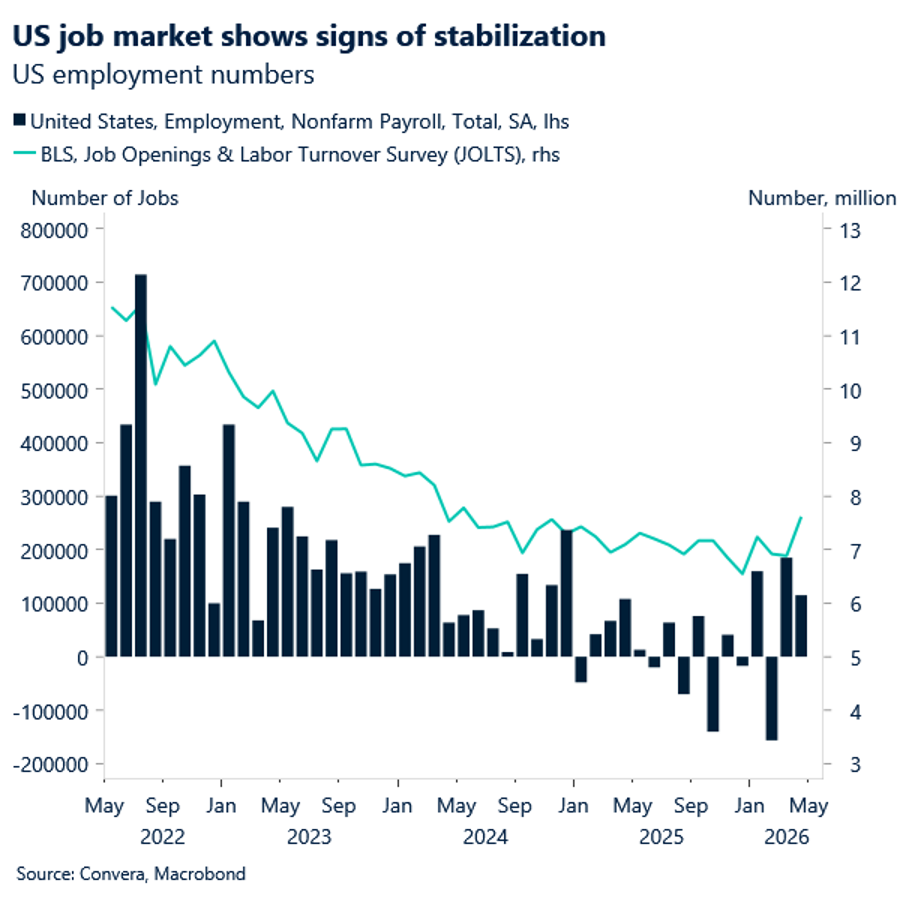
Meanwhile, yesterday saw the release of April’s JOLTS report. While the series is typically quite volatile, the near two-year high in job openings – significantly exceeding expectations with a 750k upside surprise – was notable. At the same time, the quits rate, a key gauge of employee confidence in securing new employment, came in below expectations. Overall, the data continue to point to a resilient labour market despite ongoing geopolitical concerns, while also reinforcing the case for a more hawkish-leaning Fed this year. In response, the 2-year OIS curve – a key measure of Fed expectations – has risen by nearly 7 bps so far this week, further supported by Monday’s upbeat ISM manufacturing report.
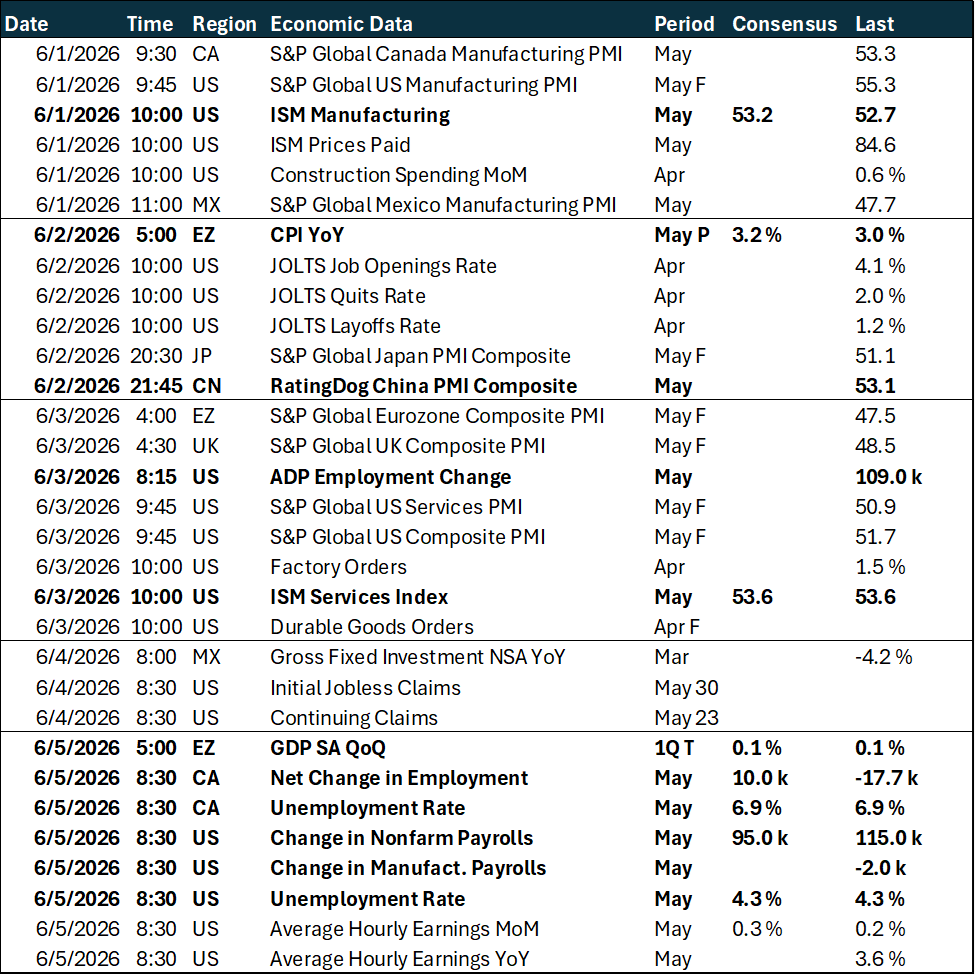
Today, focus shifts to the ISM services counterpart and ADP numbers. A likely solid outcome – supported by continued AI momentum in the services sector – is unlikely to move the USD much despite continued upside risk to front-end rates. We believe that the proximity to the much-anticipated June policy meeting, with Kevin Warsh in charge, may prompt investors to hold back on more meaningful USD buying just yet. Market participants are likely to wait for clearer signals from Warsh’s communication and policy guidance. This will serve as a useful diagnostic to confirm whether risk premia linked to fears of politically driven dovishness have receded, potentially paving the way for more constructive hawkish support for the dollar.
CAD: Weak momentum ahead of CUSMA review
Canada’s economy has now slipped into a technical recession, with real GDP falling 0.1% q/q SAAR in Q1 2026 after a 1.0% annualized decline in Q4 2025. That Q4 print was also revised down from -0.6%, making the downturn look deeper than initially thought. Just as importantly, the Q1 result missed the roughly 1.5% market consensus by a wide margin.
The composition of growth was also soft. Headline demand declined 0.4% q/q SAAR, with weakness driven primarily by a worsening trade balance and sharp declines in both residential and non-residential investment. Higher oil prices did provide some support through improved terms of trade and firmer nominal income, with corporate incomes rising 1.6%, but that support was not broad enough to offset weakness elsewhere. Export gains in energy were counterbalanced by softness in more trade-sensitive sectors, especially autos, where ongoing US tariff friction remains a drag. In other words, the commodity backdrop helped cushion income, but it did not generate enough momentum to keep real activity expanding.
The bigger problem remains at home. Final domestic demand dipped 0.1%, business fixed investment fell 3.0% annualized, and the household saving rate dropped to 3.5%, a two-year low. At the same time, cyclical headwinds are becoming more visible: debt servicing costs are rising, confidence is softening, and the labor market is losing momentum, with payroll employment falling by 32k in March. While the Bank of Canada’s latest Financial Stability Report suggests that higher rates have so far had only limited pass-through to mortgage arrears, the broader macro picture still points to softer demand, more cautious firms, and households leaning more heavily on dissaving as energy-related price pressure erodes purchasing power. Taken together, the commodity support is cushioning the economy, but it is not strong enough to offset weaker domestic demand, deteriorating trade dynamics, and fading investment. That leaves Canada entering mid-2026 with a fragile growth backdrop and a weaker macro-outlook relative to peers.
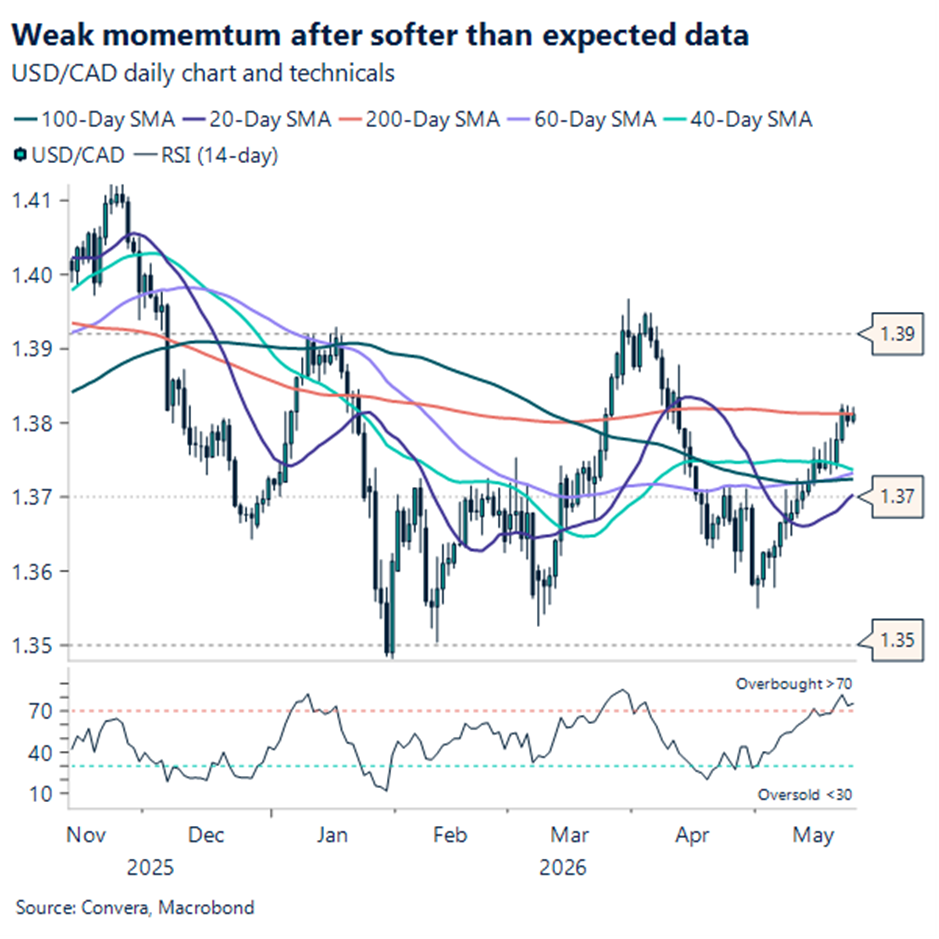
For the Canadian dollar, that softer domestic story continues to argue for caution. Starting this week, renewed Middle East tensions kept risk appetite uneasy, while the US–Canada 2-year spread near 120bp continued to favor the US dollar on carry. Even so, weaker US spending data and a downward GDP revision narrowed that advantage somewhat and gave the Loonie some breathing room after USD/CAD reversed from its weekly and monthly high near 1.387. The pair has moved back above the 20-day, 50-day, and 100-day moving averages and is now sitting above the 200-day near 1.381, which remains the key level to watch. A sustained break higher would open the door to a retest of 1.3870 and possibly 1.390, while failure there would likely leave the pair consolidating above 1.375.
From a policy perspective, the weak growth backdrop strengthens the case for the Bank of Canada to remain on hold through 2026. Near-term, upcoming labor market and PMI releases should provide additional clarity on whether domestic weakness is deepening, while attention is also likely to shift toward CUSMA negotiations in the weeks ahead as another potential source of uncertainty for the outlook.
EUR: EUR/USD flat, bias still tilted lower
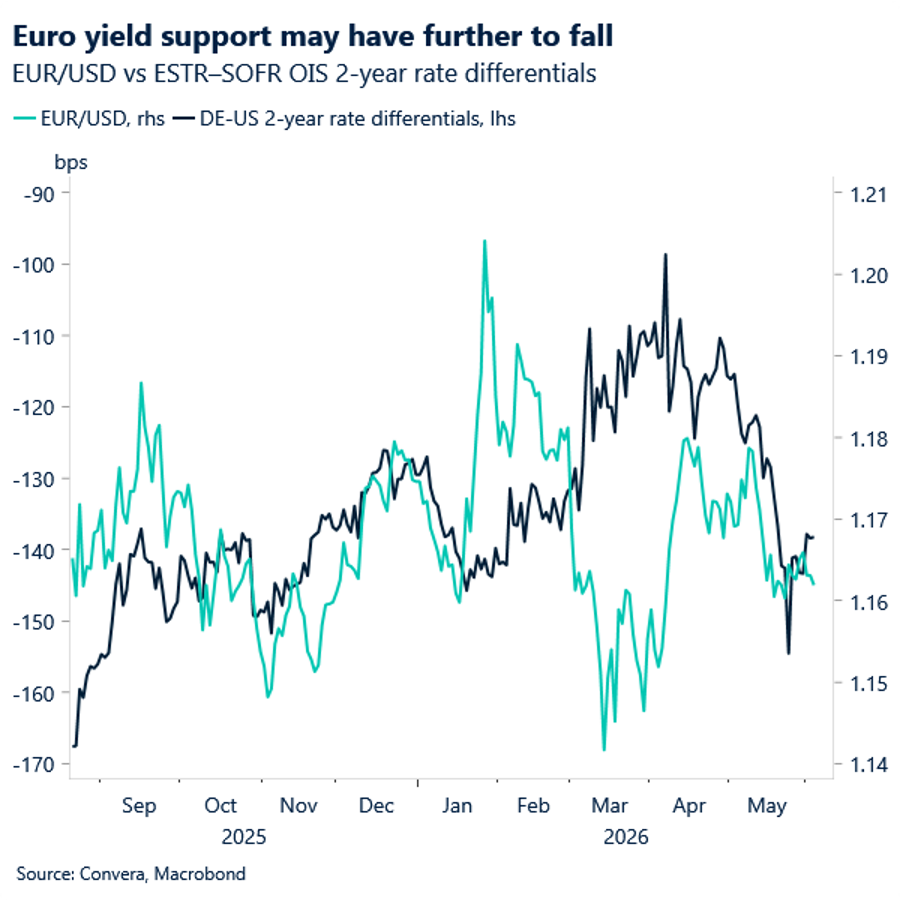
EUR/USD remains relatively flat on a month-on-month basis, hovering near the 1.16 lows and sitting below all key moving averages. Risks continue to point to the downside, as the impasse over Hormuz drags on and the relative yield advantage has shifted in the dollar’s favour since the conflict erupted earlier in the year.
Yesterday saw the release of May’s eurozone inflation (aggregate figure). We did not expect much to the upside, given the broadly subdued prints from member countries the week prior, notably Germany and France. The trajectory remains upward nonetheless, with headline y/y at 3.2% – the highest level since September 2023. Markets continue to price in nearly a full rate hike for next week, on the view that the ECB may act pre-emptively, largely for signalling purposes, to convey readiness.
The overall setup therefore continues to point to subdued support from rates for the euro, as there is little basis for a sustained hawkish narrative given the soft macro backdrop – especially if the inflation shock proves transitory rather than entrenched.
For the week, we continue to expect a similar range-bound pattern, with scope for a test of 1.16 on a meaningful upside surprise in Friday’s jobs report.
GBP: Sterling holding steady in quiet markets
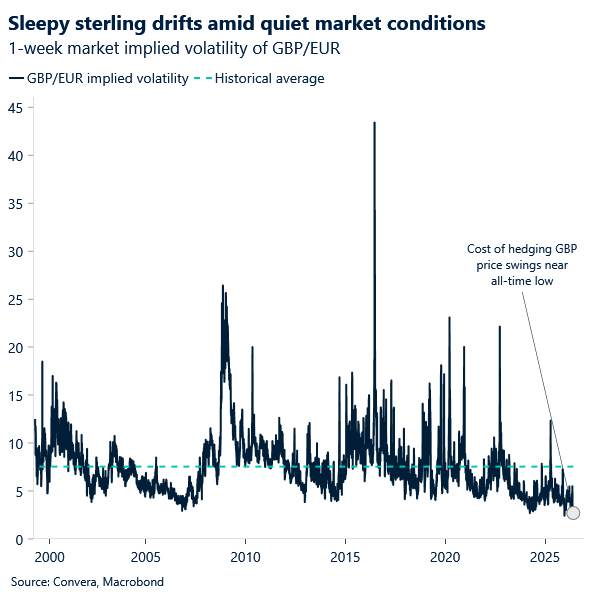
Sterling traded quietly on Tuesday, with GBP/USD edging toward the upper end of its 1.34–1.35 range and GBP/EUR hovering in the 1.15–1.16 band. Price action remains range‑bound, with little to dislodge the pair from familiar levels.
External forces continue to dominate, and for now have been broadly supportive. The Middle East conflict has pushed UK yields higher without materially denting global risk sentiment, with US equities still near record highs, allowing sterling to hold steady via the risk channel.
However, the underlying picture is less convincing. Sterling is better described as passively supported rather than actively sought. The absence of negative catalysts, rather than positive domestic drivers, has mainly kept it afloat. It continues to track global risk and USD dynamics yet has failed to fully participate in risk‑on moves of late, highlighting a lack of conviction.
This reflects a fading domestic backdrop. Earlier support from relative growth resilience and a firmer rate outlook has weakened, while political risk is creeping back into focus ahead of this month’s by‑election. Renewed concerns around policymaking and fiscal discipline remain a latent risk, particularly given ongoing pressure on Prime Minister Starmer.
In this environment, as we’ve stated for several weeks, sterling looks supported but lacking momentum – stable on the surface, yet fundamentally fragile beneath.
Market snapshot
Table: Currency trends, trading ranges & technical indicators
All times are in EST
Key global risk events
Calendar: June 1-5
All times are in EST
Have a question? [email protected]
*The FX rates published are provided by Convera’s Market Insights team for research purposes only. The rates have a unique source and may not align to any live exchange rates quoted on other sites. They are not an indication of actual buy/sell rates, or a financial offer.