


Key Takeaways
- Oil prices dropped as US-Iran tensions eased, impacting inflation but not entirely removing the risk premium.
- The US dollar remains strong ahead of the Fed’s decision, with mixed signals from real rates and inflation expectations.
- Key earnings from major tech companies this week may influence market sentiment and affect the dollar’s strength.
- USD/CAD remains stable, driven by yield spreads despite new tariffs; uncertainty from the US trade policy poses risks for Canada.
- Euro rates fluctuate with oil prices, while expectations for ECB rate hikes diminish, maintaining EUR/USD in a range-bound pattern.
USD: Fed and AI drive the week
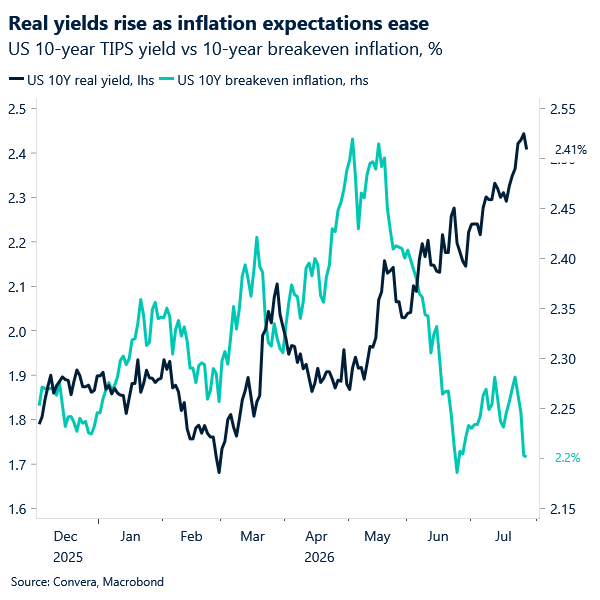
Oil fell sharply after signs of de-escalation between the US and Iran erased much of last week’s war premium. Brent’s move away from July highs around $100 gives markets some breathing room, though energy has not fully left the inflation story. A real supply disruption would quickly bring crude back into focus. For now, attention has shifted toward the Fed, real rates and mega-cap tech, with the pause in Middle East escalation reducing, but not eliminating, the risk premium.
The US dollar remains firm ahead of Wednesday’s Fed decision. Real rates continue to rise, even as inflation expectations stay anchored and recent inflation data has softened. That leaves markets in a difficult spot: traders see fewer signs of second-round inflation, but still assign a meaningful risk to tighter Fed policy. The base case remains a hold at 3.50%–3.75%, though a hike this week has not been fully ruled out, making September even more important for the dollar and the front end of the curve.
Fed communication is adding to the uncertainty. Chair Warsh has avoided setting out a clear rate path, choosing instead to put more weight on how markets digest incoming data. That has left investors unsure whether the Fed is still guiding expectations or increasingly taking its lead from them. A hold would disappoint the hawkish side of the market, while a hike would catch the broader consensus off guard, leaving plenty of room for volatility around the statement and, especially, the press conference.
Earnings make this one of the biggest market weeks of the summer. Apple, Microsoft, Amazon and Meta report between Wednesday and Thursday, and together account for about 18% of the S&P 500. Their results will test the AI trade after months of heavy capital spending. Strong numbers could steady risk appetite after the Fed, while weaker results would leave markets more exposed. In that scenario, the dollar could stay bid from multiple fronts, with real rates pressing higher and haven demand rising on any earnings disappointment.
CAD: Yield spreads keep USD/CAD supported
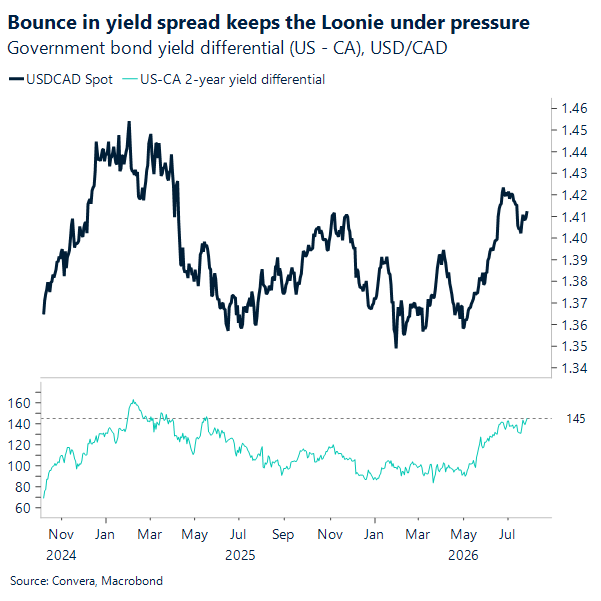
USD/CAD is still taking its cue from rate spreads more than tariff headlines. The White House’s new 50% tariffs on targeted Canadian goods look meaningful on paper, but the scope is narrow, the carve-outs are broad and the measures do not take effect for 30 days. That gives markets room to treat the move as a negotiating tool ahead of further CUSMA talks. Estimated coverage of around USD20bn in exports is small relative to total Canadian exports, which helps explain the measured FX reaction.
That does not make the trade threat harmless. For Canada, the bigger cost is often less about the tariff itself and more about the uncertainty it creates for investment, hiring and business confidence. The Bank of Canada has already argued that US tariffs and trade uncertainty have pushed Canadian activity onto a lower path. Canada also enters the talks with clear domestic vulnerabilities, including weak business investment, poor productivity and heavy reliance on the US market.
The rate channel is carrying more weight in the near term. The US-Canada two-year yield spread has bounced back toward the upper end of its recent range, reinforcing the pressure on the Loonie and helping keep USD/CAD supported above 1.40. US short-end yields have been more responsive to the latest oil move, while Canadian yields have stayed more contained after June CPI cooled to 2.8% and core inflation eased. That fits the current macro setup: CAD is trading as a mix of rates, growth divergence and policy uncertainty, not simply as a tariff shock.
Heavy short positioning should also limit the downside risk for CAD unless a new driver emerges. The latest futures data show speculative accounts still heavily short the Loonie, around -199k contracts, despite the brief rebound in recent weeks. This week, focus shifts to another Fed meeting and closing out the month with a pulse on domestic growth, with May GDP expected to arrive at an annualized pace of 1.4% YoY.
EUR: Oil swings, EUR rates follow
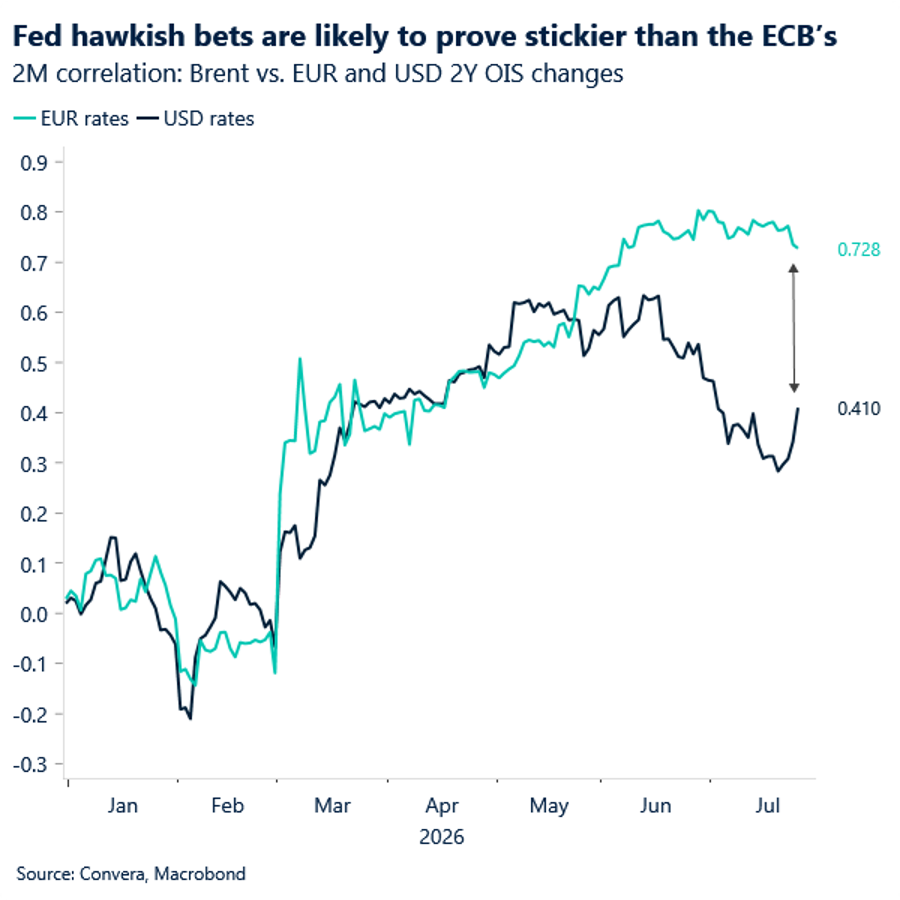
The past few days have been yet another reminder of how sensitive euro rates are to swings in oil prices. Markets went from pricing a full 25bp ECB hike in September last Thursday to assigning less than a 90% probability today, as oil prices fell on renewed peace prospects.
Interestingly, market pricing for the Fed’s tightening bias has consolidated around a fully priced September hike. These moves reinforce our view that Fed tightening expectations remain stickier than those for the ECB, regardless of oil volatility, reflecting the more resilient US macro backdrop.
That is not to say we expect significant EUR/USD downside in the near term. Markets are pricing close to two Fed hikes this year, but we continue to favour the view that the Fed remains on hold through year-end. Any unwinding of those expectations should provide support for the pair.
Meanwhile, the latest pause in hostilities between the US and Iran reinforces our view that any flare-up in violence is likely to be temporary and contained within a broader path of negotiations. That helps explain why EUR/USD has remained broadly range-bound this month despite the US-Iran standoff, trading largely within the 1.1350-1.1450 range.
We retain a mild bias for EUR/USD to move back into the 1.14 handle more comfortably as we suspect this week’s Fed meeting fails to signal any urgency around a September rate hike.
Market snapshot
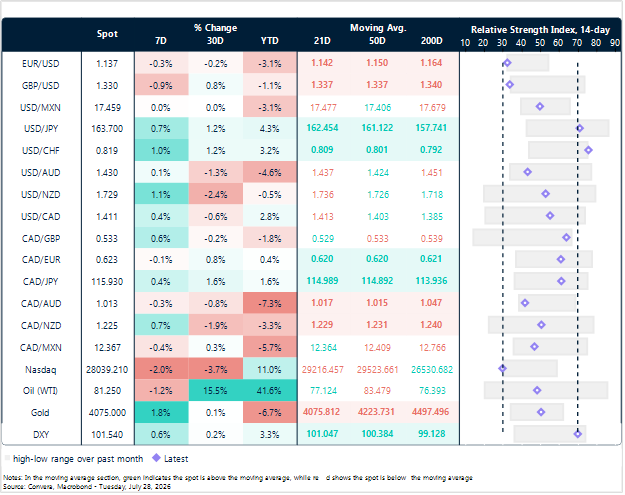
Table: Currency trends, trading ranges & technical indicators
Key global risk events
Calendar: July 27-31
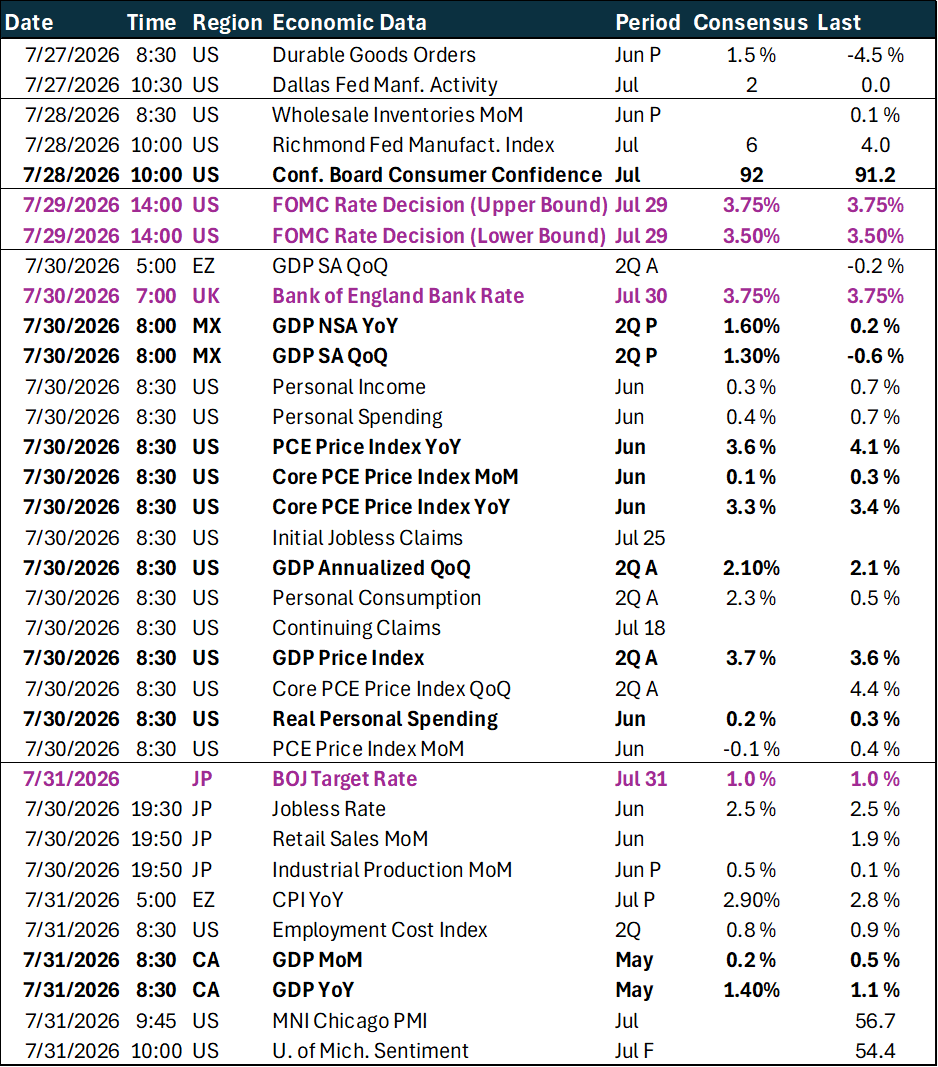
All times are in EST
Have a question? [email protected]
*The FX rates published are provided by Convera’s Market Insights team for research purposes only. The rates have a unique source and may not align to any live exchange rates quoted on other sites. They are not an indication of actual buy/sell rates, or a financial offer.