


USD: Payroll beat fails to lift US dollar
US payrolls rose by 162,000 in August, beating the 55,000 consensus and topping every estimate. June and July were also revised higher by a combined 55,000. Unemployment held at 4.1%, while participation rose to 61.6% and underemployment fell to 7.7%. Wage growth came in at 0.3% month over month and 3.1% year over year.
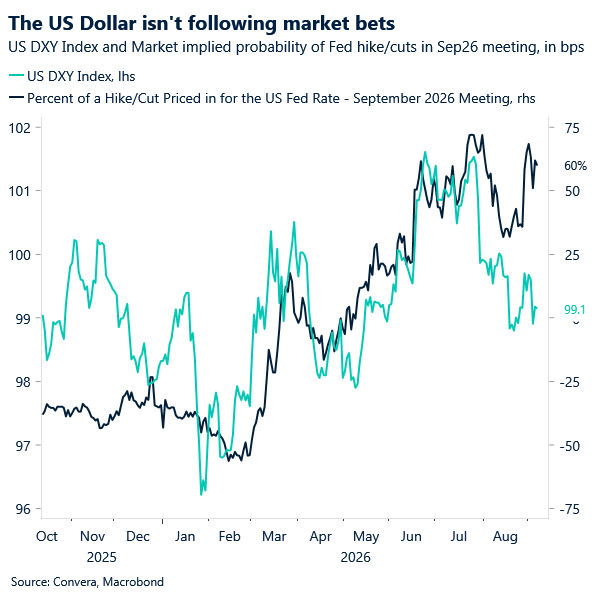
Yet the dollar’s response has been relatively muted. DXY briefly advanced after the release but has since surrendered much of that move, despite the strength of the data. A comparable upside surprise in May produced a much larger and more sustained rally. That contrast suggests investors remain cautious about chasing the dollar higher on labour data alone.
Sharp swings in the yen, plus US policy premium, have clouded the broader signal, with Bank of Japan speculation influencing DXY alongside US rate expectations. Markets now assign roughly a 60% probability to a Fed increase in September, leaving considerable doubt over the decision. Fed officials have made clear that the inflation data will carry more weight than one strong employment report. Therefore, next week’s CPI release remains the key test.
DXY ended the week trading near 99, between support around 98.80 and resistance near 99.7. A firm CPI print could strengthen the case for a September hike and help the index clear the resistance level. A softer reading would support a Fed hold and could send the dollar back toward its August low. At the same time, if policymakers pause despite resilient economic data, questions around the Fed’s policy stance could weigh on the currency.
EUR: EUR/USD awaits its CPI verdict
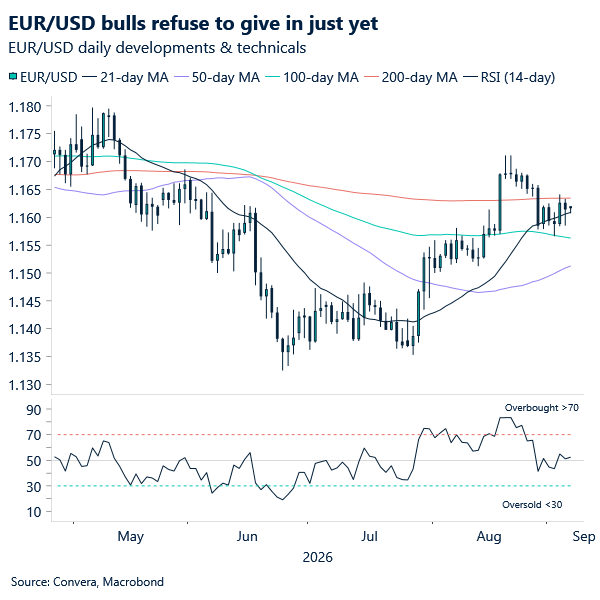
EUR/USD quickly erased losses triggered by Friday’s blowout US jobs report. The resilience highlights two things: markets remain undecided on a Fed hike next week, and right now inflation matters more than jobs. Friday’s August US inflation is the key test.
Fed officials Williams and Waller helped calm some inflation nerves last week, pointing to a relatively benign underlying inflation backdrop (strip out temporary distortions like energy prices). As a result, markets are unlikely to stray far from a roughly 50/50 view on a September hike unless data force their hand.
The more interesting question is what happens if the Fed doesn’t hike. The dollar is bound to weaken, and perhaps by more than lower yields alone would justify. Concerns about Kevin Warsh’s inflation-fighting credentials could quickly resurface, along with fresh scrutiny of his communication style. After all, a decision to stay on hold would look somewhat at odds with a Jackson Hole speech that oozed hawkishness.
And what if the Fed does hike? As things stand, that remains the clearest bearish catalyst for EUR/USD. But taking a more dollar-negative view, a hike would almost certainly anger President Trump. Following Friday’s jobs report, Trump again called on the Fed to cut rates. Would a hike next week be enough for the president to turn on Warsh just months into his tenure? If so, we would question the durability of the hawkish Fed narrative and its ability to support the dollar beyond the immediate market reaction.
Turning to the euro, the outlook is far from rosy. Continued tensions in the Middle East are keeping oil prices biased to the upside, a negative for the eurozone given its reliance on energy imports. Elsewhere, Germany’s far-right Alternative for Germany scored a major electoral success on Sunday, securing its strongest-ever result in a state election. Similar dynamics are evident in France, where Marine Le Pen’s party is projected to win were an election held today. Such developments underscore growing discontent with incumbent governments, weighing on sentiment more broadly. Moreover, the prospect of more Eurosceptic policies and, potentially, greater fiscal expansion could increasingly clash with a bond market already unsettled by rising borrowing costs. Against this backdrop, the euro risks emerging as a key casualty.
For this week, we would not expect EUR/USD to show much directional conviction ahead of Friday’s US CPI release. The 1.1570 to 1.1630 range should continue to contain price action.
Thursday’s ECB policy meeting, where a 25-bp hike is fully priced, shouldn’t stir much euro movement.
GBP: Soft DMP eradicates BoE September hike odds
Friday’s August Decision Maker Panel Survey showed an improving inflation outlook. Most notably, respondents see inflation one year ahead back at pre-conflict levels, while the three-year outlook remains well anchored. Together, the results add to the case that the inflation shock remains a temporary, supply-driven one.
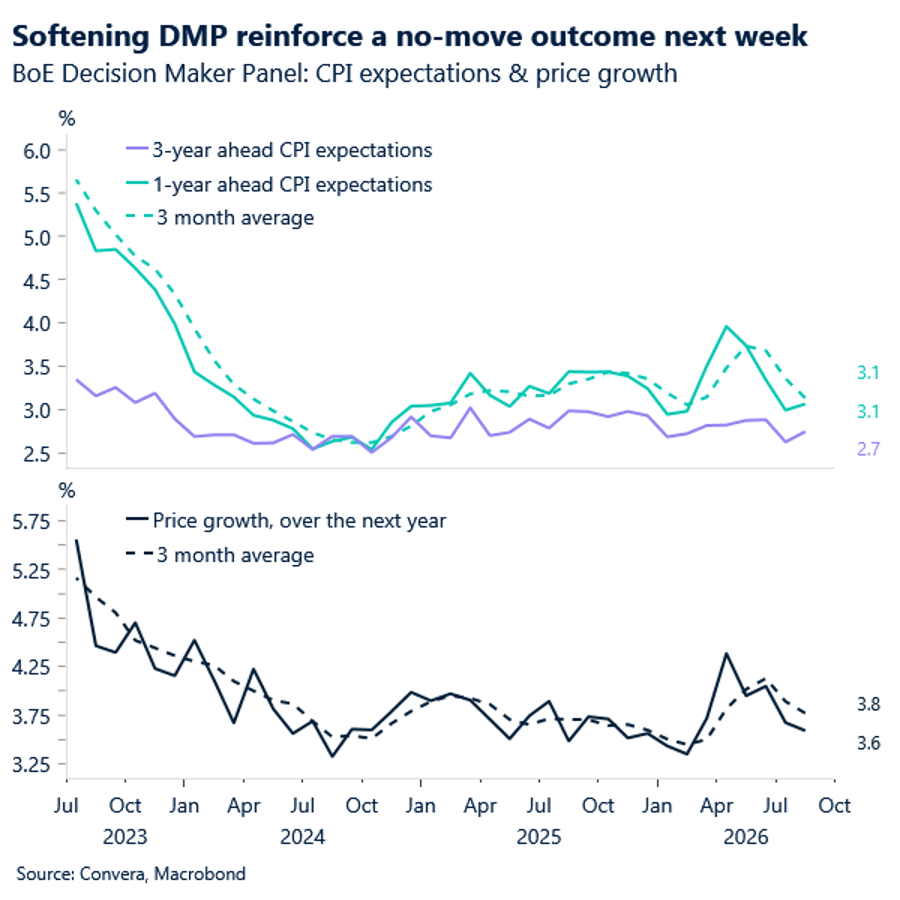
The release further eroded whatever remained of the probability of a BoE hike on 17 September, with around 13-14% priced beforehand.
What is telling is the more stubborn market view further out the curve, with just over one 25bp hike still priced by December. That stickiness in expectations may stem from the view that any hike would serve more as an “insurance” move to prevent higher energy prices from spilling over into the broader CPI basket.
Monitoring pricing at that horizon following next week’s August CPI release may be instructive. If markets are truly pricing an insurance hike, expectations may prove surprisingly stubborn even in the face of a softer inflation print.
Market snapshot
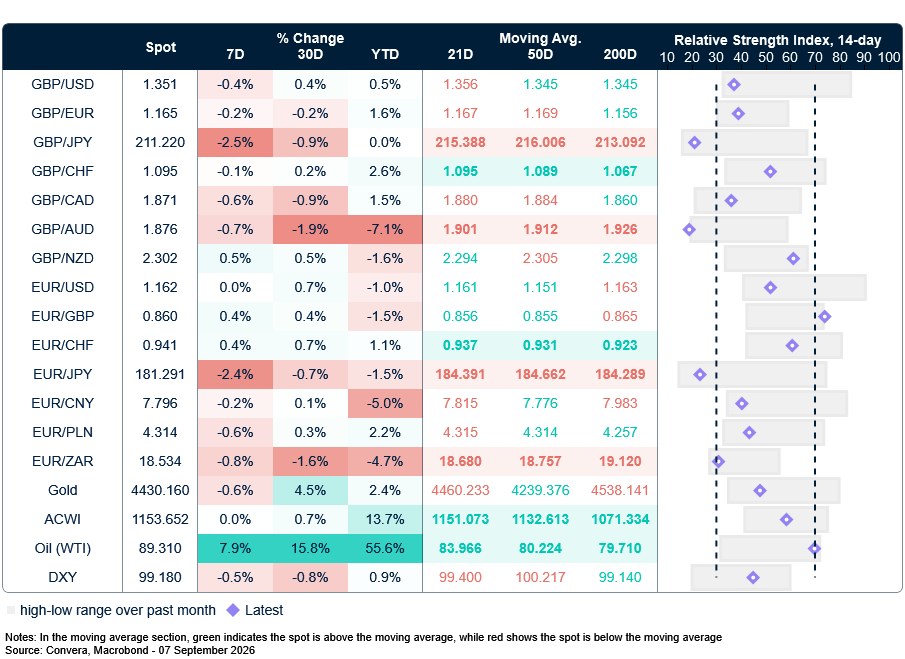
Table: Currency trends, trading ranges & technical indicators
Key global risk events
Calendar: September 7-11
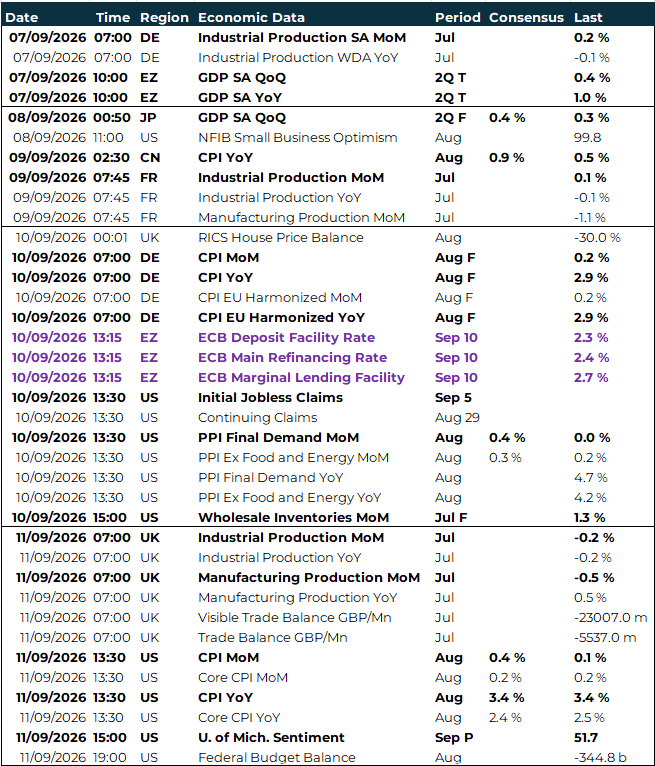
All times are in BST
Have a question? [email protected]
*The FX rates published are provided by Convera’s Market Insights team for research purposes only. The rates have a unique source and may not align to any live exchange rates quoted on other sites. They are not an indication of actual buy/sell rates, or a financial offer.