


USD: The dollar wants higher
The global market backdrop remains defined by a curious mix of elevated geopolitical risk and remarkably subdued FX volatility. Renewed US strikes on Iranian targets, alongside mounting concerns over regional energy infrastructure, continue to keep oil prices, short-dated yields and the dollar relatively well supported. Yet currency markets remain reluctant to fully embrace a broader risk-off narrative, reflecting a lack of conviction around how the conflict ultimately evolves.
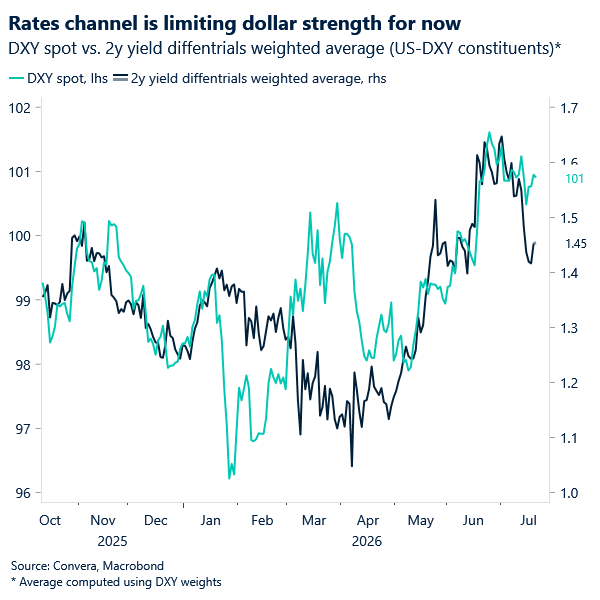
In theory, the dollar should be benefiting more. Higher energy prices, persistent uncertainty and a softer equity backdrop would normally generate stronger safe-haven demand. Instead, FX volatility remains compressed, helping to sustain carry trades despite the deteriorating geopolitical environment. Part of the explanation lies in rates. Last week’s softer US CPI and PPI prints trimmed some of the hawkish Fed premium that had underpinned the dollar through June, while markets continue to price relatively aggressive policy tightening in parts of Europe and the UK.
That said, the broader USD backdrop remains constructive. Energy prices are once again moving higher as the conflict broadens beyond the Strait of Hormuz. The growing threat of Houthi disruption at the Bab el-Mandeb adds another layer of supply-chain stress, potentially jeopardising one of the key alternative routes used by Saudi Arabia to export crude. If pressure on both waterways persists, concerns around global energy shortages will become increasingly difficult to ignore.
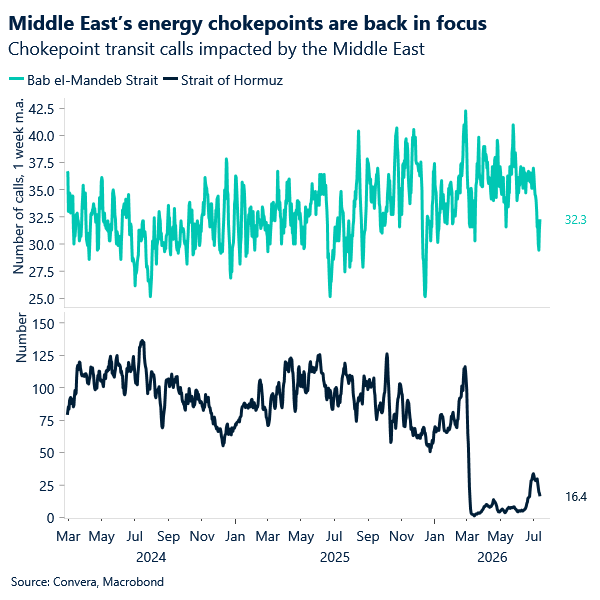
For FX markets, the implications extend beyond oil. Higher energy costs disproportionately impact major importers, particularly across Asia, while the US retains the relative advantage of being a net energy exporter. That reinforces both the terms-of-trade and growth arguments supporting the dollar.
For now, markets remain trapped between rising geopolitical risks and a reluctance to price a lasting shock. As long as that standoff persists, the dollar is likely to stay supported through the energy and safe-haven channels, even if subdued FX volatility prevents a more forceful move higher.
EUR: Waiting for a catalyst
The euro’s narrative remains one of competing forces. On one side, softer US inflation data has tempered expectations for further Fed tightening, while renewed energy‑driven inflation risks have prompted a modest hawkish repricing of the ECB, helping to support short‑term rate differentials in the euro’s favour. On the other, the same rise in energy prices and renewed Middle East tensions are darkening the eurozone growth outlook, limiting how much support the rates channel can ultimately provide.
Higher energy costs have prompted markets to partially unwind their earlier dovish repricing of the ECB, with rate expectations moving modestly higher again. However, this support looks fragile. As we have argued for several weeks, ECB tightening driven by energy‑induced inflation is not necessarily euro‑positive if it occurs alongside weaker growth and deteriorating terms of trade.
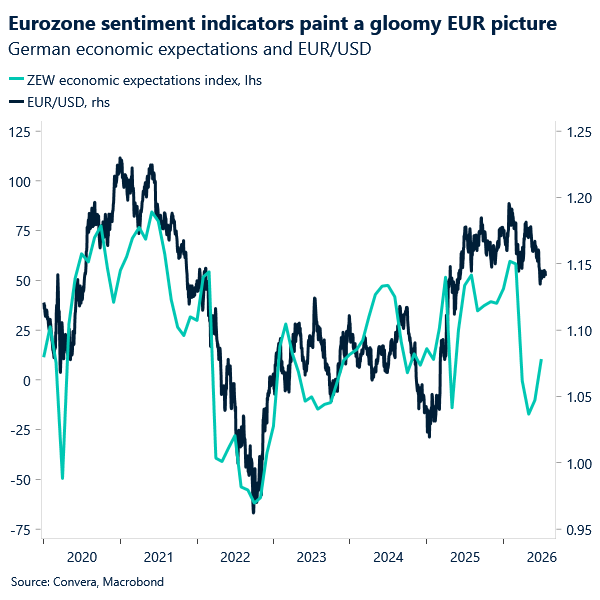
Attention now turns to today’s ZEW sentiment surveys, which will provide another test of whether the eurozone economy is beginning to stabilise or whether growth concerns continue to deepen. Last month’s release helped EUR/USD rebound from one‑year lows, but with geopolitical uncertainty elevated again, the risks around today’s data appear skewed to the downside.
For now, the pair looks anchored between support around 1.14 and resistance near 1.1450‑1.1470. Without a meaningful improvement in either energy markets or eurozone growth expectations, the broader bias remains cautiously bearish despite the recent stabilisation.
GBP: Burnham is treading carefully, with the bond market listening closely
Andy Burnham became the UK’s seventh prime minister in a decade yesterday. His first speech focused heavily on easing cost-of-living pressures, but crucially, he also pledged to explain how those measures would be funded. Burnham chose his words carefully, promising to “meet our fiscal rules” and honour the UK’s defence commitments, a clear nod to both investors and international allies.
His remarks were nonetheless brimming with ambition. He hailed a “new economic model”, pledging to deliver “the most radical changes in the last 40 years”. It is only a matter of time, and we see the 2026 Autumn Budget as the clearest risk event, before markets begin to scrutinise Burnham’s agenda with increasing intensity. Investors will want to see how such ambitions can be reconciled with fiscal discipline, if they are to be pursued at all. In the end, Burnham’s policymaking may prove considerably more pragmatic, and considerably less exciting, than his rhetoric suggests.
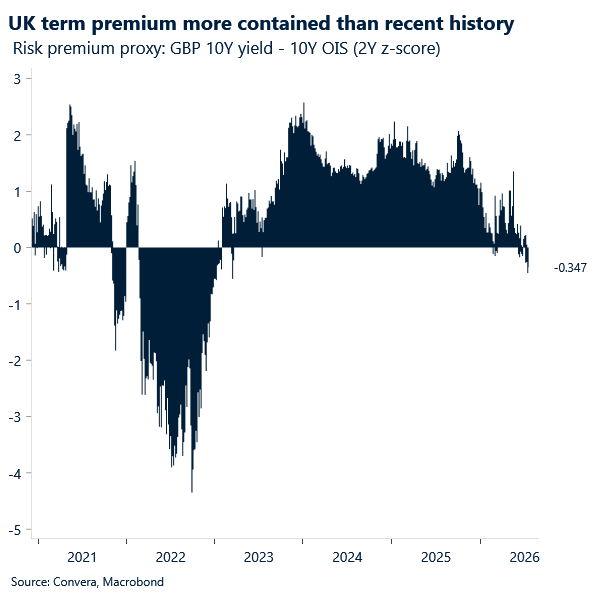
It only took a suggestion that any flexibility within the fiscal headroom could be used to help fund his policies for bonds to sell off sharply, with the 10y gilt yield surging above 5%. The episode was yet another reminder of how sensitive investors remain to the UK’s fragile fiscal backdrop.
Perhaps the most surprising development was the appointment of John Healey as Chancellor of the Exchequer. Healey brings defence spending ambitions of his own, having resigned from Starmer’s government over what he saw as the prime minister’s and former chancellor’s unwillingness to raise defence spending to 3% of GDP by 2030.
While markets were relatively unmoved by the news, his appointment raises the prospect of further fiscal pressures down the line.
Overall, sterling shrugged off what had already become a well-priced event.
Away from politics, this morning brought the release of the UK’s latest labour market report, which was broadly in line with expectations. The unemployment rate held steady at 4.9%, while employment growth came in at 148k on a three-month basis, well above the 80k consensus forecast, adding to signs of a modest recovery so far in 2026.
Wage growth undershot expectations, rising 4.3% in the three months to May versus a 4.5% forecast, though it remains above the roughly 4% pace seen earlier this year. While the report does little to challenge the view that the UK labour market remains soft, signs of stabilisation may help alleviate the Bank of England’s policy trade-off between a weakening labour market and still-elevated inflation pressures, at least for now.
For the remainder of the week, attention will turn to tomorrow’s June inflation report and any additional policy details that trickle out from Burnham’s newly formed government.
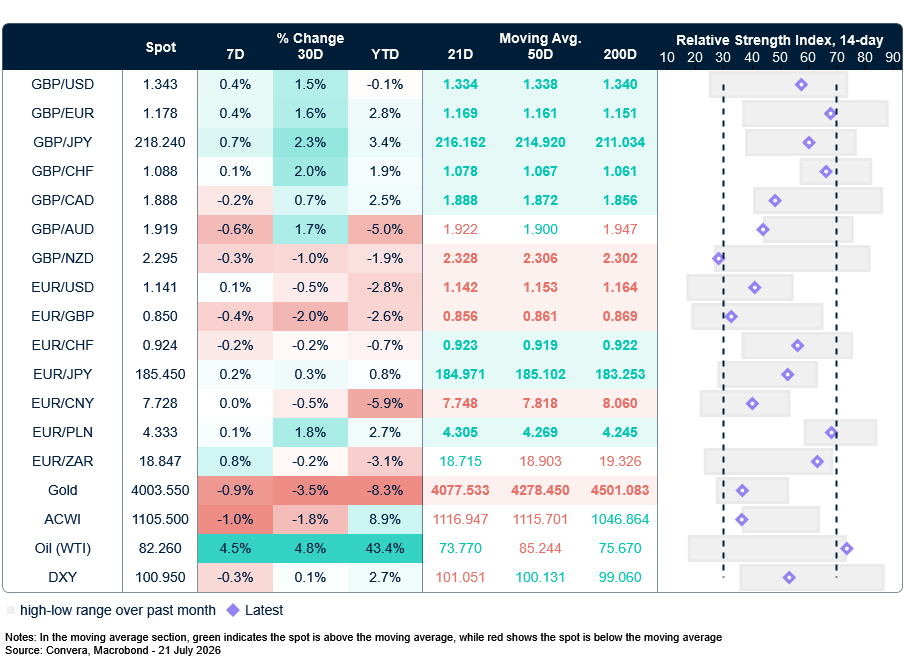
Market snapshot
Table: Currency trends, trading ranges & technical indicators
Key global risk events
Calendar: July 20-24
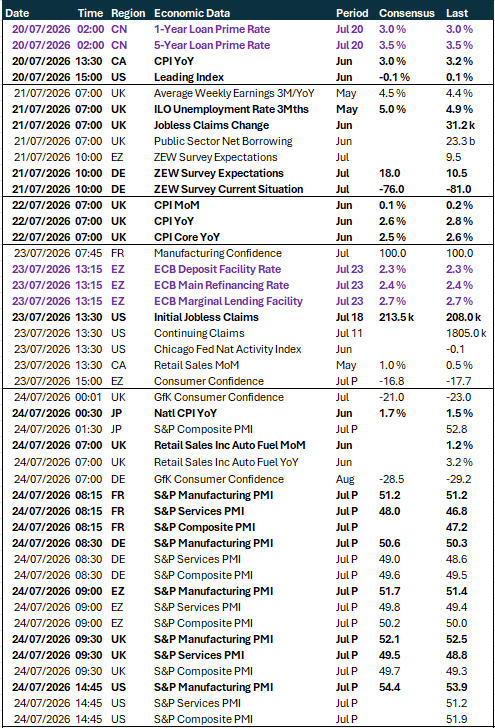
All times are in BST
Have a question? [email protected]
*The FX rates published are provided by Convera’s Market Insights team for research purposes only. The rates have a unique source and may not align to any live exchange rates quoted on other sites. They are not an indication of actual buy/sell rates, or a financial offer.