

Key Takeaways
- Canadian inflation rose to 3.1%, but softer core measures complicate the case for a Bank of Canada hike.
- Markets nevertheless lifted October hike odds to nearly 67% as higher energy costs kept the decision live.
- AI concerns pulled Treasury yields and the dollar lower by challenging the US growth and investment premium.
- The peso extended its decline to six weeks as rising US yields and Banxico easing expectations eroded its carry advantage.
Softer core inflation complicates BoC hike case
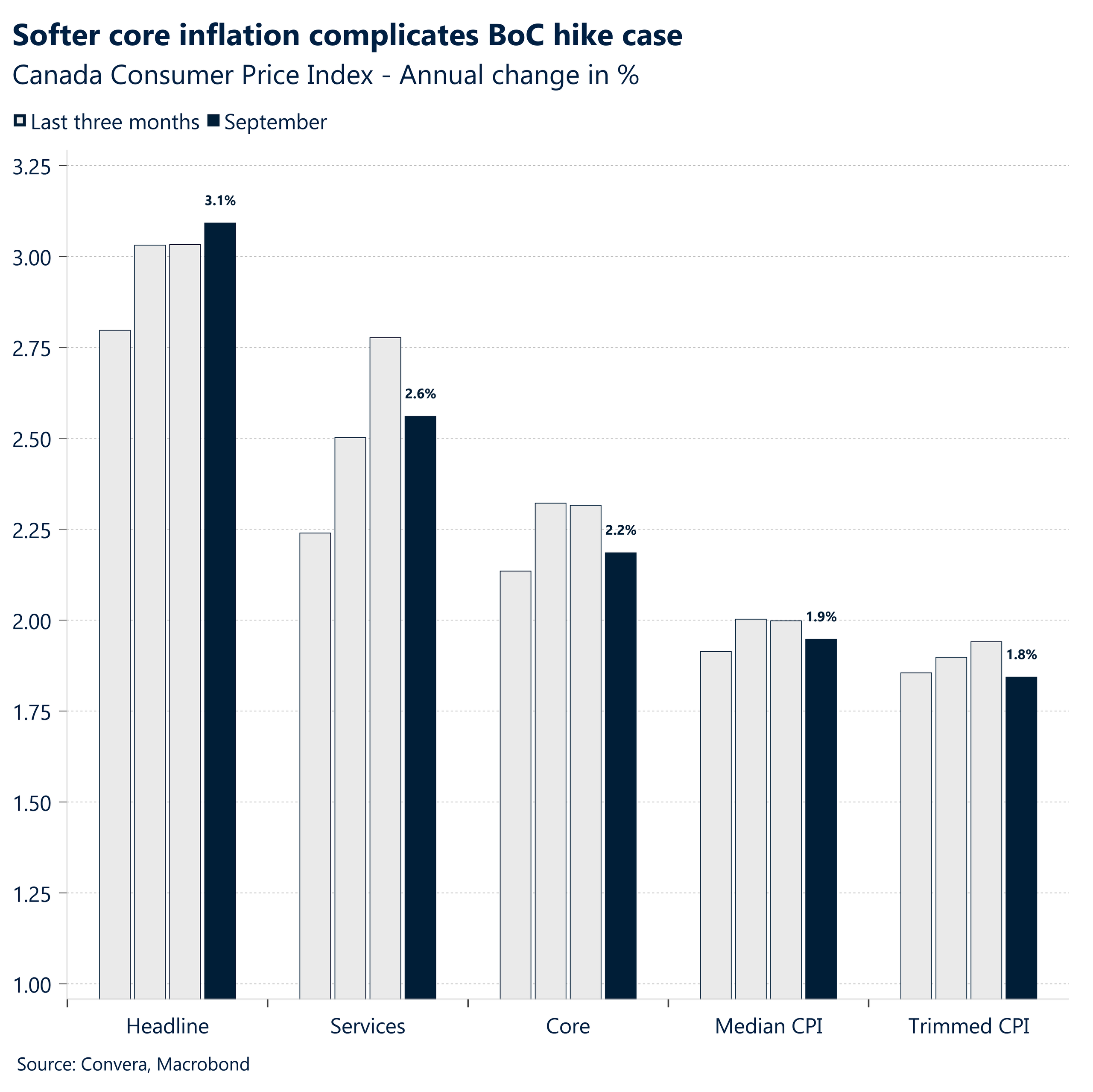
Canadian headline inflation rose to 3.1% in September, but the underlying details were softer than the headline suggests. Energy accounted for much of the increase, while the Bank of Canada’s preferred median and trimmed measures eased to their lowest average since early 2021. The Loonie gave back part of its pre-release gains as markets weighed firmer headline inflation against cooling underlying price pressures.
Rates markets nevertheless raised the implied probability of an October 28 hike to nearly 67%, treating the energy-driven increase as enough to keep the decision live. That repricing narrowed the US-Canada two-year yield spread to 146 basis points, its tightest level in more than a month. The compression has given the loonie some relief after weeks of widening differentials, although the softer core readings leave the case for a hike far from straightforward.
USD/CAD is stabilizing near 1.409 after the release, while short-term moving averages provide immediate resistance close to 1.406. The October 28 policy decision remains the key test: a hike or clearly hawkish hold could extend the move toward 1.40. A hold that emphasizes softer core inflation would risk sending the pair back above 1.42. Until then, the Loonie’s recovery depends on whether markets sustain the recent narrowing in the two-year yield spread.
When AI doubts become US dollar risks
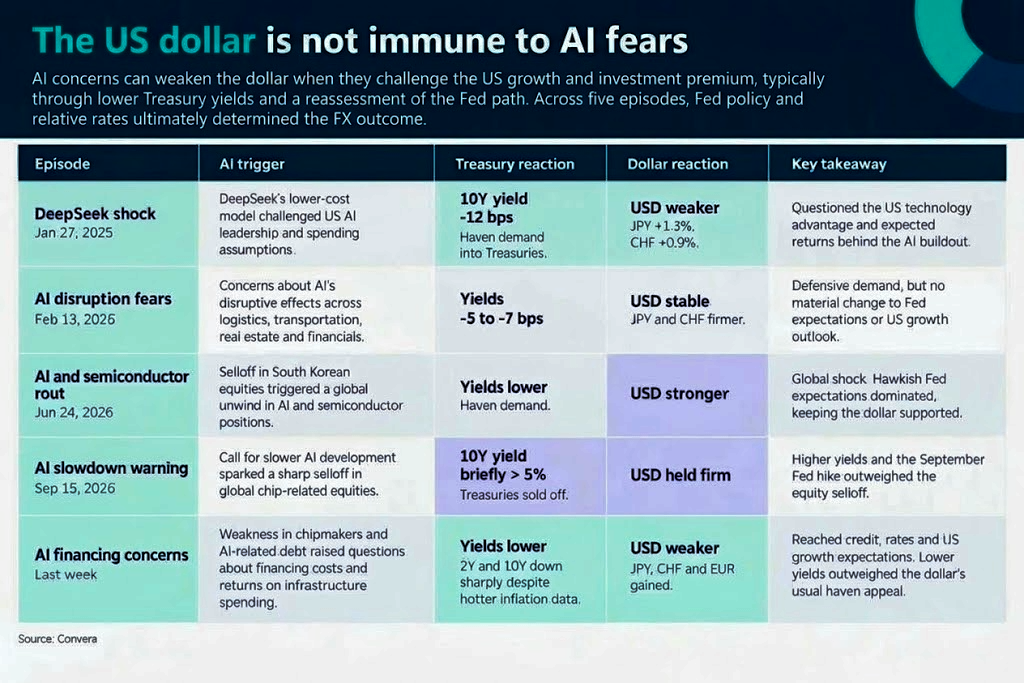
Last week exposed a growing vulnerability in the dollar. Concerns about the AI investment cycle pulled Treasury yields lower, and the dollar followed, even as stronger US inflation data pointed in the opposite direction. The move went beyond weaker technology stocks. Markets began questioning the growth, financing and investment premium attached to the US AI buildout. Once those doubts reached Treasury yields and Fed expectations, the dollar’s rate advantage weakened, while the yen and Swiss franc offered cleaner protection from a shock centred on US assets.
AI concerns have affected FX before, but the outcome depends on what part of the US outlook they challenge. Across five identifiable episodes since January 2025, only DeepSeek and last week produced a clear combination of lower Treasury yields and a weaker dollar. Both shocks questioned a specific US advantage. DeepSeek challenged American AI leadership and the scale of spending required to defend it, while last week shifted attention toward financing costs and the returns that spending will ultimately generate. In the other episodes, the dollar was largely unaffected or strengthened because Fed policy, inflation and broader risk aversion carried more weight.
That does not establish a new structural regime, but it broadens the channels through which AI concerns can reach FX. Treasury demand, Fed expectations, AI-related credit, US investment and foreign exposure to American technology assets can now move together. Relative rates remain the key transmission mechanism. If doubts about AI reduce expectations for US investment or growth, investors can seek protection in Treasuries while pricing a softer Fed path, pulling yields and the dollar lower alongside equities. The dollar’s usual haven support can then be outweighed by the loss of its rate and growth advantage.
Through the end of 2026, a hawkish Fed and elevated US real yields should keep the dollar broadly supported. AI-driven selloffs are more likely to produce temporary corrections unless stress spreads through credit markets or companies begin cutting capital expenditure. Last week’s Treasury rally did not resolve the fiscal problem either, with heavy government borrowing and rising interest costs still reflected in yields and term premium. A sustained dollar decline would require the AI correction to weaken expected US investment and growth, bring forward Fed easing and narrow relative real-rate differentials. Without that sequence, the dollar can recover even if technology shares remain volatile.
The risk becomes more important in 2027 as investors move from rewarding AI spending to assessing its returns. Data-centre utilization, revenue growth, energy costs, refinancing conditions and hyperscaler capex guidance will show whether the investment cycle can support its current scale. Strong monetization would preserve the US growth premium and remain supportive for the dollar. Weak returns and tighter financing conditions would slow investment and challenge one of the foundations of US exceptionalism. The dollar therefore remains supported while confidence in the US AI premium holds, but its exposure increases if that confidence begins to fade.
Carry erosion deepens Peso’s decline
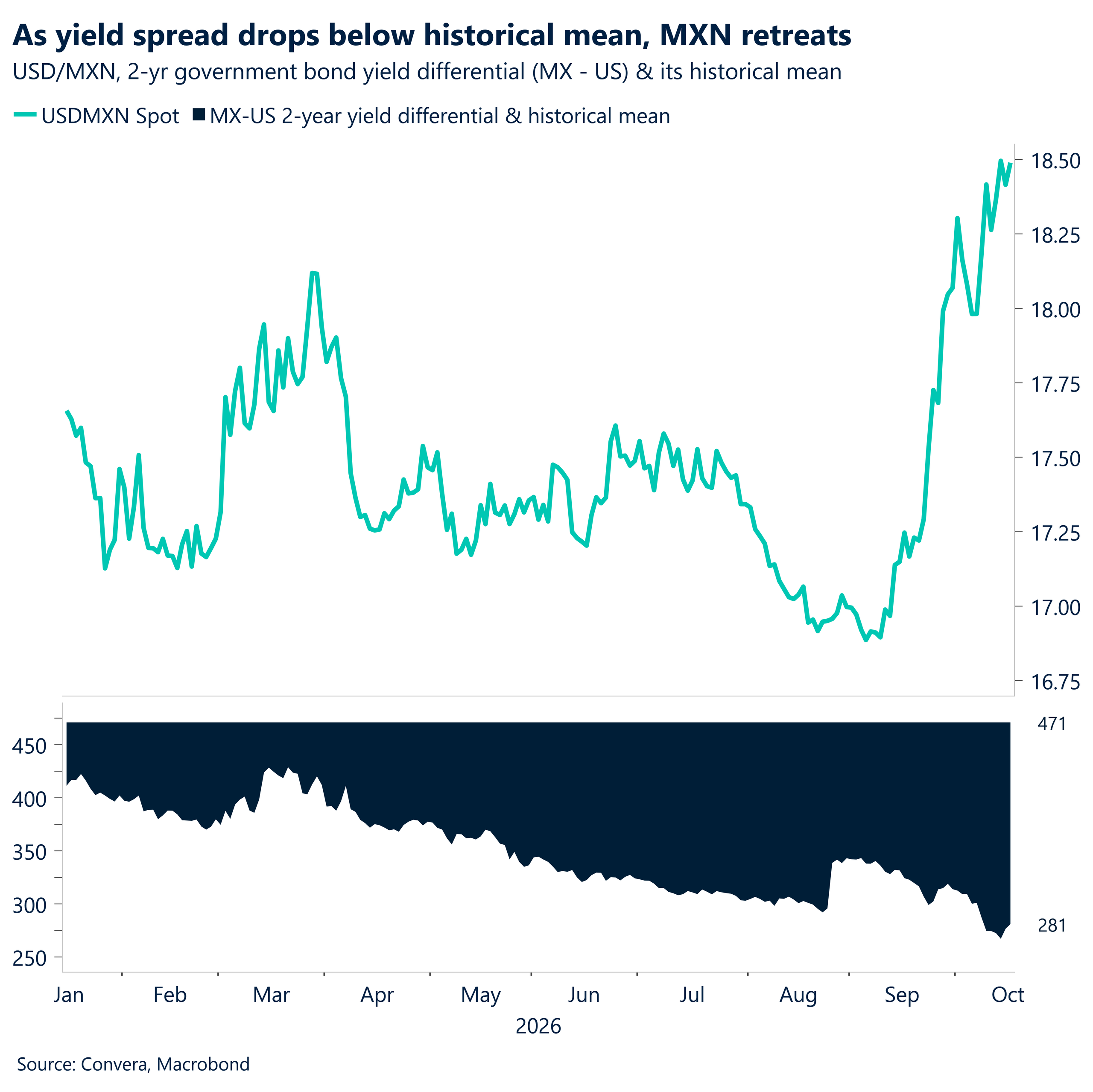
The Mexican peso is heading for a sixth consecutive weekly decline as its interest-rate advantage continues to erode. Stronger US inflation has lifted Treasury yields and made a December Fed hike increasingly likely, while Banxico’s willingness to consider easing has narrowed the two-year spread to around 250 basis points. That leaves investors with less compensation for peso volatility and has accelerated the unwind of carry positions that supported the currency earlier this year.
Trade and energy risks are reinforcing that pressure. Reports of stalled US-Mexico tariff negotiations have removed a potential catalyst for the peso, even as Mexican officials dispute that talks have reached an impasse. Brent near $110 also presents a difficult trade-off: higher energy prices keep the Fed focused on inflation while raising Mexico’s refined-fuel import costs. With domestic retail indicators weakening, Banxico has less room to defend the peso through restrictive policy without adding to the slowdown.
Positioning is now tilted against the peso, creating scope for a sharp rebound if trade talks improve or inflation changes the policy outlook. Wednesday’s biweekly CPI release is therefore the next test. A firm reading could force Banxico to push back against easing expectations and offer the peso some relief, while softer inflation would further weaken its carry support.
Market snapshot
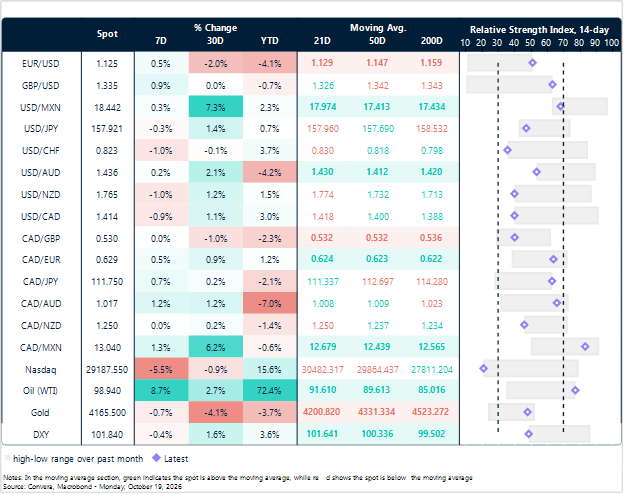
Table: Currency trends, trading ranges & technical indicators
Key global risk events
Calendar: October 19 – 23
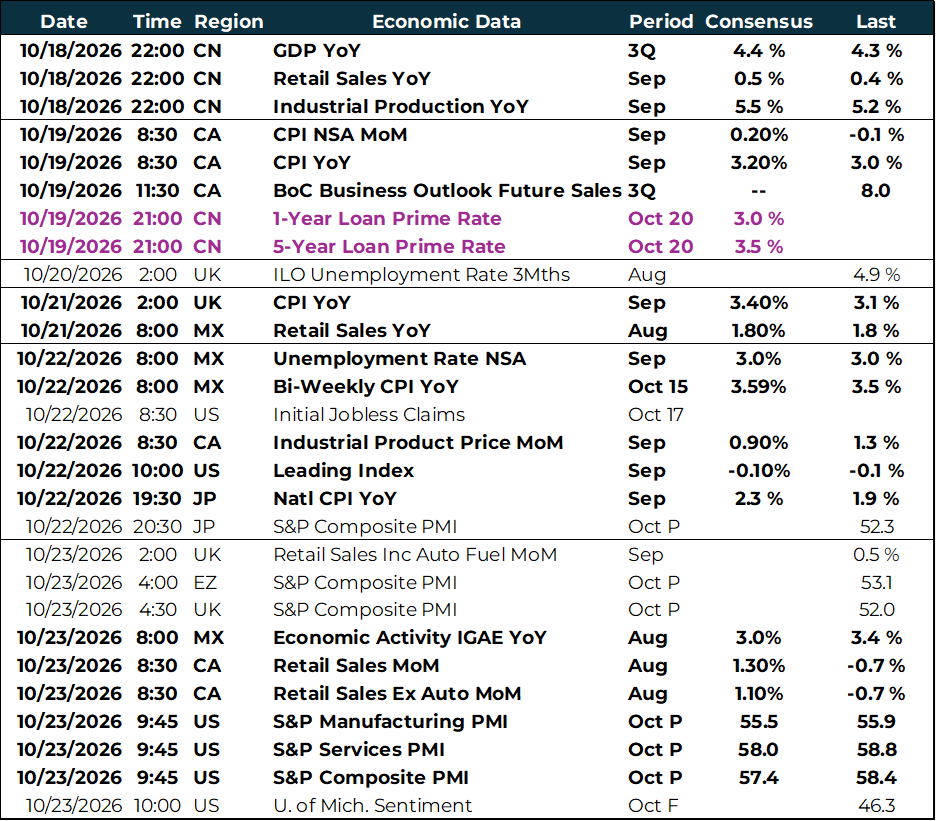
All times are in EST
Have a question? [email protected]
*The FX rates published are provided by Convera’s Market Insights team for research purposes only. The rates have a unique source and may not align to any live exchange rates quoted on other sites. They are not an indication of actual buy/sell rates, or a financial offer.