


USD: When AI doubts become dollar risks
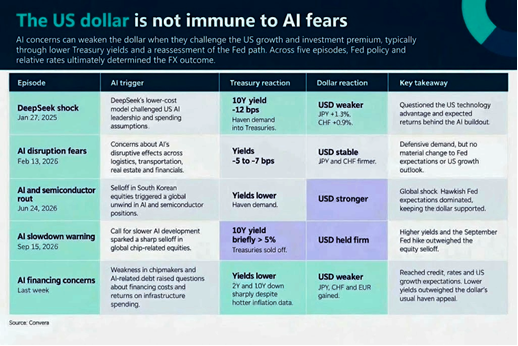
Last week exposed a growing vulnerability in the dollar. Concerns about the AI investment cycle pulled Treasury yields lower, and the dollar followed, even as stronger US inflation data pointed in the opposite direction. The move went beyond weaker technology stocks. Markets began questioning the growth, financing and investment premium attached to the US AI buildout. Once those doubts reached Treasury yields and Fed expectations, the dollar’s rate advantage weakened, while the yen and Swiss franc offered cleaner protection from a shock centered on US assets.
AI concerns have affected FX before, but the outcome depends on what part of the US outlook they challenge. Across five identifiable episodes since January 2025, only DeepSeek and last week produced a clear combination of lower Treasury yields and a weaker dollar. Both shocks questioned a specific US advantage. DeepSeek challenged American AI leadership and the scale of spending required to defend it, while last week shifted attention toward financing costs and the returns that spending will ultimately generate. In the other episodes, the dollar was largely unaffected or strengthened because Fed policy, inflation and broader risk aversion carried more weight.
That does not establish a new structural regime, but it broadens the channels through which AI concerns can reach FX. Treasury demand, Fed expectations, AI-related credit, US investment and foreign exposure to American technology assets can now move together. Relative rates remain the key transmission mechanism. If doubts about AI reduce expectations for US investment or growth, investors can seek protection in Treasuries while pricing a softer Fed path, pulling yields and the dollar lower alongside equities. The dollar’s usual haven support can then be outweighed by the loss of its rate and growth advantage.
Through the end of 2026, a hawkish Fed and elevated US real yields should keep the dollar broadly supported. AI-driven selloffs are more likely to produce temporary corrections unless stress spreads through credit markets or companies begin cutting capital expenditure. Last week’s Treasury rally did not resolve the fiscal problem either, with heavy government borrowing and rising interest costs still reflected in yields and term premium. A sustained dollar decline would require the AI correction to weaken expected US investment and growth, bring forward Fed easing and narrow relative real-rate differentials. Without that sequence, the dollar can recover even if technology shares remain volatile.
The risk becomes more important in 2027 as investors move from rewarding AI spending to assessing its returns. Data-center utilization, revenue growth, energy costs, refinancing conditions and hyperscaler capex guidance will show whether the investment cycle can support its current scale. Strong monetization would preserve the US growth premium and remain supportive for the dollar. Weak returns and tighter financing conditions would slow investment and challenge one of the foundations of US exceptionalism. The dollar therefore remains supported while confidence in the US AI premium holds, but its exposure increases if that confidence begins to fade.
EUR: French protests and Russia risks
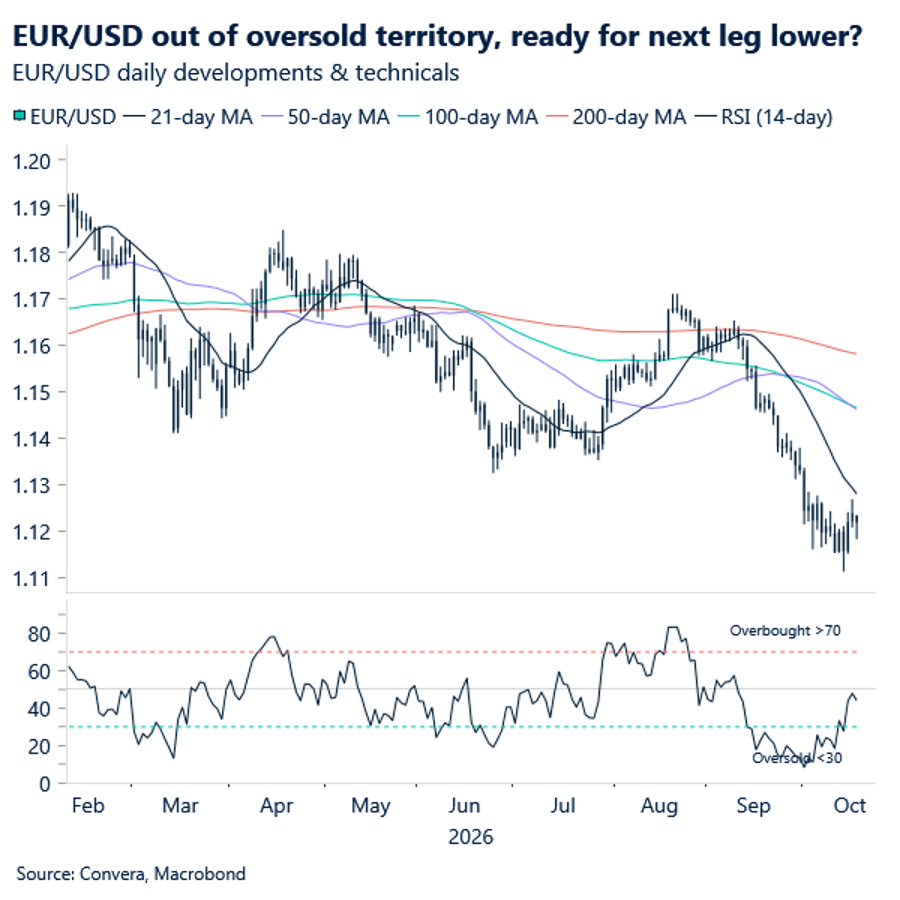
The euro started the week on the back foot as investors looked past encouraging economic data and focused instead on rising political and geopolitical risks. EUR/USD remains under pressure near recent lows, despite last week’s AI-driven dollar pullback helping the pair snap a five-week losing streak.
The eurozone economy continues to show resilience. Recent PMI and Ifo surveys pointed to solid underlying momentum despite elevated energy prices and a challenging external backdrop. Yet those positives are struggling to gain traction in FX markets.
Instead, attention has shifted firmly to France’s fiscal outlook. Weekend protests and ongoing political tensions have reinforced concerns about the government’s ability to address a rapidly deteriorating debt position ahead of next year’s presidential election. Combined with a widening French-German yield spread, this is keeping investors wary of eurozone assets more broadly.
Geopolitics is adding another layer of uncertainty. Renewed tensions surrounding Ukraine and Russia and fears about another rise in energy prices have revived concerns about Europe’s vulnerability to external shocks. While the euro has become less sensitive to energy prices than earlier in the year, sustained increases would eventually weigh on growth and reinforce downside risks.
For now, the euro remains caught between resilient economic data and a worsening political backdrop. With fiscal concerns, energy risks and dollar-supportive rate differentials all pulling in the same direction, the path of least resistance for EUR/USD remains lower in the short term.
GBP: Pound eyes fresh upside
It’s a pivotal week for sterling, with UK inflation and labour market figures set to test the market’s view of the BoE’s near-term monetary outlook.
Markets are pricing around a 90% probability of a November rate hike this morning. While investors have grown more confident that the BoE may deliver a hike next month, they remain reluctant to fully commit ahead of both incoming data and the Budget. A key missing piece remains fiscal headroom against the government’s self-imposed fiscal rules. A thinner fiscal buffer could constrain the BoE by increasing sensitivity to higher debt-servicing costs, while greater headroom would give markets more confidence to price a higher-for-longer rates path.
For sterling bulls, the ideal outcome is a stronger-than-expected OBR outlook that reveals more fiscal room than feared. That would ease concerns over the UK’s public finances and reinforce expectations for a hawkish BoE, providing a fresh tailwind for the pound. Last year’s Budget delivered a similar surprise, with more fiscal headroom than expected helping shift an otherwise gloomy narrative. With UK growth proving more resilient this year, a repeat cannot be ruled out.
That won’t become clear until Budget Day on the 28th. Still, it is instructive that sterling has maintained a broadly constructive tone despite reports suggesting the government’s fiscal buffer may be narrowing.
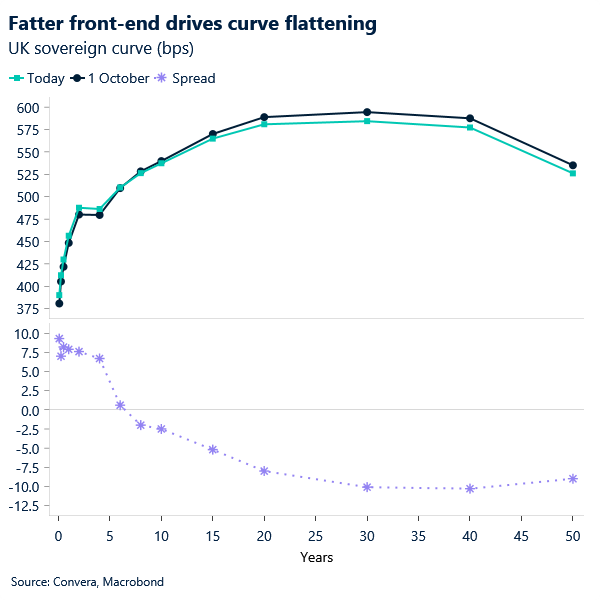
Some bear flattening, with short-end UK rates rising faster than longer-term yields, has kept the currency supported.
For this week, the spotlight is on the data. A hot CPI print should keep November hike bets firmly intact regardless of the labour market figures, leaving sterling well supported. In that scenario, GBP/EUR could make a fresh push towards 1.19.
Market snapshot
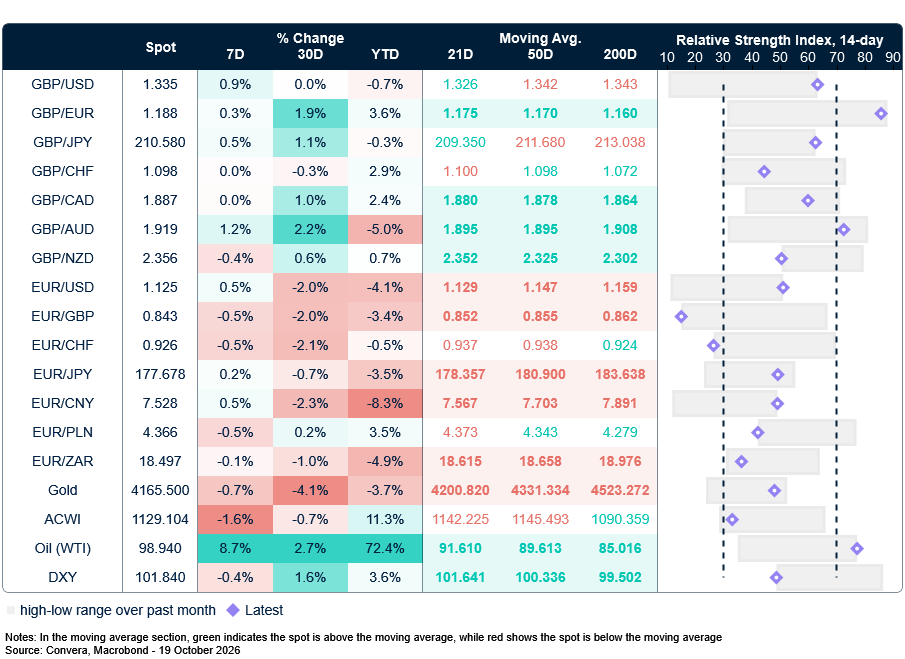
Table: Currency trends, trading ranges & technical indicators
Key global risk events
Calendar: October 19-23
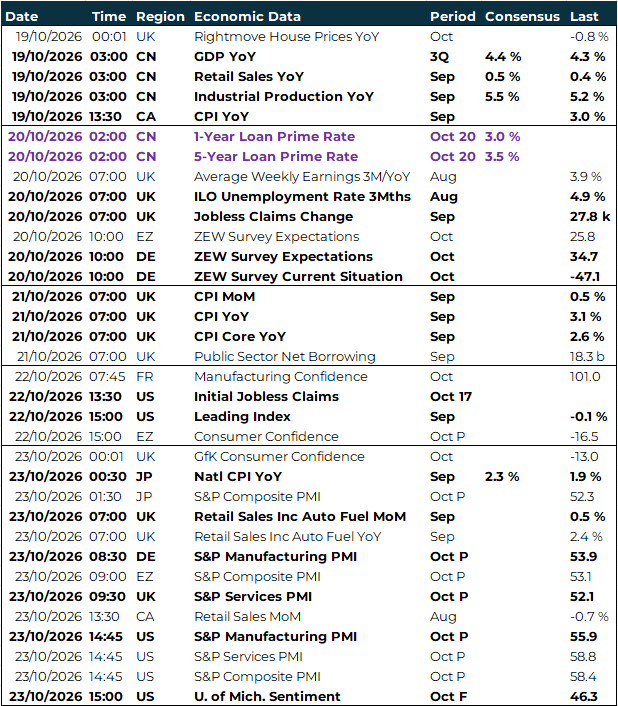
All times are in BST
Have a question? [email protected]
*The FX rates published are provided by Convera’s Market Insights team for research purposes only. The rates have a unique source and may not align to any live exchange rates quoted on other sites. They are not an indication of actual buy/sell rates, or a financial offer.