

USD: Oil and US Dollar slide after Iran US peace signal
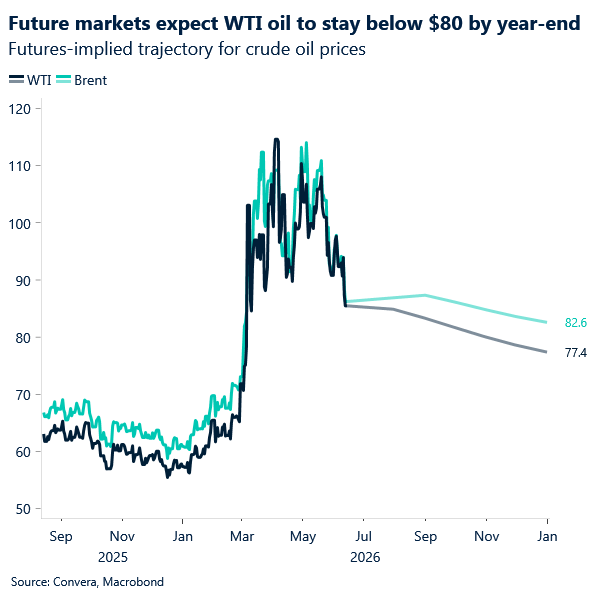
Positive news for risk-on sentiment coming from the Middle East after Iran confirmed it will sign a preliminary peace framework with the US on Friday in Switzerland. Crude oil fell roughly 5%, with the WTI sitting just at the psychological $80 a barrel on the prospect of shipping flows resuming through the Strait of Hormuz, while the dollar weakened. Together, the moves signal a rapid compression of the war-related risk premium that has weighed on global growth and inflation expectations for the past 107 days.
Are markets running ahead of the diplomacy? The agreement initiates a narrow 60‑day bridge framework rather than a comprehensive settlement, leaving the ultimate trajectory still uncertain. Iranian officials are already positioning the talks as a domestic win, even as negotiations proceed under deep mutual mistrust. Under the interim terms, Tehran would freeze nuclear expansion and reopen key shipping lanes in exchange for roughly $25 billion in released assets. The harder work, verifying compliance and resolving technical disputes, still lies ahead, a fragility underscored by mounting hardline protests inside Iran.
For policymakers, the timing is awkward. The sudden shift in the geopolitical backdrop collides with Federal Reserve Chair Kevin Warsh’s first policy meeting this Wednesday, one he had prepared to navigate amid elevated energy-driven inflation risks. The sharp pullback in oil prices now complicates that framework, forcing officials to reassess near-term inflation dynamics just days before Wednesday’s rate decision.
Markets continue to expect the Fed to hold rates in the 3.50%–3.75% range, but lower energy prices ease pressure on the committee to lean hawkish. That backdrop gives Warsh scope to steer the divided panel toward a more explicitly neutral posture. In his inaugural press conference, he is likely to emphasize trimmed-mean and core inflation measures over volatile headline prints, reinforcing the message that policy will not chase short-term commodity swings.
As a result, this week’s meeting is less about rates than credibility. Investors will parse the “dot plot” for signs of internal fracture, particularly around the inflation outlook. Any visible discord, or an unsteady debut from the chair, could reverberate quickly through rates markets. For Warsh, projecting command, with the former Chairman sitting on the board, while anchoring expectations in a shifting macro environment will be the defining test of his early tenure.
EUR: EUR/USD lifts on Hormuz reopening deal
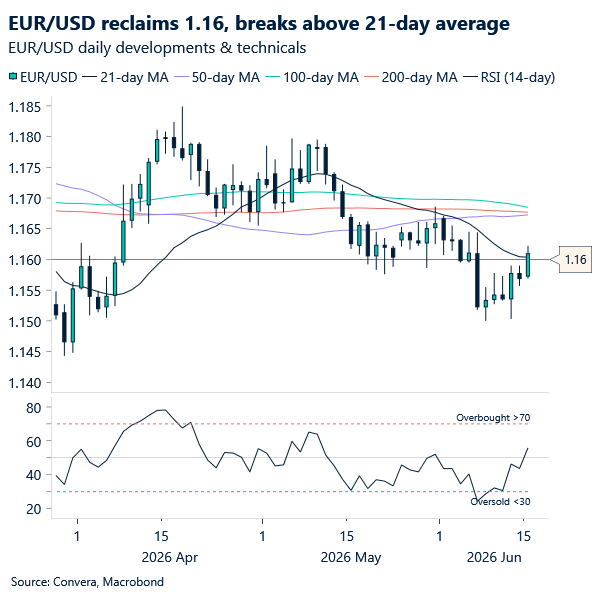
EUR/USD opened higher this morning after the United States and Iran reached an interim agreement to reopen the Strait of Hormuz. The pair had been recovering gradually from its sharp selloff two weeks ago, when it broke below the 1.16 level following a strong US jobs report. It has now regained fresh upside momentum, reclaiming that handle. EUR/USD has also moved above the 21-day moving average, a key short-term momentum gauge, which now sits near the 1.16 level. A close above this threshold would suggest euro buyers are gaining firm control.
The euro has been sensitive to shifts in sentiment around the drawn-out peace negotiations since the ceasefire announcement in early April, reflecting the region’s exposure to elevated energy prices given the bloc’s dependence on external supply. That said, uncertainty remains around the practical resumption of vessel traffic through Hormuz, as well as Israel’s stance on the agreement in the context of its parallel conflict with Hezbollah. Their ongoing hostilities have frequently disrupted diplomatic efforts, and concerns persist that they could still undermine the current accord.
We see limited scope for sustained gains in EUR/USD at this stage, as markets appear to have partly priced in the agreement following weeks of steady conciliatory rhetoric, despite sporadic bouts of violence. Participants may also prefer to wait for the formal signing in Switzerland on Friday to gain clearer insight into the details of the deal (if not to confirm that the agreement is effectively in place). If the de-escalation trend holds, resistance at 1.1650 and then 1.1670, the late-May high, will be key levels to watch. A break above could reinforce upward momentum.
Geopolitical developments around Friday’s signing and the Federal Reserve policy meeting are set to drive markets into the end of the week. Beyond that, we will keep an eye out on today’s April industrial production for the eurozone and tomorrow’s ZEW sentiment survey for Germany and the wider bloc.
GBP: High-stakes week of risk events
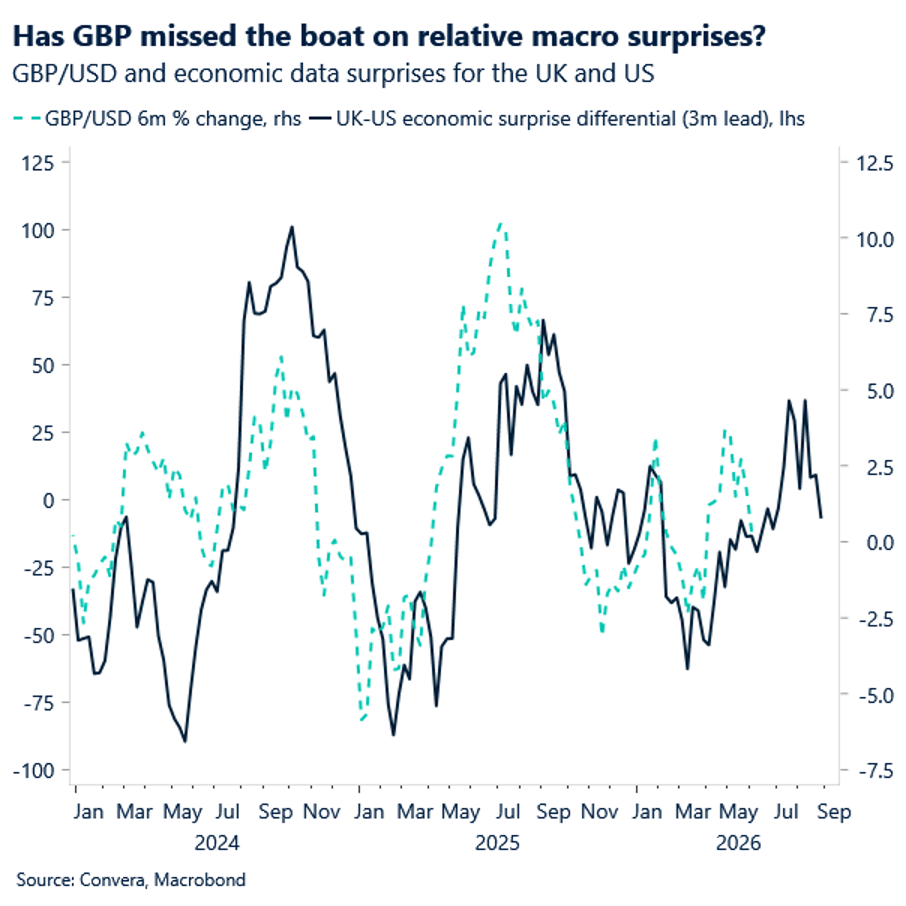
GBP/USD moved higher following the peace deal announcement, although it remains premature to call a shift toward a more directional move. The pair continues to trade within a defined range, lacking clear conviction, holding broadly between 1.33 and 1.35 against the USD and within a tighter 1.15 to 1.16 band versus the euro. This week’s cluster of event risk could provide the catalyst needed to break the recent consolidation.
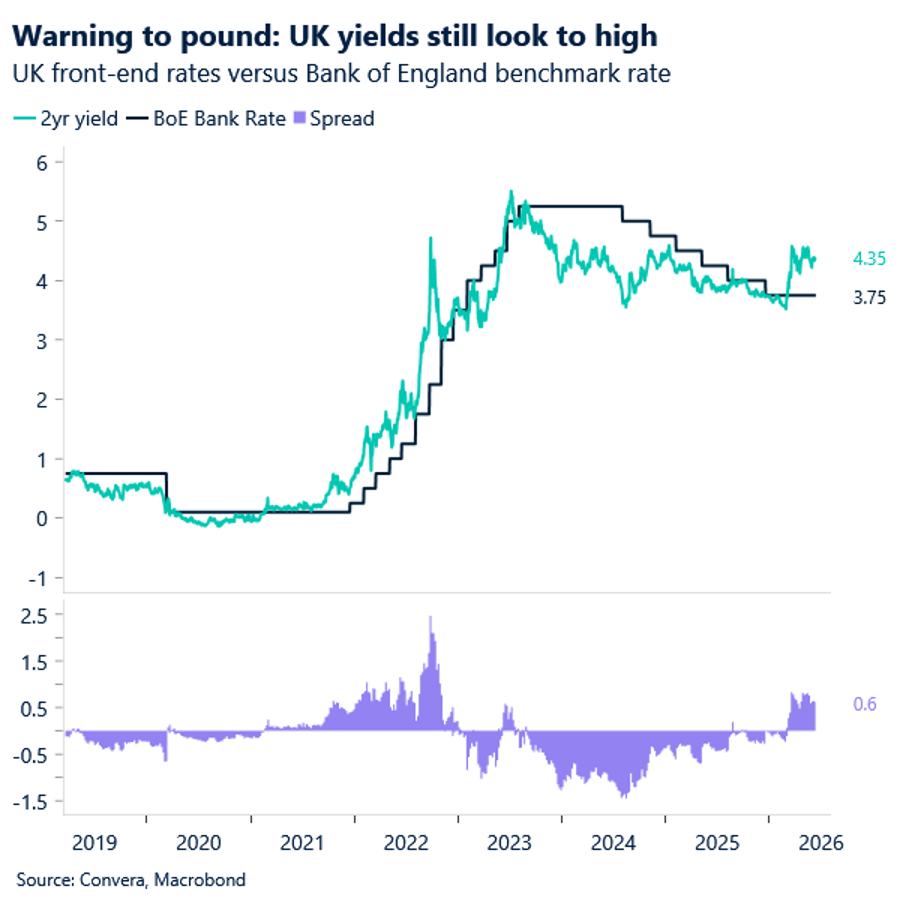
Recent stability in GBP has been driven more by external dynamics than domestic strength. Improved risk sentiment – underpinned by firmer equities and lower oil prices amid optimism over a Middle East deal – has supported the pound via both risk and energy channels. In addition, relatively elevated UK gilt yields continue to offer carry support in a low-volatility backdrop. That said, domestic constraints persist: UK data momentum has softened and political uncertainty is beginning to resurface.
Focus now shifts to a heavy UK data calendar, including inflation and labour market releases, which will shape expectations for the Bank of England (BoE) ahead of Thursday’s policy decision. While we don’t expect a rate change, in line with consensus, the tone of the BoE – particularly whether it mirrors the ECB’s hawkish rhetoric – will be closely scrutinised.
Beyond macro, political risk also comes into view. The Makerfield by-election on Thursday could carry broader implications. A win for Andy Burnham would mark a return to Westminster and potentially revive questions around Labour leadership, adding to pressure on Keir Starmer. Any pickup in political uncertainty risks feeding into higher risk premia, with potential downside implications for both sterling and gilts.
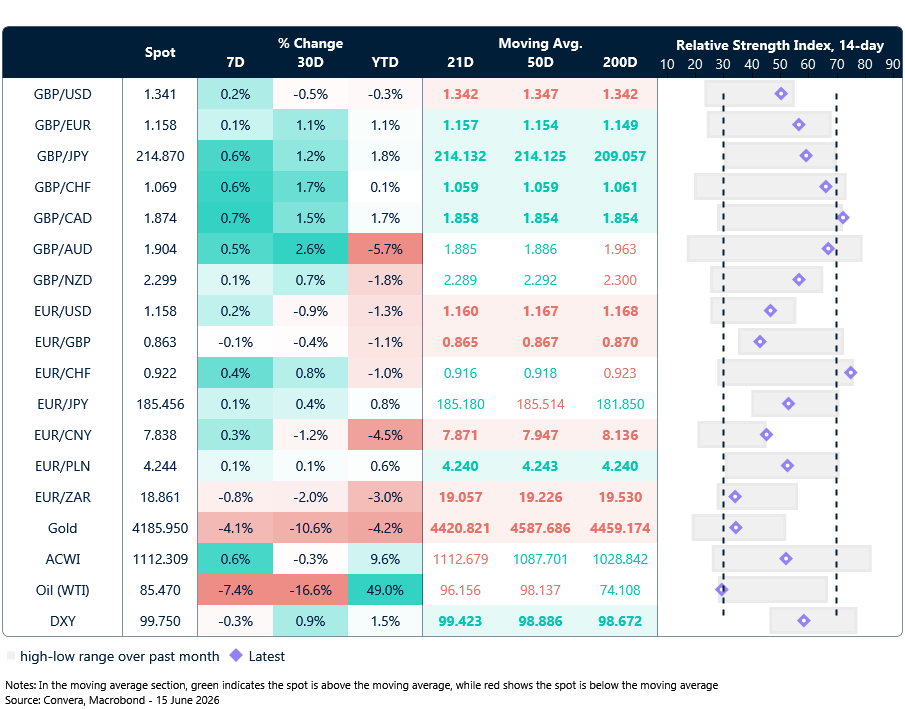
Market snapshot
Table: Currency trends, trading ranges & technical indicators
Key global risk events
Calendar: June 15-19
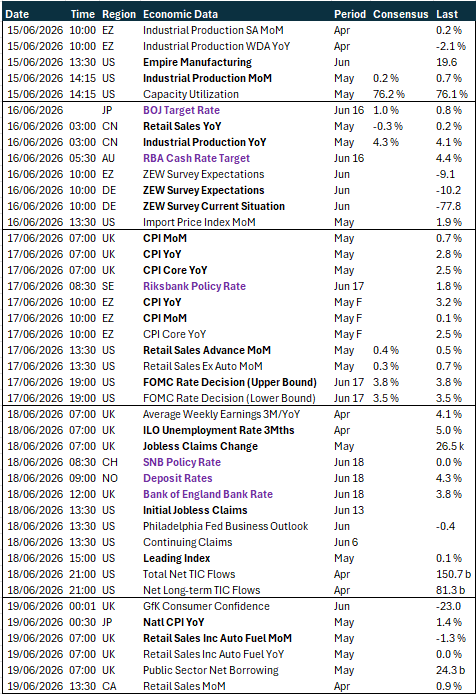
All times are in BST
Have a question? [email protected]
*The FX rates published are provided by Convera’s Market Insights team for research purposes only. The rates have a unique source and may not align to any live exchange rates quoted on other sites. They are not an indication of actual buy/sell rates, or a financial offer.