
The FX outlook for April 2026 is focused on reduced sensitivity to traditional economic data and heightened dependence on geopolitical developments.
The escalating US and Israeli conflict with Iran has reshaped inflation expectations, monetary policy pricing, and relative currency performance through sharp moves in oil and gas markets.
For businesses operating across borders, understanding these dynamics is critical for managing pricing, costs, and cash flows.
Download the full Global FX Outlook April now
How geopolitical risk is reshaping global FX pricing
The conflict in the Middle East has increased the risk of sustained disruption to global energy supply.
The Strait of Hormuz remains a key focal point due to its role in global oil and liquefied natural gas transportation. Markets are pricing uncertainty around the duration, escalation risk, and economic spillovers of the conflict.
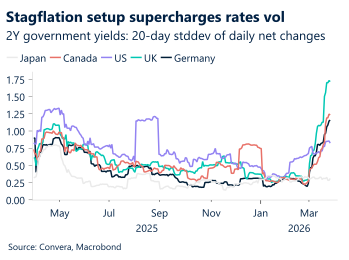
With energy prices surging, inflation risks have remerged again just as many central banks were preparing to ease policy. Investors are reassessing rate paths and currency valuations.
The result has been a return of terms‑of‑trade dynamics as a primary FX driver. Energy‑exporting economies have found relative support, while energy‑importing currencies have struggled to offset deteriorating external balances, even where local rate expectations have turned more hawkish.
How rising energy prices are reshaping inflation expectations and rates
Higher oil and gas prices have reignited inflation concerns, even as labor markets soften in several developed economies.
The memory of post‑pandemic and energy‑driven inflation remains fresh for policymakers. Rising oil and gas prices have triggered an immediate hawkish reassessment across rates markets, despite long‑term inflation expectations remaining broadly anchored.
Central banks are facing a more complex trade‑off, as softer labor markets in economies like the US and UK still point toward eventual easing, while renewed supply‑side shocks complicate the near‑term outlook.
This policy tension increases uncertainty and raises the probability of abrupt repricing across rates and FX markets as new information emerges.
Interaction between energy shocks, growth, and technology investment
Beyond inflation, higher energy prices are undermining global growth expectations.
Elevated costs and heightened uncertainty risk are reducing household purchasing power and increasing business operating expenses. Historically, sharp oil shocks have often preceded periods of broader economic stress, reinforcing caution across risk‑sensitive assets. This is contributing to a downgrade in global growth prospects for 2026.
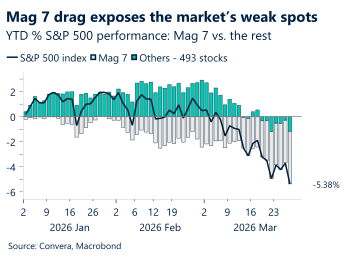
An emerging, less visible theme is the interaction between rising energy costs and capital‑intensive sectors such as artificial intelligence. AI infrastructure is energy‑intensive and often funded through private credit. Rising power costs and tighter liquidity raise questions about valuation sustainability. Stress in this sector could spill over into broader risk sentiment, affecting FX, equities, and credit markets.
Why the US dollar has regained conditional support
Unlike previous cycles, higher commodity prices now tend to support the dollar due to the US position as a net energy exporter.
This structural shift has helped the currency outperform peers whose external balances deteriorate when energy prices rise. However, this support remains conditional. Markets continue to price in a political risk premium that limits how fully the dollar reflects strong headline data.
If geopolitical tensions stabilize or move into a more predictable phase, safe‑haven demand could fade, refocusing attention on that lingering risk premium. In contrast, a prolonged conflict that keeps oil prices elevated for an extended period could begin to weigh on US domestic consumption, softening the dollar’s advantage.
Key currency dynamics to monitor:
- The durability of the US dollar as energy prices and risk sentiment evolve.
- Ongoing pressure on euro area currencies due to weaker terms of trade.
- Sensitivity of risk‑aligned currencies, including the Australian dollar, to shifts in global growth sentiment.
- Repricing of rate expectations in markets such as the UK, where inflation risks have challenged earlier easing assumptions.
What does the FX Outlook for April 2026 mean for businesses?
Businesses with international exposure should prepare for:
- Higher short‑term FX volatility driven by geopolitical headlines.
- Potential swings in funding costs linked to interest rate repricing.
- Increased uncertainty around input costs, margins, and pricing decisions.
Understanding these forces is essential for navigating FX risk in an environment where traditional macro signals have temporarily taken a back seat to geopolitical reality.
Read the Global FX outlook for April 2026 now, and gain the insight needed to navigate FX risk with greater confidence in an increasingly unpredictable environment.
