
Written by Convera’s Market Insights Team
The latest non-farm payrolls and inflation reports continued the theme of the first quarter and came in hotter than expected, effectively ending any bets on policy easing coming from the Federal Reserve in the first half of the year.
The Bank of Canada and European Central Bank have voiced their desire to start their respective cutting cycles irrespective of when the Fed moves. This could spark policy divergence that could drive up FX volatility.
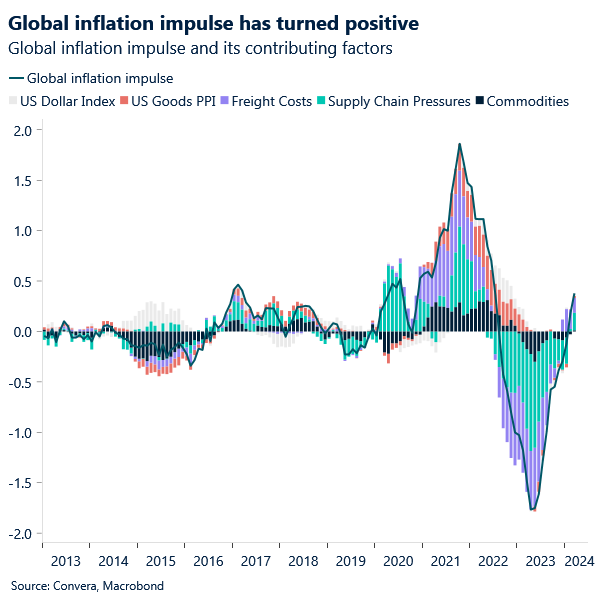
Shipping rates, the Fed’s supply chain pressure index, commodity prices, the global inflation surprise index and the US dollar all bottomed in Q4 and have since then rebounded. We conclude that the global inflationary impulse has picked up in Q1.
The European Central Bank (ECB) unsurprisingly left its key policy rates unchanged from record highs at its 11 April rate decision, but it gave its clearest signal to date that it is ready to start cutting rates soon.
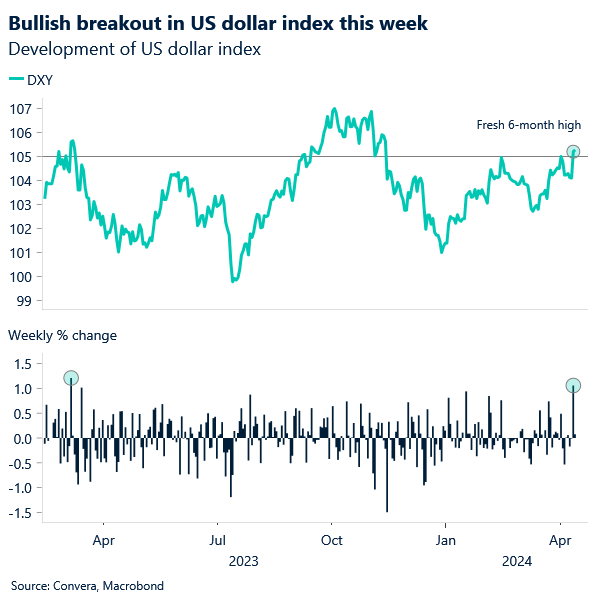
The US dollar index (DXY) recorded its biggest weekly ascent since May 2023 after scoring its biggest daily rise since March 2023, triggered by above-forecast US inflation data.
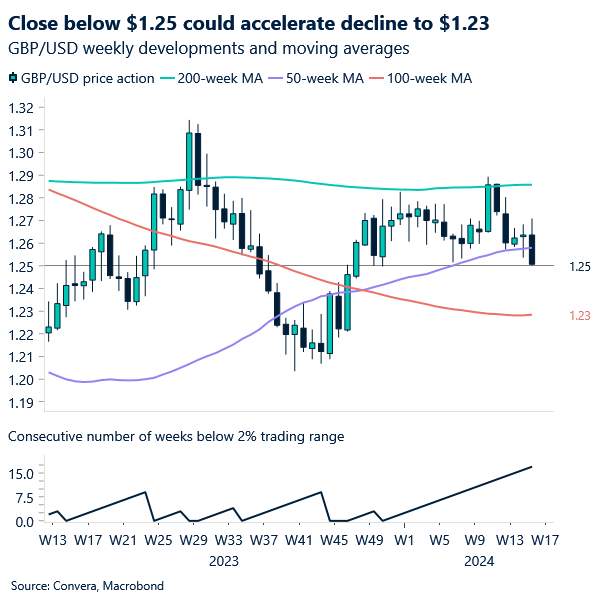
UK-US 2-year yield spread slipped to the lowest in a year and GBP/USD hit a fresh 2024 low just below the $1.25 mark.
US retail sales and industrial production will be front and center over the week ahead as the shock wave of the latest CPI report continues to make its way through financial markets.
Global Macro
US and Fed diverge from the world
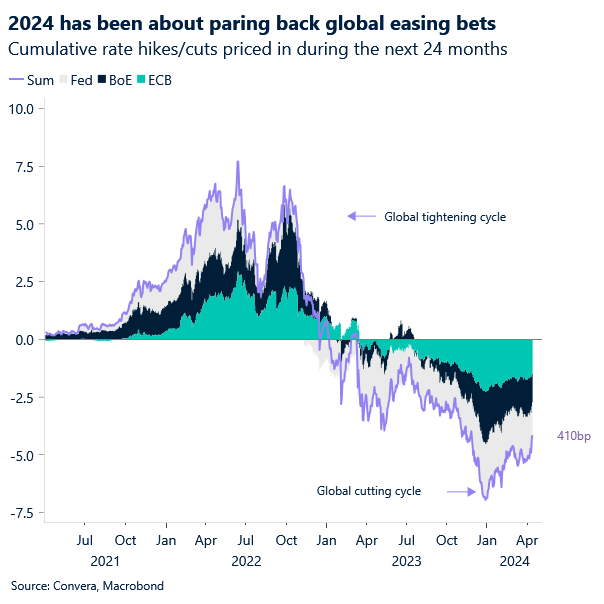
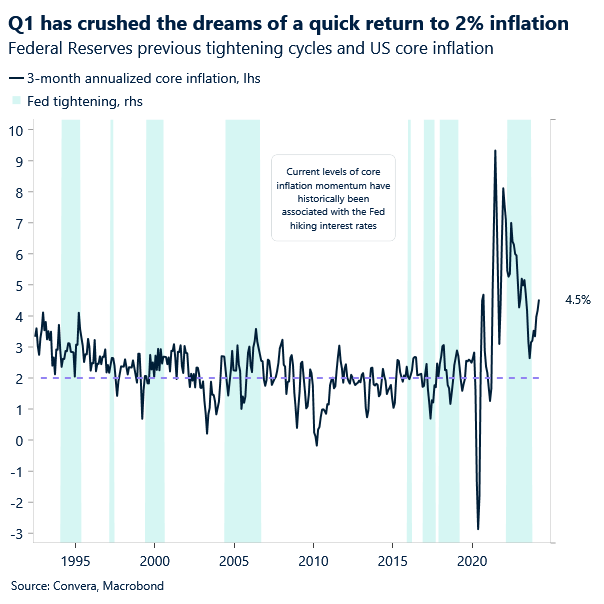
A new landscape to settle into. Macro and markets look a lot different now then they did two weeks ago, and it has once again been US economic data that investors can blame for causing this volatility. The latest non-farm payrolls and inflation reports continued the theme of the first quarter and came in hotter than expected, effectively ending any bets on policy easing coming from the Federal Reserve in the first half of the year. With the 3-month average jobs growth running at 244 thousand and 3-month annualized core inflation at 4.5%, policy makers will most likely be able to sit out a couple of meetings and hold rates unchanged. Investors are adjusting to this new neutral Fed with selling government bonds and buying the US dollar.
The need for divergence. Investors have been pricing in the same policy path for most G10 central banks for the past few months, which had suppressed FX volatility. However, the US just seems to be too strong and the Fed to patient for policy makers across the world to keep up. The Canadian and European Central Bank have voiced their desire to start their respective cutting cycles irrespective of when the Fed moves. This could start a divergence on the currency side of things.
Inflation still matters. As we have been saying in our FX weekly two weeks ago, the US is the most at risk of inflation settling above 2% as the incoming macro data continues to remain robust. However, the goods side of the inflation equation in general seems to have bottomed at the end of last year and has now stopped improving. Shipping rates, the Fed’s supply chain pressure index, commodity prices, the global inflation surprise index and the US dollar all bottomed in Q4 and have since then rebounded. While the push higher has not been too concerning, it does add to the risks central banks are facing in addition to services inflation remaining sticky. We conclude that the global inflationary impulse has picked up in Q1.
Regional outlook: United States
Two macro points changed the consensus
Inflation remains too hot to cut. The latest string of hotter than expected inflation prints just got longer with the consumer price index surprising once again to the upside in March, ending the first quarter with a high level of uncertainty for investors and the US central bank. The third consecutive +0.35% monthly print on core inflation has thrown the expected beginning of the Fed’s easing cycle into question. With 3-month annualized core inflation now running at double the central banks target – the highest level in 30-years (excluding 2021-2022) – markets have cut back the probability of a June cut from more than 50% to 4%, highlighting the drastic change in sentiment. While we continue to expect inflation to trend lower over Q2 and Q3, the current levels of core, medium and trimmed inflation momentum have historically been associated with the Fed hiking interest rates, not cutting them.
Jobs growth remains solid. US job growth once again blew the consensus forecast out of the water. The US economy added 303 thousand jobs to its workforce and therefore the most in ten months. It was the fourth consecutive print above 200 thousand as the health care sector and government contributed just shy of 50% to the overall number. The labor market continues to defy expectations of a slowdown and is currently in its 5th longest expansion in US history. The employment sub-indicators from the ISM surveys have been pointing to weaker job growth for some months now as well. Which means that the inherent resilience of the labor market as of late had to come from developments new to the last couple of years. Some of these novelties might be (1) the rise in immigration, (2) the increase in importance of part-time jobs and (3) the government and health care sector compensating for the stagnation of other parts of the economy. These two sectors have been adding workers at the fastest pace since the early 2000s on an annualized basis.
Regional outlook: Eurozone
Picture brightens as ECB commits to cuts
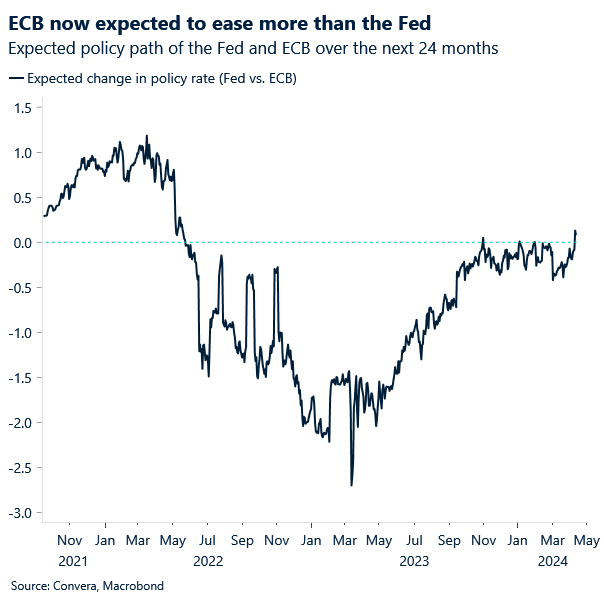
Easing is coming. Unsurprisingly, the European Central Bank (ECB) left its key policy rates unchanged from record highs at its 11 April rate decision, but it gave its clearest signal to date that it is ready to start cutting rates soon. Satisfied with the disinflation progress in bringing inflation back to its 2% target, the central bank stated it would be appropriate to reduce the tightness of policy, pointing to a likely cut at the next policy meeting in June. We continue to hold the view that ECB will cut the rates before the Fed, but subsequent ECB policy outlook will be closely correlated with US developments.
Inflation is falling. Across the Eurozone bloc, the preliminary March Eurozone inflation report matched November’s 28-month low at 2.4% y/y, with the core rate cooling to an over 2-year low. Meanwhile the latest Q4 2023 wages costs rose by 3.4% y/y – the slowest pace since Q3 2022.
Loan growth is bottoming. The ECB’s quarterly Bank Lending Survey, showed that bank lending across the bloc continues to flatline. Expectations of loan demand recovery expressed in last quarter’s survey failed to materialise as demand for corporate loans in the Eurozone saw a substantial 28% q/q decline in Q1 2024. Meanwhile loan demand for consumer credit turned positive for the first time since Q3 2022.
Uptick in production. The latest report showed that German industrial production expanded by 2.1% m/m in February, exceeding market estimates of 0.3%. It marked a second consecutive month of expansion and the fastest rate of growth in 16 months, boosted by construction, auto and chemicals activity.
Week ahead
Lots of small pieces could add up to something big
UK economy still growing? Although the UK economy sank into a technical recession at the end of last year, investors have been encouraged by recent upbeat business surveys that suggest the downturn will be short lived. Indeed, UK GDP came in at 0.1% m/m in February, in line with market consensus, but at a slower pace than the month prior. Now the focus shifts to the labor market report on Tuesday and retail sales numbers on Friday. These will be important for gauging the development of the British economy in the month of March.
China trying to recover. Chinese exports disappointed expectations in March, shrinking 7.5% in dollar terms from a year ago and setting the stage for the retail sales and GDP releases on Tuesday. Export growth has been below the 10% threshold for one-and-a-half years now, something untypical for the worlds second largest economy.
Once again, US in focus. US retail sales and industrial production will be front and center as the shock wave of the latest CPI report continues to make its way through financial markets. Consumer spending is expected to shift down a gear from rising 0.6% in February to a more modest 0.3% increase in March. However, any deviation from the consensus will be market moving in the context of the current macro environment.
Second-tier data. With the US jobs and inflation report out of the way, second tier data will be in focus over the next few days. Regional Fed surveys (New York, Philadelphia) and the Beige Book will provide new updates into the standing of the US economy.
FX Views
Dollar’s not done yet
USD Standing tall as Fed easing bets slashed. The US dollar index (DXY) recorded its biggest weekly ascent since May 2023 after scoring its biggest daily rise since March 2023, triggered by above-forecast US inflation data. Investors slashed bets on a Fed rate cut in June and are pricing in less than two cuts for 2024, down from seven at the start of the year. After the CPI release, the 10-year Treasury yield jump 18 basis points, a three standard-deviation move to November highs above 4.5%. Naturally, the dollar surged and the DXY hit a 6-month high above 105, breaking out of its medium-term triangle formation, which lasted since the middle of 2021. Consequently, we must question our dollar pessimism, especially if other major central banks push ahead with rate cuts ahead of the Fed. This is increasingly possible given the more encouraging inflation outlook relative to the US. We still think the dollar has an asymmetric reaction function to data, meaning weaker US data should spark bigger sell offs in the dollar. But given the ongoing resilience of the US economy, growing fears of US reflation and policy rate divergence widening in favour of the USD, dollar bulls remain in control for now and we cannot rule out further upside in the short-term.
EUR Slumps to fresh 2024 lows. The dovish ECB signals and willingness to decouple from the Fed attracted further euro sellers to an already crowded trade. Mid week EUR/USD was under a heavy bearish pressure, registering the largest one-day loss in 2024, on the back of hot US CPI report. With cumulative 2-day losses amounting to 1.4% – the worst performance in 14 months – EUR/USD erased all Q2 gains, touching 5-month lows, as broad US dollar strength prevails. Having registered its worst weekly loss since May ’23 and worst YTD performance since 2022 (down over 3%), this record-breaking week is one that euro bulls will be glad to forget. As daily RSI edges towards oversold territory, we expect the pair to consolidate closer to $1.0700 level, but a break below could see EUR/USD test the next support level at $1.0650.
GBP Shaky ground near 2024 lows. In the last five weeks, GBP/USD has dropped around 3% from 7-month highs near $1.29. This is mainly a US driven story, with markets now pricing in less Fed rate cuts than the BoE in 2024 because of hot US inflation data. The UK-US 2-year yield spread slipped to the lowest in a year and GBP/USD hit a fresh 2024 low just below the $1.25 mark. The pound slumped by more than 1% against the dollar on CPI day, exhibiting its largest daily trading range on a losing day since last July, reflecting the importance of US data and Fed policy expectations across the FX space. After breaking north of a descending trendline and key moving averages earlier in the week, the pair plunged back below its 200-day moving average, erasing recovery attempts and exposing the risk of a deeper decline towards the 100-week moving average located around $1.23. The pound remains more upbeat against other peers, however, up 1.4% against the euro this year, due to the dovish ECB outlook, but the currency pair lacks volatility and momentum in either direction, caught in a tight 1.2% range for the past three months. UK inflation and labour market data will test sterling over the next few trading sessions. Any outcome that pulls forward UK rate-cut expectations could weigh heavy, but the UK growth outlook is improving, which should support the pound in the longer term.
CHF Strong in April, but downside bias intact. The Swiss franc remains the 2nd worst performing major currency so far this year, down over 8% versus the US dollar and hitting fresh 6-month lows over the week. With the SNB being the first G10 central bank to cut interest rates, this undermines the currency from a carry perspective with the CHF likely to be increasingly seen as a funding currency of choice, especially in the current world of low FX volatility. CHF appreciated against just 16% of global currency peers in Q1, the weakest 3-month performance since 2007 and its weakest quarter since 2003 against the euro. However, the franc’s safe haven status has supported amidst a rise in global risk aversion. This means, the franc has appreciated against 70% of global peers in April and EUR/CHF’s record-long weekly winning streak is poised to come to an end as a result. But we retain a longer-term bearish view on the swissy with EUR/CHF reaching parity this year given the SNB has stopped selling FX reserves and is expected to cut rates again in June.
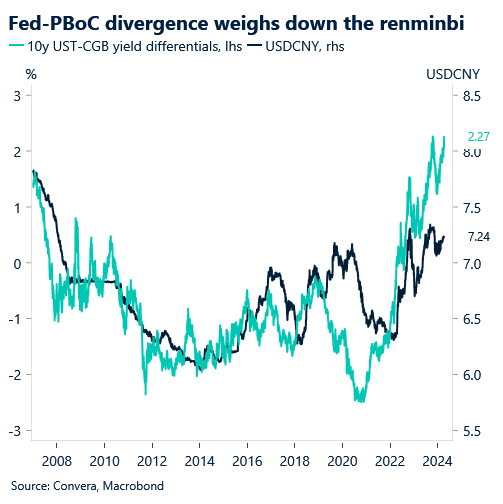
CNY China inflation eases, but deflation risks linger. China’s March CPI rose a mere 0.1% year-on-year, weaker than the 0.4% consensus expectation and the prior 0.7% reading, as the Lunar New Year base effect faded. This reflects ongoing weakness in consumer demand amid a housing slump, with food prices falling 2.7% year-on-year and tourism-related prices also declining. Core CPI growth slowed to 0.6% year-on-year from 1.2% previously. Meanwhile, PPI deflation deepened to -2.8% year-on-year, in line with expectations and after -2.7% last, marking the 18th consecutive month of decline. This deflationary pressure is likely to fuel calls for more policy support from the People’s Bank of China. However, the central bank’s room for easing may be limited, as Fed rate cut expectations have been pushed out following the hot US CPI print, pushing the US dollar high and adding pressure on the yuan. The USD/CNH remains in a clear uptrend and this creates a more negative outlook for the Chinese currency through the end of the year. Looking forward, we see the all-important March-quarter GDP and March industrial production and unemployment rate.
JPY Yen intervention risks loom as USD/JPY surges. The higher-than-expected US CPI read has pushed out expectations for a June rate cut by the Federal Reserve and driven the US dollar index (DXY) beyond 105, the highest level this year. This has led to a sharp rise in the USD/JPY, which has broken through the 152 level, prompting Japanese officials to warn of intervention risk. Finance Minister Shunichi Suzuki said the government will not rule out options against “excessive moves” and is watching the foreign exchange market with a higher sense of urgency. The market is divided on the likelihood of intervention, with some believing it is imminent given the authorities’ past actions, while others think the authorities may adopt a wait-and-see approach as this is a broad-based US dollar move. Key economic indicators to monitor include Japan’s exports, trade balance, and national core CPI, which could provide further clues on the authorities’ next move.
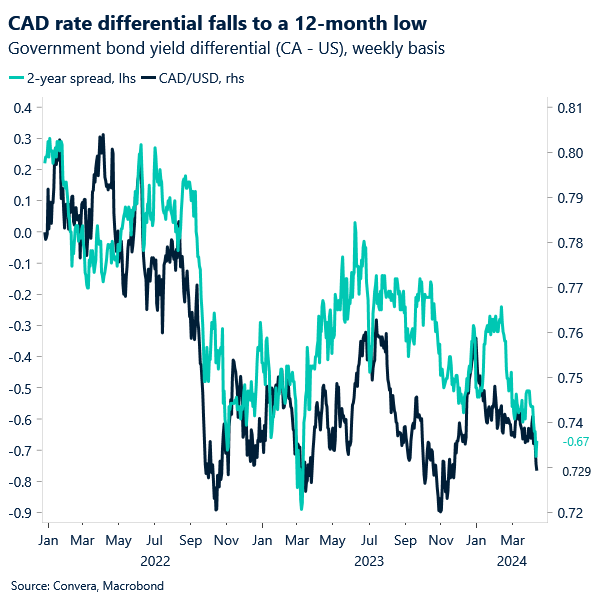
CAD BoC-Fed divergence sparks USD/CAD breakout. The USD/CAD outlook shines brighter with bullish prospects as the outlook for rate cuts between Canada and the US diverges. Unsurprisingly, the BoC maintained its cash rate unchanged at 5%, but signalled the start of rate cuts in June is “within the realm of possibilities”. Meanwhile, the latest US CPI came in hotter than expected, indicating a pause in the downtrend. The BoC is now seen as buying time, but diverging economic paths will force the central bank to press the trigger first and trim rates. US-CA 2-year government bond spreads widened to the highest level in over a year, prompting the sharpest CAD selloff on weekly basis since mid Nov ’23. Albeit further catalysts, we expect USD/CAD to pull back from the current near 5-month highs, as daily RSI is approaching overbought territory, and consolidate around $1.3680. However, the upcoming calendar is front loaded with US Retail sales and CA inflation reports, we expect pockets of FX volatility to spill over into the start of the week with risks skewed against meaningful CAD recovery. In the case of strong US data or cooler CA inflation print, we could see USD/CAD break past the current resistance level at $1.3750, putting the pair in the fast lane on the way to $1.3900 (Nov’23 high).
AUD Softening business conditions, prices also weigh on Aussie. Like other FX markets, the AUD/USD was mostly driven the US CPI numbers with the pair seeing its largest one-day loss for the year after the shock result. Locally, Australia’s business conditions fell 1 point to +9 in March, while confidence rose 1 point to just +1, according to the NAB business survey. Importantly, the survey showed that business selling prices eased to the lowest level since February 2021, implying that annualized CPI inflation is now below 3% after being stuck around 4%-5%. Australian inflation looks to be cooling further ahead of the 24 April CPI read. More broadly, the Australian dollar remains resilient in other markets, near recent highs versus the euro, Japanese yen and NZ dollar. Looking at the AUD/USD, the pair is in a clear downtrend, below key moving averages, with resistance at 0.6640-0.6708 and support at 0.6475 and then 0.6440. Markets will be closely watching the March employment change and unemployment rate, due Thursday AEST, for further insight into the health of the Australian economy.