
No alternative to the dollar in the short term
Last week’s economic data has investors worried about the Federal Reserve (Fed) not being done raising interest rates. While markets do not see a hike in September as likely, the probability of an increase in November or December stands just below 40%. This comes after both the purchasing manager index for the services sector and labour market data performed better than expected last week, surprising the consensus forecast to the upside. While we continue to expect the labour market to lose steam and the US economy to slow down, current nominal growth is still too strong for that fear to be priced into markets. Coupled with the cyclical downtrend in other parts of the world like China and the Eurozone, this creates an environment of dollar outperformance, explaining the USD’s 5.5% gain in eight weeks.
The dollar has been particularly strong against the euro, yen and yuan with both USD/CNY and USD/JPY sitting near multi-year highs. The latter currency pair gained attention last week after rising above the 147 marks for just the second time in the 21 centuries as the Bank of Japan’s laissez-faire attitude toward high inflation created an incredible rate differential between the US and Japan. However, the Japanese yen surged on Monday after comments from central bank Governor Kazuo Ueda sparked hopes that Japan could soon move away from negative rates. It could be that these comments were intended to stop the yen’s steep slide with the Japanese 10-year government bond yield continuing its ascent to above 0.7% to the highest level in over nine years.
Comments from Japanese and Chinese policymakers will be closely watched by investors as both currency pairs remain of global importance for sentiment and FX markets. Back in the US, focus will fall on the economic data with retail sales, industrial production, producer prices and CPI inflation coming up. Economists expect inflation to tick up again for the second month in a row to 3.6%. However, the more important core inflation rates, excluding food and energy, is expected to have fallen to 4.3%, the lowest level since late 2021.

Euro stabilising after seven weeks of losses
Another week has ended with deep losses for the euro against the backdrop of weak economic data and rising expectations that the European Central Bank (ECB) might be done raising interest rates. Last week’s economic data was not particularly market moving, however, macro releases such as Eurozone retail sales (-1% y/y) and GDP growth (0.1%) showed a lack of economic momentum in the Eurozone. With China continuing to print weak numbers and the US economy outperforming, investors carried on selling the euro against the dollar and even the yen and yuan.
The global downtrend and consequent recession of the manufacturing sector in particular has been a drag on Europe. With purchasing manager indices across the board being deeply negative, last week’s 11.7% fall of German factory orders – the largest monthly drop since April 2020 – sparked worries about the outlook for Europe’s largest economy. The consensus now expects Germany to have contracted in the three months through September. This is dragging down the GDP growth of the rest of Europe. Investors are now hoping for continued stimulus measures from Beijing and the stabilisation of the Chinese economy to act as a catalyst for a global industrial recovery.
The euro is heading into a busy week with releases such as German economic sentiment, Eurozone industrial production, and inflation functioning as market movers just before the ECB meets on Thursday. With seven weekly losses versus the US dollar on its back, the euro is trying to stabilise in early Monday trading just above the $1.07 mark. The economic data will most likely not bring the common currency any joy as the loss of economic momentum continues. However, should the ECB unexpectedly increase interest rates, the euro would be pushed higher in the short term.

Is a BoE pause looming?
The pound remains caught in a downtrend against the US dollar, but the 200-day moving average support remains intact and GBP/USD is back above the key $1.25 handle this morning. UK labour market data (Tuesday) and GDP (Wednesday) will be closely watched by GBP traders though US inflation (Wednesday) is the main data point in focus this week.
Domestically, UK economic activity is slowing rapidly, fuelling stagflation fears and a potential pause in rate hikes by the Bank of England (BoE) sooner than expected. We still expect another 25-basis point rate rise next week and markets are pricing an 80% chance of such a move, but the odds of another hike in November have dropped to 40%. There’s mounting evidence from surveys that price pressures in the UK are easing and the jobs market is cooling. But the BoE has made it abundantly clear that it’s waiting for the actual data to show those trends too. Therefore, tomorrow’s wage growth and jobs data will be critical. Any sign of cooling wage growth will be welcomed by policymakers’ whist the ratio of unfilled job openings to unemployed workers should continue to fall and is closing in on pre-Covid levels.
Could September’s hike be the last? It’s certainly plausible if the hard data backs up the soft data. Hence, the pound’s yield advantage may further weaken, which leaves the downside bias intact and GBP/USD vulnerable to retest its key support level nearer $1.24. Elsewhere, GBP/EUR continues to trade sideways within the narrow €1.16-€1.17 corridor, whilst GBP/JPY has fallen 1.5% in just three trading days as the yen surges across the board.

Japanese yen surges across the board
Table: 7-day currency trends and trading ranges

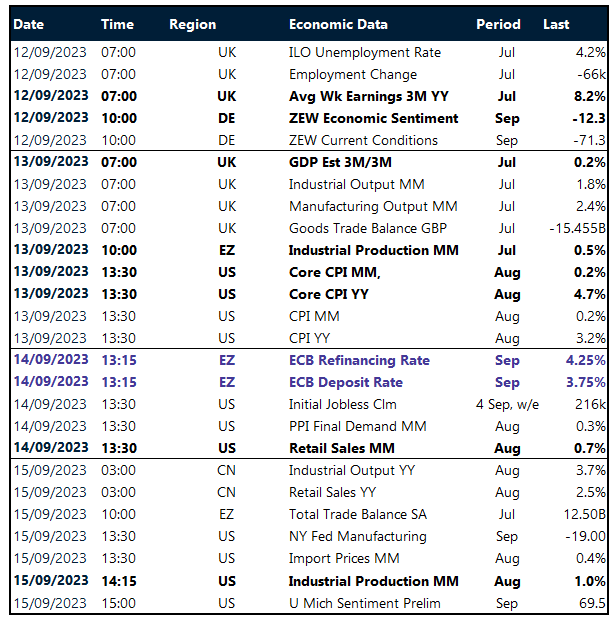
Key global risk events
Calendar: September 11-15
Have a question? [email protected]
*The FX rates published are provided by Convera’s Market Insights team for research purposes only. The rates have a unique source and may not align to any live exchange rates quoted on other sites. They are not an indication of actual buy/sell rates, or a financial offer.