


USD: The dollar’s shifting fault lines
The balance of risks underpinning the dollar is in flux.
On one hand, President Trump has doubled down in recent weeks on threats aimed at squeezing Iran’s economy. The rhetoric has clearly shifted from military threats to economic pressure. In a recent post on X, the president announced plans to subject Iran to an “economic D-Day” and warned that any trading partner seeking to support the Islamic Republic would face “tremendous consequences”.
There remains considerable uncertainty around what these measures would entail, how they would be implemented, and how China, Iran’s largest trading partner, would respond, particularly while the US-China trade truce remains a live issue.
The current geopolitical backdrop is hardly dollar-supportive. This new phase of the conflict, effectively an economic pressure campaign, limits any safe-haven appeal the dollar might otherwise attract. Through the oil channel, Brent has been quietly rising and is now up for a fifth consecutive session, but prices remain well below the peaks reached when the conflict was at its most intense. Markets appear far better equipped today to absorb USD-denominated oil transactions at these levels.
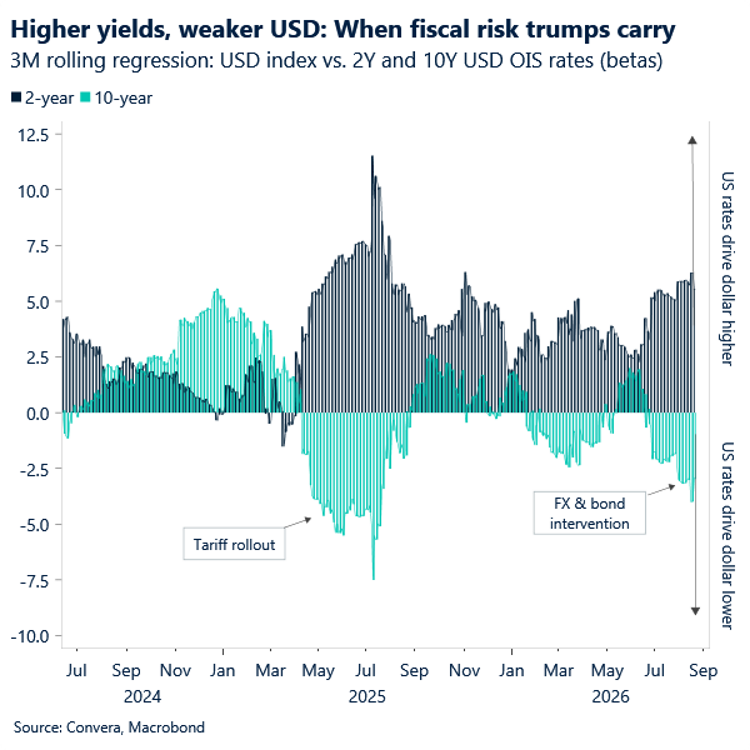
On the other hand, we think the debasement trade that dominated parts of 2025 is beginning to creep back into the narrative, with the US dollar increasingly viewed as the sacrificial lamb. The Treasury’s unplanned update to its buyback programme was an early warning sign that the administration is becoming increasingly sensitive to rising long-end borrowing costs amid ballooning debt, oil-induced inflation and broader supply pressure from the AI industry’s borrowing binge. The move also invites a fresh interpretation of the US intervention to weaken the Japanese yen a few weeks later, perhaps as an attempt to discourage Treasury selling by Japan that could have placed further pressure on long-end yields. Coincidentally, the US sold euros, not dollars, in exchange for yen.
More broadly, the move revives concerns that were very much alive in 2025: waning confidence in US institutions. Back then, the catalysts were tariffs and threats to the Fed. Today, they are a more interventionist Treasury, heightened fiscal concerns, and the Fed’s new zero-forward-guidance mantra. Different triggers, same source of scepticism.
In our view, these concerns, and the associated dollar weakness, are here to stay and are likely to intensify heading into the midterms. While this is primarily a longer-term narrative, near-term catalysts are likely to revolve around Kevin Warsh’s communication, with the Jackson Hole symposium the key event to watch. We would expect further dollar downside if markets remain dissatisfied with his less precise communication style and the “let the market do the work” philosophy he alluded to at the July meeting.
Before then, the key data tests are tomorrow’s PMIs and the PCE inflation and personal spending figures due on 26 August. None is expected to materially rock the boat for the dollar. We therefore expect DXY to consolidate in the 98-99 range, albeit with a modest downside bias. The 98 level remains the key support to watch heading into Jackson Hole.
EUR: No rush to 1.18
In the options market, EUR/USD risk reversals have turned positive across tenors for the first time since the pre-conflict period, signalling a renewed preference for upside euro exposure over downside protection. Shorter-dated tenors now span the ECB and, more importantly, the Fed policy decisions due in September, pointing to growing investor concern over a further unwinding of hawkish Fed expectations ahead of the meeting.
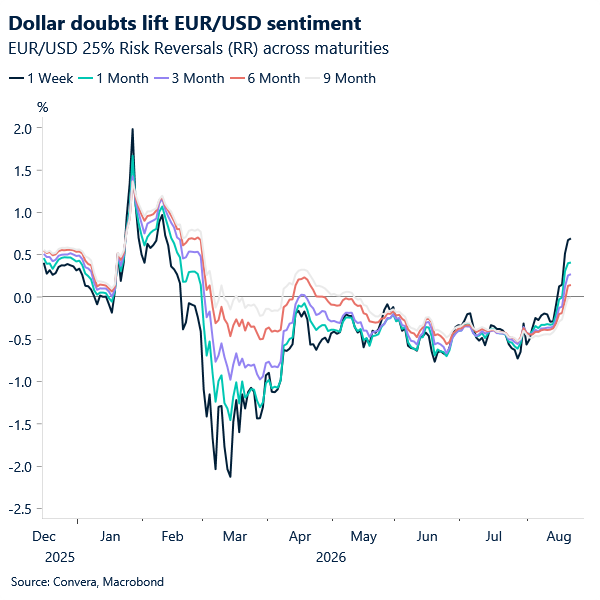
Importantly, the more vulnerable position in which the dollar finds itself following the announcement of renewed Treasury intervention only reinforces the desire to hedge against further dollar weakness. Should Kevin Warsh’s appearance at the Jackson Hole symposium, and the press conference following the September decision, fail to establish sufficiently hawkish credentials in the face of above-target inflation, the dollar could weaken further, beyond what fundamentals alone would justify.
EUR/USD has enjoyed two consecutive days of gains on softer dollar sentiment, while rate differentials have barely moved. We remain reluctant to chase a more sustained move toward 1.18 from here without clearer catalysts. The Jackson Hole symposium at month-end is the next key test.
GBP: Climbing to six-month high
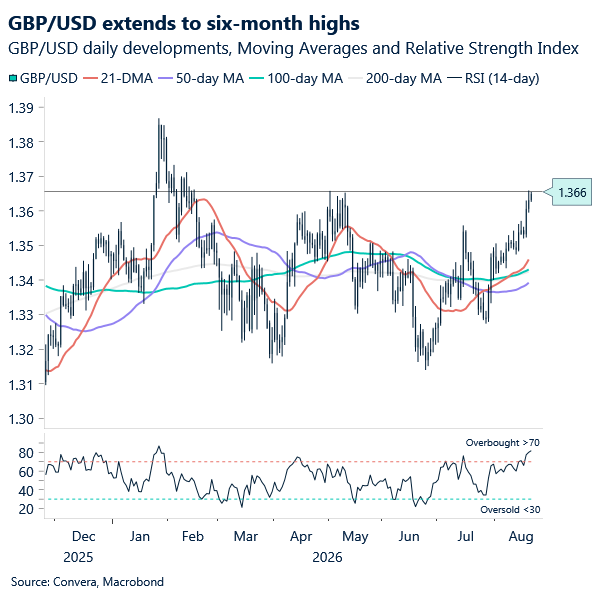
Sterling is on track for its fourth weekly rise in a row versus the US dollar. GBP/USD has pushed above 1.36 to a fresh six-month high and well above key daily and weekly moving averages. The move has been driven primarily by the USD leg of the equation, rather than a wholesale improvement in the UK story. Markets have become increasingly uneasy with the direction of US fiscal policy following the Treasury’s decision to increase long-dated debt issuance, weighing on the dollar despite a still-resilient US economy.
That said, the UK backdrop has quietly improved. Recent polling suggests Labour’s position has stabilised, and the fiscal fears that briefly weighed on UK assets earlier in the summer have eased. As a result, the political risk premium embedded in sterling has continued to compress.
The latest UK data offered little reason to challenge that narrative. Retail sales fell 0.5% m/m in July, matching expectations and marking the first decline since April, while consumer confidence climbed to its highest level in two years. The mixed signals suggest households are feeling more optimistic, but remain cautious when it comes to spending. Attention now turns to the flash PMIs, which should provide a timely gauge of whether the UK’s recent economic resilience is being maintained.
More broadly, sterling continues to benefit from a supportive global backdrop. A weaker dollar, firm equity markets and exceptionally low FX volatility have all underpinned demand for higher-yielding, risk-sensitive currencies.
For now, external factors remain firmly in control. The more important test for sterling will come later this year, when attention shifts from politics to policy and investors begin scrutinising the Burnham government’s fiscal plans ahead of the Autumn Budget.
Market snapshot
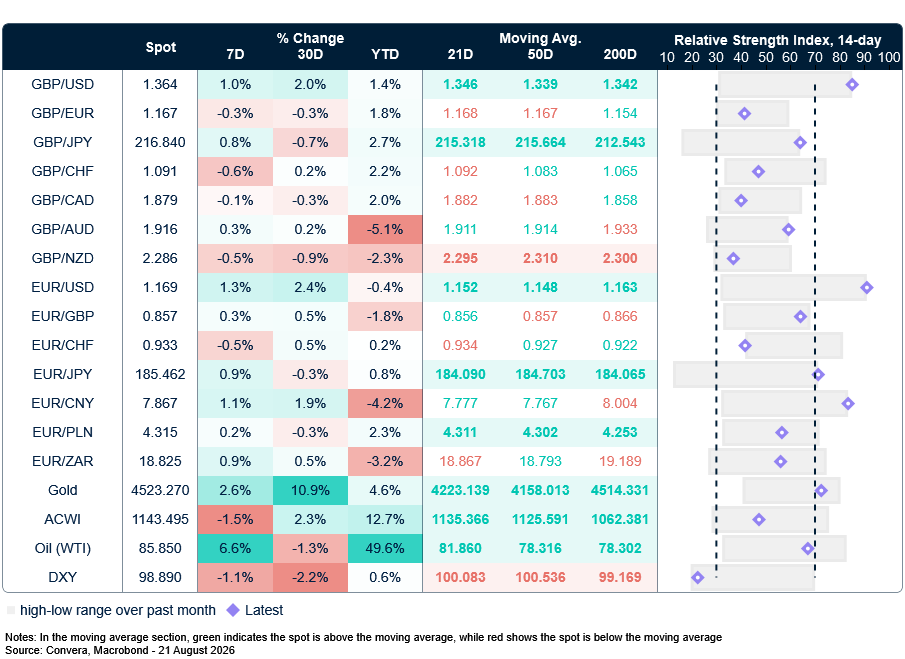
Table: Currency trends, trading ranges & technical indicators
Key global risk events
Calendar: August 17-21
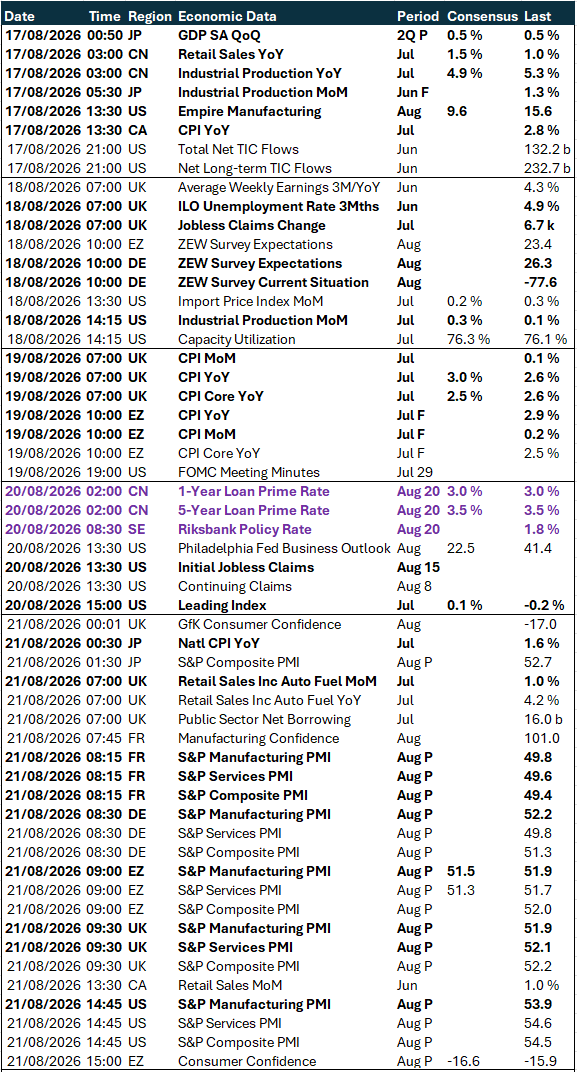
All times are in BST
Have a question? [email protected]
*The FX rates published are provided by Convera’s Market Insights team for research purposes only. The rates have a unique source and may not align to any live exchange rates quoted on other sites. They are not an indication of actual buy/sell rates, or a financial offer.