

Key Takeaways
- The US dollar faces downward pressure as the Treasury doubles bond buybacks to support yield suppression.
- This intervention complicates the Federal Reserve’s ability to gauge economic restrictiveness amid rising inflation risks.
- The Canadian dollar strengthens amidst trade deal hopes, with potential tariff reductions driving USD/CAD lower.
- The Mexican peso tests new lows, remains supported by its carry advantage, even as geopolitical tensions rise.
- Overall, market dynamics are shifting, with emerging currencies reacting to US policy changes and global economic conditions.
USD: US dollar pays for treasury yield suppression
The US Treasury recently caught markets off guard by doubling its bond buybacks to at least $4 billion per operation. These accelerated purchases will officially begin on September 9 and run precisely through November 4. Interestingly, this sudden liquidity campaign conveniently wraps up the exact day after voters head to the midterm polls on November 3. Washington discovered a deep concern for bond market functioning right as rising mortgage rates threatened to anger the electorate. Consequently, this poorly disguised yield-suppression effort triggered an immediate and aggressive market reaction. Long-term yields tumbled, swap spreads widened sharply, and the US dollar suffered its largest single-day decline in weeks.
This aggressive Treasury intervention creates a remarkably complicated environment for the Federal Reserve. Fed Chairman Kevin Warsh famously urged markets to play the ball rather than the referee, but that proves difficult when the referee actively changes the rules mid-game. July FOMC minutes reveal many officials already worry that current financial conditions are far too loose to defeat inflation. Now, the Treasury is deploying its toolkit to suppress yields right when the Fed needs to accurately gauge restrictiveness. Suppressing long rates to juice the economy puts the two institutions at distinct cross-purposes. Ultimately, investors are left navigating higher inflation risks while questioning central bank autonomy, adding to the Fed’s independence premium at the long end—classic Catch-22.
To understand why yields pushed higher in the first place, we must look at the drastically shifting buyer base. The era of price-insensitive central banks blindly absorbing Treasuries is over, leaving private investors to drive marginal demand. These private buyers are highly sensitive to price and demand real compensation for taking on duration risk. Furthermore, Uncle Sam is now competing directly against deep-pocketed tech giants for global capital. Hyperscalers are issuing hundreds of billions in corporate bonds to fund the artificial intelligence boom, offering highly attractive spreads over government debt. This explosive AI investment cycle is actively pulling cheap credit away from the public sector.
Beneath these shifting buyer dynamics lies the ultimate force anchoring yields higher, which is robust nominal economic growth. When real economic expansion combines with sticky inflation, long-term interest rates naturally adjust upward to reflect that broader reality. For years, quantitative easing allowed yields to remain artificially suppressed far below the nominal growth rate. Now that the global economy is accelerating in nominal terms, bond yields are simply catching up to the hard data. Policymakers desperately want the combination of a booming economy and cheap borrowing costs, but financial markets eventually enforce basic arithmetic. You simply cannot maintain structurally lower yields unless you are willing to accept much weaker economic demand. Or avoid wars in key global energy chokepoints.
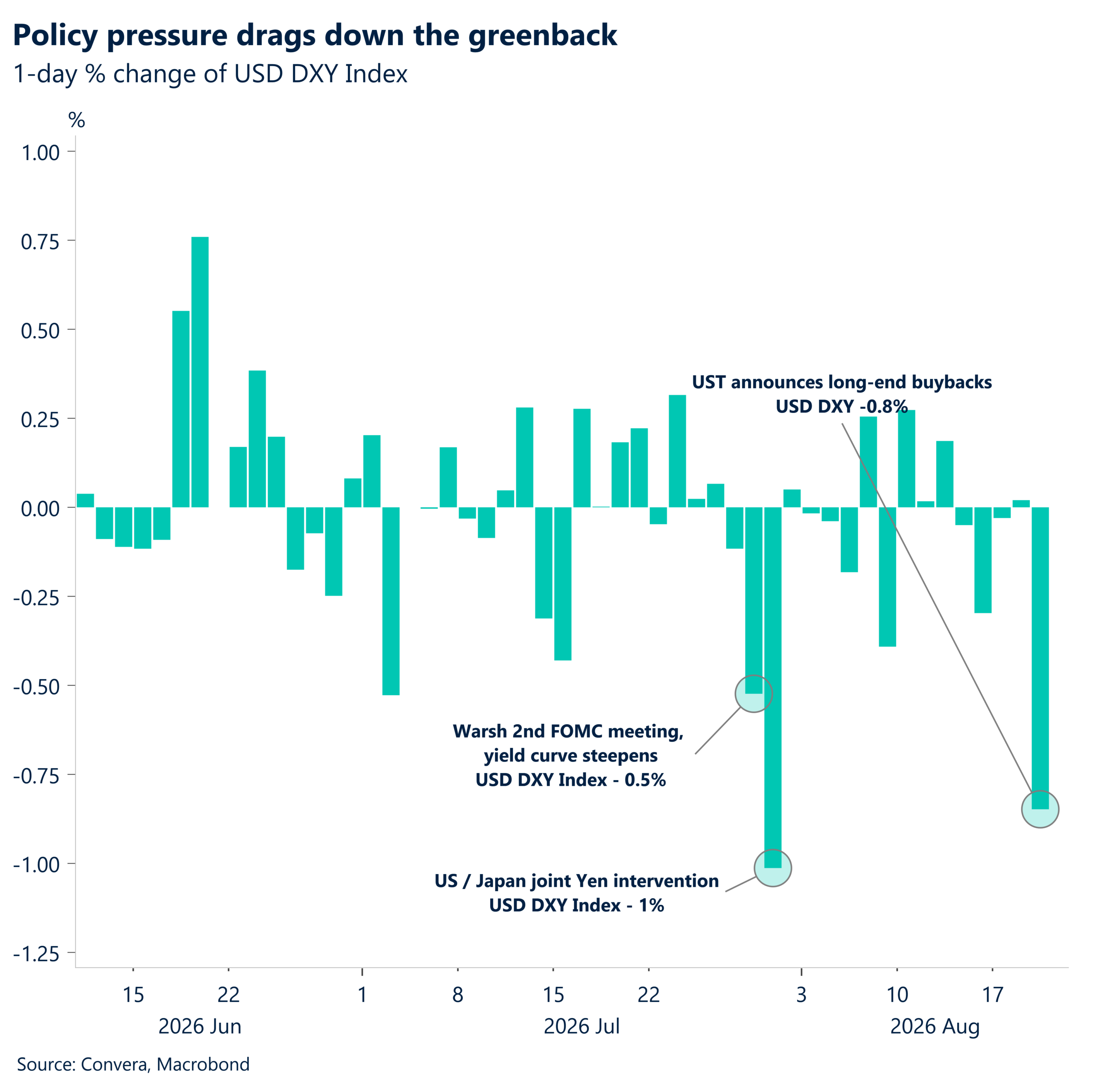
When viewed together, recent policy announcements have delivered a direct, cumulative blow to the US dollar, as illustrated below. From the curve steepening after Warsh’s second FOMC meeting (-0.5%) to the joint US-Japan Yen intervention (-1.0%) and the latest buybacks (-0.8%), each step has systematically undercut greenback strength. There is no grand strategy at play here—part of this stems from the unintended consequences of Fed Chair Warsh’s “zero guidance” stance, while the rest reflects an administration trying to contain Middle East fallout and steady the bond market ahead of the midterms. Social media has only amplified the noise by treating record debt figures as if they were a new revelation. Ultimately, engineering artificially lower borrowing costs to appease voters comes with a clear trade-off, forcing the US dollar to absorb the full brunt of domestic policy priorities. Because the dollar remains heavily anchored to Treasury yields, this political suppression inherently caps the currency’s upside, ensuring that hard economic data—rather than central bank rhetoric—will dictate the greenback’s true floor.
CAD: Loonie rallies on trade deal hopes
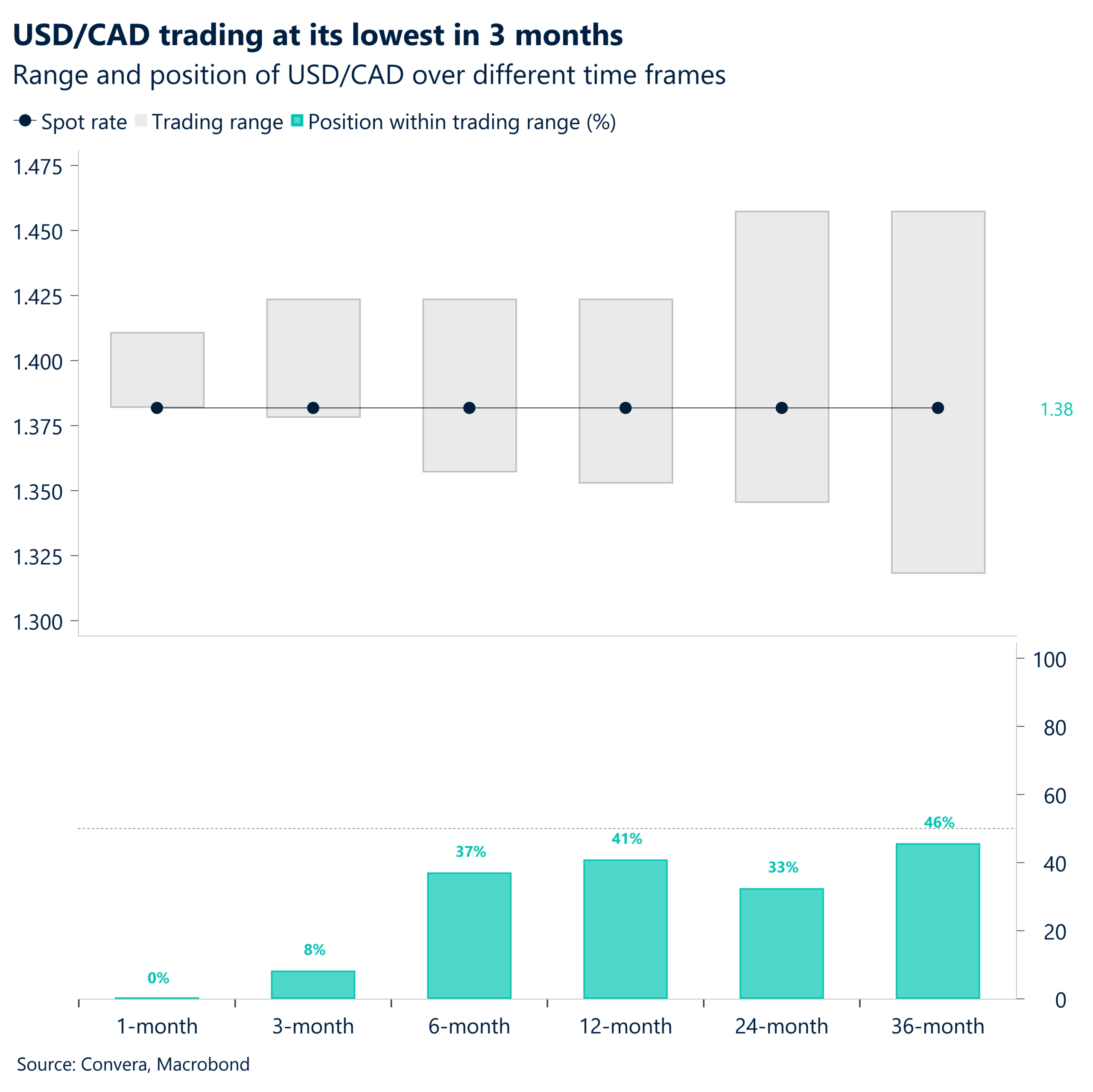
The Canadian dollar leads G10 currencies this morning, with USD/CAD down 0.3% to 1.3771, its lowest level since May 20. Reports suggest Washington may halve Canadian steel and aluminum tariffs to 25% and cut auto tariffs to 15%, although the terms could change. The current tariff pause expires at midnight Friday in Washington, leaving markets focused on the final negotiations. A signed deal could push USD/CAD deeper into the 1.35 to 1.37 range, while unresolved dairy, forestry and energy issues remain potential obstacles.
Relative rates are also moving in the loonie’s favour. The US-Canada two-year yield spread has narrowed to about 116 basis points from roughly 145 in late July, while larger Treasury buybacks have added pressure on the US dollar. The USD DXY Index fell 0.8% yesterday and remains near an 11-week low as investors weigh lower US term yields against a prolonged Fed pause. However, renewed selling at the long end of the Treasury curve and weaker equity futures could limit further CAD gains today.
The USD/CAD has fallen 3.1% from its July high of 1.4216 and has broken below the June cycle low of 1.3839. A trade agreement would expose 1.3700 and potentially 1.35 to 1.36, while failed talks could drive a sharp rebound above 1.4100.
MXN: Mexican Peso tests new lows
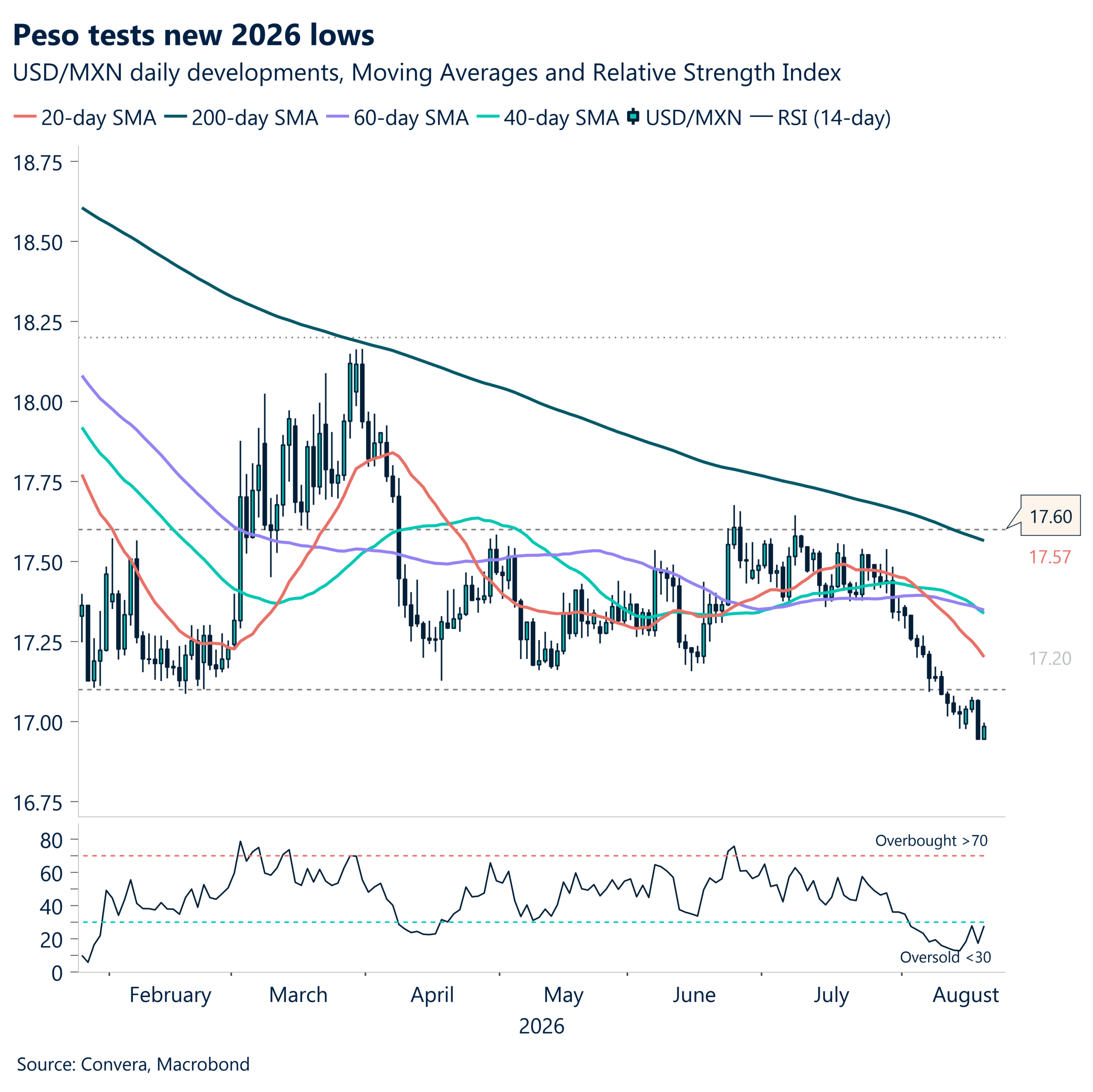
The peso closed Wednesday at a new 52-week high, with USD/MXN falling to 16.9455 as Treasury buybacks pressured the dollar and supported emerging-market currencies. However, fresh US measures against Iran and rising tensions around the Strait of Hormuz have revived global risk concerns. Brent crude climbed 2.3% to $94, while gold moved above $4,500 for the first time. The shift has pushed USD/MXN back toward 16.985 this morning.
Mexico’s carry advantage continues to support the peso through bouts of volatility. The two-year yield spread over the US remains near 299 basis points, while the 10-year spread stands around 445 basis points. Banxico’s second consecutive hold at 6.50% signals that further easing is unlikely soon, while reserves of $257.42 billion provide a strong external buffer. Limited support for additional Fed hikes also reduces the risk of a sharp unwind in MXN carry positions.
USD/MXN has fallen 3.2% from its July high of 17.579 and broken below several key support levels. A sustained move under 16.90 would bring 16.80 into view, although crowded peso longs increase the risk of a sharp reversal. Escalation involving Iran, higher oil prices and rising US yields could trigger broader selling across emerging-market currencies. For now, the peso’s medium-term trend remains constructive, but geopolitical headlines will drive near-term price action.
Market snapshot
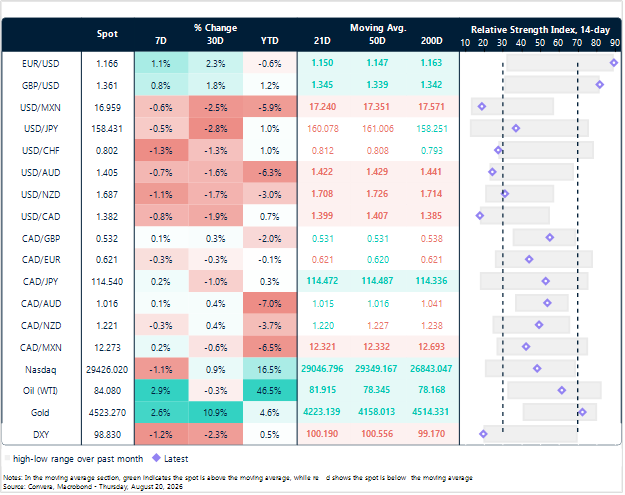
Table: Currency trends, trading ranges & technical indicators
Key global risk events
Calendar: August 17 – 21
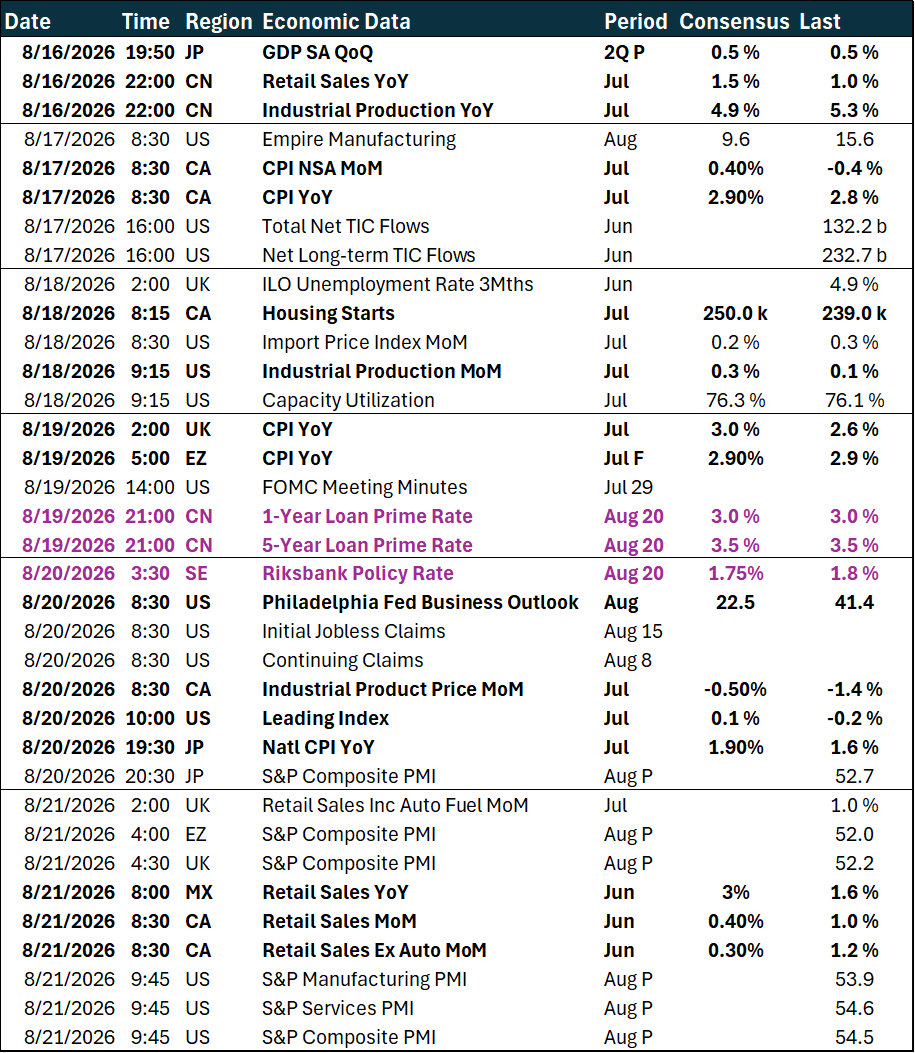
All times are in EST
Have a question? [email protected]
*The FX rates published are provided by Convera’s Market Insights team for research purposes only. The rates have a unique source and may not align to any live exchange rates quoted on other sites. They are not an indication of actual buy/sell rates, or a financial offer.