


USD: It’s not just tariff-inflation
Section written by: Kevin Ford
The September CPI release, arguably the most pivotal data point this week, is now scheduled for October 24 at 8:30 ET, delayed due to the ongoing government shutdown. In the interim, a limited stream of pre-shutdown releases and private sector data continues to paint a familiar picture: a cooling labor market, and consumer spending holding firm. This backdrop keeps the Fed on track for another 25bp rate cut at its late October meeting. This was confirmed yesterday by Fed Chairman Powell during an annual speech. Powell pointed to the slow pace of hiring, noting that it may weaken further and that further declines in job openings might eventually lead to higher unemployment. Powell’s remarks put a cap on the Dollar’s momentum, though it is still holding up above the 99 level and 1.3% up month-to-date. Furthermore, US-China tariff tensions keep the markets on edge, as the VIX index has creeped back above the 20 level.

On the inflation front, the dynamics beneath the surface are evolving in ways that complicate the Fed’s policy calculus. Tariff-related price pressures, once a modest drag, are now contributing to headline inflation, notably in core goods. While the August data showed only a 0.23%-point boost from tariffs, the shift from deflationary to inflationary pressure in core goods marks a meaningful change. Categories like household furnishings and recreational goods are seeing more pronounced effects, while others such as apparel and vehicles remain muted, underscoring the uneven transmission of trade policy into consumer prices.
More critically, the persistence of inflation is increasingly rooted in domestic demand, particularly in core services excluding housing, a segment that comprises over half of the PCE consumption basket. According to the San Francisco Fed, recent price increases in this category are demand-driven, not supply-constrained. Both core goods and non-housing core services are currently contributing roughly 0.3 percentage points above target-consistent inflation, suggesting that inflationary pressures are broad-based and not easily reversible.
The Dallas Fed adds that while tariff effects may fade, “further slowing in non-housing core services is not obvious.” This aligns with the latest FOMC minutes, which push back against the notion that tariffs are the primary inflation driver. Only “a couple” of participants attributed high inflation solely to trade policy, while several emphasized that progress toward the 2% target had stalled even when excluding tariff effects. This entrenched inflation is most visible in the services sector, where prices are “stickier” due to their dependence on domestic labor costs and shelter. Elevated wage growth, a byproduct of a tight labor market, feeds directly into higher business costs, which are then passed on to consumers. This wage-price feedback loop is a key source of inflation persistence and cannot be resolved through trade policy adjustments alone. Controlling services inflation will require signs of labor market slack.
The Fed’s cautious, data-dependent stance reflects this reality, with close monitoring of indicators like the unemployment rate, job vacancy ratios, wage growth, and the quits rate. These metrics are essential for assessing whether inflationary pressures are sustainably easing.

EUR: Euro finds relief in politics, not data
Section written by: Antonio Ruggiero
Germany’s ZEW survey data released yesterday broadly undershot expectations on both the current situation and expectations components, while sentiment for the broader euro area also deteriorated – October’s expectations reading came in lower than September’s. The sentiment data reinforces what hard indicators have already shown this month: an economy grappling with stagflation, following disappointing industrial production and factory orders earlier in October.

ECB’s Villeroy added to the dovish tone, stating that the next move for the ECB is more likely to be a cut than a hike – supporting our view that supply-driven inflation shocks – feared by the ECB – are less persistent than demand-driven ones, the latter being less of a concern amid stagnant domestic demand.
Yet the euro held firm against the dollar yesterday, climbing 0.3%. The push was driven more by sentiment than fundamentals. Prime Minister Sébastien Lecornu, reappointed last Friday, appears to have secured support from the center-left Socialists by suspending the controversial pension reform – namely, the plan to raise the retirement age from 62 to 64 – until after the 2027 presidential election in a bid for political stability. While political risk remains elevated, the move offered markets a moment of relief: the FR/DE spread narrowed by several basis points, and the CAC 40 pared back some losses.
Overall, it made sense to see the bruised euro shrug off fundamentally driven, dovish headlines, while embracing a more sentiment-led and much-needed rebound.
CAD: Slight pull back
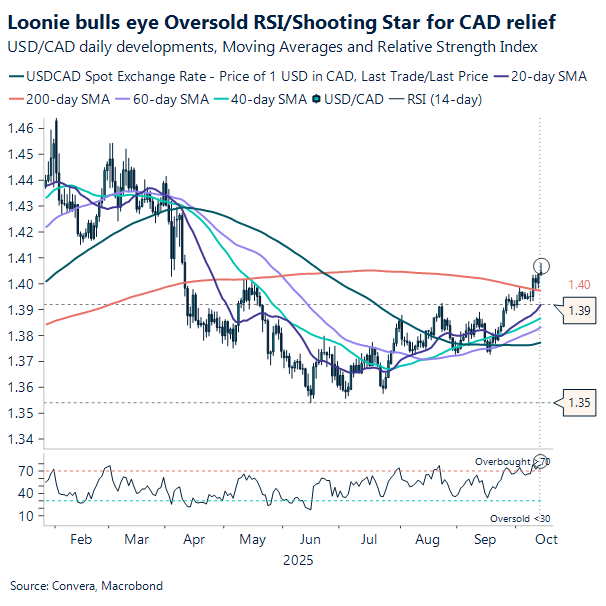
The USD/CAD pulled back to 1.404 after tapping 1.408 yesterday, but buyers defended the crucial 200-day SMA. This modest recovery was fueled by Fed Chair Jerome Powell’s dovish comments: he suggested the quantitative tightening process is nearly complete to ensure market liquidity, while simultaneously underscoring deteriorating labor prospects. The combination firmly cemented expectations for an additional Fed rate cut this month, easing pressure on the Loonie.
On the tariff front, no good news for the north. President Trump introduced a new round of tariffs on imported lumber and wood products, a move his administration justifies as necessary to protect the US economy and bolster domestic manufacturing. These duties will significantly impact trade, particularly with Canada, the largest lumber supplier to the US, which already contends with separate duties totaling 35%. The trade action also affects other wood-exporting nations, including China, which faces high tariffs on its furniture, while partners like the EU and Japan have secured caps on the rates they must pay.
The most immediate consequence of these tariffs is a likely increase in consumer costs. US homebuilders and retailers are cautioning that these higher import fees will ultimately push up housing prices and furniture costs for American consumers. While the administration’s intent is to curb imports and create jobs by favoring domestic production, critics warn that the time needed to fully scale up the domestic supply chain means that, in the short term, consumers will be the ones who bear the financial burden of this trade dispute.
Short-term overbought signs from Aussie, Kiwi and Loonie
Table: Currency trends, trading ranges and technical indicators

Key global risk events
Calendar: October 13-17 (US CPI will be published on October 24 at 8:30 am ET)
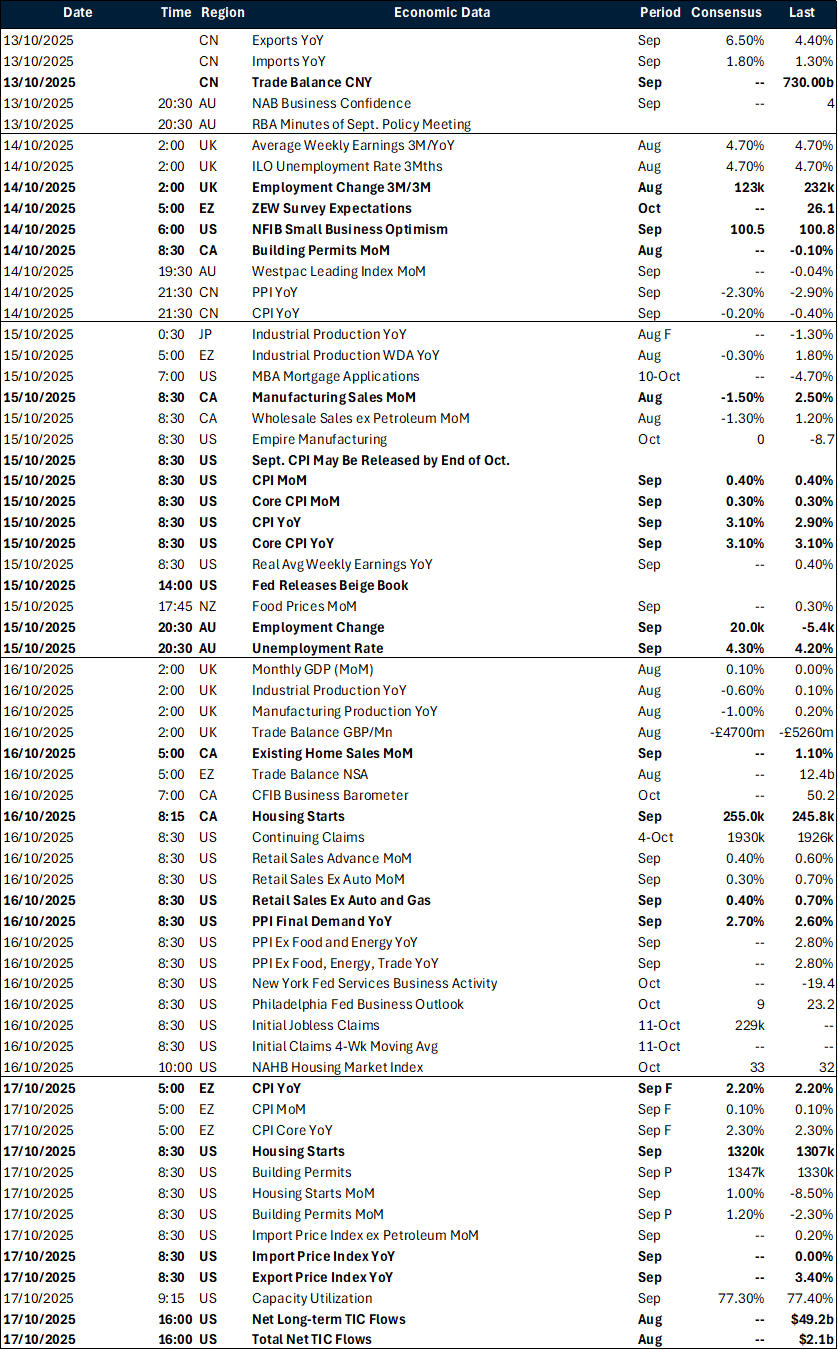
All times are in EST
Have a question? [email protected]
*The FX rates published are provided by Convera’s Market Insights team for research purposes only. The rates have a unique source and may not align to any live exchange rates quoted on other sites. They are not an indication of actual buy/sell rates, or a financial offer.