


CAD: September inflation comes in hotter than expected
The September CPI inflation print came in hotter than expected, making the path for the central bank even more complicated now. The Consumer Price Index (CPI) accelerated sharply to 2.4% year-over-year, up from 1.9% in August. This acceleration was largely driven by a smaller year-over-year decline in gasoline prices (-4.1% vs. -12.7% in August) due to a base-year effect, and a faster rise in grocery prices (+4.0%). The increase was broad-based, with the CPI excluding gasoline also rising to 2.6% from 2.4%, and prices rising at a faster pace in all provinces. This outcome sharply contrasts with the dovish bias that macro conditions had been suggesting, now injecting significant doubt into the need for immediate stimulus.
Further complicating the outlook for monetary policy is the continued upward pressure in key consumer spending areas. Food purchased from stores saw its fastest price growth since the recent low in April 2024, and rent prices accelerated to 4.8% nationally. These strong price dynamics reinforce the concern that inflation expectations remain elevated, hovering near the upper bound of the BoC’s 1–3% target range, as indicated by recent business outlook surveys. While the partial removal of retaliatory tariffs in September might offer future relief, the immediate risk is that a rate cut, despite the economy needing stimulus, would reinforce entrenched inflation expectations and mounting margin pressures reported by firms. The BoC is truly navigating a narrow path: macro conditions point to the need for stimulus, but this CPI data now firmly warrants caution.
In reaction to the release, the USD/CAD saw a slight appreciation against the US dollar, dropping 20 pips to 1.402. This market move confirms the perception that the hotter-than-expected inflation data will serve as a decisive factor in the policy debate. The odds of a rate cut next week by the BoC have dropped; however, the probability of a cut is still relatively high. This high probability reflects the market’s acknowledgment of the BoC’s dilemma: the Bank must weigh the need to address weak macro conditions against the risk of validating high inflation expectations that this September print just confirmed.

USD: Strong earnings and global calm ease banking jitters
Section written by: Kevin Ford
The latest earnings reports from major U.S. banks underscore a robust performance across the financial sector, with notable year-over-year gains. Both commercial and investment banking divisions posted strong results, signaling broad-based resilience. For example, Morgan Stanley reported an 80% increase in revenue from equity underwriting, while Goldman Sachs achieved record revenues in its markets and investment banking segments.
More telling than topline growth, however, was the conservative posture on credit risk. Given how sensitive the topic has been over the last week, it’s worth noticing that several institutions reduced their provisions for potential losses, reflecting confidence in consumer and business credit quality. Citi saw a decline in delinquencies compared to the prior year, and JPMorgan Chase (JPM) lowered its credit card charge-off rate. Similarly, Bank of America (BoA), PNC, and Wells Fargo reported improvements in net charge-offs and delinquency metrics, collectively suggesting that U.S. consumers remain on solid financial footing.
This encouraging data prompted a wave of positive commentary from bank executives. BoA’s CFO cited “continued strong performance in the credit portfolios,” while JPM’s CFO emphasized that both consumers and businesses “remain resilient.” while PNC’s CEO mentioned that “the economy is fine.”
Last week the optimism was tempered by caution from JPM CEO Jamie Dimon, who pointed to recent failures among smaller institutions, such as Tricolor and First Bank, as potential indicators of broader instability. Additional fraud-related losses reported by regional lenders like Zions Bank and Western Alliance have reignited concerns reminiscent of the SVB bankruptcy in spring 2023. While such developments warrant attention, they are not necessarily indicative of systemic risk. The credit performance of the largest banks offers a more reliable gauge of economic health, and current data suggests that both the U.S. economy and its consumers remain fundamentally resilient, an encouraging signal for market sentiment.
Confidence also appears to be extending beyond domestic indicators, with signs of easing tensions in U.S.-China relations. President Trump recently described proposed tariff levels as “not sustainable” and is expected to meet with President Xi. Meanwhile, Secretary Bessent is scheduled to engage with Vice Premier Lifeng in discussions aimed at de-escalation. The dynamic between the two nations resembles a modern economic version of Mutually Assured Destruction (MAD), given China’s dominance in rare earth permanent magnets (REPMs) and the interdependence of both economies. This mutual leverage makes a negotiated resolution the most probable outcome, which in turn supports global risk appetite.
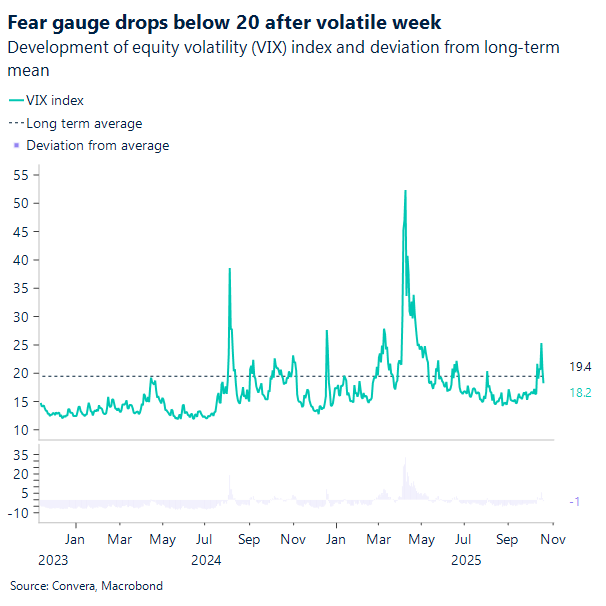
Despite recent volatility, equities have remained stable, and expectations for Federal Reserve rate cuts remain intact. Chair Powell’s recent remarks suggest the Fed may be nearing the end of its Quantitative Tightening (QT) cycle sooner than anticipated. Taken together, the strong performance of leading financial institutions, improving geopolitical outlook, and a more accommodative monetary policy stance, these factors contribute to a market environment that is fundamentally well-supported for the week. In FX markets, calm waters, as markets await key macro data, with PMIs, and most importantly, US CPI this Friday on focus.
EUR: Mean reversion, minus momentum
Section written by: Antonio Ruggiero
Yesterday’s EUR/USD price action was quiet, 0.1% lower. Meanwhile, dollar sentiment was recharged, buoyed by renewed optimism around Q3 earnings. With 85% of S&P 500 companies beating estimates, corporate resilience has become the market’s new proxy for economic growth – dollar positive – amid data silence due to the shutdown.
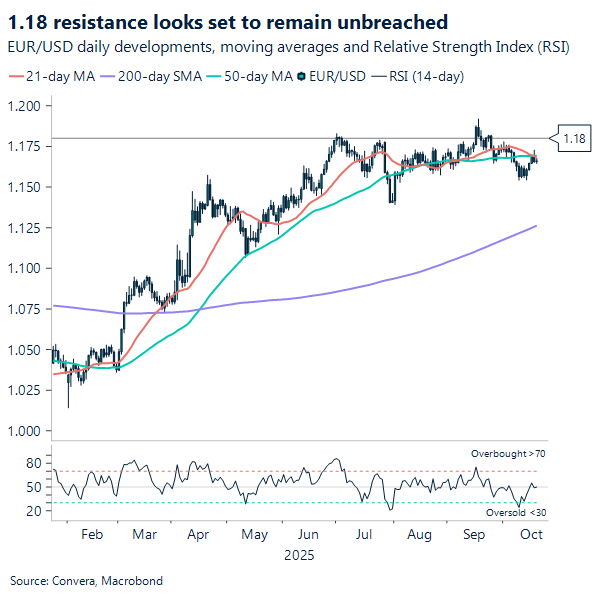
The euro, meanwhile, remains hesitant. Sentiment recovery is only partial, and Friday’s S&P downgrade from AA– to A+ has reignited concerns about the eurozone’s fiscal fragility. The downgrade re-establishes awareness of the precarious backdrop, capping euro upside. As a result, EUR/USD’s mean reversion – its return to a macro-warranted anchor – continues to stall. The pair remains below its fair value, but the path back is proving slow – let alone a reclaiming of the year-to-date high of 1.1919, which looks increasingly unlikely given the current balance of risks.
Paralyzed EUR:USD rate differentials offer little support, with neither side unlikely to offer fresh directional impulse in the near term. While we remain cautious, peak negative US sentiment may be behind us, further tilting the bias against the euro.
Zooming out from short-term price action, the setup reinforces the durability of the 1.18 resistance – unbroken since summer – and supports the view that EUR/USD continues to reject its long-term downtrend. Yet at higher frequencies, the pair even struggles to hold above the more achievable 1.17 level.
Christine Lagarde is scheduled to speak later today – but with markets already saturated by recent remarks affirming the ECB’s comfort with current levels, we don’t expect this to move the needle.
Gold continues to rally
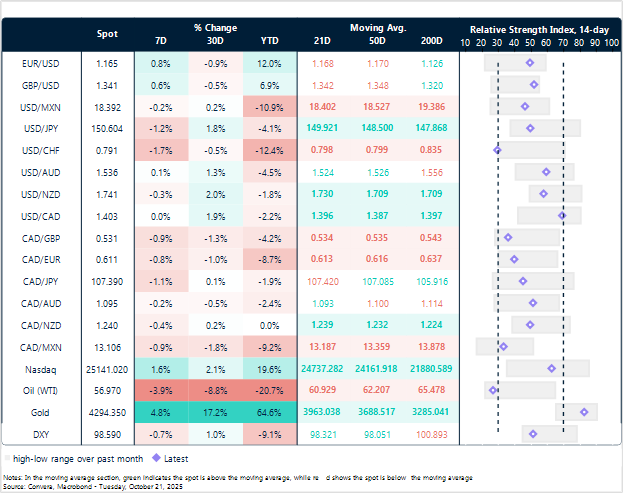
Table: Currency trends, trading ranges and technical indicators
Key global risk events
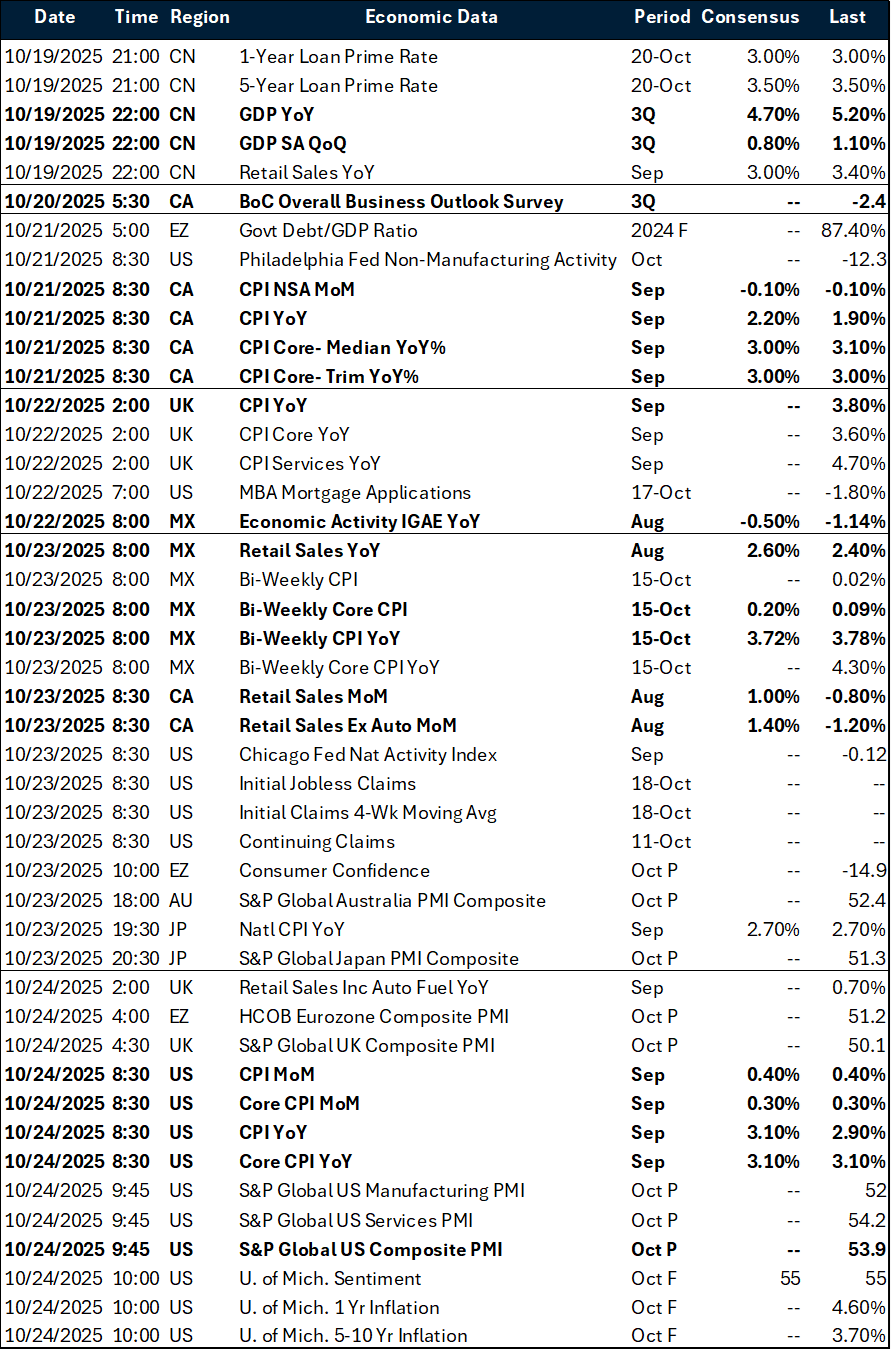
Calendar: October 20-24
All times are in EST
Have a question? [email protected]
*The FX rates published are provided by Convera’s Market Insights team for research purposes only. The rates have a unique source and may not align to any live exchange rates quoted on other sites. They are not an indication of actual buy/sell rates, or a financial offer.