

Key Takeaways
- The US dollar faces pressure despite AI stock rebounds stabilizing market sentiment, with cautious investor outlook persisting.
- The euro struggles as political risks in France raise concerns; bearish positioning grows among investors.
- GBP remains strong due to a resilient labor market, supporting the idea of a potential Bank of England rate hike.
USD: AI rebound steadies sentiment
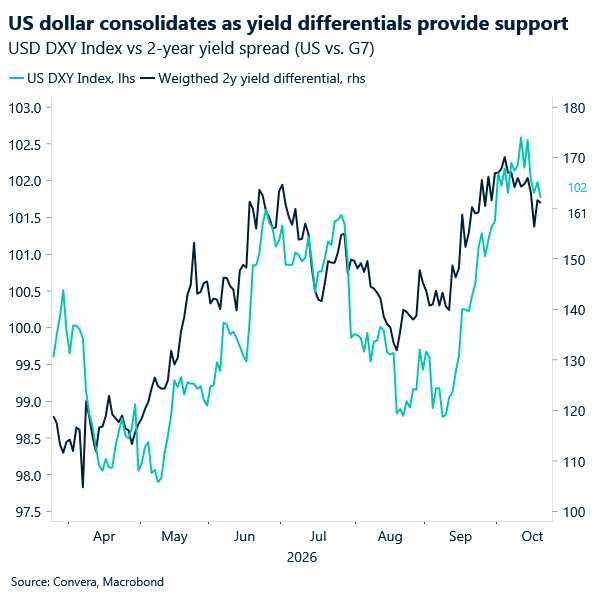
The US dollar remains on the back foot after retreating from recent cycle highs, though the broader support structure remains intact. A rebound in heavyweight AI infrastructure stocks helped stabilise risk sentiment yesterday, lifting the S&P 500 by 0.5% and the Nasdaq 100 by 1.2%. The VIX fell almost 10% to 18, slipping back below its long-run average and signalling a partial easing of market anxiety.
The move matters because the AI investment cycle has become deeply intertwined with the broader US exceptionalism narrative. Over the past 18 months, AI-related capital expenditure has supported growth, attracted capital inflows and helped justify both elevated valuations and dollar strength. Recent concerns around the profitability of “neocloud” providers and the sustainability of outsized AI spending therefore reverberated well beyond technology stocks, contributing to lower yields and a softer dollar.
For now, however, the rebound in AI sentiment looks more like a stabilisation than a full recovery. US equity futures are lower this morning following renewed weakness in Asia, suggesting investors remain cautious about the sector’s medium-term outlook.
For the dollar, recent price action reinforces two key points. First, the AI capex cycle remains an important pillar of USD support. Second, positioning had become sufficiently stretched following the Fed’s hawkish pivot and the rally to 18-month highs to justify a period of consolidation. While the dollar may struggle to extend gains in the near term, the combination of elevated yields, resilient growth and persistent inflation pressures argues more for a tactical pause than a structural reversal.
EUR: Positioning reflects caution
The euro remains under pressure as investors continue to reassess political and fiscal risks across the bloc. EUR/USD is struggling to build any meaningful recovery from the 1.12 area, with sentiment towards European assets remaining fragile.
The focus remains squarely on France. French 10-year yields have climbed to their highest level since 2002, while the spread over equivalent German bunds has widened to levels not seen since 2012. Markets are increasingly treating French debt as a source of eurozone risk rather than a localised issue, with attention now turning to a potential Moody’s review later this week and the political implications of next year’s presidential election.
Importantly, this is not just a France story anymore. The fear is that wider sovereign spreads begin to spill over into broader eurozone assets, creating another headwind for a currency already grappling with higher energy prices, widening US-European rate differentials and a resilient dollar.
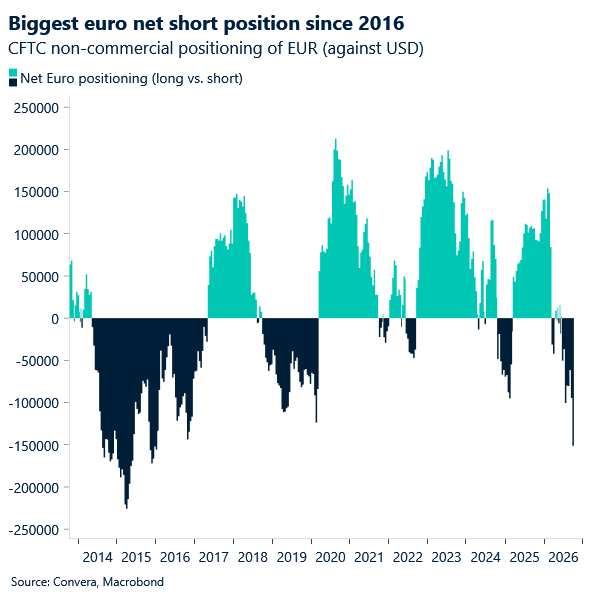
Positioning reflects that caution. Speculative accounts are now the most bearish on the euro in a decade, while options markets continue to favour downside protection. Although that raises the possibility of short-covering rallies, there is little evidence yet of a catalyst capable of changing the broader narrative.
GBP: Labour market surprises
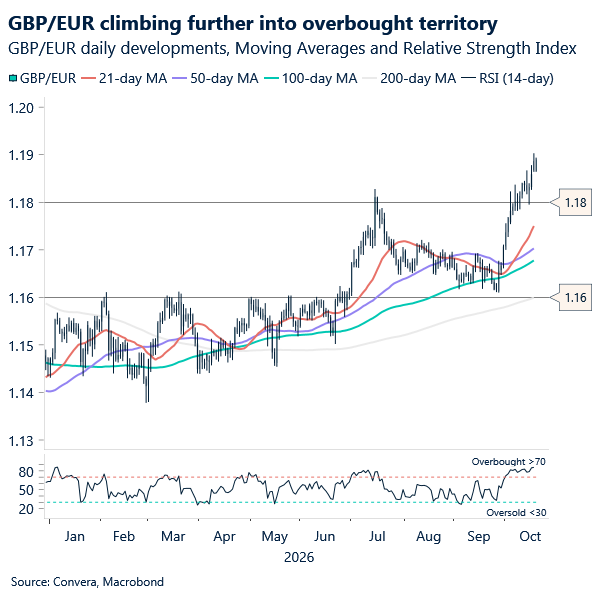
Sterling remains on the front foot, with GBP/USD holding comfortably in the mid‑1.33s and GBP/EUR continuing to edge closer to 1.19 – the latter up over 1.5% this month and over 3.6% year-to-date. The pound’s resilience reflects a combination of supportive carry dynamics, relatively hawkish Bank of England (BoE) pricing and persistent euro weakness.
This morning’s labour market report adds to that constructive backdrop. The headline numbers were stronger than expected, with payroll employment rising by 13,000 in September versus expectations for an 8,000 decline. Even more notably, August’s previously reported 26,000 fall was revised to a modest increase. Unemployment also surprised lower at 4.7%, while wage growth delivered a mixed message, with headline earnings easing but underlying pay pressures remaining firm.
The data do not fundamentally alter the broader narrative, but they do challenge the notion that the labour market is deteriorating rapidly. More importantly, they offer some support to the view that the UK economy remains more resilient than many had anticipated despite elevated energy prices and tighter financial conditions.
Taken together, the report offers a timely boost to Chancellor John Healey ahead of next week’s Budget and keep the chances of a BoE rate hike alive next month.
For sterling, the key support remains relative rates. Markets continue to price a more hawkish path for the BoE than many of its peers, helping underpin the pound’s carry appeal. Against the euro, that story is reinforced by ongoing concerns around French public finances and softer ECB expectations.
Technically, GBP/EUR remains in a strong uptrend but in overbought territory, while GBP/USD continues to hold above the 1.32 support zone that has contained recent weakness.
Market snapshot
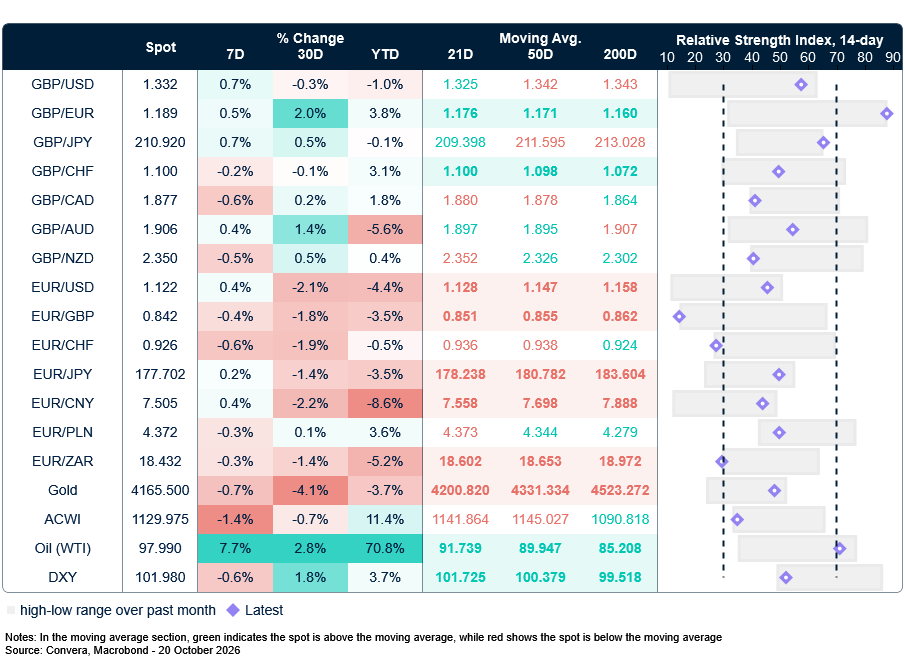
Table: Currency trends, trading ranges & technical indicators
Key global risk events
Calendar: October 19-23
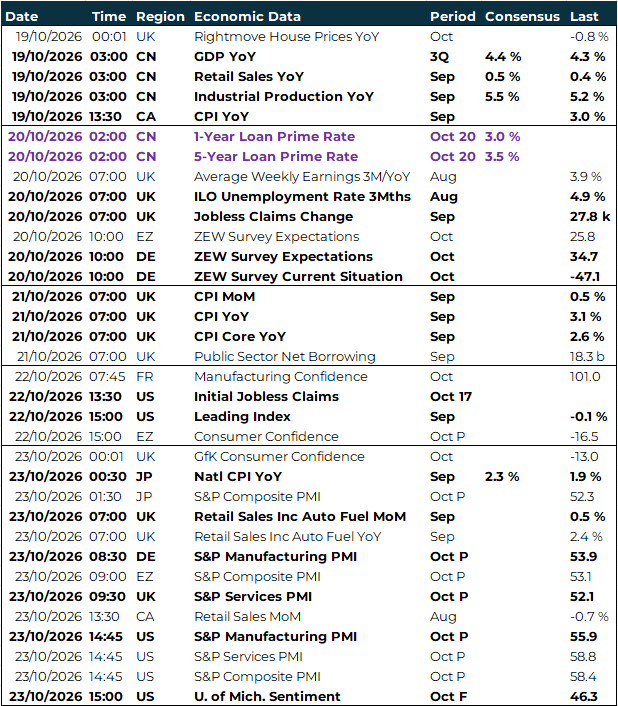
All times are in BST
Have a question? [email protected]
*The FX rates published are provided by Convera’s Market Insights team for research purposes only. The rates have a unique source and may not align to any live exchange rates quoted on other sites. They are not an indication of actual buy/sell rates, or a financial offer.