


U.S. (fragile) gains amid Fed focus
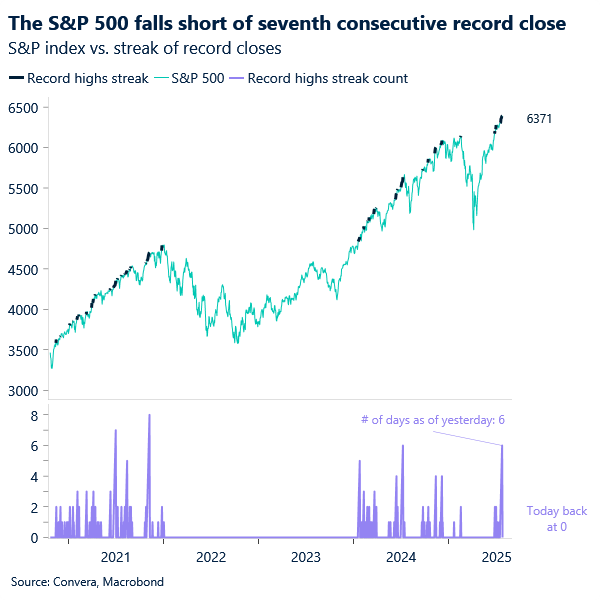
The US dollar reached its strongest level in five weeks yesterday, while the S&P 500 got close to notching a seventh consecutive record close – after somewhat disappointing JOLTS figures cooled Wall Street’s recent bullish outburst.
The dollar index – DXY – appears comfortable around 98 highs, with newly formed support at 98.700, after yesterday’s mixed macroeconomic data had muted impact on the greenback. While consumer confidence from the Conference Board exceeded expectations, the JOLTS report slightly undershot forecasts, coming in at 7.437 million versus the expected 7.5 million for June. Layoffs ticked up modestly to 1.604 million from 1.601 million (compared to a prior 1.568 million). Nonetheless, these figures suggest generally stable demand for workers.
That 98.700 level, however, looks fragile and is likely to be tested by upcoming macroeconomic releases, today’s Fed meeting, and – though to a lesser extent – tariff news (unless notably negative). Today’s quarterly GDP print is expected to show improvement, following a dip in the previous release that was weighed down by a surge in imports as importers rushed to bring in goods ahead of anticipated tariff hikes.
All eyes are onto the Fed’s policy meeting – arguably one of the most influential events in shaping dollar price action at the moment: although recent dollar strength has largely stemmed from waning confidence in the euro, it has also been quietly bolstered by renewed expectations of the Fed continuing its data-dependent policy trajectory, free (at least for now) from political interference. Markets are anticipating a steady Fed, with cautious forward guidance that could temper expectations of further rate cuts.
That said, we can’t rule out the market latching onto any dovish tones. After all, yesterday’s JOLTS data wasn’t so great, and the previous month’s NFP was largely a public affair. It’s a tough call, however, especially since the NFP release is not out until Friday, leaving the Fed without a complete snapshot of the US labor market.
Barring any significantly negative data surprise, we have a bias for DXY to test resistance at 99.500 this week.
Pause or pivot for the euro?
EUR/USD started the week under intense pressure following a trade deal between the US and EU that, while avoiding escalation, offered little relief for Brussels. Terms largely favour the US, with 15% tariffs on most EU goods and promises of additional investment and commodity purchases. Mixed messaging from key leaders has added uncertainty. Although euro losses reflect disappointment, the longer-term damage may be skewed toward the US economy though. With the highest average tariff rates since 1936, inflation and growth risks there are mounting.
Still, the short-term reaction has been eye-catching. EUR/USD has dropped well over 1.5% since the deal, and traders are rotating back toward the dollar as monetary policy comes back into focus. Macro fundamentals now drive the narrative. The US economy is expected to have grown 2.4% in Q2, with core PCE holding at 2.7%. Europe, by contrast, looks stagnant, with flat GDP and CPI slipping below 2%. This divergence supports the dollar, especially as the historic link between US front-end yields and dollar strength reasserts itself after trade-induced volatility earlier in the year. Moreover, the euro’s haven-like behaviour throughout 2025 has also made it vulnerable to reversal now that trade tensions have moderated.
However, despite the recent selloff, structural support for the euro remains. Monday’s 1.3% dip may mark a clearing of stretched positions rather than a fundamental shift. The recent surge in EUR/USD was the strongest six-month gain since 2003, so it was bound to come to an end. But back in 2003 also saw a correction before a multi-year rally resumed.

Additionally, looking back at Trump’s first term and EUR/USD price action vs. his second term, the convergence holds for now. History doesn’t repeat, but it often rhymes, suggesting this may be a pause, not a pivot – and with global trade frictions likely to weigh more heavily on the US over time, the longer-term euro outlook could remain positive.

GBP/USD slips to two-month Low
GBP/USD dropped for the fourth consecutive session yesterday, hitting a two-month low of 1.3308 and briefly breaching the 100-day moving average. The pair had held confidently above this level throughout H1, making the recent slide significant. A close below this key average would open further downside potential.

As of yesterday, the pair has continued to struggle breaching a newly formed resistance at 1.3360, leaving the 100-day MA just a few pips underneath at 1.3337. If resistance holds, a retest of support at the moving average becomes increasingly likely, particularly if resilient U.S. macro data dominates—a possibility given the relatively light UK data calendar this week.
A confirmed close below the 100-day MA will pave the way toward the May low at 1.3140.
On the macro front, the UK economy continues to show signs of stagflation – a toxic mix of sluggish growth and persistent inflation. Despite being better shielded than the EU on the trade front this week, Monday’s retailing report revealed a tenth consecutive monthly decline in sales. Meanwhile, the Shop Price Index jumped to 0.7% yesterday, significantly above the 0.3% forecast – highs not seen since in over a year.
This stagflationary environment adds preassure to the Bank of England’s next steps, with expectations for a 25 basis-point rate cut currently priced in with over 93% probability.

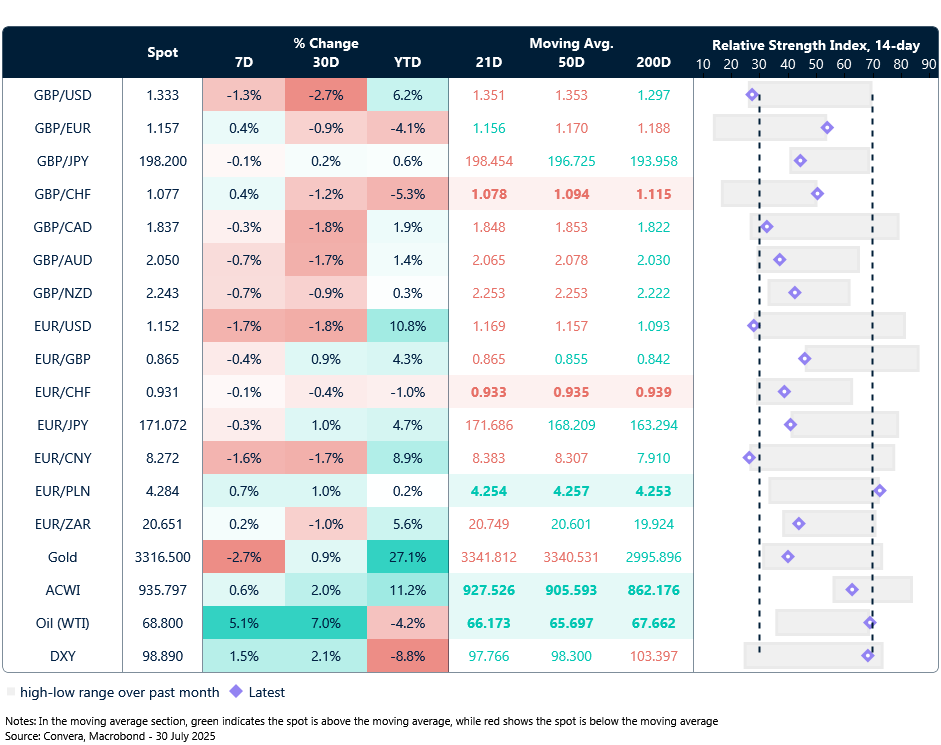
GBP and EUR continue the bleeding
Table: 7-day currency trends and trading ranges
Key global risk events
Calendar: July 28 – August 1
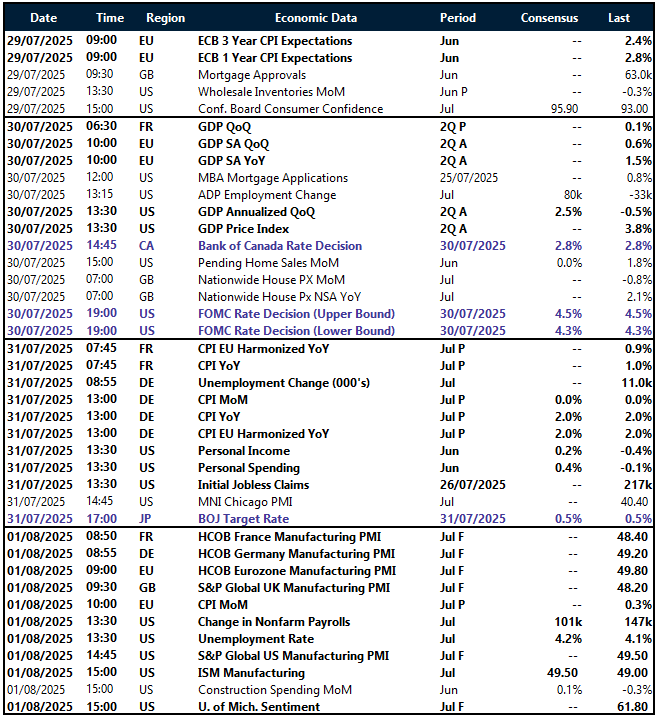
All times are in BST
Have a question? [email protected]
*The FX rates published are provided by Convera’s Market Insights team for research purposes only. The rates have a unique source and may not align to any live exchange rates quoted on other sites. They are not an indication of actual buy/sell rates, or a financial offer.