


USD: May payrolls reinforce labor strength
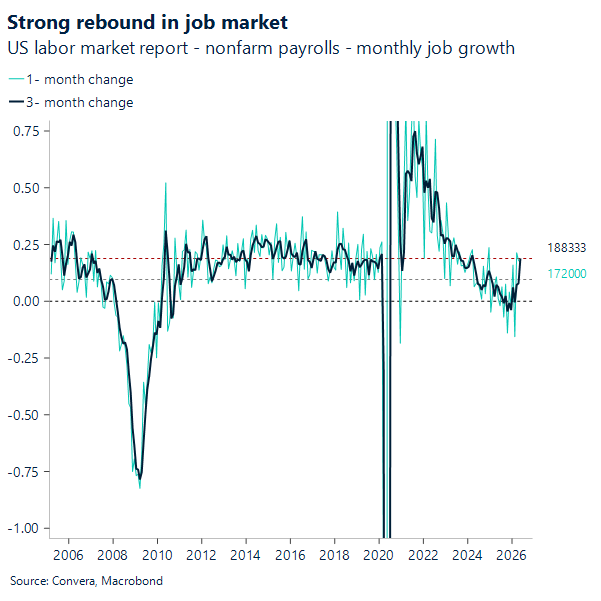
The May jobs report landed firmly on the strong side. Nonfarm payrolls rose 172,000, well above the 88,000 consensus, while the prior two months were revised up by a combined 93,000. The revisions make the underlying trend look stronger even before factoring in May’s gain. The unemployment rate held at 4.3%, and labor force participation stayed at 61.8%. In short, this was another solid print for a labor market that still looks resilient.
Importantly, hiring was broad enough to add credibility to the headline. Leisure and hospitality led the way with a 70,000 increase, including a 48,000 gain in food services and drinking places. Health care added 35,000 jobs, and local government rose by 55,000. Average hourly earnings also remained firm, up 0.3% on the month and 3.4% from a year ago. Even with weakness in financial activities, the overall mix still points to steady labor demand.
Taken together, the report makes it hard to argue that the job market is rolling over. The three-month average for payrolls is now running close to 188,000, which is not consistent with a meaningful slowdown. Wage growth is not surging, but it is still firm enough to keep the Fed cautious. As a result, the risk has shifted further away from near-term cuts and more toward a longer period of policy restraint. One strong payroll report does not force a hike, but a few more like this would make a tighter Fed path much harder to dismiss.
Markets reacted in line with that message. Treasury yields moved higher as investors priced out easier policy, while the US Dollar strengthened on the shift in rate expectations. Equity futures, meanwhile, moved toward session lows as good labor news translated into a less friendly rates backdrop. The move in pricing now points to one Fed rate hike being expected at the first meeting of 2027 in January. For now, the takeaway is simple: a stronger labor market is keeping Treasury yields elevated, the dollar supported, and Fed policy expectations tilted in a more hawkish direction.
CAD: Canada jobs rebound in May
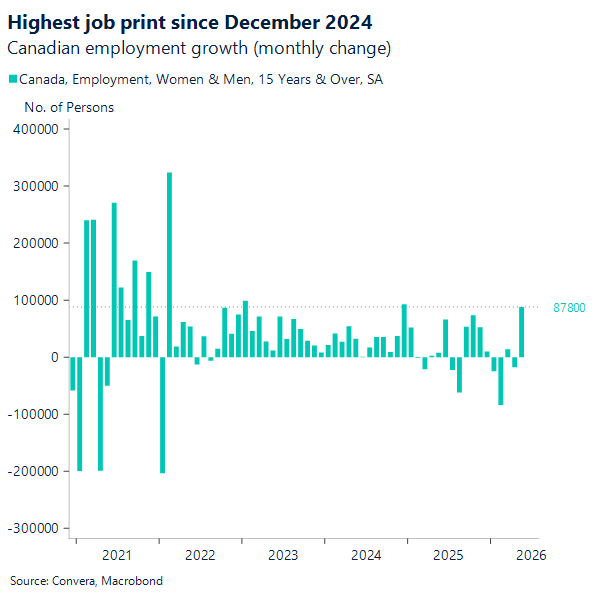
Canada’s labour market gave the Bank of Canada a firmer signal in May. Employment rose by 87.8K, well above consensus, while the unemployment rate fell to 6.6% from 6.9%. That was the first meaningful job gain since November and suggests the weakness seen earlier this year may be starting to fade.
The mix of jobs also looked better. Full-time employment jumped by 154K, more than reversing the losses seen from January to April, while part-time work fell by 66.2K. At the same time, wage growth slowed to 3.2% year over year from 4.8%, so the report was strong on hiring without adding much new wage pressure.
The gains were broad enough to matter. Construction led the increase, with support from transportation, accommodation and food services, recreation, and manufacturing, while Ontario posted another solid month and Toronto’s unemployment rate fell to 6.8%. Youth employment also improved, which points to a better start to the summer job market than last year.
Markets read the release as supportive for the Canadian dollar. USD/CAD moved lower after the data, while expectations for a Bank of Canada rate hike shifted toward December this year. Still, a hotter-than-expected US May payrolls report should keep the pair consolidating around recent levels rather than breaking sharply lower.
GBP: Caught between competing forces
Sterling has performed well over the past week, appreciating against most of its major counterparts. The exception has been the US dollar, where a combination of firmer oil prices and robust US data has applied some modest downward pressure. Even so, GBP/USD continues to demonstrate resilience above 1.34, trading in a tight, one-cent range that has persisted for much of the past month.
At the moment, GBP/USD remains largely rangebound and that reflects a balance of opposing forces in the current market regime. On one side, elevated oil prices are acting as a drag on sterling, given the UK’s sensitivity to energy costs. On the other, resilient equity markets, are supporting risk sentiment and, by extension, GBP/USD. What’s important here is that FX doesn’t react to one input in isolation. It absorbs signals from across markets (commodities, equities, rates, and more) but those drivers don’t operate equally or simultaneously. Instead, markets establish a hierarchy, where certain forces dominate at any given time.
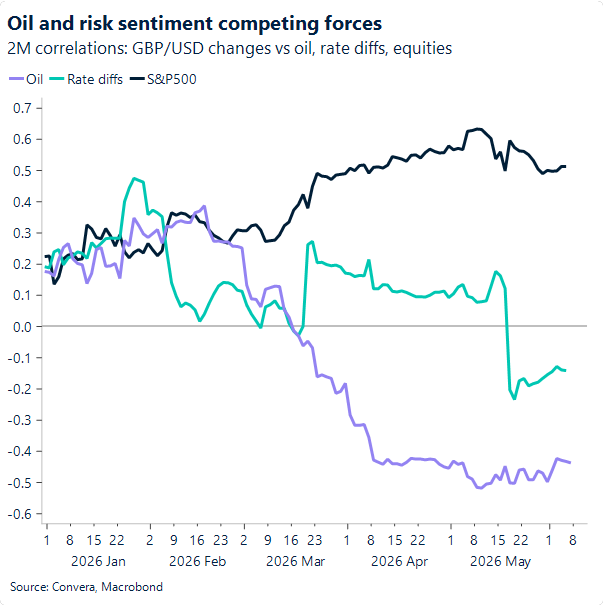
Right now, that hierarchy is clearly visible: GBP/USD is showing a strong positive relationship with equities and a negative one with oil, while rate differentials, typically a key driver, are playing a less decisive role.
But this is regime-specific. These relationships are not fixed, and history shows that rate differentials, in particular, tend to reassert themselves over time. So, the current rangebound behaviour isn’t a lack of movement – it’s the result of competing forces offsetting one another under the current market lens.
Turning to the data docket, attention will be on the Bank of England’s Decision Maker Panel survey, which may provide early signals on second-round inflation effects. That said, the spotlight will shift swiftly to the US, with the latest jobs report expected to dominate and set the near-term tone for markets.
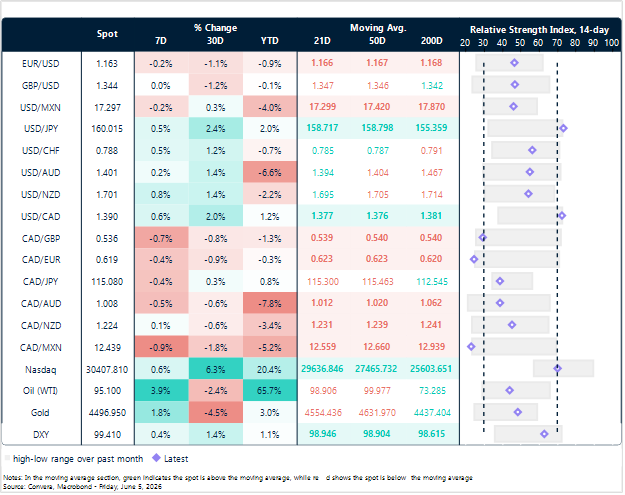
Market snapshot
Table: Currency trends, trading ranges & technical indicators
Key global risk events
Calendar: June 01 – 05
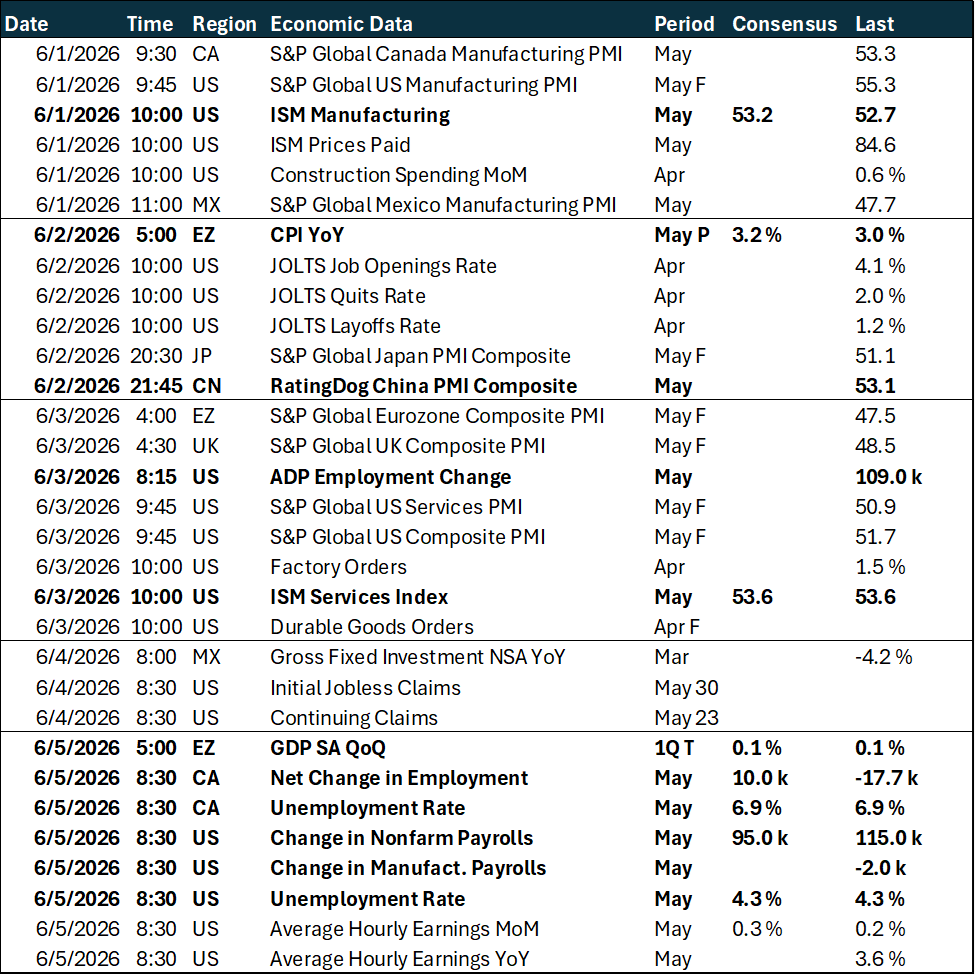
All times are in EST
Have a question? [email protected]
*The FX rates published are provided by Convera’s Market Insights team for research purposes only. The rates have a unique source and may not align to any live exchange rates quoted on other sites. They are not an indication of actual buy/sell rates, or a financial offer.