


USD: Dollar losing momentum
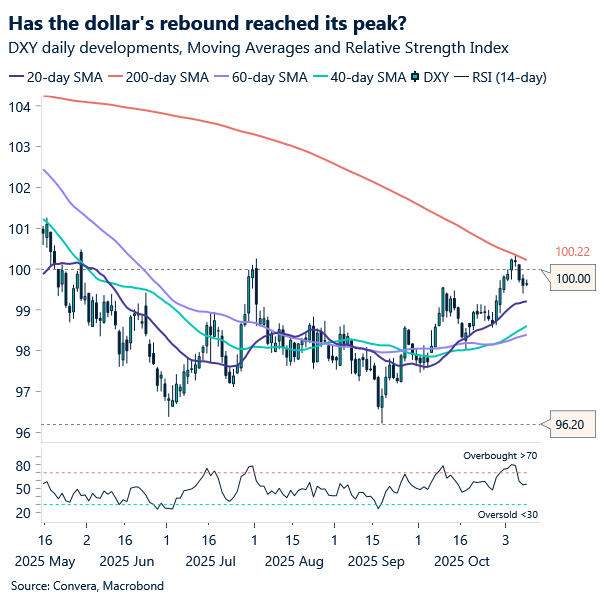
After a two-month stretch of US dollar strength – fuelled by hawkish Fed repricing in the absence of official data and amplified by political uncertainty in Japan, France, and the UK – the rally is beginning to lose momentum. Recent price action points to consolidation rather than a full reversal, with attention now turning to whether the dollar index can decisively break above its 200-day moving average or not.
Despite recording its sharpest two-day decline in nearly a month, the dollar etched out its third consecutive weekly gain. This kind of pullback reflects a classic mismatch between positioning and shifting fundamentals. Traders entered autumn short the dollar, anticipating further weakness. But political surprises in Japan, France, and the UK flipped the macro narrative, triggering a swift unwind. Demand for dollar upside protection surged as risk sentiment recalibrated.
However, momentum has stalled. Even supportive US data – such as the ISM services beat – failed to generate fresh dollar highs last week. The broader narrative suggests that once delayed US data resumes, it could reinforce dovish Fed expectations. The dollar’s biggest vulnerability? Labour data. Serving as a timely reminder of underlying labour market fragility, Challenger reported 153,000 US job cuts in October, the highest for that month in over 20 years.
Political uncertainty adds further complexity. Legal challenges to Trump’s tariffs may leave affected businesses in limbo, while the ongoing government shutdown continues to weigh on Q4 growth expectations. However, rumours that the record-breaking US government shutdown is nearing an end is also weighing heavier on the dollar this morning as global risk sentiment improves.
GBP: Data dump in focus this week
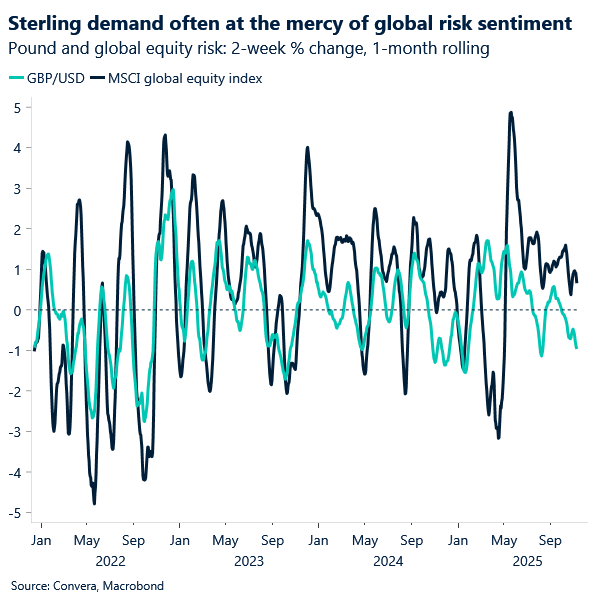
European risk sentiment is firming, with Stoxx 50 futures up 1.4% as optimism builds around a potential resolution to the US government shutdown. GBP/USD is tracking the broader risk rebound, edging toward $1.32, though performance remains mixed against higher-beta currencies like the Scandis and Antipodeans.
Last week’s MPC decision delivered a dovish hold, offering little support to the pound overall. Market focus now shifts to the 26 November Autumn Statement, particularly the size and structure of the fiscal package. The OBR’s sharper-than-expected productivity downgrade (–0.3pts) adds pressure on the government to deliver credible growth measures.
Data remains pivotal for rate expectations. Governor Bailey’s vote remains explicitly data-dependent, regardless of fiscal developments. This week’s labour market report (Tuesday) and flash Q3 GDP print (Thursday) will be key inputs, with markets already pricing a December rate cut at nearly 70%.
Looking ahead, we remain cautiously constructive. A material repricing of terminal Bank Rate below 3.40% appears unlikely given current data trends. The bar for a credible Budget is modest, GBP remains undervalued relative to rates, and positioning suggests shorts are crowded. However, a sustained rebound likely hinges on Budget delivery and UK growth expectations.
CAD: Positive jobs data boosts Loonie
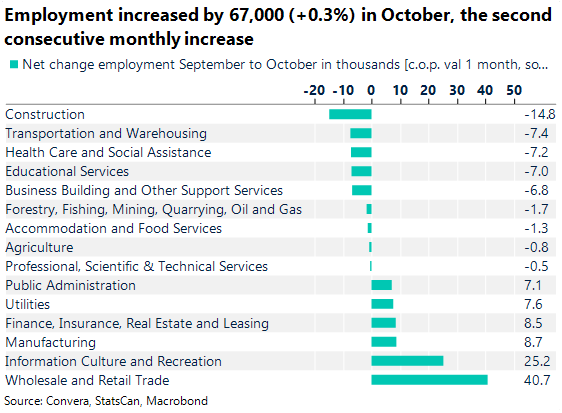
According to Statistics Canada, the Canadian labour market showed significant and unexpected strength in its latest Labour Force Survey for October 2025. Employment surged by 67,000, marking the second consecutive monthly gain and blowing past market expectations. This hiring pushed the national unemployment rate down by 0.2 percentage points to 6.9%. In a sign of underlying inflationary pressure, average hourly wages also continued to climb, accelerating to a 3.5% year-over-year increase. A significant caveat to the strong headline number was its composition: the gains were entirely in part-time roles, while full-time employment dropped by 18,500.
The details of the report show the gains were concentrated in the private sector, which added 73,000 jobs. Growth was led by core-aged men and youth and was primarily driven by an increase in part-time work. On an industry basis, the services-producing sector saw large increases, particularly in wholesale and retail trade, as well as transportation and warehousing. Geographically, the strength was heavily concentrated in Ontario, which saw employment jump by 55,000, its first increase since June.
The market reaction to the jobs report was immediate. The Canadian dollar strengthened against the greenback dropping from 1.4100 to 1.4060 in the moments after the release. This ‘hawkish’ data, showing high employment and accelerating wage growth, has led traders to believe the Bank of Canada will have no reason to ease its monetary policy.
Dollar eases after weeklong rally
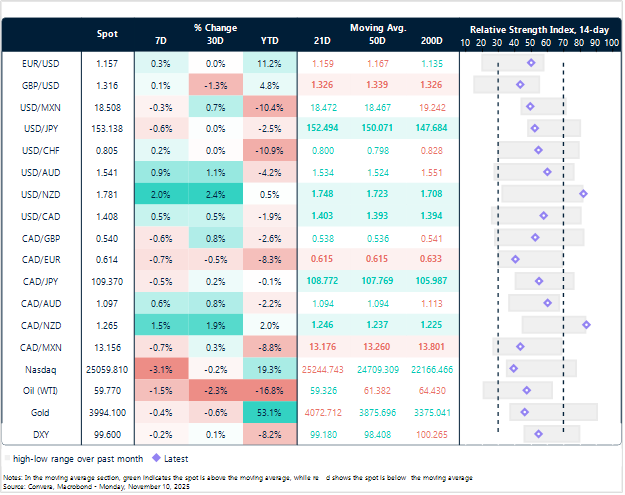
Table: Currency trends, trading ranges and technical indicators
Key global risk events
Calendar: November 10-14
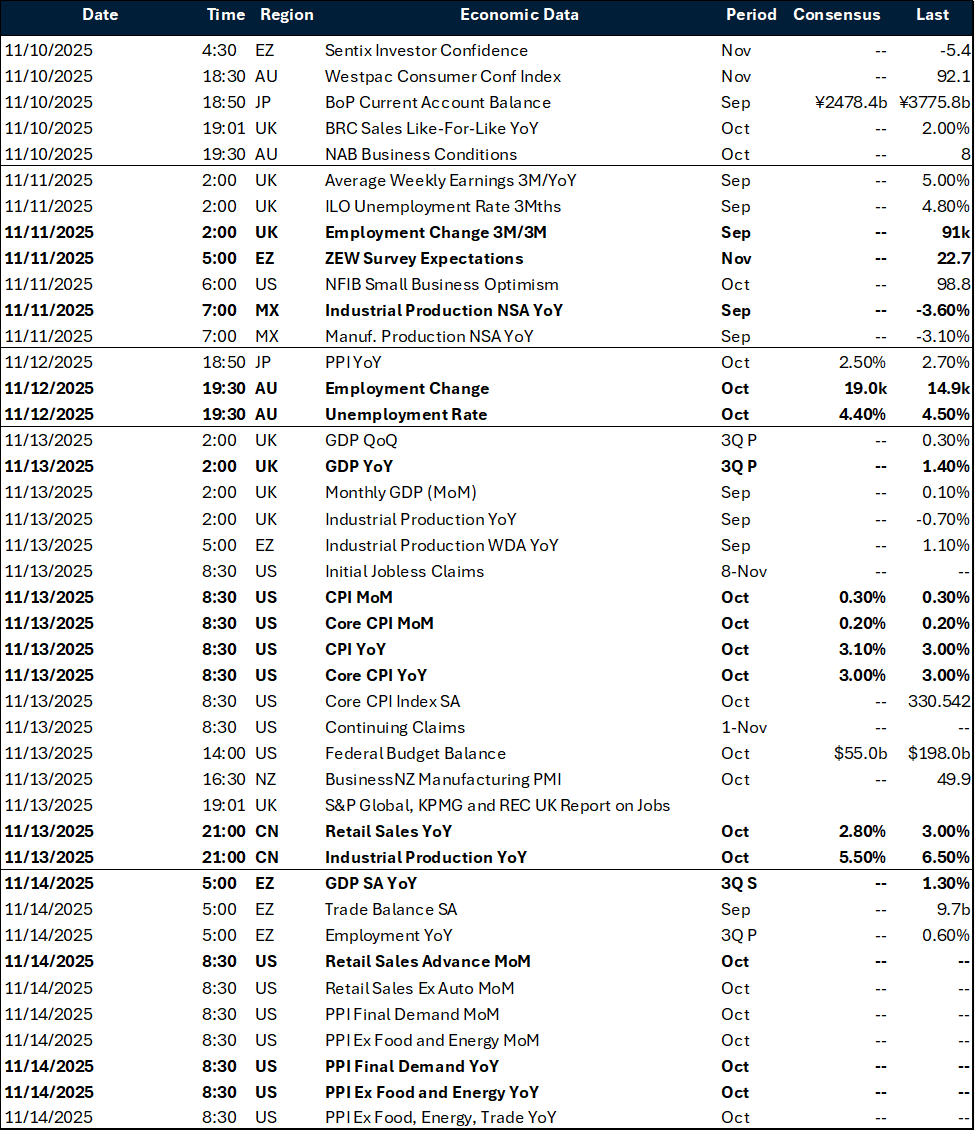
All times are in EST
Have a question? [email protected]
*The FX rates published are provided by Convera’s Market Insights team for research purposes only. The rates have a unique source and may not align to any live exchange rates quoted on other sites. They are not an indication of actual buy/sell rates, or a financial offer.