


Dollar awaits a defining moment
Applications for US unemployment benefits fell for a sixth straight week, dropping by 4,000 to 217,000 in the week ended July 19 — the lowest level since mid-April. The streak highlights the continued resilience of the U.S. job market and sheds light on what the dollar is most sensitive to right now: macro data.
Overall, it was a week of hesitation for the dollar — each day began with a flat dollar index, only to decline by fairly chunky amounts as sessions progressed.
A quiet data calendar didn’t help, fueling investor unease around uncertainty and the economic impact of tariffs, triggering further sell-offs. A handful of releases did trickle in — nothing headline-grabbing — but early-week results came in below expectations. Think: the Richmond Fed manufacturing index on Tuesday and existing home sales on Wednesday, both of which distinctly marked the beginning of respective dollar’s daily declines.
Then came Thursday, when the dollar index climbed nearly 0.3% on the back of strong claims data, only to pare those gains after new home sales came in below expectations. The index managed to close the session higher.
This week was yet another reminder that investors’ crave for macro data to validate the U.S. economy’s health now outweighs the influence of news, announcements, and even trade deals — which, while offering some clarity, remain uncertain in their economic impact.
This leaves the dollar adrift, and in search for the next big catalyst.
DXY, in fact, remains above its July 1 low of 96.377 — and it would take more substantial, data-driven weakness for a move below key support at 97. The dollar remains range-bound between 97.000 and 98.500, waiting for next week’s July job report, PCE, quarterly GDP figures, and the Fed’s policy meeting to embark on path that’s more directionally defined.

Mild hawkish support for the euro
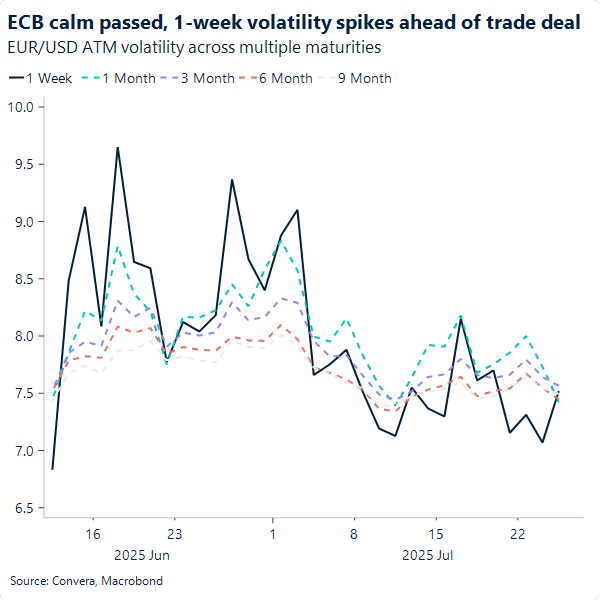
Rates were left unchanged yesterday by the ECB, as widely expected. The language was mildly alarmist, permeated by the now-familiar wait-and-see tone. The euro, despite declining for most of the session against the dollar, rebounded during the press conference, which turned out less dovish than anticipated. The absence of any mention of the adverse effects of euro strength, which would result in further cutting, helped fuel the recovery.
Meanwhile, the eurozone’s Composite Purchasing Managers’ Index (PMI) rose to 51 in July — above expectations and up from 50.6 in June — pushing further past the 50 threshold that separates expansion from contraction.
While manufacturing continued its recovery in line with forecasts, recording its highest reading since July 2022 and moving closer to exiting contractionary territory, the services sector saw a surprisingly strong increase to 51.2. Overall, the data suggests the eurozone economy may be gradually regaining momentum.
The further pricing out of rate-cut expectations — now down to 74% from over 100% for the December meeting— should provide foundational support for the euro in the coming months, helping EUR/USD appear less over-stretched, and more fundamentally comfortable, near 1.18 highs. Any progress in reducing tariffs with the U.S., and enshrining it in a formal deal, would further contribute to that momentum.
While EUR/USD remains at the mercy of unravelling U.S. macro data, focus is on the confirmation of a U.S.-EU deal. As said before, while we don’t expect the deal itself to have important directional impact on EUR/USD price action, it will help set the tone for a not-so-beaten U.S. dollar in H2, as trade optimism brews. Barring further (negative) trade surprises and poor U.S. macro releases, growing trade certainty should keep further euro upside at bay.
Pound softens after mixed data dump
UK retail sales rose 0.9% in June, rebounding from May’s sharp 2.8% drop as warmer weather boosted consumer activity. The recovery was slightly softer than the 1.2% gain economists had forecast but supports signs of a modest economic pick-up.
Nevertheless, sterling remains under pressure following a softer-than-expected set of UK PMI figures, which underscore the Bank of England’s (BoE) policy dilemma. The services PMI slipped to 51.2 in July from 52.8, dragged lower by weaker hiring as firms respond to April’s rise in payroll taxes and the National Living Wage. This aligns with the BoE’s own survey and official payroll data, both pointing to a gradual deterioration in labour market conditions.
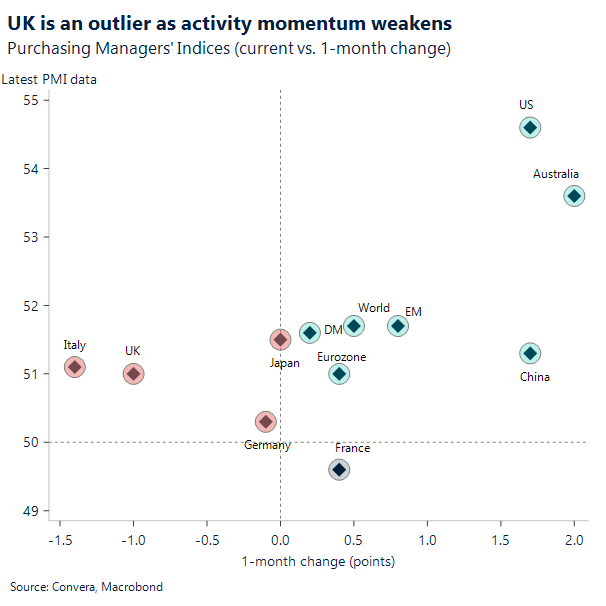
Yet inflationary pressures remain sticky. The PMI flagged rising input costs, particularly in food and hospitality, suggesting wage-linked price pressures are still filtering through. This dual challenge – slowing employment and persistent inflation – sets the stage for another split vote at the BoE’s August meeting, echoing May’s three-way divide, but we agree with the consensus that a 25-basis point cut will be delivered next week.
In terms of the pound, GBP/USD failed to hold above its 21-day moving average in a sign that the modest rebound this week may be short-lived. The pair remains largely tethered to USD sentiment, but the latest UK PMI data offers little domestic support, as the services sector – the backbone of the UK economy – continues to lose momentum.
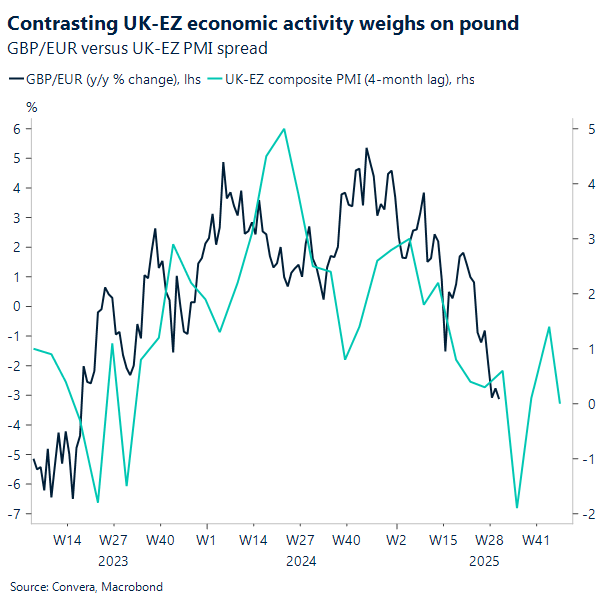
This underperformance is also weighing on GBP/EUR, which closed below €1.15 for the first time since late 2023. The pound has now declined in seven of the past nine weeks, shedding roughly 3.5% as markets increasingly price in a more dovish BoE stance relative to the ECB. With the eurozone showing signs of resilience and the ECB nearing the end of its easing cycle, the policy divergence could keep pressure on the currency pair through the summer.
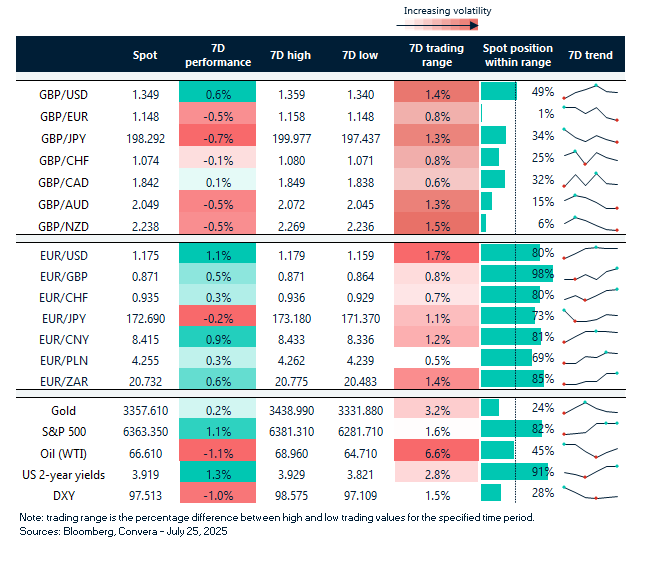
Euro is this week’s winner
Table: 7-day currency trends and trading ranges
Key global risk events
Calendar: July 21-25

All times are in BST
Have a question? [email protected]
*The FX rates published are provided by Convera’s Market Insights team for research purposes only. The rates have a unique source and may not align to any live exchange rates quoted on other sites. They are not an indication of actual buy/sell rates, or a financial offer.