


The bear steepener, the USD, and the Fed’s path
The U.S. Treasury yield curve is currently in a bear steepener, a significant market phase where both short- and long-term interest rates are rising, but long-term yields are increasing at a faster rate. This has caused the 30-year minus 2-year spread to widen to +117 basis points, a level not seen in roughly three years. This marks a sharp reversal from the deep inversion that characterized the market in 2022 and 2023, signaling a fundamental shift in market sentiment from recessionary fears to expectations of economic growth and persistent inflation.
The “bear” aspect signifies a negative development for bond prices, as investors demand a higher “term premium” to hold long-duration assets. Recently, this has been driven by expectations of sticky inflation, expectations of nominal growth fueled by public spending, higher term premium, the ‘AI Boom’, and a significant increase in Treasury supply. The current market signals align with historical parallels, such as in 1994–95, 2013, and 2021, when long-duration bonds underperformed while cyclical sectors like financials and value stocks thrived.
The movement of the yield curve is particularly critical given the U.S. dollar’s recent performance, which has already lost 9% of its value year-to-date. The ongoing bear steepener, which points to expectations of robust long-term growth and inflation, can be seen as a continuation of this trend. When the economy is perceived as strong, investors often move away from safe-haven assets like the dollar and into riskier, higher-yielding assets abroad. The bear steepener, with its higher long-term yields, also makes long-duration U.S. assets less appealing, which can further fuel a bearish sentiment toward the USD.
The dollar’s future weakness, however, may depend on a crucial shift from the current bear steepener to a “bull steepener.” A bull steepener occurs when short-term yields fall faster than long-term yields, often triggered by Federal Reserve interest rate cuts in response to a weakening economy or imminent recession. If the U.S. labor market were to soften significantly and core inflation were to fall rapidly, the Fed would likely be compelled to start a more aggressive cutting cycle, accelerating the dollar’s decline.
But despite recent market speculation, a September rate cut is unlikely. While recent dovish comments, two dissenting votes at the July FOMC meeting, and soft payroll numbers have led some to price in a cut, recent unemployment and inflation data is unlikely to shift Powell’s stance significantly.
This apparent conflict between markets pricing in a September cut and the broader outlook for a “shallow, later-starting” cutting path is not a contradiction but a reflection of a nuanced situation, further complicated by the economic consequences of new tariffs. While July’s CPI showed a cooling in prices for certain tariff-exposed goods, a sign that the effects of these new levies are being absorbed, PPI figures and services inflation remained firm. This mixed economic picture, with goods prices easing but services and some key components staying hot, maintains the dilemma for the Fed and reinforces our view that a September rate cut is far from assured.
Ultimately, the current yield curve’s position near a three-year high sends a clear message. The market is not yet convinced that disinflation is on a smooth path, nor does it expect a rapid, aggressive pivot from the Federal Reserve. Powell’s “inflation-first” posture suggests that a shallow, later-starting cutting path is more likely, which would be consistent with the ongoing bear steepener. For the U.S. dollar, its recent weakness is deeply intertwined with this dynamic, and its future trajectory will be a function of whether this steepening trend persists or if a weakening economy eventually forces a shift from bear to bull.

Rising yields, rising doubts: sterling’s fiscal challenge
After ranking as the second-best performing G10 currency last week, the pound has started this week on the back foot, slipping against all major peers as traders turn their focus to tomorrow’s UK inflation data. GBP/USD is struggling to hold above the $1.35 handle, while GBP/EUR has stalled at its 50-day moving average near €1.16 — a level it hasn’t convincingly breached since mid-June.
Last week’s stronger-than-expected GDP figures helped ease immediate stagflation concerns, but the data is backward-looking, and forward momentum appears to be fading. Growth is expected to moderate in H2, while inflation pressures remain sticky — a combination that continues to cloud the Bank of England’s (BoE) policy outlook and puts the pound’s recent yield-driven gains on shaky ground.
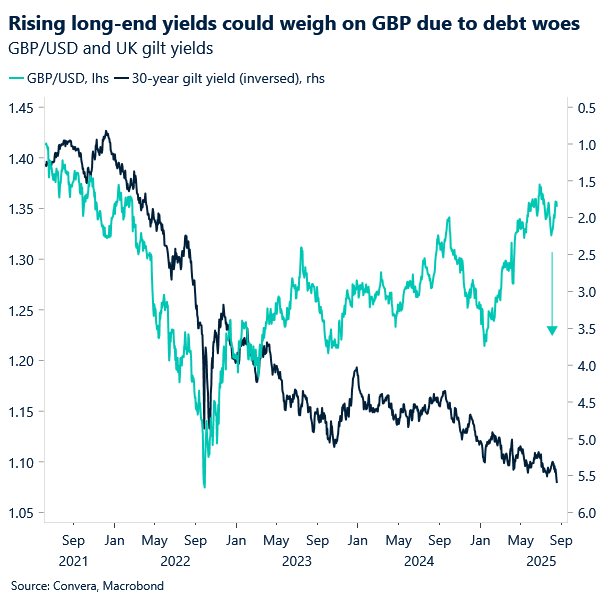
Thirty-year inflation-linked gilt yields have surged to their highest since 1998, surpassing levels seen during the Truss-era fiscal turmoil. Rising borrowing costs are amplifying concerns about the UK’s fiscal sustainability, especially with the autumn budget looming and the government’s savings buffer eroding. Chancellor Reeves now faces the risk of breaching her key fiscal rule unless tax hikes are introduced. That’s a politically sensitive prospect and one that could weigh on investor confidence.
Tomorrow’s July CPI release is expected to show headline inflation rising to 3.7%. If confirmed, it would reinforce expectations that the BoE will hold rates at 4% through year-end. Normally, that would be supportive for sterling. But as seen in past episodes, concerns over debt sustainability and weak growth could cap the pound’s upside — even in a high-rate environment.
Canada’s housing market paradox
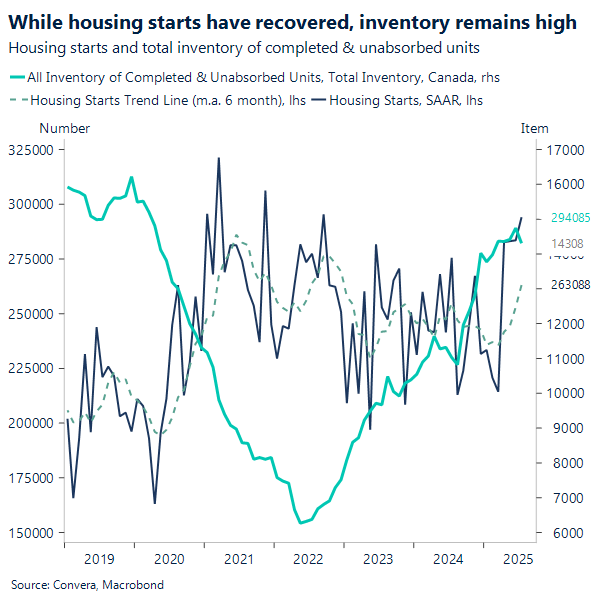
Canada’s housing market data for July 2025 presents a paradoxical picture. On a national level, housing starts saw a healthy month-over-month increase of 3.7%, rising to 294,085 units, its highest level in nearly 3 years. This growth was largely propelled by a significant 4.8% surge in multi-unit projects, such as apartments and condominiums, with Ontario leading in volume and provinces like Prince Edward Island and Nova Scotia experiencing triple-digit percentage increases. This strong construction activity suggests that new supply is continuing to enter the market at a brisk pace, particularly in regions where demand remains robust.
However, this positive trend in new construction exists alongside a troubling increase in the inventory of completed and unabsorbed units. This inventory issue is not a nationwide problem but is highly concentrated in specific, high-cost urban centers, most notably Toronto and Vancouver. In these markets, a large number of multi-unit projects have recently been completed, creating a supply glut that has outpaced demand. The primary drivers behind this unabsorbed inventory are a combination of high borrowing costs for investors, slowing immigration and sales activity, and uncertainty around the economic outlook.
The presence of both a construction boom and a supply glut is a clear indicator that the Canadian real estate market is a collection of highly fragmented regional markets. While new construction is thriving in more affordable provinces, the high inventory in Canada’s largest cities reflects a pause in buyer confidence. Economic uncertainty, lingering high interest rates, and recent policy changes affecting immigration and household formation are all contributing to a “wait-and-see” approach from both prospective homebuyers and developers.
Ultimately, the outlook for Canadian real estate remains deeply uncertain. The future trajectory of the market depends on how these disparate regional economies respond to a complex mix of factors. While continued construction will help alleviate the long-term supply shortage, the short-term challenge of absorbing current inventory in key markets will persist. The delicate balance between supply, demand, and economic headwinds ensures that a single, clear forecast for the entire country’s housing market is virtually impossible.
Euro treads water ahead of Jackson Hole
EUR/USD remains in consolidation mode, floating just above the $1.16 handle and trading sideways for ten consecutive sessions. The lack of progress on a potential Russia–Ukraine ceasefire hasn’t shifted the pair’s trajectory, but attention is now turning to the Jackson Hole symposium, which could prove a pivotal catalyst.
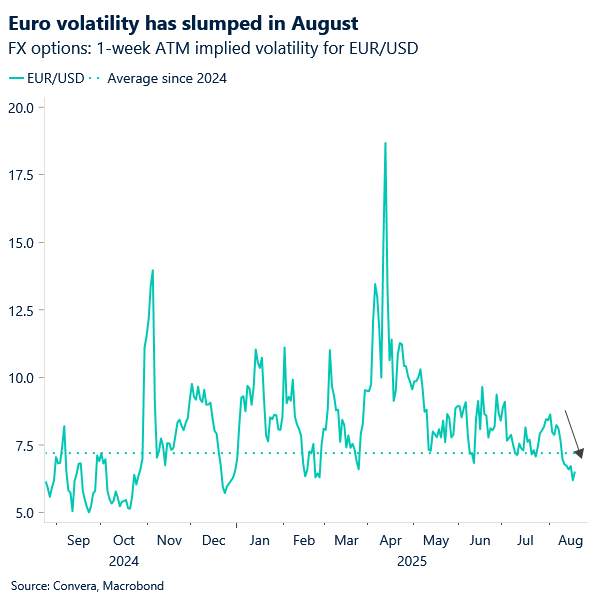
Volatility in the euro has dropped to its lowest since March, even with key event risks on the horizon. Positioning data and options sentiment suggest traders are scaling back bullish exposure, pointing to a more cautious tone in the near term. With conviction fading and volatility subdued, EUR/USD looks likely to stay range-bound into the end of the week.
Still, the broader structural narrative remains intact. The euro’s summer setback hasn’t derailed its longer-term appeal, underpinned by its evolving role as a reserve currency and portfolio anchor. With trade war risks now largely removed, Europe’s focus has shifted toward infrastructure and defence investment — a theme that could become a key growth driver in the years ahead.
Technically, the charts suggest caution, but the macro backdrop — including monetary divergence, geopolitical easing, and persistent eurozone inflows — continues to tilt the longer-term bias higher. A breakout may require fresh catalysts, but the foundation for euro strength remains firm.
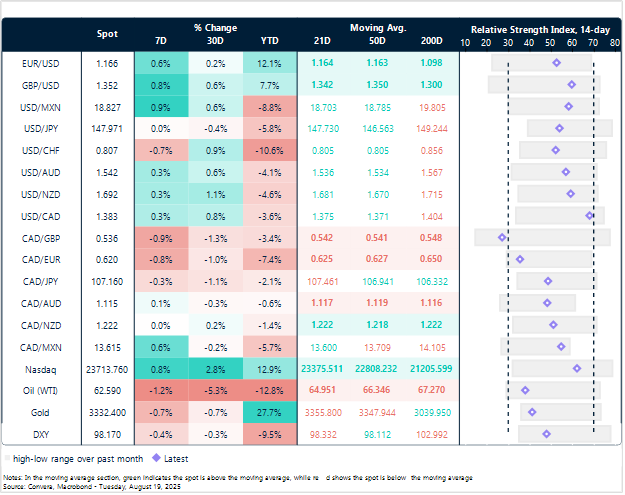
Oil prices down almost 13% this year
Table: Currency trends, trading ranges and technical indicators
Key global risk events
Calendar: August 18-22

All times are in ET
Have a question? [email protected]
*The FX rates published are provided by Convera’s Market Insights team for research purposes only. The rates have a unique source and may not align to any live exchange rates quoted on other sites. They are not an indication of actual buy/sell rates, or a financial offer.ve a unique source and may not align to any live exchange rates quoted on other sites. They are not an indication of actual buy/sell rates, or a financial offer.