


Unpacking the effects of tariffs on Canadian inflation
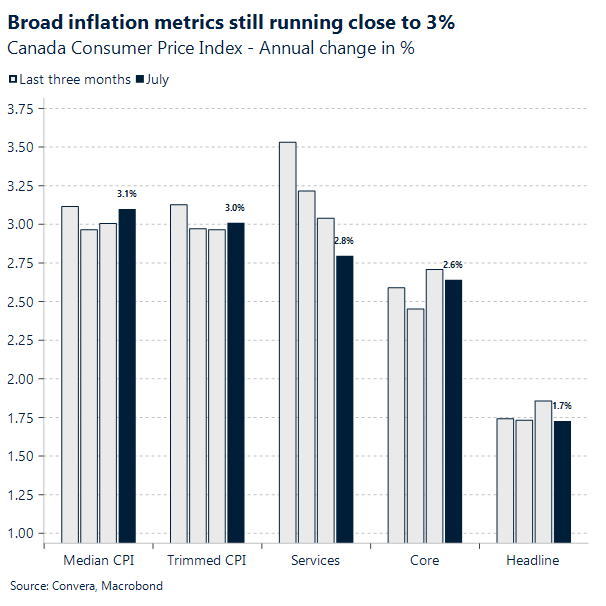
The latest Consumer Price Index (CPI) report for July showed a headline inflation rate that cooled slightly on an annual basis, at 1.7%, a result largely driven by a sharp decline in energy prices. While this top-line figure may suggest a significant easing of price pressures, a deeper look into the report reveals persistent underlying inflationary forces. A key factor in this complex inflationary environment is the ongoing impact of tariffs, which have been incrementally pushing up the cost of goods and services for Canadian consumers. The full effect of these trade-related levies is not always immediately apparent in the headline numbers, as their costs are embedded directly within the final prices of products.
A close examination of the CPI basket indicates that the impact of tariffs is particularly evident in the food sector. Prices for groceries continued to accelerate, rising at a faster pace in July than in June. This increase was not uniform but was concentrated in specific categories that are highly susceptible to trade disruptions and higher import costs. For instance, fresh fruit saw a notable year-over-year price jump, and prices for confectionery and coffee also climbed sharply. These increases reflect not only domestic factors but also the ripple effects of international trade friction, as tariffs on imported ingredients and finished goods flow down to the retail level.
Beyond food, the tariffs are also contributing to price pressures in other key components of the CPI. Durable goods have seen a continued acceleration in price growth, a trend that can be attributed, in part, to tariff impacts on products like motor vehicles and furniture. These goods are often part of complex cross-border supply chains, and the added cost of tariffs on components or finished products is being passed on to consumers. This broad-based effect across multiple categories, from food to big-ticket items, illustrates the pervasive nature of trade policy on consumer spending.
Statistics Canada has noted that the effects of tariffs are embedded in the final prices of goods and that no special adjustments will be made to the CPI to account for them. This approach reinforces that the price increases from tariffs are a direct and integral part of the overall inflation picture. The agency, along with other economic bodies, continues to closely monitor how these levies influence consumer prices and spending patterns over time.
For businesses, the tariffs represent an immediate increase in operational costs. Many are facing the challenge of higher prices for materials, components, and finished products that they import. While some companies may absorb these costs to remain competitive, others are forced to pass them on to consumers. This pass-through effect is a critical mechanism by which tariffs translate from a business concern to a consumer burden, and it is a process that is still unfolding across the economy.
The central bank has been clear that it is closely watching the pass-through of tariff costs into the economy. In its latest summary of deliberations, the Bank of Canada acknowledged that it’s still too early to fully assess how tariffs and the “rewiring of trade” will affect economic activity and inflation in Canada in the long term. This cautious stance highlights the significant uncertainty that trade policy introduces into the inflation outlook. The Bank remains vigilant for signs that these costs are becoming more persistent or widespread.
The current economic backdrop is defined by this dichotomy: a moderating headline inflation figure contrasted with stubborn and rising underlying price pressures. While lower gasoline prices have provided Canadians with some relief at the pump, they mask the ongoing upward trend in other essential goods. The price of food, for example, has consistently grown faster than the headline CPI for months, highlighting the real-world impact on household budgets.
In conclusion, while the headline CPI has eased, the analysis of the July report makes it clear that inflationary pressures remain a significant concern. Tariffs are a key contributor to this, particularly by driving up the cost of food and durable goods. The full extent of their impact is still being measured, but their effect is undeniably filtering through supply chains and into consumer prices, complicating the outlook for inflation and consumer spending in the months ahead.
The market reacted swiftly to the CPI report, showing a growing belief that a Bank of Canada rate cut is not off the table. The yield on the 2-year Canadian government note dropped 7 basis points, a sign that investors anticipate lower future interest rates. This was accompanied by a jump in the odds of a BoC rate cut for the September meeting, rising from 25% to 35%. The CAD is now trading closer to 1.39. Investors seem to be focusing on the cooling headline inflation figure, outweighing concerns about persistent underlying price pressures, and are pricing in the possibility of a move toward a more accommodative monetary policy.
UK inflation heats up, rate cut bets cool down
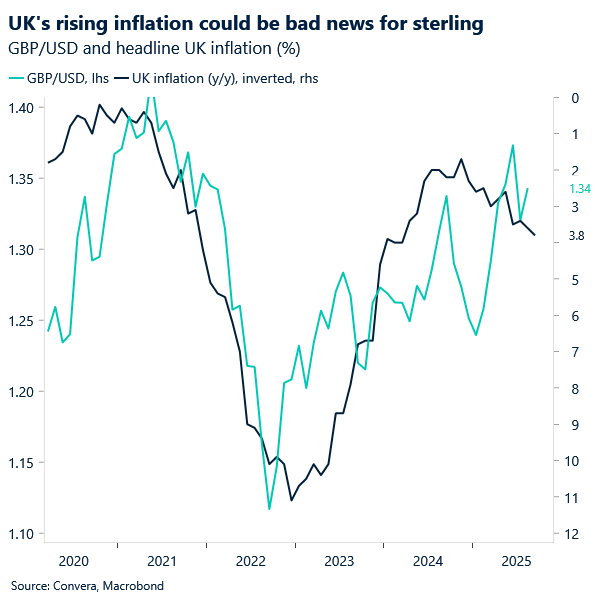
The British pound’s knee-jerk reaction to this morning’s hotter-than-expected UK inflation report was one of strength. However, as noted yesterday, a stagflationary backdrop rarely supports sustained currency gains — putting the pound’s recent yield-driven rally on increasingly shaky ground.
UK inflation accelerated in July, with the annual rate rising to 3.8%, the highest since January 2024 and above market expectations of 3.7%. That’s up from 3.6% in June, driven largely by a sharp increase in transport costs. Airfares surged 30.2%, pushing overall transport inflation to 3.2%, up from 1.7% the previous month — marking a key source of upward pressure in the latest CPI print.
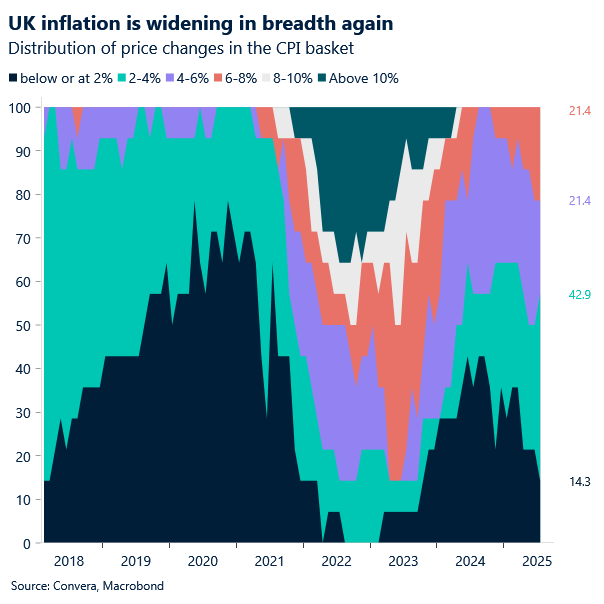
Not only did the full suite of July inflation figures exceed expectations, but services inflation has returned to 5% — a deeply troubling development for the Bank of England (BoE). UK inflation breadth is widening notably as well. Over 40% of the inflation basket is now running above 4%, with more than 20% exceeding 6% — a sharp shift from last year, when over 40% of components were below the BoE’s 2% target and none were above 6%. This broadening pressure underscores the persistence of inflation and complicates the outlook for monetary easing.
It raises questions over whether the central bank acted prematurely in cutting rates earlier this month. Markets had already scaled back expectations for another rate cut this year, and today’s data has seen the probability of a reduction by December now at around 42%, compared to about 50% as of Tuesday’s close, according to overnight swaps tied to meeting dates.
Euro stuck in low gear
EUR/USD has traded in a narrow range this month, moving less than 0.5% in either direction each session, underscoring the lack of volatility in the world’s most traded currency pair as investors await a fresh catalyst. Despite being up 12% year-to-date, upside momentum has faded in recent weeks, with the pair hovering near its 21- and 50-day moving averages for support.
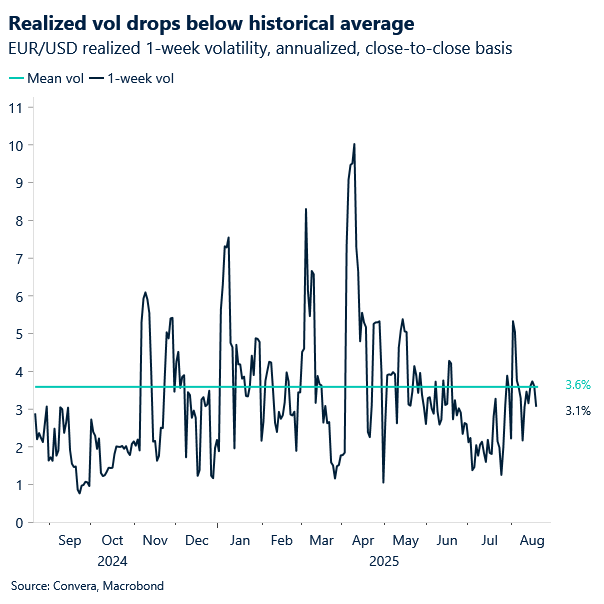
Markets are watching Thursday’s eurozone PMIs for signs that business sentiment is deteriorating in response to the new US-EU trade deal. The August ZEW survey already flashed a warning: German economic sentiment plunged 18 points to 34.7, with the current conditions index falling to -68.6 — both well below expectations. Analysts cited disappointment over the trade agreement and weak Q2 German growth, particularly in key sectors like chemicals, autos, and engineering. With volatility low and EUR/USD rangebound, any downside surprise in the PMIs could trigger a more defensive market tone.
Still, as markets begin to move past the structural implications of tariffs, growth differentials are re-emerging as key FX drivers. This dynamic already supported the euro’s rally in the first half, as the relative growth gap between the euro area and the US narrowed. The eurozone economy bottomed out higher than feared, and upcoming fiscal stimulus could lift GDP from late 2025 into 2026. Meanwhile, the US economy showed resilience through H1, but that momentum may be fading — setting the stage for renewed divergence in growth expectations and FX performance.
Loonie under pressure amid broad-based losses
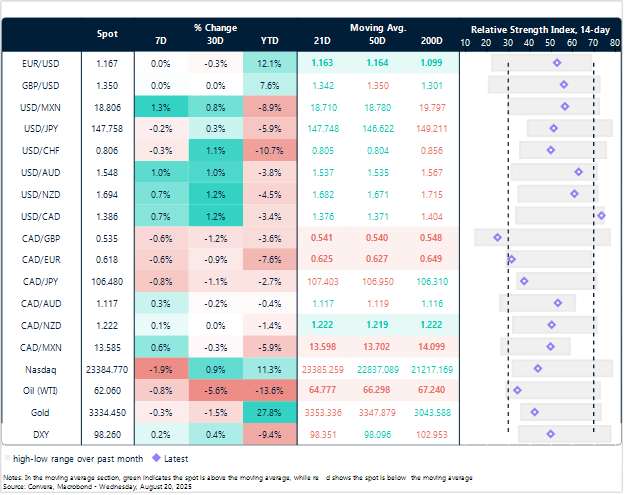
Table: Currency trends, trading ranges and technical indicators
Key global risk events
Calendar: August 18-22

All times are in ET
Have a question? [email protected]
*The FX rates published are provided by Convera’s Market Insights team for research purposes only. The rates have a unique source and may not align to any live exchange rates quoted on other sites. They are not an indication of actual buy/sell rates, or a financial offer.ve a unique source and may not align to any live exchange rates quoted on other sites. They are not an indication of actual buy/sell rates, or a financial offer.