

USD: Geopolitical bid, macro backbone
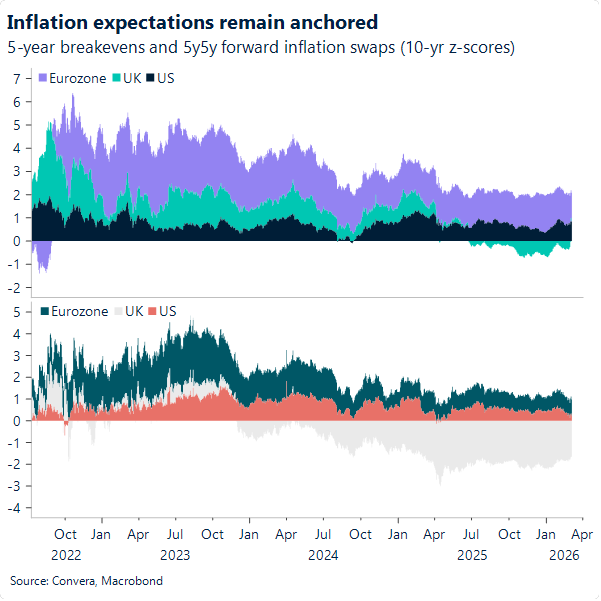
Material de‑escalation efforts from both sides in the Middle Eastern conflict are still absent, yet even small hints of diplomacy have been enough to stall the market trends of recent days, albeit temporarily. Oil closed lower and equities rebounded yesterday, after a New York Times report suggesting that Iran had indirectly reached out to the CIA to discuss terms for ending the conflict (a claim since denied) added to earlier comments from President Trump that he would ensure safe passage of Middle Eastern oil through insurance guarantees and naval escorts. Fragile as these developments are, markets continue to view the escalation through a fundamentally driven lens – namely, whether the inflation outlook is being disrupted. So far it isn’t, and even tentative signs of an off‑ramp are enough to give markets a breather.
But the reality is that the Strait of Hormuz remains practically at a halt, whether due to inability or unwillingness given the high risks involved. The material and psychological damage the conflict has caused would delay the rollout of any updated US‑organized insurance solution, especially given the large and complex network of consumers and producers involved. On the escort front, questions remain around capacity and whether enough Navy assets exist to both escort ships and continue operations in Iran. This is to say that while it’s too early to judge a meaningful impact, the economic risks are multiplying and would materialise if the conflict proves prolonged.
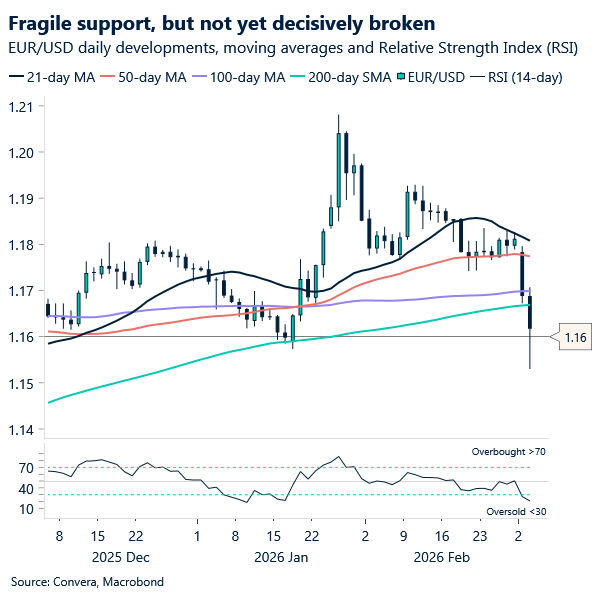
When it comes to the US dollar, it pared some weekly gains yesterday, after having risen to levels last seen in November. It found fresh buying support during the Asia session, with the DXY now hovering around the 99 line. 98.560, the 100‑day moving average, may emerge as a short- to medium-term support level. While technicals may matter less when headline risk is this potent, they can still be instructive when the dust settles in gauging whether the foundations are in place for further upside.
And then we have the US macro story. The ADP report yesterday showed above‑consensus figures, with 63K jobs added in the private sector. Meanwhile, ISM services also surprised to the upside: the headline came in at 56.1 (53.5 est.) from 53.8 in January, the highest reading since summer 2022. This underscores strong activity and momentum in the services space, and suggests the AI‑driven economy remains rampant despite ongoing concerns about the sector. While the dollar remains most sensitive to geopolitics for now, the data backdrop nonetheless helps reinforce the robustness of the 100‑day MA support line, and with it the dollar’s more bullish posture in recent days.
A resilient US macro backdrop remains a key supportive factor for the dollar, and the one likely to exert the most durable influence on the currency. Although its impact has been muted for most of 2026 – first by the January’s turmoil that brought renewed softness in the greenback sentiment, and now by a more mechanically driven push higher linked to the conflict. Even so, in a scenario where the conflict persists long enough to put sustained upward pressure on prices, a more hawkish Fed may not necessarily translate into a stronger dollar – lingering inflation pressures could fuel domestic dissatisfaction with the administration. That political risk premium, combined with a broader “debasement trade” angle, could act as a headwind for the dollar. After all, behind the latest surge in the greenback, markets are still inclined to interpret Trump’s decision to strike Iran as yet another instance of erratic policymaking – something that, as seen through 2025 and early 2026, has tended to be dollar‑negative.
EUR: A fragile euro floor
EUR/USD appears to find buying interest around the 1.16 line after losing 1.7% so far this week and briefly touching November lows near 1.1530. Building on Wunsch’s comments from earlier in the week, ECB Governing Council member Olli Rehn stressed the need for patience before pricing in knock‑on effects from the war in Iran on the economic outlook, warning against drawing overly “hasty conclusions”. Bank of France chief Villeroy added today that he “doesn’t see a need to hike rates today”.
So while downside risks stemming from the conflict are worth examining, ECB officials – and we – remain cautious about making material forecast adjustments that assume a conflict‑driven shock, at least for now. This is especially true given other factors that we see as offsetting any conflict‑related price spikes, notably a stronger euro.
On the trade front, we heard that the EU received assurances from the US that the current global tariff rate of 10% – instituted via Section 122 of the Trade Act after the administration’s 2025 duties were deemed illegal – would not be raised to 15%, even though that increase remains part of the administration’s plans. Treasury Secretary Scott Bessent said yesterday that the 5% bump would go into effect this week.
While this may look like positive news at first glance, the pre‑ruling, still‑to‑be‑ratified US‑EU trade accord would have imposed a 15% ceiling, cushioning EU exporters from tariff increases above that level. Under the current regime, the 10% baseline stacks on top of existing most‑favoured‑nation tariffs, pushing effective rates above 15% in some cases. Bloomberg reported that the new tariff structure would leave about $4.9bn of EU exports facing tariffs above the 15% threshold.
GBP: Pound cautious on energy, mindful of history
The pound is trading cautiously as fleeting equity rebounds fail to offset a market mood still dominated by uncertainty, volatility, and the deepening global energy shock The renewed surge in oil and gas prices this week has re‑energised classic petro‑dollar dynamics, pulling GBP/USD briefly back below $1.33 this week — its weakest level since December. There are tentative signs that downside momentum is slowing on the daily chart, but nothing yet that resembles a convincing reversal.
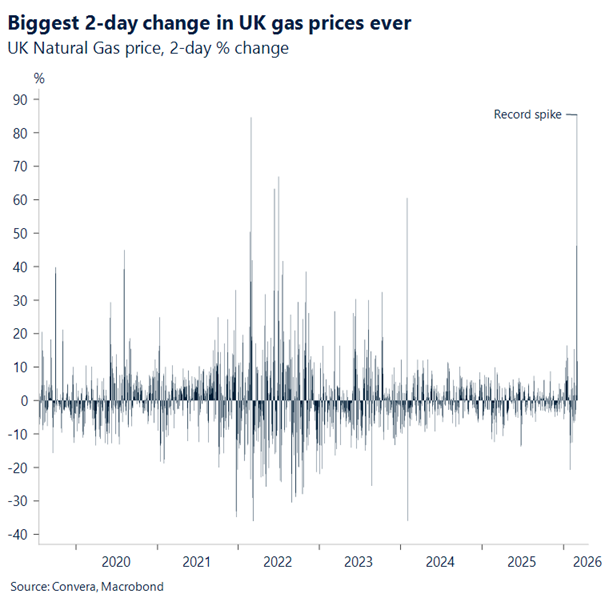
The UK’s vulnerability stems from its status as a net energy importer, so rising oil prices are uncomfortable — but it’s the surge in gas prices that poses the real threat. Wholesale prices have more than doubled since the weekend and have recorded the sharpest two‑day rise on record. They remain well below the extremes seen during the early stages of Russia’s invasion of Ukraine, but the speed of the move — combined with storage levels that sit below where they were at the start of the Ukraine war — exposes a clear fragility.
This marks a clear deterioration in the UK’s terms of trade — a theme that played a central role in the 20% GBP/USD decline in 2022. We’re not drawing a direct parallel, but it’s a risk worth keeping on the radar.
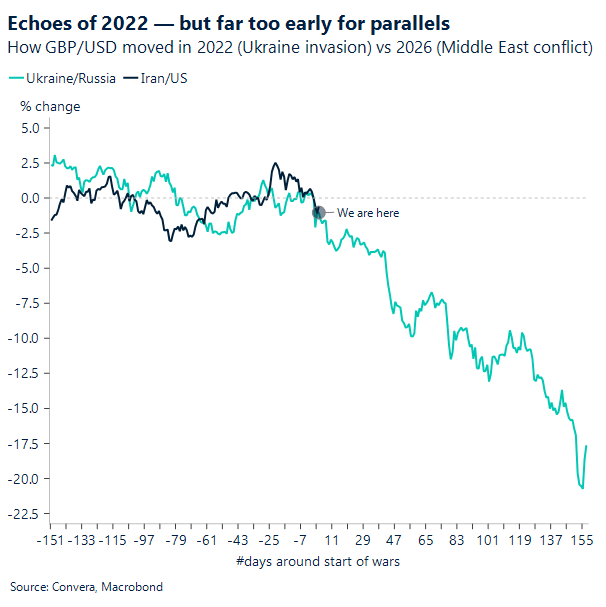
For now, though, sterling is showing pockets of resilience though. Broader risk sentiment remains another dominant driver, with GBP/EUR continuing to shadow global equity moves. But the domestic rates narrative is shifting too. Markets spent much of early 2026 assuming the Bank of England would cut more aggressively than the ECB. That assumption is now being challenged. Energy‑driven inflation risks are forcing investors to reassess how far the BoE can ease, pushing gilt yields higher and offering the pound intermittent support via the yield channel, even as risk sentiment remains fragile.
In the near term, the hawkish repricing of BoE expectations may give sterling some support, but it’s not an unambiguous positive. Higher yields help at the margin, yet if the energy shock evolves into a more persistent squeeze on growth and real incomes, the UK edges toward a stagflationary mix that is typically currency‑negative. The market is already adjusting: an 80% probability of a March cut has collapsed to just 25%, but that support can only carry GBP so far if the underlying macro backdrop continues to deteriorate.
Market snapshot
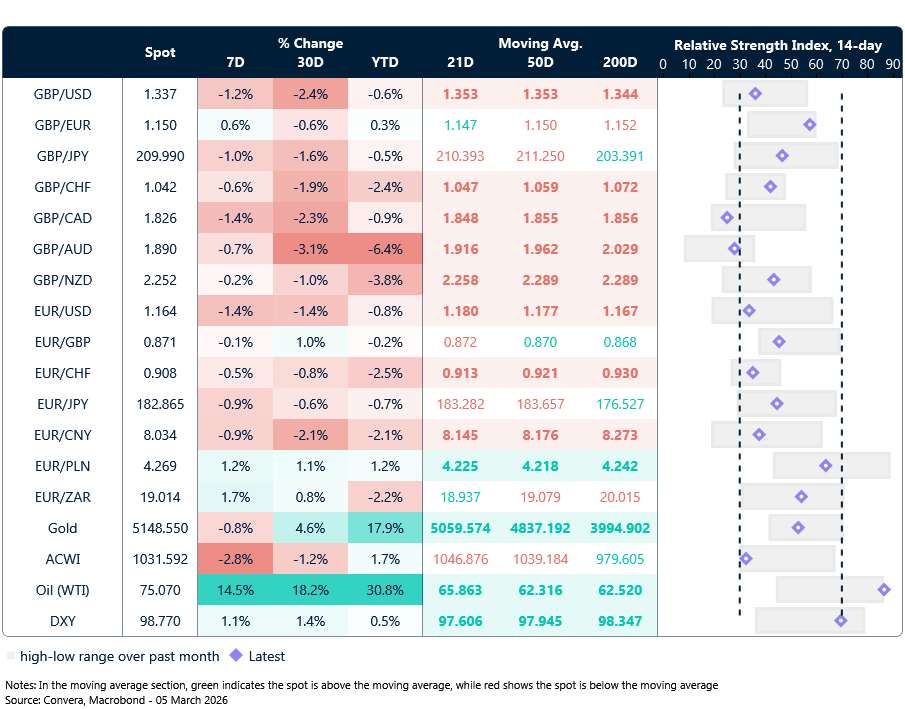
Table: Currency trends, trading ranges & technical indicators
Key global risk events
Calendar: March 2-6
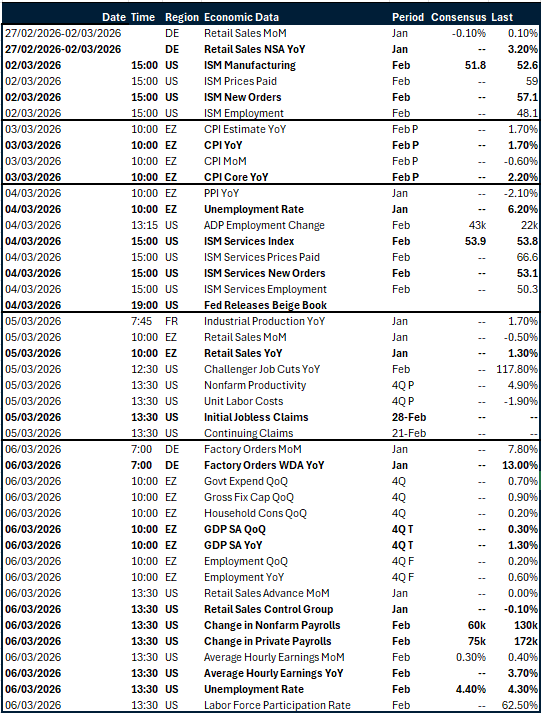
All times are in GMT
Have a question? [email protected]
*The FX rates published are provided by Convera’s Market Insights team for research purposes only. The rates have a unique source and may not align to any live exchange rates quoted on other sites. They are not an indication of actual buy/sell rates, or a financial offer.