


Key Takeaways
- CAD remains under pressure despite oil trading above $100, as the wide US-Canada rate differential and defensive dollar demand outweigh the terms-of-trade support.
- EUR/USD has slipped below 1.16 as higher energy costs, weaker risk appetite and dollar-supportive rate differentials begin to overwhelm the euro’s recent resilience.
- Sterling’s near-term direction hinges on UK inflation and whether the Bank of England signals greater willingness to tighten, although markets may be pricing more hikes than policymakers ultimately deliver.
- The Federal Reserve, Bank of England and Bank of Japan decisions will test relative rate expectations across G10 FX, with the Fed likely to set the broader dollar direction.
- Beyond central banks, Canadian and UK inflation, US retail sales and eurozone price data will shape the next round of policy repricing.
CAD: Higher oil fails to close CAD’s rate gap
The Canadian dollar remains under pressure despite oil trading above $100 a barrel. USD/CAD has risen for a fourth consecutive session and is approaching 1.3920, with wide US-Canada rate differentials and defensive demand for dollars outweighing the support from crude. Canada’s August CPI report matched expectations, giving markets no reason to bring forward Bank of Canada tightening or narrow the rate gap ahead of Wednesday’s Federal Reserve decision.
Headline inflation held at 3.0% year over year, while the average of the Bank of Canada’s preferred core measures remained at 1.95%. The report was not soft enough to rule out the hikes already priced, but it offered no hawkish surprise to lift Canadian front-end yields. That leaves the two-year yield gap near 128 basis points in favour of the US, with further Fed tightening priced as Canadian employment, wages and manufacturing data soften.
Oil would ordinarily offer CAD more support, but the source of the rally has weakened that relationship. The supply disruption has lifted crude prices while adding to inflation concerns, weighing on equities and strengthening demand for the US dollar. Trade tensions add another risk to Canadian growth and the expected Bank of Canada path, although they appear to be reinforcing the move rather than driving today’s direction.
USD/CAD is now testing 1.3920, with a break bringing 1.3990 and the broader 1.40 area into view. A hawkish Fed would keep US front-end yields elevated and maintain pressure on CAD, while softer guidance could narrow the rate differential and allow higher oil to offer more support. A move back below 1.3827 would be stronger evidence that the latest advance has failed.

EUR: Pressure is building below 1.16
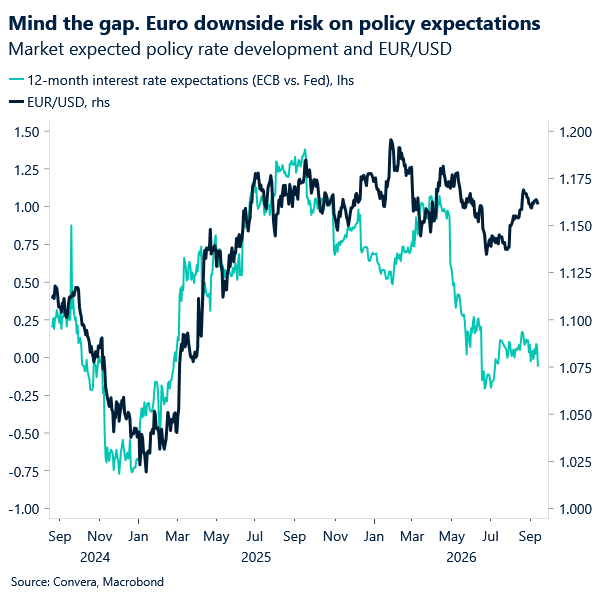
The euro proved surprisingly resilient last week despite oil prices surging to their highest levels since May. The ECB’s hawkish hike helped offset this headwind. However, with markets already pricing two further ECB hikes by April 2027, there appears limited scope for the rates channel to provide much additional support for the euro, particularly while the pass-through from higher energy costs into broader inflation remains contained.
Today, we’ve already seen the euro’s resilience tested. EUR/USD has slipped further below 1.16, falling around 0.4% to its lowest level in a month, as higher energy prices, weaker risk appetite and increasingly dollar-supportive rate differentials converge.
Although higher oil prices can initially support ECB tightening expectations, beyond a certain point – the negative implications for eurozone growth and terms of trade begin to dominate. At the same time, souring risk sentiment naturally favours the dollar through the safe haven channel, leaving the euro increasingly squeezed from both sides.
With the Fed meeting now approaching, relative rate expectations are likely to remain the dominant driver. Unless energy prices retreat or risk sentiment improves, EUR/USD looks vulnerable to extending its recent decline, with last week’s resilience increasingly giving way to renewed downside pressure.
GBP: Pound awaits hawkish nudge
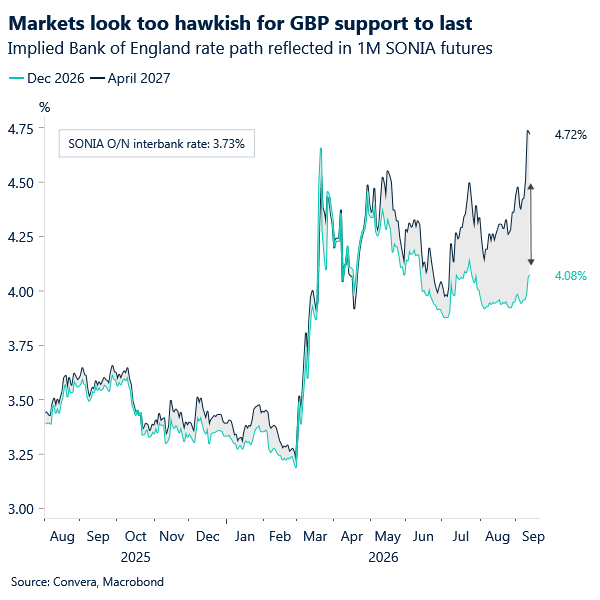
This week is a key test for the pound. A more actively hawkish BoE bias has yet to materialise, despite higher energy prices pushing short-end rates higher. The BoE is still widely seen as reluctant to hike, partly due to a soft labour market, little pass-through from higher energy prices, and well-anchored long-term inflation expectations.
That said, oil prices are now significantly higher than they were ahead of the July policy meeting, on which the BoE’s latest projections were based. Combined with tomorrow’s UK CPI release, expected to rise to 3.1% from 2.9% in July, that could encourage markets to take the recent hawkish repricing more seriously. Much, however, will depend on the tone struck at the MPC press conference.
A hawkish hold that hints at a possible rate hike ahead would help underpin sterling in the near term. We remain sceptical that the BoE will ultimately follow through, however, as policymakers are unlikely to validate the aggressive tightening currently priced by markets (3 hikes by April 2027).
Beyond the MPC, sentiment towards the pound will become increasingly important as the Budget approaches. So far, the fiscal news flow has been relatively benign, giving GBP bulls little reason to walk away from a currency that continues to offer some of the highest yields in the G10.
GBP/USD remains stuck in the 1.35-1.3550 range, with mild downside risks should the Fed deliver a hike this week. A firm UK inflation print and hawkish BoE rhetoric could help offset some of that pressure.
As for GBP/EUR, we see scope for the pair to firm above 1.1650 if inflation comes in hot and the BoE delivers a hawkish hold.
What’s happening in markets this week?
The week’s biggest risk event comes from three major central bank meetings within roughly 36 hours, with the Federal Reserve on Wednesday, the Bank of England on Thursday and the Bank of Japan on Friday. Markets will focus closely on what each signals about the path for interest rates through year-end.
Beyond central banks, a busy Monday morning in Canada brings August CPI and July manufacturing sales. US retail sales and Canadian housing data follow on Wednesday, with Eurozone inflation on Thursday and UK retail sales and US industrial production rounding out the week on Friday.
Market snapshot
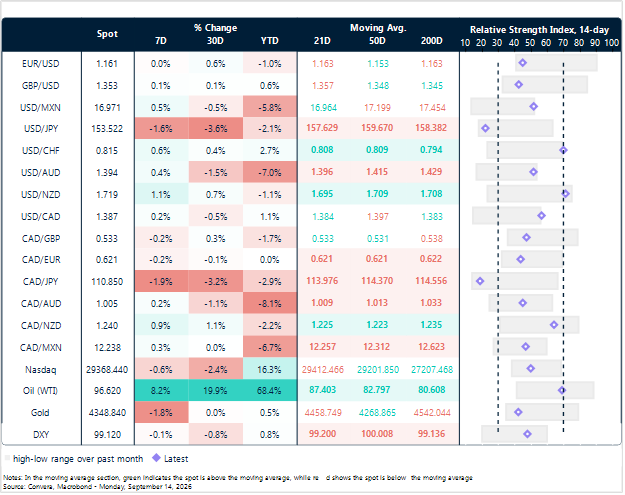
Table: Currency trends, trading ranges & technical indicators
Key global risk events
Calendar: September 14 – 18
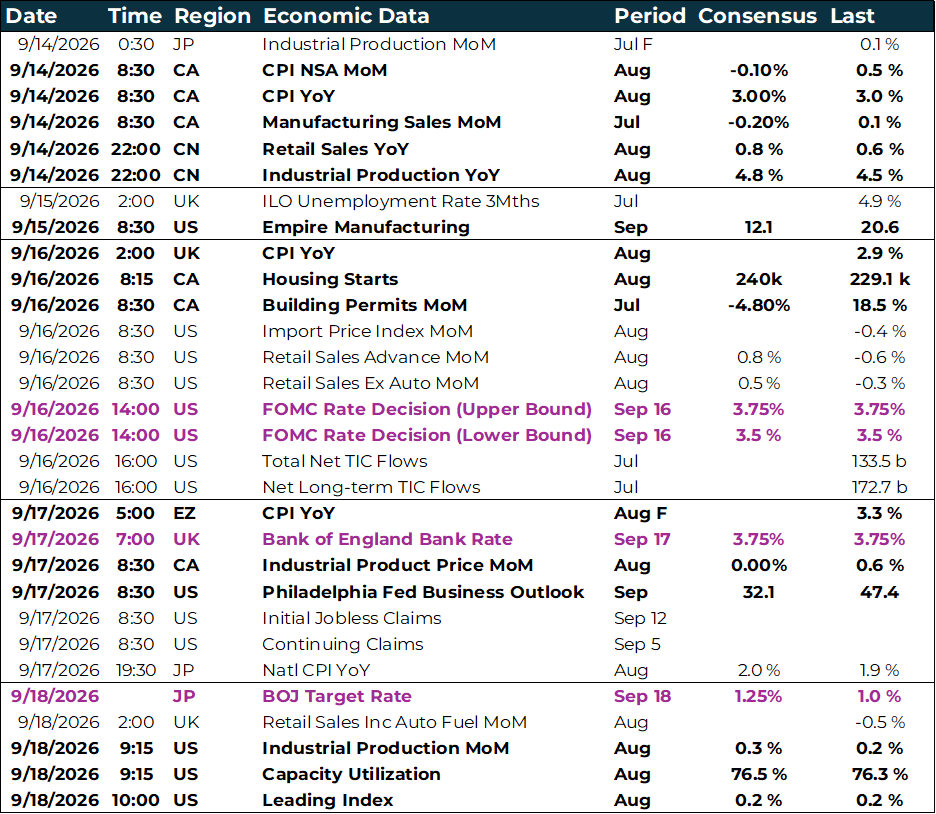
All times are in EST
Have a question? [email protected]
*The FX rates published are provided by Convera’s Market Insights team for research purposes only. The rates have a unique source and may not align to any live exchange rates quoted on other sites. They are not an indication of actual buy/sell rates, or a financial offer.