

USD: Higher for longer path boosts US Dollar
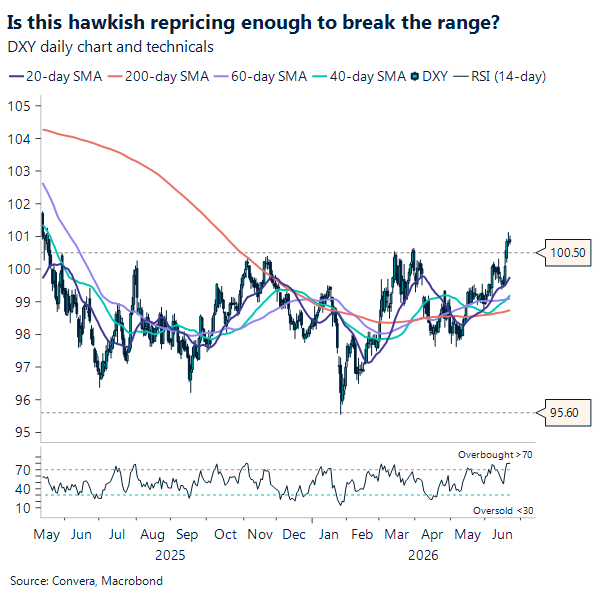
After spending the better part of a year trapped in a narrow range, DXY has kept pressing hard against the 100.50 ceiling. The move reflects the aftermath of a sharper hawkish repricing after the Fed meeting. By holding rates at 3.50%–3.75% and quietly dropping its legacy easing bias, the Fed forced investors to confront a path that higher for longer is back in play. The headlines coming from the Middle East throughout the weekend haven’t had an impact thus far, beyond putting a floor to oil prices. The US yield curve has flattened, and with it, has brought the US DXY Index to a one-year high.
A couple of refreshers from last week. Kevin Warsh hinted that the Fed’s communication framework may change, leaving markets in an awkward transition. Investors are still leaning on the SEP and the dot plot for guidance, even as the new chair suggests those tools may carry less weight over time. That makes hawkish repricing more potent. When guidance thins out, markets will have to fill the gap themselves, usually with a heavier risk premium.
The technical backdrop has given the US Dollar a shot at testing the top of the range, though calling it a breakout would still be premature. DXY has reclaimed its short-term moving averages and is leaning on the 100.50 level that has capped rallies for much of the past year. Clear that barrier decisively and the market starts talking about a fresh leg higher. Fail here and this starts to look like another failed breakout inside a broader sideways market.
The timing complicates the signal. Month-end, quarter-end, half-year rebalancing are about to hit, which will only add to the noise. Over the next couple of weeks, flows and momentum will add to macro direction.
That leaves the broader macro argument in a tricky place. Crude has retreated sharply from its geopolitical highs, which should, in theory, ease some of the pressure around headline inflation. Markets know that story. More interesting is that the US Dollar rose roughly 2% at the peak of stress in oil and rates back in March, yet it has found a fresh bid even as oil has moved back close to pre-war levels.
The harder question is whether markets are focusing too much on rates and on the broader spread of inflation, rather than on falling oil. Recent US data suggest the pressure is no longer concentrated in energy. It is embedded more broadly across the domestic economy. Core producer measures, including the ex-food, energy and trade-services gauge, are still running hot at 5.1%. That points to inflation that has spread into sticky services, labour costs and the parts of the price basket that do not reverse quickly.
Energy shocks do not disappear cleanly once oil rolls over. Higher fuel costs feed into shipping, insurance, inventory management and operating costs, and those effects tend to linger. Companies rarely rush to hand back margin once a ceasefire hits the tape. By the time crude starts falling, much of the pricing damage has already moved deeper into the system. Until service-sector inflation cools in a convincing way, lower oil looks more like short-term relief than a genuine all-clear in the inflation story.
For the US Dollar, that still leaves room to at least consolidate recent gains. The Fed has turned less forgiving. The market is still adjusting to a chair who may say less and ask investors to infer more. The inflation pipeline does not look ready to reflect lower oil prices any time soon. The US consumer has also stayed resilient through the first half of 2026. Any revival in crude prices and the upside bias for Treasury yields enhance the case to keep the US Dollar bid alive.
CAD: Inflation surges as core pressures build
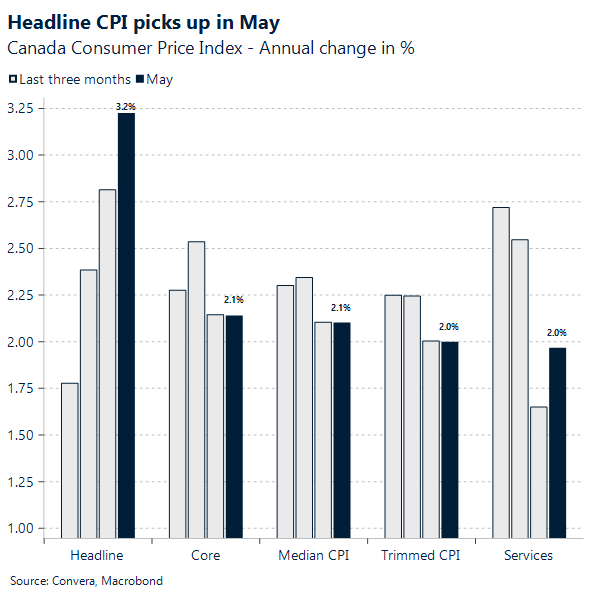
Canada’s headline inflation accelerated unexpectedly in May, rising to 3.2% year-over-year from April’s 2.8% gain. The reading outpaced the market consensus of 3.0%, while month-over-month prices jumped by 1.0%. Even when stripping out volatile gasoline prices, the underlying consumer price index still climbed at a quicker pace of 2.2%. This broad-based reacceleration presents a fresh challenge for policymakers hoping to see steady price stabilization.
Surging energy and food costs primarily drove this unexpected inflationary spike across the country. Gasoline prices jumped 33.2% due to Middle East supply anxieties, forcing consumers to pay the highest pump prices since mid-2022. Meanwhile, grocery bills climbed as fresh vegetable prices surged 9.0%, led by a staggering 45.2% spike in tomatoes caused by poor weather and US tariffs. Higher jet fuel costs also pushed airfares up by 7.4%, reversing the previous month’s decline.
Fortunately, easing shelter costs offered a minor cushion against the upward pressures. Rent inflation slowed slightly to 3.5% in May, representing its lowest annual growth rate since January 2022. Additionally, the mortgage interest cost index continued its 33-month streak of deceleration, while durable goods growth held steady at 1.9%. Nevertheless, because prices accelerated in every single province, the overall inflationary environment remains stubbornly firm.
This domestic inflation pressure has done little in FX. The USD/CAD pair has been moving steadily higher over the last three weeks, breaking from 1.379 to hit a one-year high at 1.419. Much of this weakness stems from a stronger US Dollar, wider yield differential and ongoing tariff friction with the United States, which continues to weigh heavily on investor sentiment. Ahead of the critical CUSMA deal review, markets have turned bearish against the Loonie.
What’s happening in markets this week?
The trading week opens against a highly fluid global backdrop, starting with the Canadian CPI release and monetary policy insights from the Fed’s Christopher Waller (Mon). Market will parse flash PMI updates across the US, UK, Eurozone, and Japan, which arrive alongside the MSCI annual market-classification review (Tue). These indicators are crucial because they will reveal whether a resilient US economy can continue outperforming a sluggish Europe. Meanwhile, attention shifts to Asia-Pacific inflation pressures with Australia’s CPI release, dropping right as tech investors pivot to the pivotal Micron earnings report (Wed) to gauge the ongoing strength of the AI stock rally.
The true weight of the week lands on a heavily packed, critical macro session. Central banks and bond markets face a dense cluster of US indicators, including the Fed’s favored May PCE price index, final Q1 GDP revisions, durable goods orders, and initial jobless claims (Thu). Given the central bank’s aggressive stance on hitting its inflation target, these figures, paired with a speech from the NY Fed’s John Williams and the Banxico interest-rate decision, will intensely sway global yields. Finally, the calendar wraps up overnight with the release of Tokyo’s latest CPI numbers (Fri).
Market snapshot
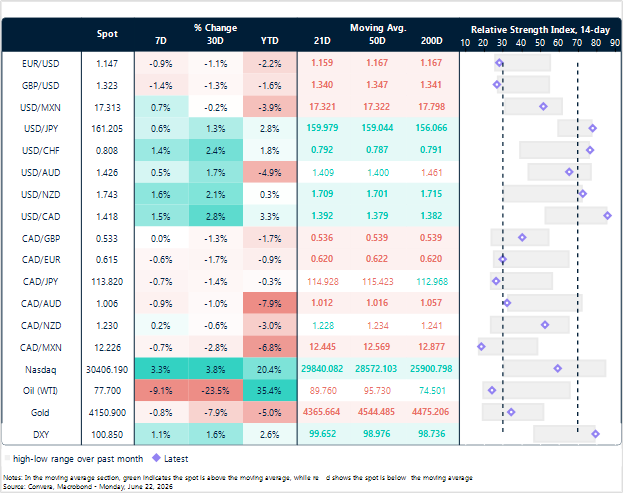
Table: Currency trends, trading ranges & technical indicators
Key global risk events
Calendar: June 22-26
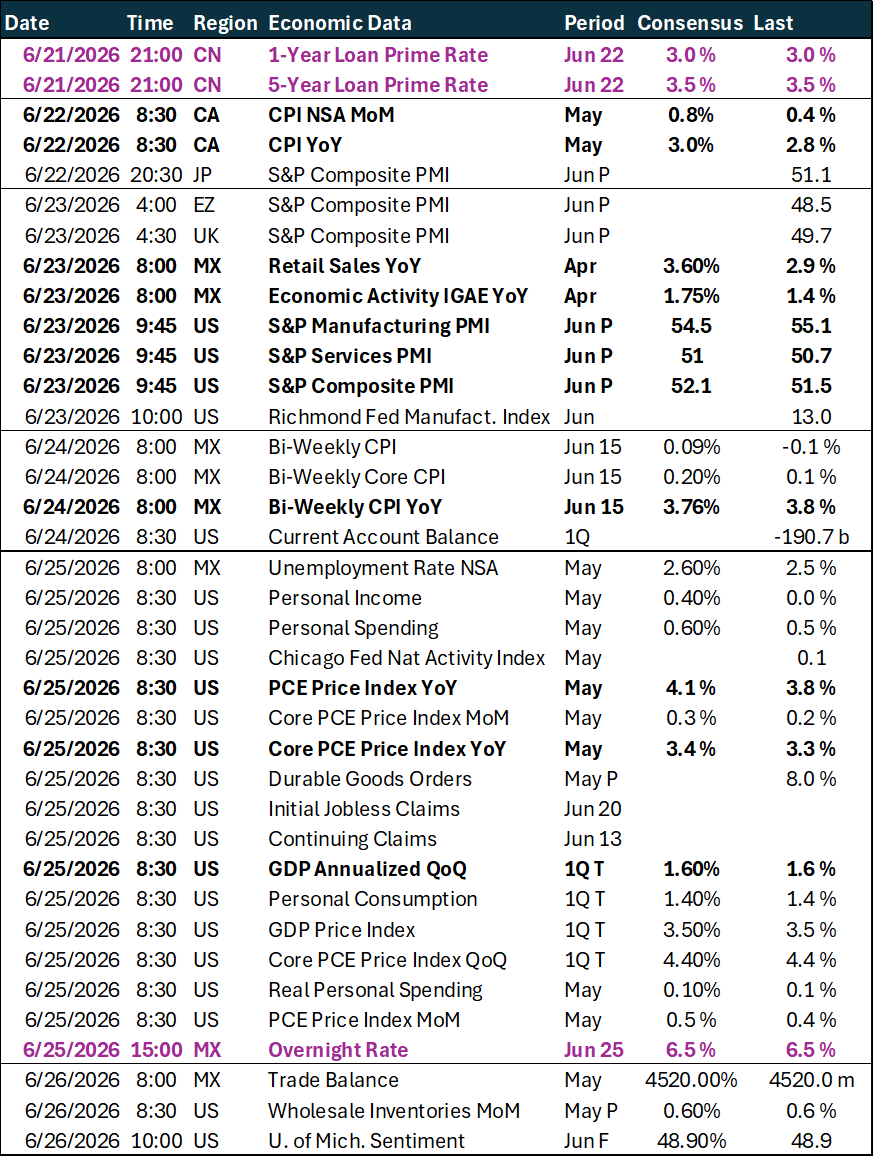
All times are in EST
Have a question? [email protected]
*The FX rates published are provided by Convera’s Market Insights team for research purposes only. The rates have a unique source and may not align to any live exchange rates quoted on other sites. They are not an indication of actual buy/sell rates, or a financial offer.