


USD: Policy risks linger, dollar stays firm
The US dollar is consolidating near one-year highs, holding just above the 21-day moving average around 100.700.
Despite last week’s softer-than-expected US jobs report and investors’ growing disenchantment with Fed Chair Warsh’s hawkishness, the dollar’s broader bullish bias remains intact.
With the economic calendar relatively light this week and little fresh data to reinforce the hawkish Fed narrative, the dollar has instead found support from a modest risk-off tone across markets. Concerns surrounding the AI trade, alongside sporadic attacks in and around the Strait of Hormuz, may be helping to sustain safe-haven demand for the greenback. That support was reinforced overnight after the US launched fresh strikes against Iranian targets following attacks on commercial shipping in the Strait of Hormuz, sending oil prices sharply higher and reminding markets that geopolitical risks remain far from resolved.
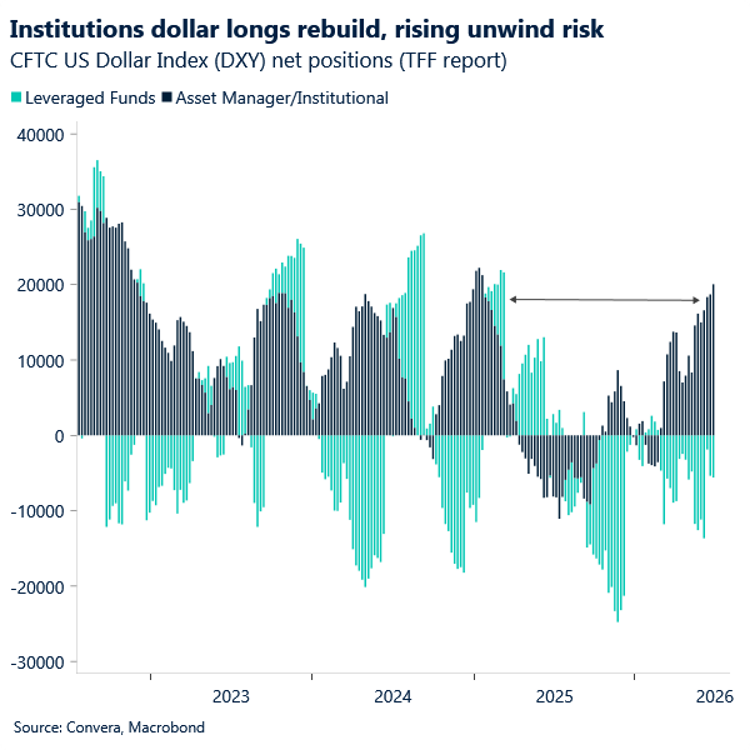
Still, latent dollar risks remain. President Trump reiterated his desire for Greenland ahead of his meeting with NATO leaders. Combined with renewed tariff threats and his attacks on the Fed earlier this year, similar rhetoric previously contributed to an acute USD sell-off. For now, it is difficult to see the dollar reacting meaningfully to Washington policy noise while its revitalised safe-haven bid remains underpinned by geopolitical uncertainty. That said, we would not rule out the dollar regaining sensitivity to policy risk further ahead, particularly if geopolitical tensions recede. Any renewed focus on Washington-related risks could be amplified by increasingly crowded bullish positioning, a consequence of both safe-haven inflows and the Fed’s hawkish stance.
Looking ahead, the FOMC minutes are due later today. While the message is likely to remain hawkish, this is now well understood by markets. Moreover, the sharp decline in oil prices following the interim peace agreement between the US and Iran has eased some of the inflation concerns. As a result, the minutes may feel somewhat stale from a market perspective. We therefore do not expect a meaningful upside reaction in the dollar, although the release should be sufficient to keep the greenback supported above the 100.700 level.
EUR: Conflict jitters and defence spending lift long-end yields
EUR/USD continues to trade timidly just above 1.14, lacking clear catalysts this week to drive a more directional move.
NATO members have gathered in Ankara, Turkey, where they are expected to formalise defence spending commitments in line with US President Trump’s long-standing demands. The US president has for years expressed scepticism towards NATO, arguing that Europe and Canada have been free-riding on America’s defence capabilities while underinvesting in their own security.
Against an increasingly conflict-ridden geopolitical backdrop, and following the recent drawdown of US military assets in Europe, NATO allies yesterday announced at least $50 billion in additional defence spending. We see this theme exerting upward pressure on long-end yields across Eurozone sovereign debt markets in the months ahead, as investors increasingly focus on public finances amid larger spending commitments and often fragile fiscal positions.
Yesterday provided a clear case in point, with 10-year yields across major European economies rising by as much as 5bp. Although part of the move may also have reflected higher oil prices following renewed attacks in and around the Strait of Hormuz.
For the remainder of the week, we struggle to see EUR/USD breaking above the 1.1460 resistance level, with a re-test of 1.14 appearing more likely in the wake of hawkish FOMC minutes.
GBP: Sterling rises above the political noise
As we’ve highlighted over the past few weeks, sterling has responded positively to signs that the post‑Starmer transition could prove far less disruptive than initially feared, with several potential challengers reportedly backing Andy Burnham, leaving the prospect of a contested leadership race increasingly remote. Investors appear particularly reassured by indications that a Burnham government would broadly retain the existing fiscal framework, helping to compress political risk premia that had weighed on UK assets earlier in the summer.
However, political drama is hardly absent. Reform leader Nigel Farage’s decision to resign as an MP and force a by‑election has injected another layer of theatre into UK politics, although the market impact has so far been negligible. With most major parties opting not to field candidates and his only confirmed challenger currently being the satirical Count Binface, investors appear focused on the bigger question of government continuity rather than electoral spectacle.
Against the US dollar, sterling has eased from recent three‑week highs after reports that commercial vessels in the Strait of Hormuz were struck overnight dented risk appetite. Once again, GBP/USD is behaving primarily as a function of global sentiment and USD dynamics, rather than domestic developments.
The more notable move remains in GBP/EUR, where sterling has continued to outperform. This reflects a combination of favourable rate differentials and supportive market conditions. UK yields remain comfortably above their eurozone counterparts, and with volatility measures subdued and the global equity rally broadening, investors have been more willing to pursue carry opportunities. In that environment, sterling’s yield advantage matters more.
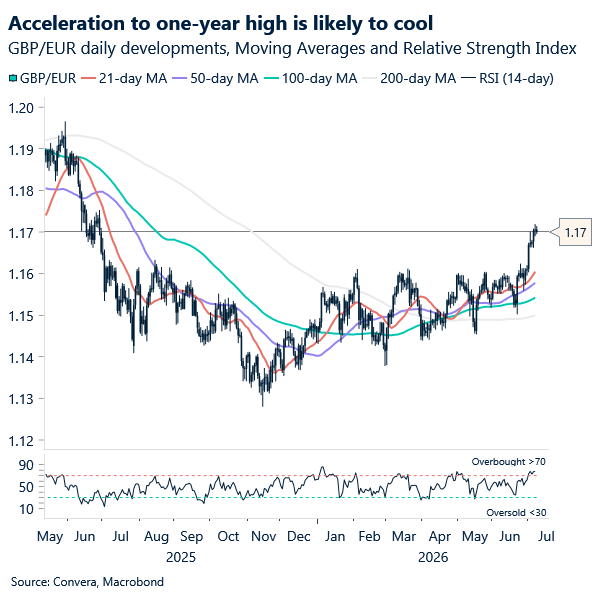
GBP/EUR reached a fresh one‑year high above 1.17, but the rally is looking increasingly overextended. With the daily relative strength index at 73, the cross sits firmly in overbought territory, suggesting further gains may prove harder to sustain.
Market snapshot
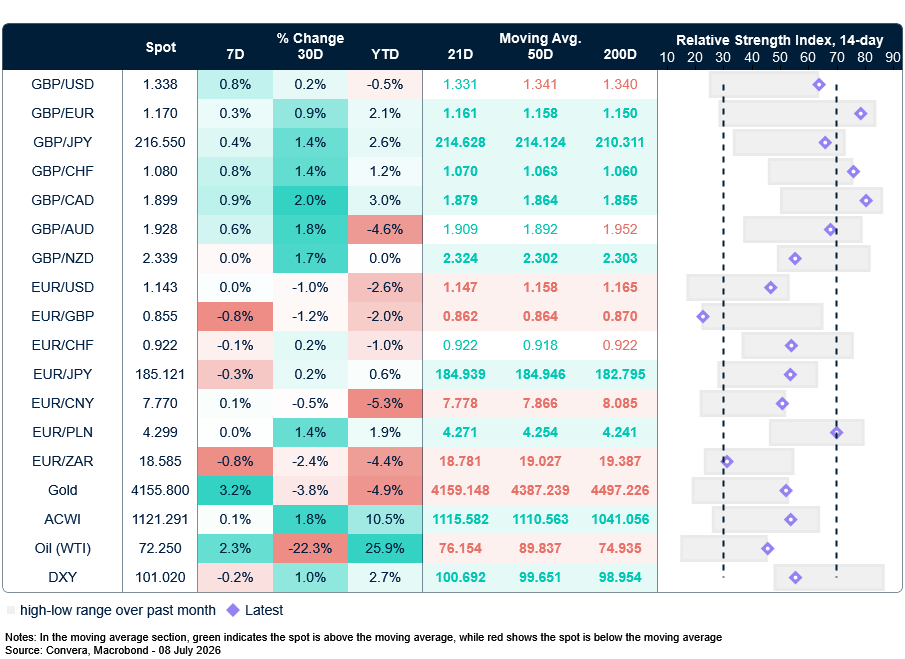
Table: Currency trends, trading ranges & technical indicators
Key global risk events
Calendar: July 06-10
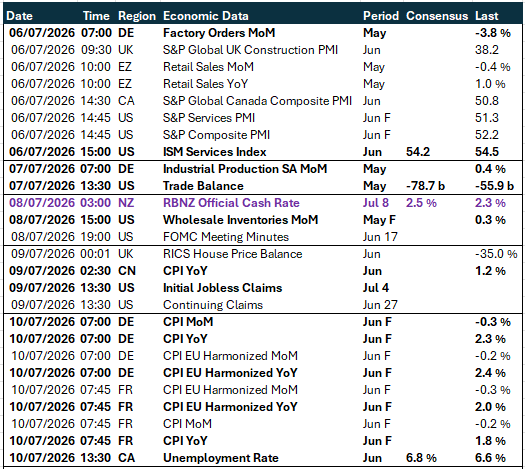
All times are in BST
Have a question? [email protected]
*The FX rates published are provided by Convera’s Market Insights team for research purposes only. The rates have a unique source and may not align to any live exchange rates quoted on other sites. They are not an indication of actual buy/sell rates, or a financial offer.