

Aussie, kiwi lower ahead of RBNZ
The US dollar was higher overnight after the US announced new military strikes on Iran following Iranian attacks on ships moving through the Strait of Hormuz.
Oil prices jumped after the US also said Iran was again subject to oil-selling restrictions. WTI crude gained 2.7% to USD72.37 per barrel.
The news hit sentiment, with US shares lower and the greenback higher as investors sought safe havens.
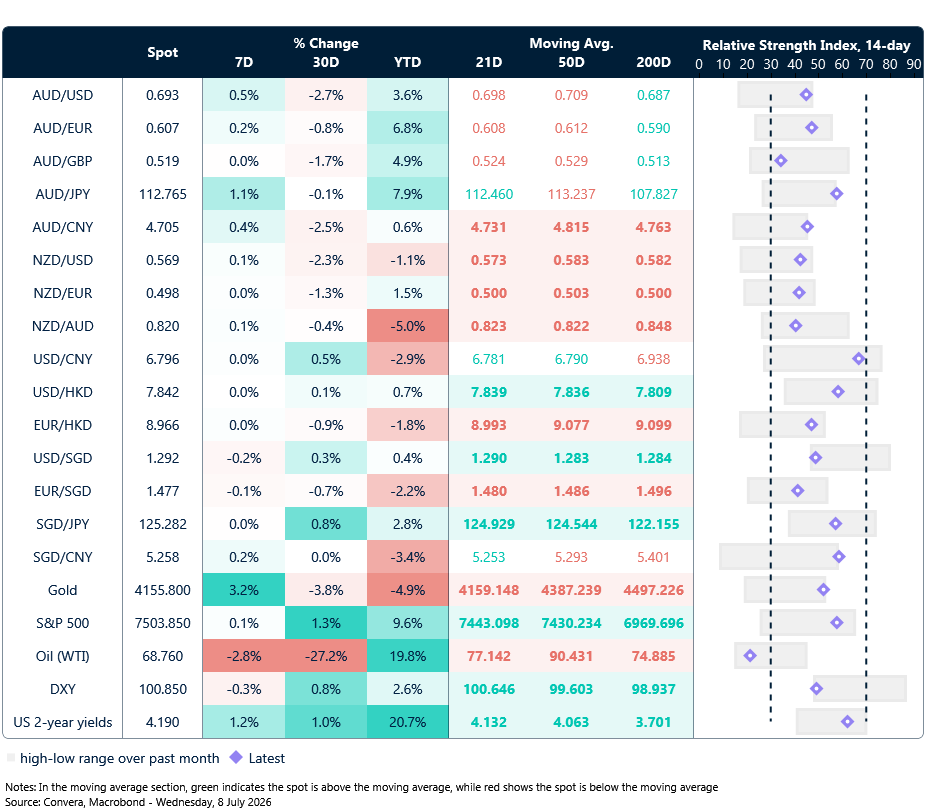
The AUD/USD fell 0.4% from two-week highs as the market turned from key resistance at the 21-day moving average.
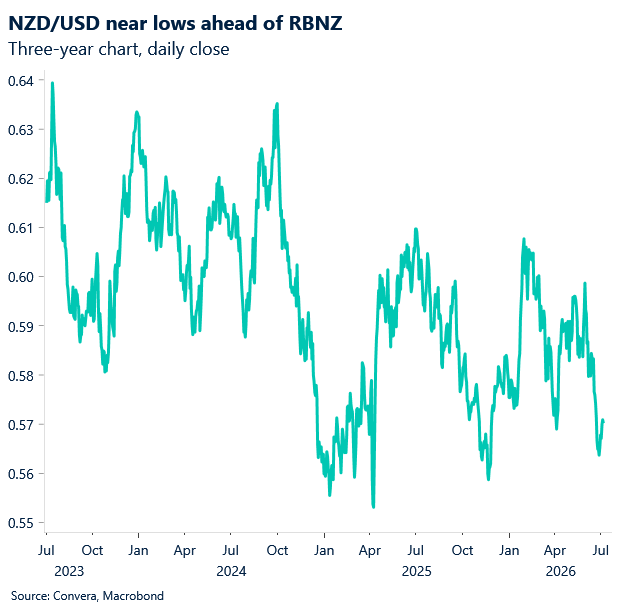
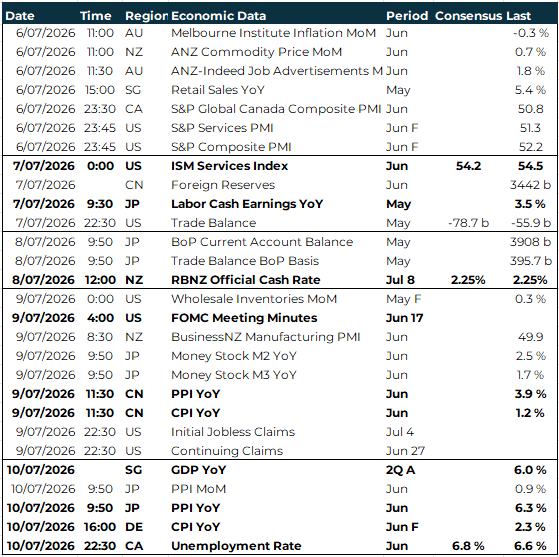
The NZD/USD lost 0.5% ahead of today’s all-important Reserve Bank of New Zealand decision at 2.00pm NZST (12.00pm AEST). Financial markets see an 80% chance of a hike (Source: Bloomberg).
Trump signals possible Xi meeting
Sticking with geopolitics, US President Donald Trump said he expects to meet Chinese President Xi Jinping around 24 September, which would coincide with the United Nations General Assembly in New York.
Trump mentioned the potential timing while discussing plans for a new White House ballroom, making it the first time a specific timeframe has been indicated for Xi’s possible US visit.
The comments offer a modest boost to sentiment around US-China relations, suggesting senior-level engagement remains active and communication channels continue to function constructively.
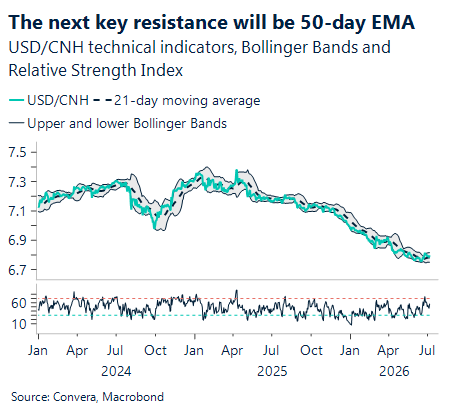
The Chinese yuan remains strong in 2026 and USD/CNH remains close to a three-year low, trading about 0.6% above its 17 June low of 6.7539.
To strengthen upside momentum, the pair needs to break above the 50-day EMA at 6.8001, followed by the 100-day EMA at 6.8384. On the downside, the 21-day EMA at 6.7898 remains the next key support level.
Meanwhile, AUD/CNH and SGD/CNH both slipped from two-week highs.
USD/JPY holds near 40-year highs
Japan’s nominal wages rose 3.2% y/y in May, missing market expectations of 3.4% and easing from April’s revised 3.6% increase. Even so, wage growth remained above 3% for a fourth consecutive month, marking the longest such stretch since 1992.
Real wages increased 1.4% y/y, below forecasts of 1.7% and slower than April’s revised 2.0% gain. However, real wage growth stayed positive for a fifth straight month, highlighting continued resilience in household earnings.
Overall, steady wage gains should help support expectations that the Bank of Japan will continue moving towards further policy tightening.
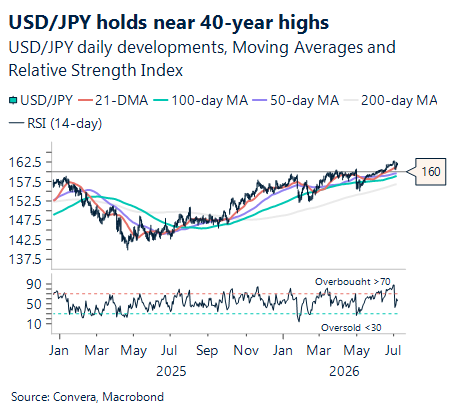
USD/JPY continues to trade close to its multi-decade peak, sitting just below the 40-year high near 162.00. The pair remains roughly 0.6% below its recent peak of 162.84 reached on 1 July.
The 21-day EMA at 161.28 provides initial support, followed by the 50-day EMA at 160.29 and the 100-day EMA at 159.05.
Greenback higher after Iran strikes
Table: seven-day rolling currency trends and trading ranges
Key global risk events
Calendar: 6 – 10 July
Have a question? [email protected]
*The FX rates published are provided by Convera’s Market Insights team for research purposes only. The rates have a unique source and may not align to any live exchange rates quoted on other sites. They are not an indication of actual buy/sell rates, or a financial offer.