

Key Takeaways
- The dollar is extending its retreat as falling oil prices and Treasury yields unwind the inflation and rate support behind its recent rally.
- Strong US inflation, producer prices and retail sales have failed to revive near-term Fed expectations, with October hike odds falling to roughly 16%.
- The Loonie is gaining as Bank of Canada hike pricing and narrower US-Canada yield spreads outweigh concerns about Canada’s weakening labour market.
- The peso’s rebound remains fragile as its shrinking carry advantage limits the benefit of a softer dollar without concrete progress on US-Mexico trade.
- The Fed and Bank of Canada decisions will test the current repricing, while Mexican inflation will determine whether Banxico can continue signalling lower rates.
Falling oil and yields extend US dollar retreat
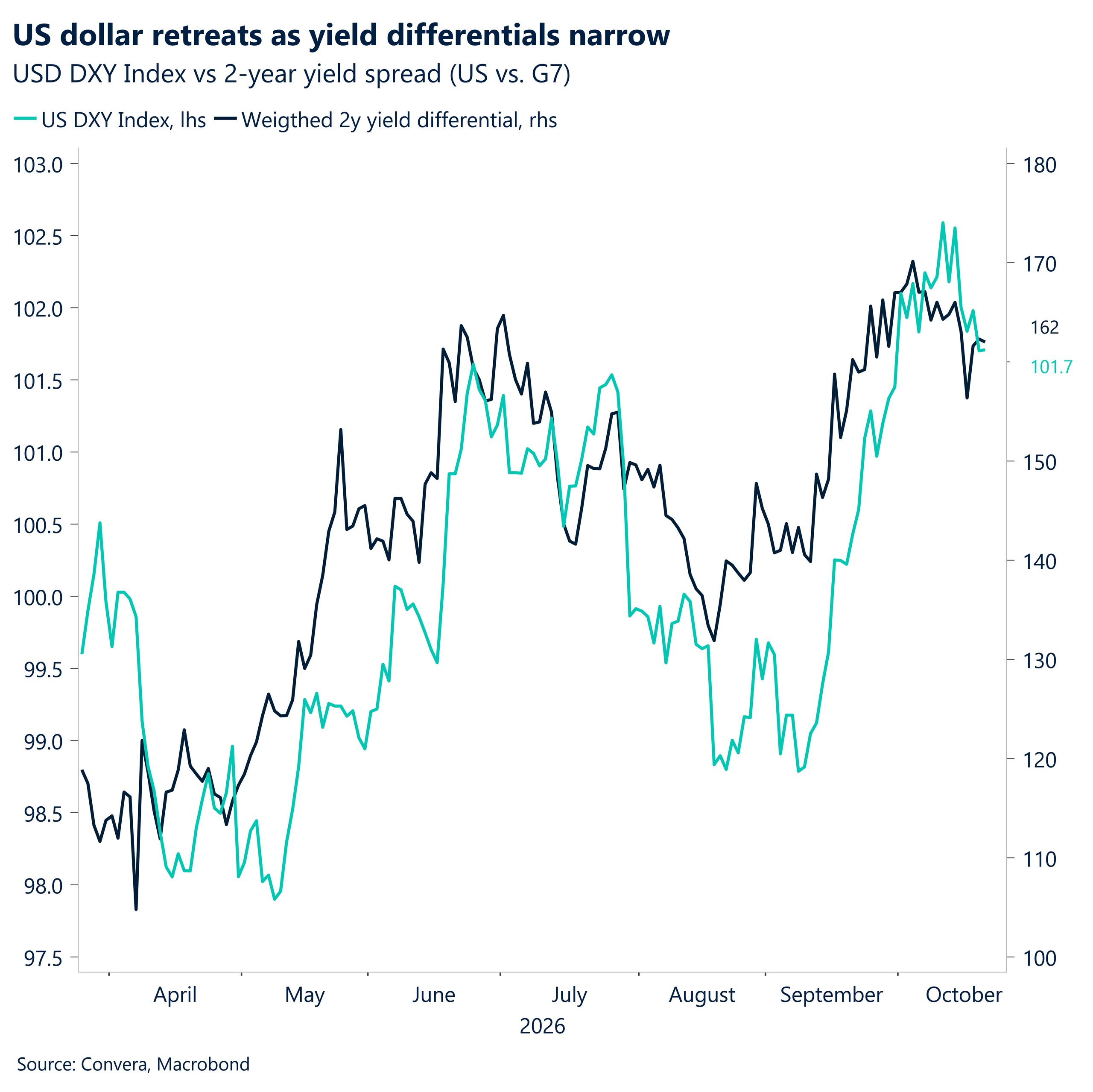
The dollar is heading for a fourth consecutive decline, with DXY falling toward 101.7 as two sources of support weaken at the same time. Reassurance around crude flows has pulled oil prices lower despite attacks near the Strait of Hormuz, reducing the energy-related inflation premium that had supported the dollar since February. Meanwhile, safe-haven demand for Treasuries following the technology selloff has pushed two-year yields 13 basis points below their post-CPI high. Lower oil and lower yields have now erased the dollar’s immediate momentum from last week’s inflation surprise.
The pullback is striking given the strength of recent US data. CPI, PPI and retail sales all reinforced the case for tighter policy, but Chair Kevin Warsh’s refusal to signal an October move during his Bangkok appearance left markets with little reason to bring forward the Fed path. The probability of an October hike has fallen to 16%, while December remains firmly priced near 85%. The data still support another hike, but the delay has removed the near-term catalyst that was pushing yield differentials and the dollar higher.
The equity backdrop and the AI trade will determine whether that rates pressure starts to rebuild. Strong earnings from SpaceX and Super Micro Computer have steadied parts of the technology sector, although concerns about semiconductor capital spending have not disappeared. If equities stabilize and the Treasury haven bid fades, US yields could recover and bring the 102.5 area back for the DXY. European fiscal strains are also limiting the downside by keeping EUR/USD near 1.123, preventing the dollar retreat from becoming a broader reversal.
The DXY is now approaching support near 101.5. Jobless claims and flash PMIs could shift expectations at the edges, but the October 28 Fed decision is the next event capable of resetting the dollar’s direction. A renewed rise in oil or firmer Fed “guidance” would restore some of the support lost this week, while softer growth and stable crude flows would leave the index near the bottom of its recent range. Until yields find a floor, the dollar is likely to remain capped below 102.5.
BoC hike repricing extends Loonie rally
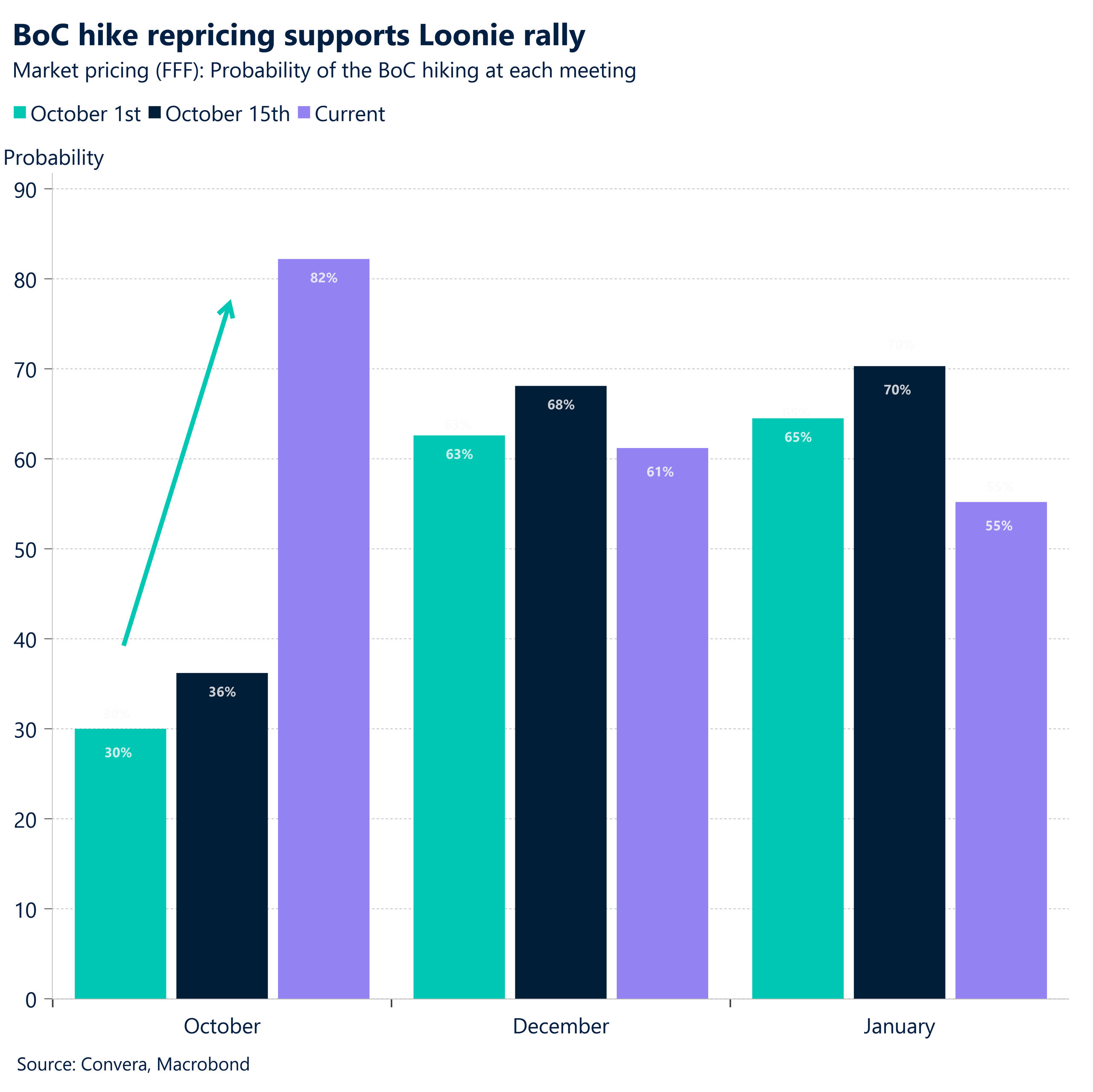
The Loonie is extending its strongest rally in a month, pushing USD/CAD toward 1.406 as markets sharply increase the odds of a Bank of Canada hike. Headline inflation rose to 3.1% in September, driven largely by a 27.8% increase in gasoline prices, lifting the implied probability of an October move to 81.2%. Alberta’s vote against separation removed another source of risk, while higher Canadian yields narrowed the US-Canada two-year spread by almost 15 basis points from its recent peak. That combination of political relief and rate repricing has given the Canadian dollar firmer support.
The difficulty is that the inflation report did not deliver a uniformly hawkish signal. Canada lost more than 110,000 jobs across August and September, while the underlying inflation measures eased despite the energy-driven rise in the headline rate. Governor Macklem must now weigh the risk of tightening into a weakening labour market against the possibility that higher energy costs keep inflation elevated. Higher oil helps the currency through Canada’s terms of trade, but it also makes the Bank of Canada’s decision more difficult.
Thursday’s retail sales report is the final major check on domestic demand before the October 28 meeting. A firm reading would give the Bank of Canada more room to raise rates.
The October 28 decision will determine whether the move can extend beyond the 1.40 level. A 25-basis-point hike, particularly if accompanied by firm inflation guidance, could narrow the rate differential further and help the Loonie break below the key threshold. A hold that emphasizes weaker employment and softer core inflation would challenge the current pricing and could send USD/CAD back toward 1.415. As Loonie’s support from oil, lower political risk and rising hike expectations is already reflected in the market, consolidation close to 1.405 is likely ahead of next week’s meeting.
Trade hopes offer Peso only temporary relief
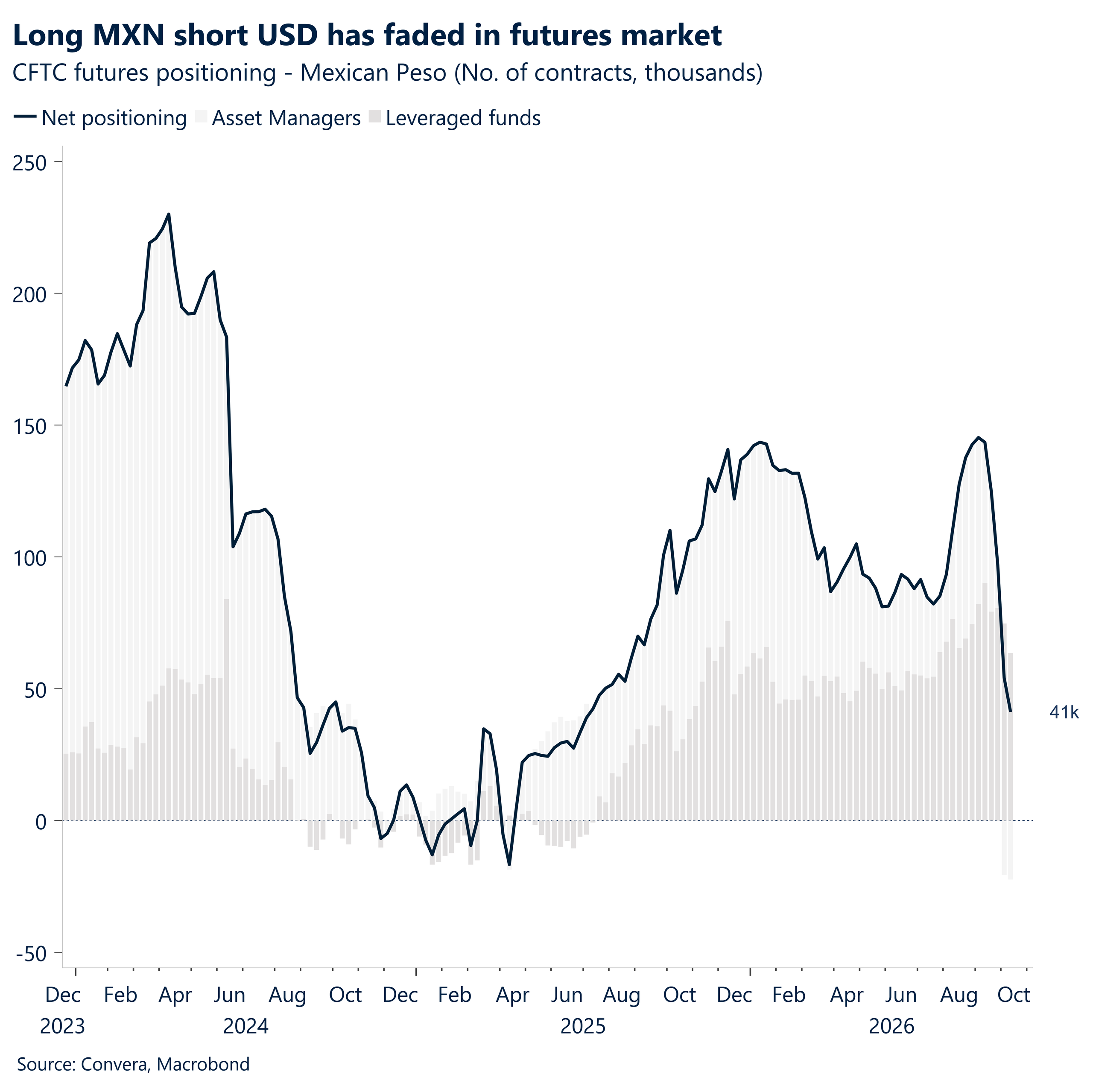
USD/MXN has eased toward 18.45 as a softer dollar and improved risk appetite give the peso some breathing room. President Sheinbaum’s signal that a US trade agreement is “very close” has also countered earlier reports that negotiations had stalled. Yet the peso’s main source of support continues to weaken: the Mexico-US two-year yield spread has narrowed to roughly 280 basis points as Banxico considers easing while the Fed keeps a December hike firmly in play. With the carry buffer now below 300 basis points, trade optimism may slow the peso’s decline but is unlikely to reverse it without concrete progress.
The currency is also caught between external inflation pressure and a softer domestic outlook. Higher oil raises Mexico’s refined-fuel import costs while keeping US inflation and Treasury yields elevated, squeezing the carry spread from both sides. Wednesday’s biweekly CPI report will therefore be critical. Firmer core inflation could force Banxico to push back against easing expectations and give the peso some rate support, while a softer reading would reinforce the narrowing yield advantage. Record bearish institutional positioning creates two-way risk, however, as any upside surprise or confirmed trade agreement could trigger a sharp short-covering rally.
USD/MXN’s failure to hold above 18.6 shows that the market still needs a stronger catalyst to challenge the 18.60–18.70 resistance zone. A confirmed agreement covering steel, aluminum or autos could pull the pair back toward 18.00, while stalled negotiations and softer Mexican inflation would leave 18.70 exposed. For now, the peso is balancing credible hopes of trade relief against weaker carry fundamentals, with the rates backdrop still carrying more weight.
Market snapshot
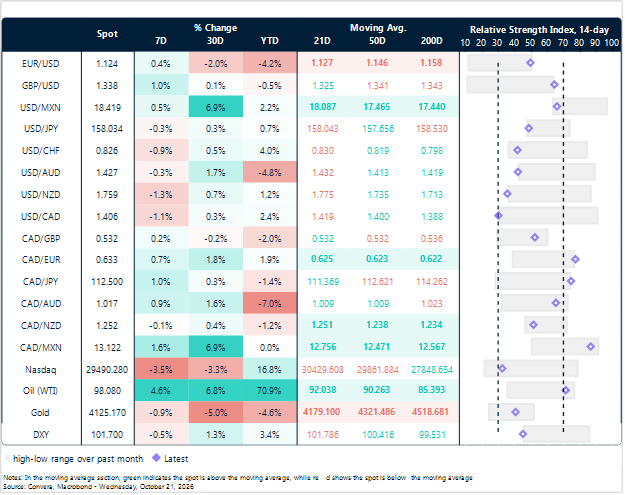
Table: Currency trends, trading ranges & technical indicators
Key global risk events
Calendar: October 19 – 23
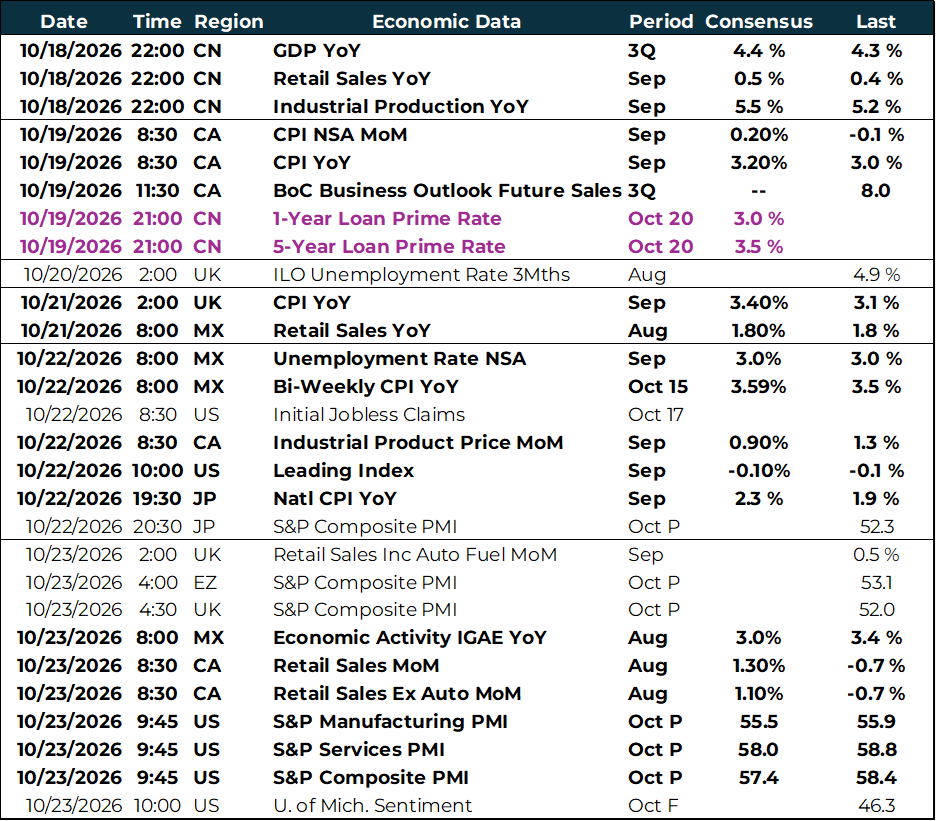
All times are in EST
Have a question? [email protected]
*The FX rates published are provided by Convera’s Market Insights team for research purposes only. The rates have a unique source and may not align to any live exchange rates quoted on other sites. They are not an indication of actual buy/sell rates, or a financial offer.