


USD: More red flags for the buck
The US dollar index slipped over 0.8% on Monday, giving up last week’s gains as G10 currencies firmed and fresh concerns emerged over global appetite for dollar‑denominated assets. Chinese regulators reportedly advised financial institutions to limit exposure to US Treasuries on concentration‑risk grounds — a sensitive headline at a time when diversification themes are already simmering.
The Japanese yen also found support after Prime Minister Takaichi’s landslide victory fuelled expectations of FX intervention, given the administration’s loose fiscal stance. USD/JPY is down over 1% this week, and with the yen carrying a 13.6% weight in the dollar index, that move has added to the broader softness in the US dollar index.
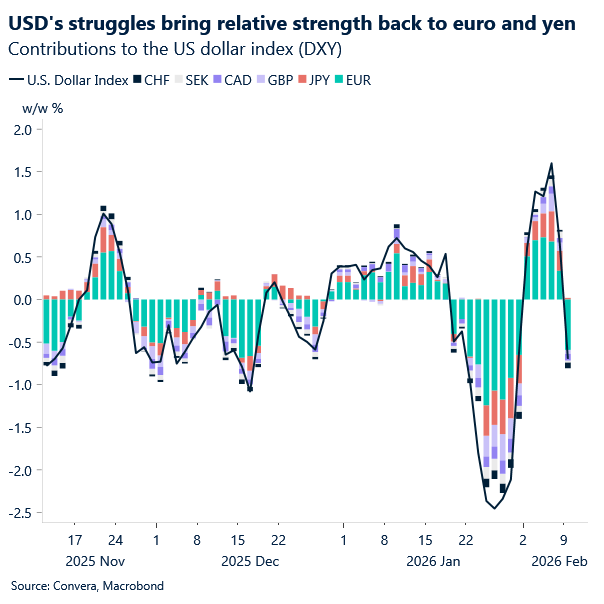
On the US side, last week’s softer labour data has left the dollar exposed heading into a heavy run of data releases. Today brings December retail sales, Friday delivers CPI, and tomorrow is the all‑important non‑farm payrolls and benchmark revisions. Consensus is +70k, but the market is far more sensitive to a downside miss — any softness would simply reinforce the dollar’s drift lower.
Taken together, this week’s employment and inflation prints could prove pivotal for the Fed as it weighs slowing job growth against lingering inflation risks. If Kevin Hassett is right and jobs growth is set to soften, that strengthens the case for cuts. For the dollar, the story is less about absolute rate differentials — the Fed’s benchmark still sits above most peers — and more about the policy trajectory and how those decisions are reached.
EUR: Euro supported by diversification flows
After bouncing off its 21‑day moving average last week, EUR/USD posted its second‑strongest daily gain since September on Monday, breaking through the $1.19 handle — a level it has only traded above for seven days since 2022. The pair is being buoyed by firmer global risk sentiment, a steeper US yield curve, and an extended rebound in silver.
With metals‑FX correlations running unusually high, the backdrop continues to favour a grind higher in the near term, even if stretched long positioning remains a headwind. Volatile swings in precious metals are still spilling into EUR/USD, but the correlation has flipped direction of late: silver surged 7% yesterday and the euro firmed alongside it. The 30‑day EUR/USD–silver correlation now sits in the 75th percentile of the past five years — a reminder that metals sentiment is exerting an unusually strong pull on the pair, whether the impulse is risk‑on or risk‑off.
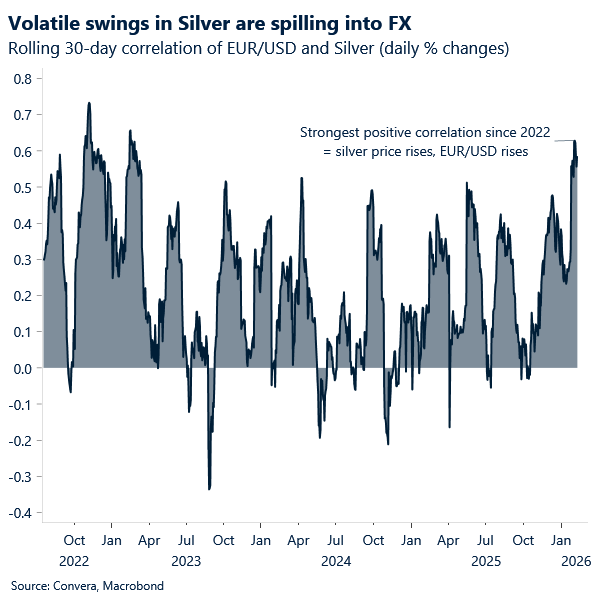
The underlying story is the broader diversification‑away‑from‑USD theme. When precious metals attract flows as alternative stores of value, EUR/USD tends to benefit in parallel — and that linkage has only strengthened as the dollar faces a growing list of domestic and external headwinds.
However, stretched long positioning remains the main obstacle to a sustained EUR/USD push higher. Friday’s CFTC data showed leverage‑fund net longs edging back toward cyclical extremes, which might keep a lid on upside traction in the near term.
GBP: GBP/EUR flashes political stress again
Sterling shed losses across the board yesterday on spreading fears that Starmer’s leadership is in the balance. During a televised press conference, Scottish Labour Leader Anas Sarwar urged Prime Minister Keir Starmer to quit over his controversial appointment of Peter Mandelson as US ambassador. While Sarwar is the most senior party figure so far to call for Starmer’s resignation, his remarks add to a series of criticisms from Labour backbenchers over the past week, not to mention the resignation of Starmer’s chief of staff on Sunday. Nerves eased later in the day as a chorus of UK cabinet ministers, including figures like Health Secretary Wes Streeting who had been viewed as potential leadership challengers, publicly backed Starmer to remain prime minister, helping sterling pare back some of its losses.
Reminiscent of the pre‑budget sterling dark days, GBP/EUR remains the clearest channel through which the market is expressing sterling’s risk premium tied to rising political uncertainty. Heavier spot selling this month is now joined by the most bearish repricing in GBP/EUR risk reversals across tenors since the pre‑budget period. The shift suggests investors are willing to pay the highest premium to hedge against GBP weakness versus euro strength since then.
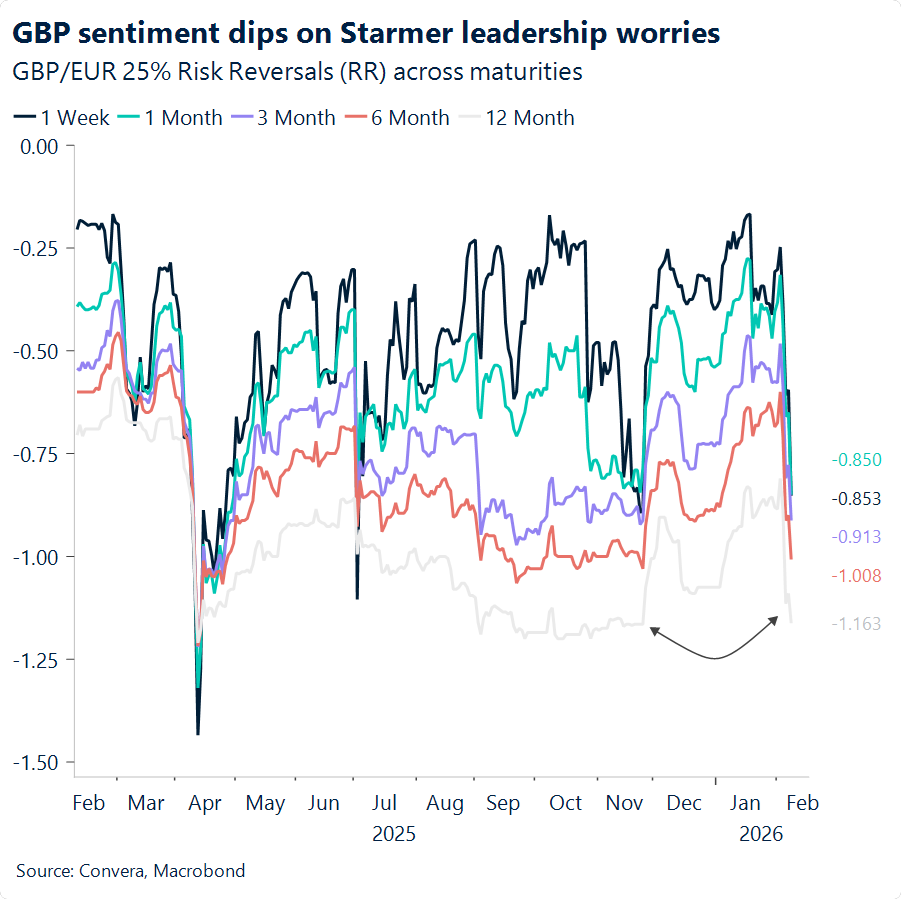
Technically, however, spot continues to trade near the 50‑day moving average, closely followed by the 100-day, which has held as support since December. The move signals that downside risk remains more forward looking, as reflected most clearly in the options market, rather than fully realised in spot. GBP/EUR is only 0.5% lower on a month‑to‑date basis and is essentially flat since the start of 2026. Investors may be eyeing more structural disruptions into this month’s by‑election and May’s state election before committing to heavier selling. On the fundamentals side as well, one can argue that the BoE’s dovish tilt will crystallise only once inflation, still at 3.4%, starts to move lower, since it heavily hinges on that deflationary trajectory.
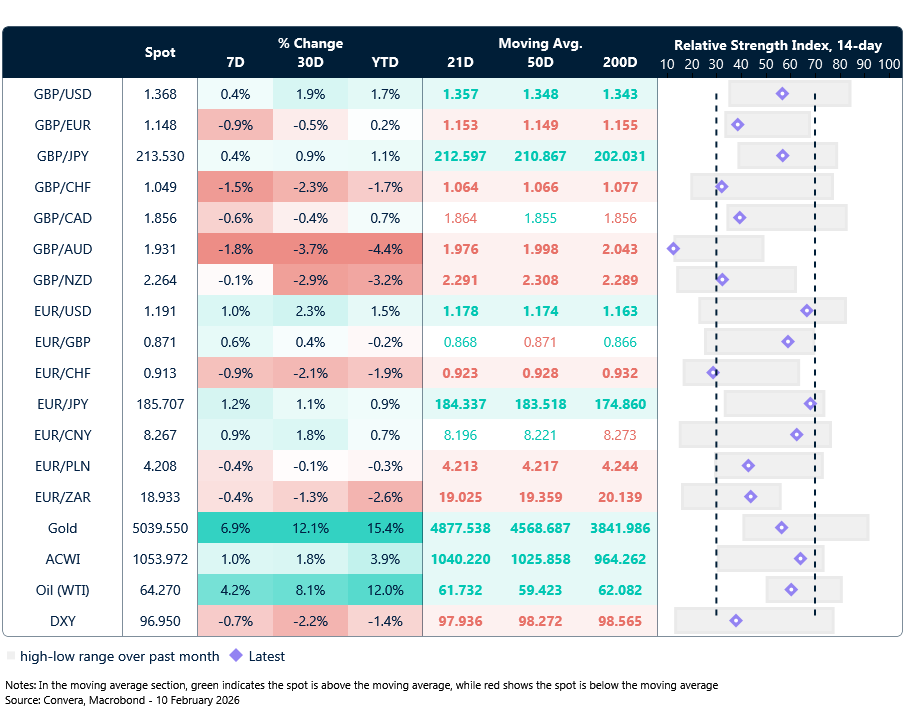
Market snapshot
Table: Currency trends, trading ranges & technical indicators
Key global risk events
Calendar: February 9-13
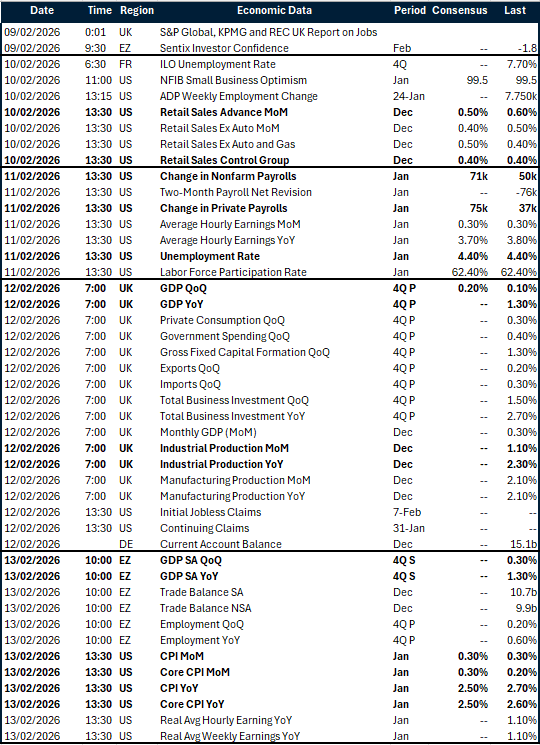
All times are in GMT
Have a question? [email protected]
*The FX rates published are provided by Convera’s Market Insights team for research purposes only. The rates have a unique source and may not align to any live exchange rates quoted on other sites. They are not an indication of actual buy/sell rates, or a financial offer.