


USD: Markets stall asymmetrically as de-escalation awaits confirmation
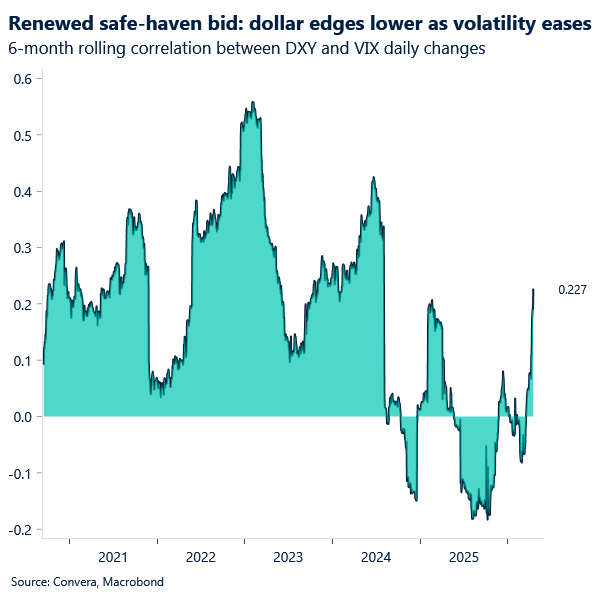
Risk sentiment has become somewhat bifurcated: Equities are hovering near all‑time highs, supported by a solid earnings season that is lifting market morale, with the S&P 500 up more than 3% this week. In FX, we are seeing a more fatigued price action. The US dollar – proxied by the dollar index (DXY) – has edged higher yesterday, helping to keep the upside in G10 peers – e.g., EUR and GBP – more contained. Markets are now waiting for something more concrete to emerge from the still‑intact de‑escalation momentum. Growing unease around the re‑opening of the Strait of Hormuz is understandably capping a deeper unwinding of March’s trades.
The dollar index is holding above support at the 98 level as it awaits further directional impetus. At present, the US and Iran are reportedly considering extending their ceasefire – set to expire on Tuesday – by a further two weeks to allow more time for negotiations, while Pakistan steps up its mediating role. President Trump has expressed increasingly explicit confidence that a deal with Iran will be reached, although Iran has so far offered little in the way of optimistic commentary on progress. Meanwhile, Israel and Lebanon have agreed to a 10‑day ceasefire, adding fresh momentum to the increasingly fatigued de-escalation narrative.
Confirmation of a ceasefire extension should help keep further upside in the dollar contained. However, we believe this outcome is at least partially priced in and unlikely to justify a sustained break below the 98 level. Instead, a re‑opening of the Strait of Hormuz would be the more plausible catalyst for a further leg lower in the dollar, via a more substantive easing in oil prices.
EUR: Resilient, but still waiting for conviction
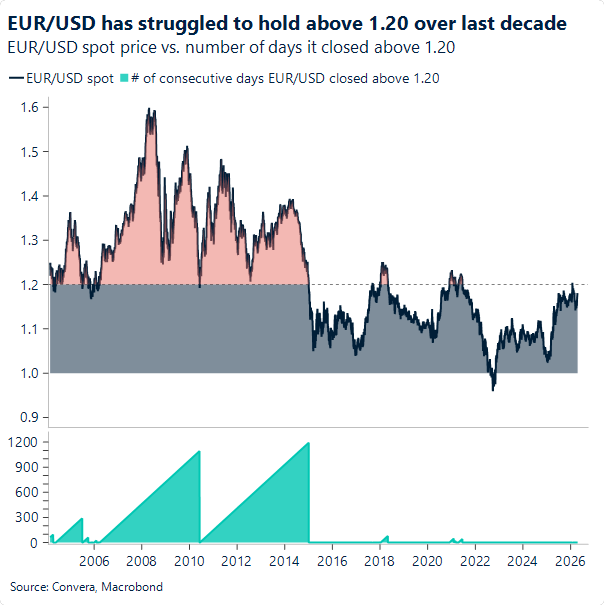
Despite snapping an eight‑day winning streak yesterday, EUR/USD is on track for a third consecutive weekly gain, up more than 3% from the war‑driven March low near 1.14. The broader signal remains constructive. The pair is trading above its key daily and weekly moving averages, reinforcing the view that bullish momentum has been rebuilt after the initial conflict shock – even if progress has slowed near the top of the recent range.
That slowdown is telling. EUR/USD continues to struggle to sustain moves beyond the 1.18–1.19 area, and it has not closed above 1.20 since 2022. This reinforces an important distinction that has defined euro price action throughout April: resilience should not be confused with conviction. The euro has recovered, but that recovery has been driven more by fading USD war premium than by a decisive improvement in Europe’s own fundamentals.
Markets have increasingly leaned toward a de‑escalation narrative, with both the US and Iran refraining from renewed strikes and keeping channels for talks open. That has helped keep risk sentiment supported and capped haven demand for the dollar. However, investors have also grown more selective. Headline‑driven optimism now requires clearer confirmation, particularly progress toward reopening the Strait of Hormuz, before EUR/USD can justify a clean upside break.
From a macro perspective, the outlook remains conditional. Europe’s structural exposure to energy prices means any renewed escalation would quickly tighten financial conditions and revive growth–inflation trade‑offs. By contrast, a sustained easing of tensions would likely allow EUR/USD to test higher levels, supported by narrowing US–EU rate differentials and a softer dollar bias.
Whether EUR/USD can attempt a durable move above 1.20 in the coming month will depend squarely on one factor: the conflict staying contained.
GBP: Sterling holds, but upside lacks conviction
Sterling failed to draw any meaningful bullish impetus from yesterday morning’s upbeat monthly GDP data. Expectations that the conflict will deliver a significant drag on the UK economy have helped limit any surprise reaction in market pricing.
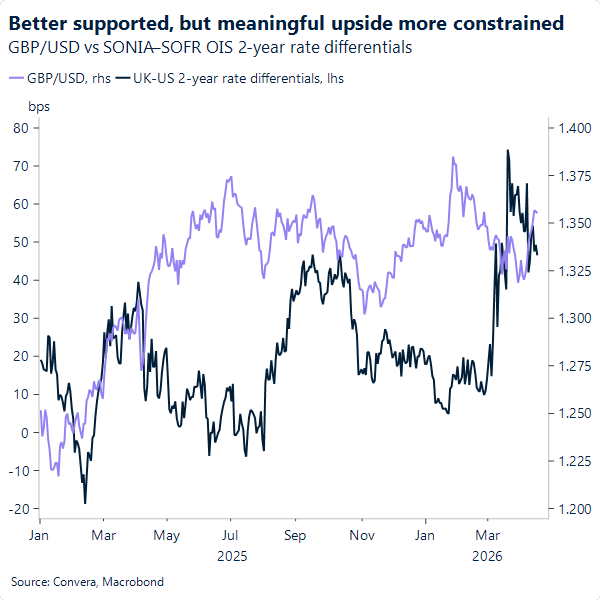
Short‑end yields have fallen by around 10 basis points so far this week, as bond markets continue to unwind part of the earlier aggressive hawkish repricing driven by conflict‑related inflation pressures. Virtually no rate hikes are now priced in for this month, with just over one expected by year‑end. BoE Governor Andrew Bailey noted at the IMF on Tuesday that there is, so far, no substantive evidence warranting a hike – helping ease front‑end rates. Even so, GBP–USD OIS rate spreads remain the widest in sterling’s favour since 2023, suggesting that GBP/USD is better supported at current levels.
GBP/USD is holding just south of 1.36 as the broader risk‑on rally loses steam. A more confident push higher remains possible should we receive more substantive signs of de‑escalation in the coming days. However, with a UK jobs report looming next Tuesday – and further unwinding of hawkish expectations likely if de‑escalation gains traction/the report points to further softening – a sentiment‑driven knee‑jerk move may struggle to translate into a more sustained break above the 1.36 handle.
Market snapshot
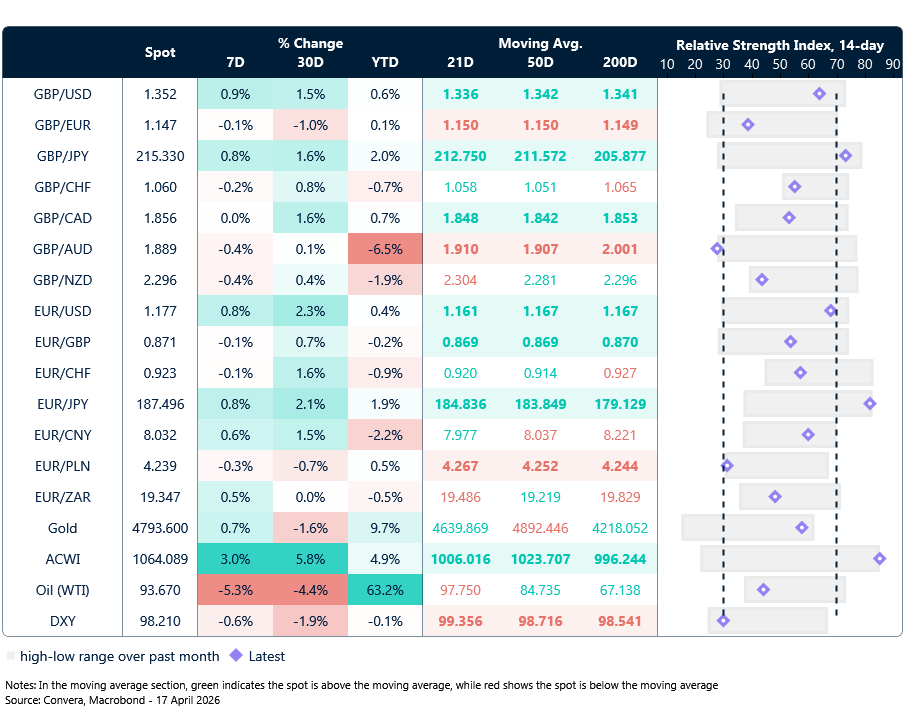
Table: Currency trends, trading ranges & technical indicators
Key global risk events
Calendar: April 13-17
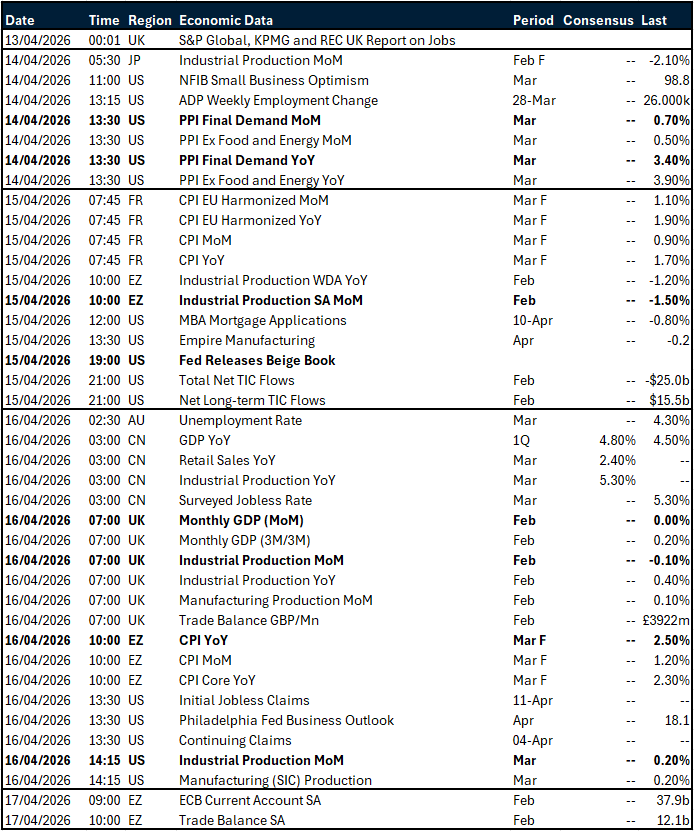
All times are in BST
Have a question? [email protected]
*The FX rates published are provided by Convera’s Market Insights team for research purposes only. The rates have a unique source and may not align to any live exchange rates quoted on other sites. They are not an indication of actual buy/sell rates, or a financial offer.