


USD: Soft jobs, strong dollar
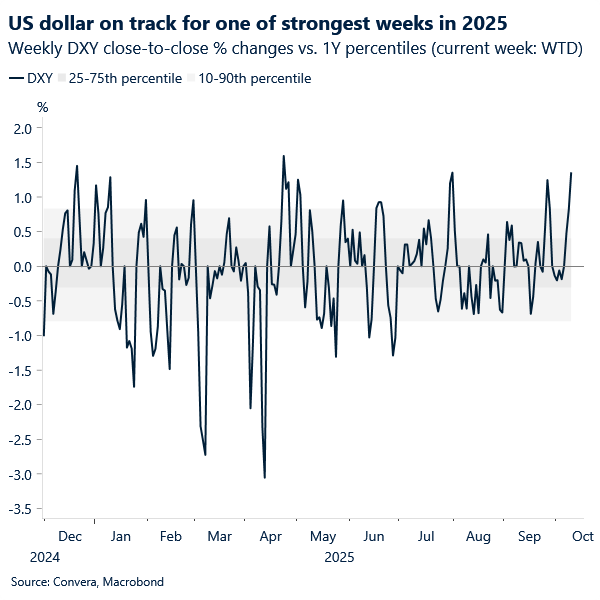
The US dollar extended its climb yesterday, with the Dollar Index (DXY) breaching resistance at the 99 level – hitting its strongest levels in two months. This week’s rebound certainly capitalized on JPY and EUR weakness but managed to extend even as peak negative sentiment faded – without the greenback having to confront its own vulnerability: a softening labour market.
Then came fresh research from the Federal Reserve Bank of Dallas, suggesting that slower immigration means the US no longer needs blockbuster job gains to keep unemployment steady. That adds nuance to the recent payrolls slide: still a concern, but perhaps less alarming if part of the weakness reflects structural recalibration rather than just tariff-driven drag.
So the dollar pushed higher – not by confronting its vulnerabilities, but by sidestepping them. What we may be seeing now is a market rethink: risks facing the Fed and the broader economy are tilting more toward inflation than unemployment, prompting a reassessment of the bearish weight that disappointing macro data had placed on the dollar. Layer in the immigration shift, AI-driven labour market transformation, DOGE-fuelled public sector layoffs, and labour data itself may be losing some of its sway in the Fed’s dual mandate. If this narrative sticks, the dollar could be set up for a more sustained rebound into 2026.
EUR: No joy for the euro
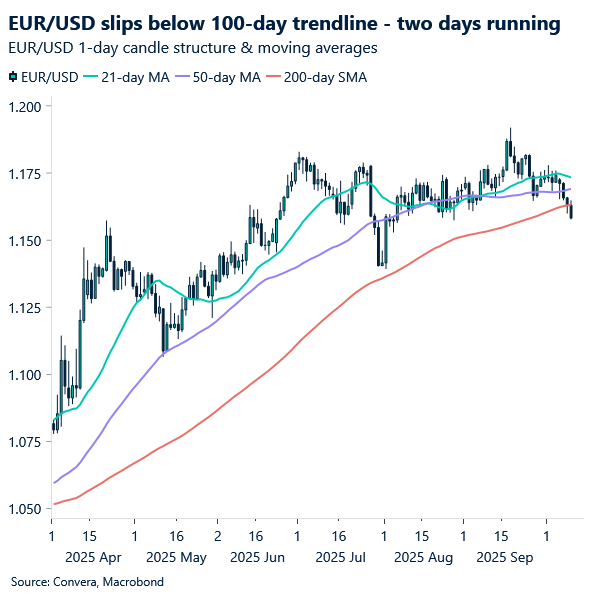
Euro-negative sentiment did less of the heavy lifting yesterday, as other forces took over-extending the euro’s slide against the dollar for a fourth straight day. The setup was there for further downside: EUR/USD had slipped below its 100-day moving average the day before and lingered beneath it in early London trading. That line had remained untouched during the entire euro’s rally, making the breach a tempting trigger for further downside.
Firstly, the ECB minutes released yesterday revealed that officials had considered another rate cut in September – reinforcing their flexible stance and reminding investors that rate expectations on the euro side are more fluid than previously assumed. Ultimately, however, they held back. With inflation hovering near target and a broadly benign economic outlook, policymakers judged it too early to cut further. The main concern was inflation undershooting. The assessment goes: should upside risks to inflation materialize – particularly from geopolitical developments or tariff retaliation – that would validate the decision to hold rates steady. One could argue, however, that inflation driven by supply shocks may be less sustainable than demand-led inflation, potentially warranting another cut sooner rather than later if the economic outlook fails to gain traction.
The now-revealed consideration of a September cut was enough to nudge the still-bruised euro lower against the dollar. Yet it wasn’t euro-specific news, but rather developments on the US side that triggered a breach below support at 1.16, sending EUR/USD to two-month lows. Put simply, we have reason to believe the new research from the Federal Reserve Bank of Dallas “debunking” the severity of the recent non-farm payrolls report played a role. The report carries weight – especially considering that a weakening labour market was perhaps the euro’s last beacon of hope for further upside. Coming from the Fed itself, the report suggests inflation is likely to remain a growing focus, with the labour market perhaps taking the back seat. That’s not good news for the euro, which now appears exposed to bearish forces on both sides of the Atlantic.
GBP: UK jobs market is stabilising
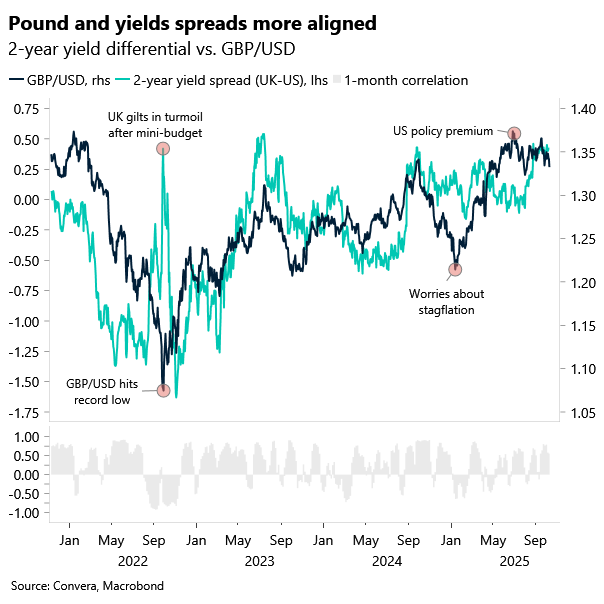
GBP/USD came under heavy pressure, falling 0.75% — its second-worst daily drop in over two months — and testing the 200-day exponential moving average just below $1.33, as flagged in our prior note. The move reflects a broader recalibration in FX markets, with dollar demand firming amid reduced US data flow and rising global political risks. If this key support fails to hold, the next technical target is the 200-day simple moving average at $1.3173.
Momentum may soon slow, however, with the 14-day relative strength index nearing oversold territory. That suggests the downside bias could fade in the near term, especially if incoming UK data or central bank rhetoric offers a counterbalance. Still, with real-money accounts rotating back into long-dollar exposure and risk reversals skewing bearish on sterling, the path of least resistance remains lower unless GBP finds a fresh catalyst.
A stabilising UK jobs market could offer that near-term counterweight to GBP/USD’s bearish momentum. According to a poll by the Recruitment & Employment Confederation and KPMG, employers scaled back hiring at the softest pace in a year, and other metrics — including vacancies and jobseeker numbers — show signs of levelling off. Starting pay growth has slowed to its weakest in nearly five years, easing pressure on the Bank of England (BoE) as it battles sticky inflation.
While there’s little evidence of a rebound, the pace of deterioration has moderated, and the unemployment rate should remain broadly steady through year-end. That backdrop supports the view that BoE will keep rates on hold this year, which should support sterling via the yield channel.
Dollar to pullback from overbought conditions?
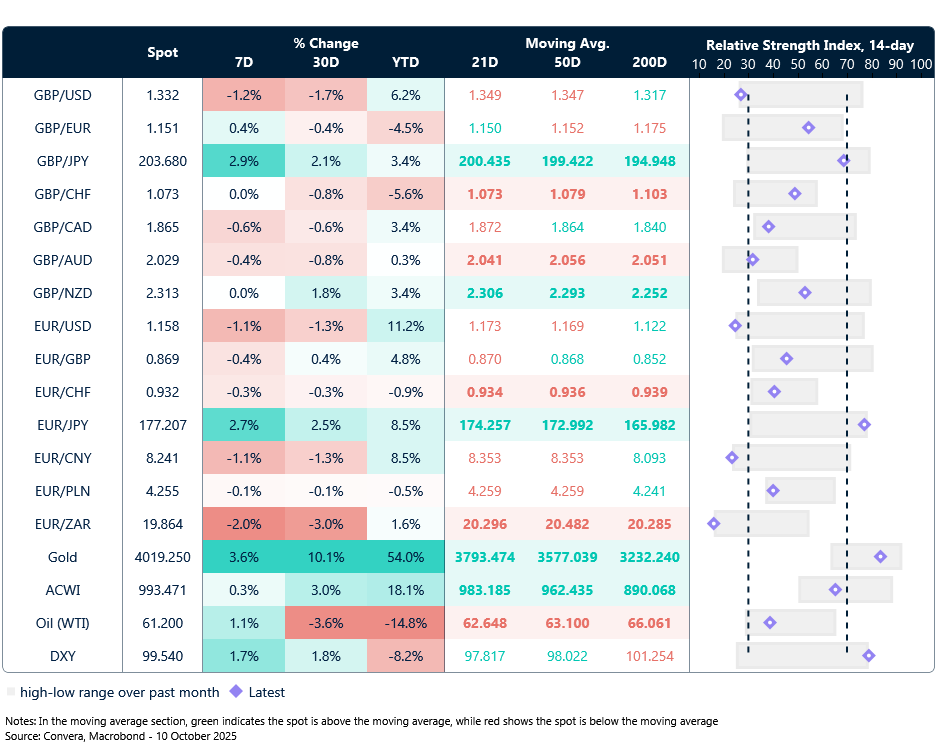
Table: Currency trends, trading ranges and technical indicators
Key global risk events
Calendar: October 6-10
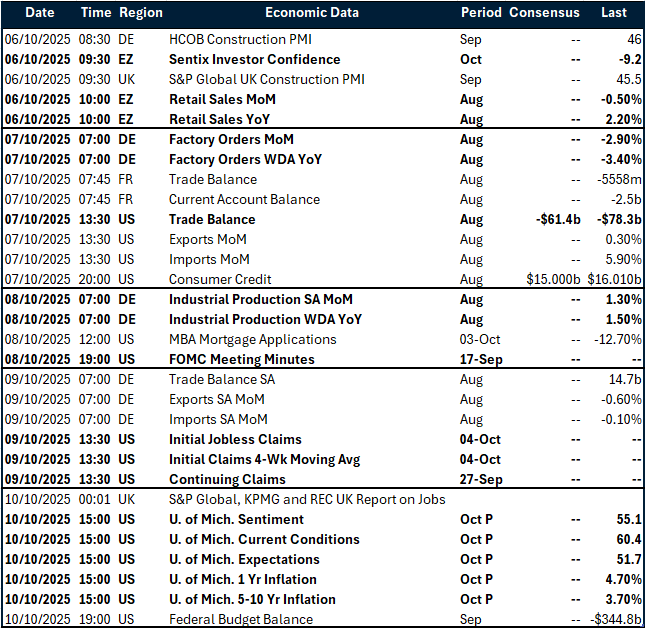
All times are in BST
Have a question? [email protected]
*The FX rates published are provided by Convera’s Market Insights team for research purposes only. The rates have a unique source and may not align to any live exchange rates quoted on other sites. They are not an indication of actual buy/sell rates, or a financial offer.