

Key Takeaways
- US growth resilience and hawkish Fed repricing have lifted Treasury yields, keeping the dollar firmly supported.
- The speed of the Treasury sell-off now matters as much as outright yield levels, with a rising MOVE Index signalling greater spillover risk for credit, equities and FX.
- A 2026 high US-Canada two-year yield gap continues to weigh on the loonie, while Canadian GDP will test whether markets are overpricing near-term Bank of Canada tightening.
- The peso’s carry cushion is narrowing as US yields rise, leaving it increasingly exposed to higher FX volatility and uncertainty around US-Mexico trade talks.
- US PCE, ISM and payrolls will determine whether rate differentials extend the dollar’s advance or trigger a consolidation after its recent gains.
US yields keep the dollar in control
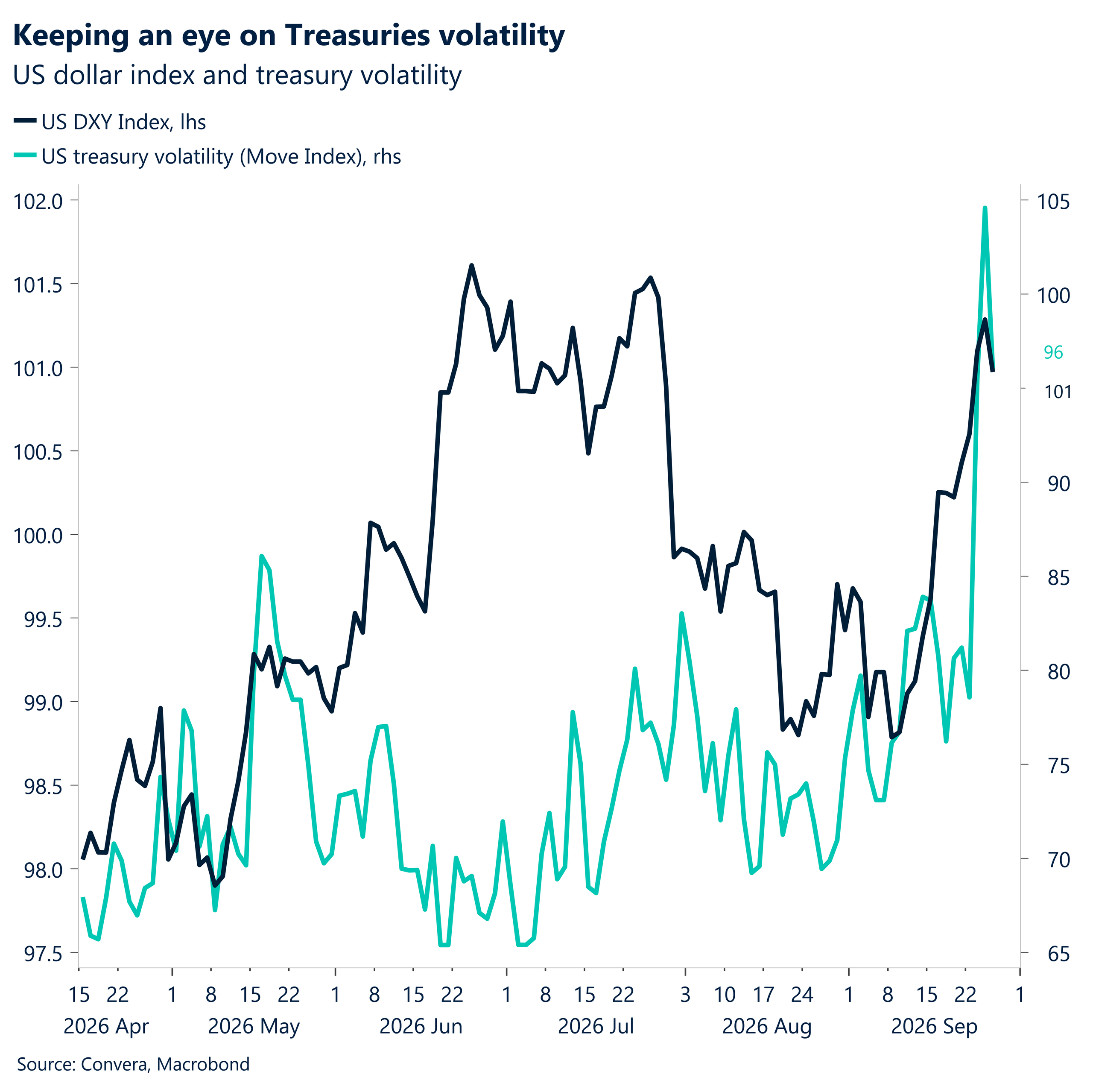
Supported by US growth outperformance and a renewed shift higher in rate expectations, the US dollar has posted its strongest two-week advance since March. September’s composite PMI reached its highest since 2021, with stronger demand, capacity pressures and rising input costs pushing the two-year Treasury yield towards 4.9%. DXY has followed the front end closely, while the retreat in WTI has had little influence on the broader move. For now, US rates are setting the direction.
The 10-year above 5% adds another dimension, reflecting higher expected policy rates, rising real yields and a larger fiscal premium, rather than a clear loss of confidence in the Fed. The speed of the adjustment now matters as much as the yield level, with the MOVE Index offering an important gauge of whether rates volatility is beginning to spread into credit and equities. A gradual repricing remains broadly dollar-supportive, but a disorderly sell-off could trigger deleveraging and make the currency’s response less predictable.
Energy and European risks reinforce the relative US advantage. Brent above $100 and the absence of a concrete US-Iran agreement keep inflation uncertainty elevated, while a possible US diesel export ban could ease some domestic price pressure but tighten fuel supply abroad. Wider French spreads and Europe’s exposure to imported energy add pressure on the euro side of DXY. Dollar positioning has shifted from bearish to neutral, suggesting short covering has run its course without leaving long positions clearly extended.
This week’s PCE, ISM surveys and payrolls report will determine whether the rate move has further room to run. Firm inflation and activity readings would keep additional Fed tightening in play and could carry DXY through 101 towards 101.5, particularly if the two-year yield reaches 5%. A weak payroll gain would bring labor-market risks back into the policy debate and expose the 100 area, while a sharp rise in the MOVE Index would warn that the Treasury sell-off is becoming a broader risk event. The dollar remains supported, but both the data and the pace of the rates adjustment will shape the next move.
Rate gap keeps loonie under pressure
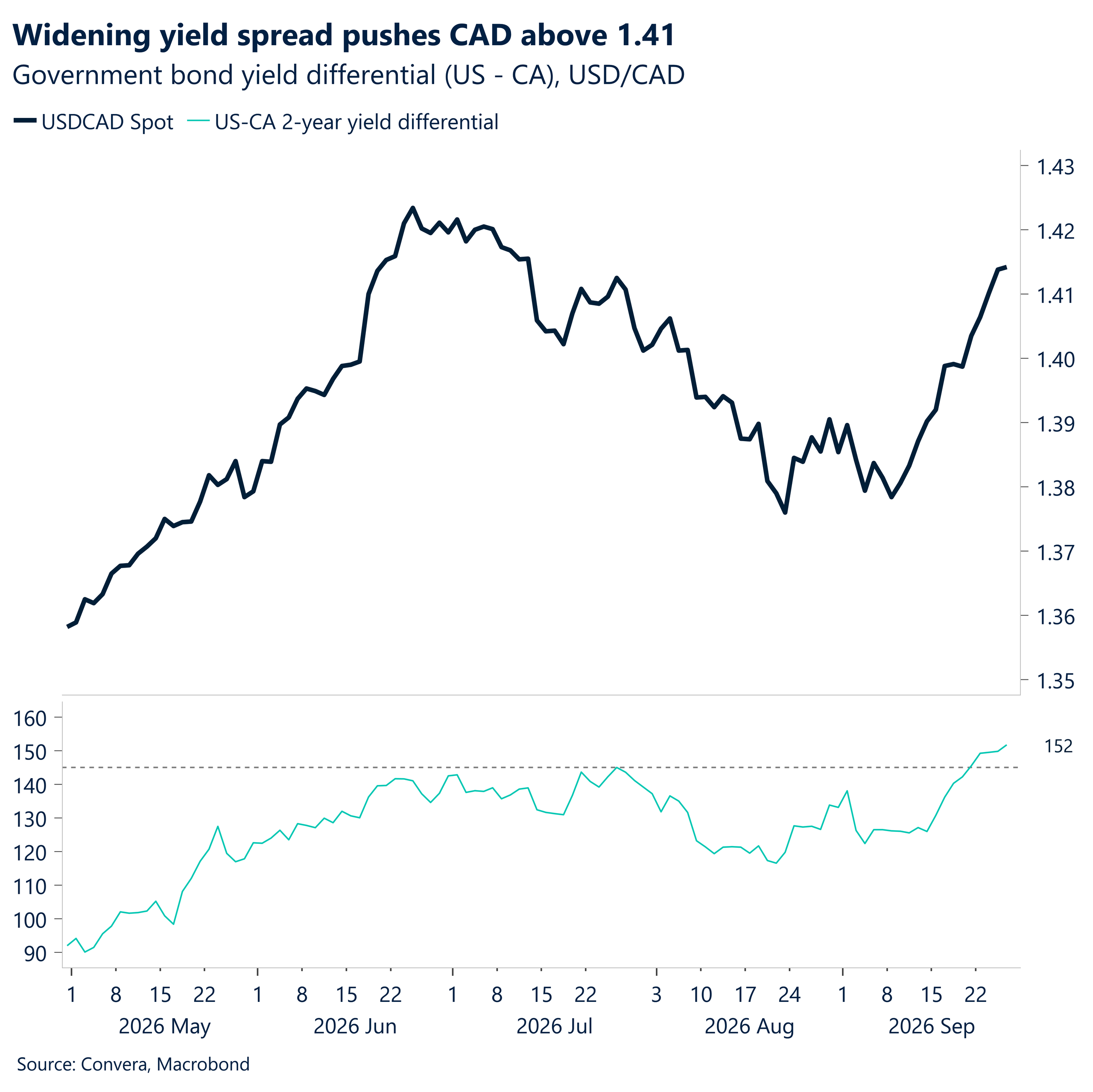
Nine consecutive sessions of losses have exposed how little support the loonie is receiving from renewed Bank of Canada tightening expectations. The two-year spread has reached a 2026 high near 152bp as US yields have risen faster than Canadian yields, carrying USD/CAD above 1.41. Expectations for Bank of Canada hikes in October and December have gained support as the Middle East conflict raises inflation risks, but the loonie has received little benefit. Markets remain unsure whether Canada’s weaker growth backdrop can absorb tighter policy as comfortably as the US economy.
Tuesday’s GDP report should test that concern, with no growth expected in July after June’s 0.3% expansion. A weak release would reinforce the view that the economy wasn’t in a great track even before the latest trade spat and make an October hike harder to justify, particularly as new US import restrictions take effect the same day. Uncertainty around the broader trade relationship remains a drag on investment and Canadian growth expectations. A stronger GDP reading could narrow the policy divergence, although the October 28 Bank of Canada decision remains the more important test.
USD/CAD is approaching short-term overbought conditions after its persistent rise, so some consolidation around 1.41 would not challenge the broader trend. A close above 1.4155 would open the path towards 1.42, while 1.40 and the 50-day moving average near 1.398 provide initial support. Canadian GDP and manufacturing PMI will shape expectations for the Bank of Canada, while Friday’s US payrolls report will influence the other side of the rate differential.
Peso carry advantage shows signs of strain
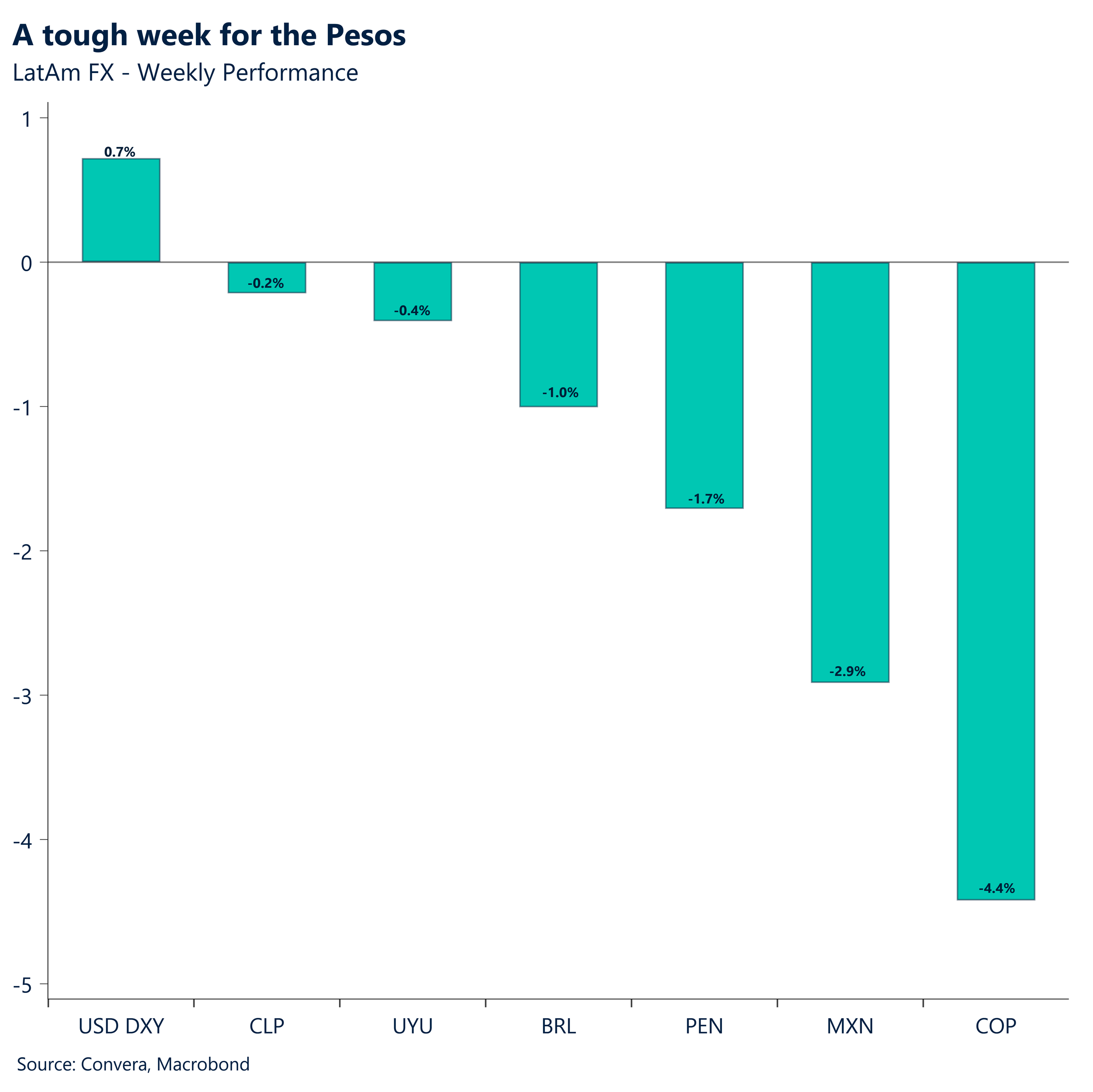
The peso’s recent underperformance suggests its narrowing carry advantage is no longer enough to offset rising US yields and higher FX volatility. The two-year spread narrowed to around 314 basis points, close to the 300bp area where institutional investors may begin questioning whether the return still compensates for the risk.
Banxico’s latest guidance was read as dovish because the board said it would not mechanically follow the Fed, but removing its commitment to keep rates unchanged also preserves the option to tighten if inflation, peso weakness or FX pass-through becomes a concern. The initial reaction may have gone too far, leaving room for some relief before the peso reconnects with the broader dollar trend.
The larger risk comes from volatility rather than the carry spread alone. A faster US rates adjustment, reflected in a further rise in the MOVE Index, could push FX into a higher-volatility regime and accelerate the unwind of dollar-funded carry positions. That would leave the peso exposed even if Mexico’s domestic fundamentals justify some Banxico hike premium, particularly as trade negotiations remain unsettled and a possible US diesel export ban threatens a country that relies heavily on US fuel supply. Any credible progress towards a US-Mexico agreement would offer the clearest route to a sustained peso recovery, but the timing now appears less certain.
US PCE, ISM and payrolls will therefore matter more for USD/MXN than most of Mexico’s domestic calendar. Firm US inflation and activity data could lift the two-year Treasury yield towards 5%, compress the carry spread towards 300bp and push USD/MXN through 17.80 towards 18.00. Softer US data or firmer Mexican manufacturing indicators could support a pullback, particularly after the speed of last week’s move, but the broader balance remains fragile while US yields and rates volatility are rising together.
Investors should monitor the MOVE Index alongside the US-Mexico two-year spread to judge whether this remains an orderly repricing or is becoming a wider carry unwind.
Market snapshot
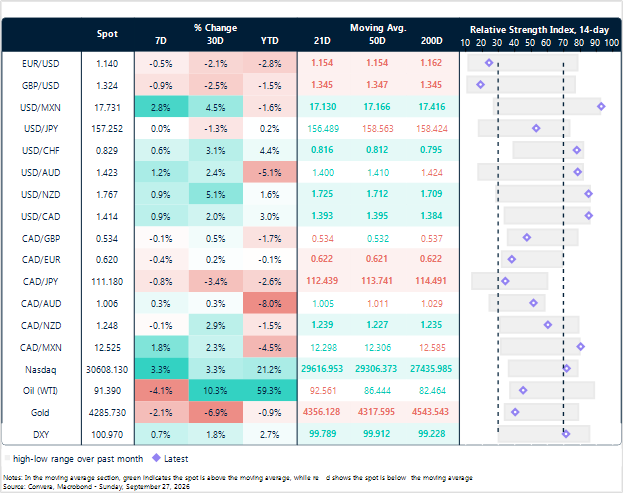
Table: Currency trends, trading ranges & technical indicators
Key global risk events
Calendar: September 28 – October 02
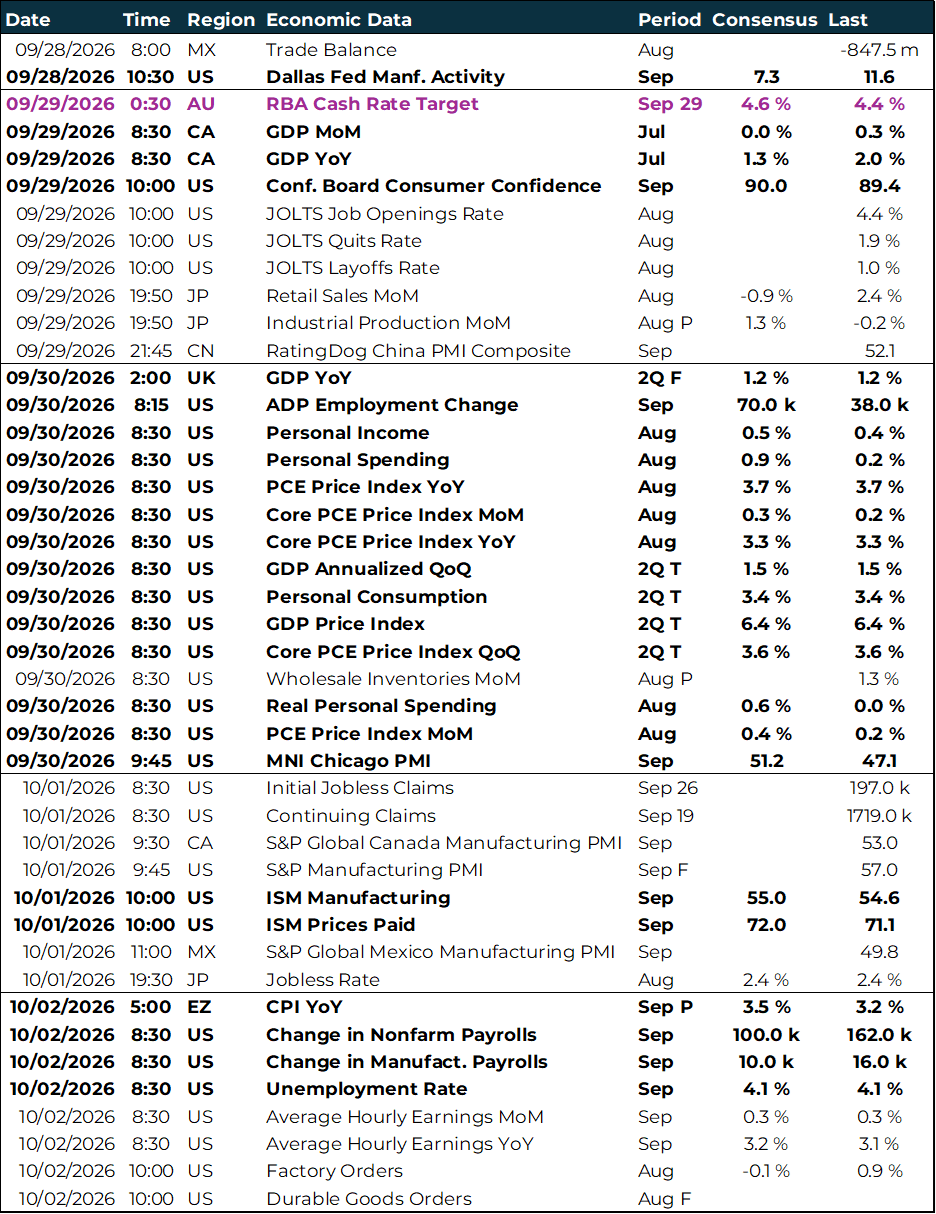
All times are in EST
Have a question? [email protected]
*The FX rates published are provided by Convera’s Market Insights team for research purposes only. The rates have a unique source and may not align to any live exchange rates quoted on other sites. They are not an indication of actual buy/sell rates, or a financial offer.